upkept.
upkept.

The whole shop

Everything your place needs, in one place.

75 single documents, 20 sector packs and 7 toolbox-talk bundles, all in one shop. The checklists for the daily jobs, the logs and registers that keep your place in good order, and the staff briefings that prove your team was trained. Every one is plain enough for a brand-new starter, built on the real UK rules (FSA, HSE, the Fire Safety Order, RIDDOR, COSHH, EYFS), and names its source. Print them, open them on a phone, and they are yours to keep, with free updates when the guidance changes. Start with a pack for your trade, or pick exactly the documents you need.

New: risk assessments

The hazards are the same everywhere. Your building is not.

Pre-filled general risk assessment sets for maintenance and cleaning teams, in two editions: one written cross-sector for any workplace, one written for a hotel, club or venue. The hazards, who is harmed and the controls good operators already run are done. You score it, add your own, and sign it. One risk per page, with room to write.

See the range

Build your own pack

Pick exactly the documents you need and watch your three-for-two saving update live.

Start building

Start here

Sector packs

All 20 packs
Best seller

The Cafe Pack

Everything your team needs to open up, run a clean kitchen and close down right, with nothing left to memory.

£99
See inside
6 templates

The Food Safety Pack

The everyday records that keep your food safe and your team confident, all clear and ready to use.

£99
See inside
6 templates

The Pub & Bar Pack

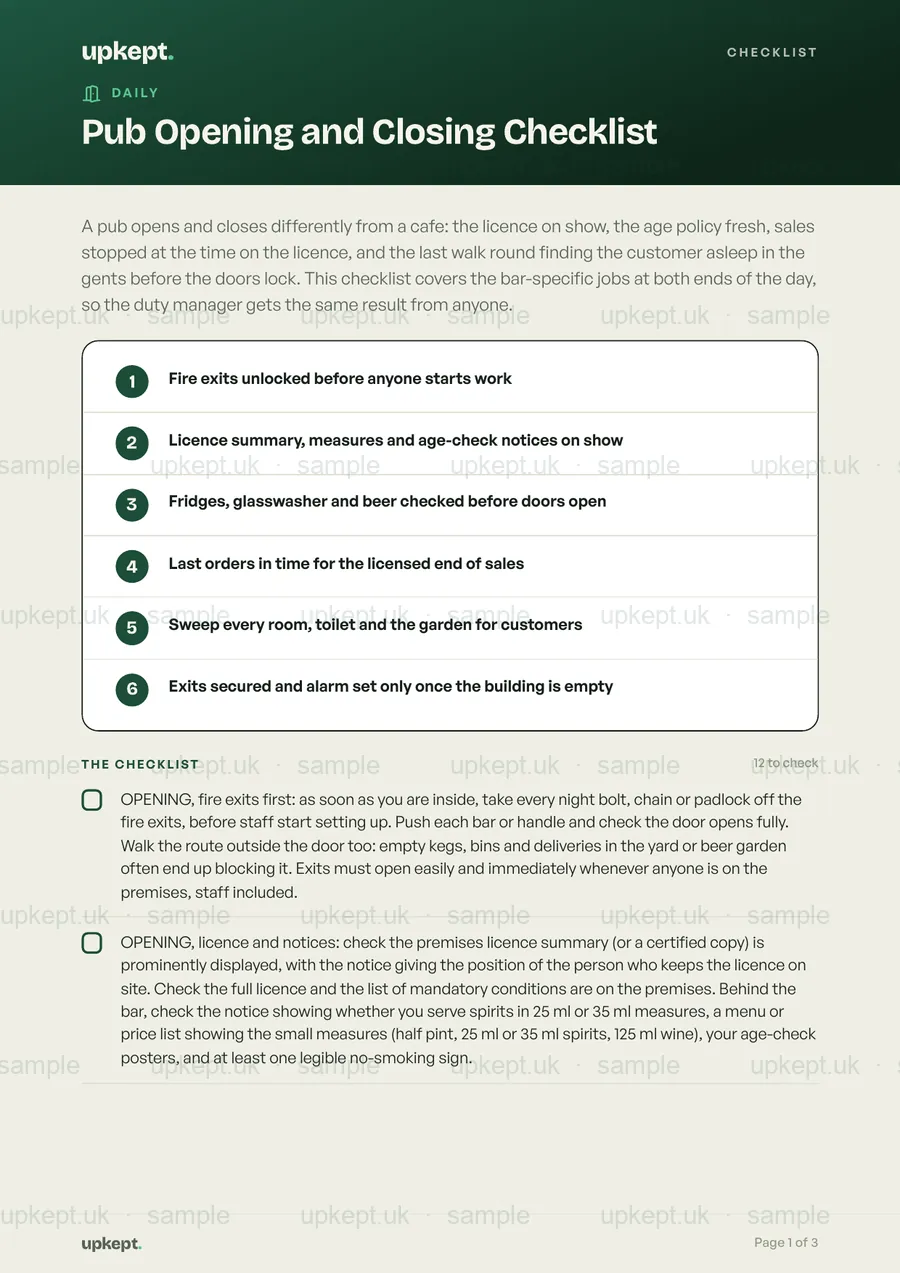
Open up, keep the cellar sweet and lock up clean, with the line-cleaning rota sorted.

£99
See inside
6 templates

The Care Home Pack

Daily checks and clear handovers so every resident gets safe, consistent, person-centred care.

£149
See inside
Best value

The Everything Bundle

Every template we make, today and in the future, in one set. The whole library, sorted in a single move.

£399£686 separatelySave £287
See inside

Pick exactly what you need

Single documents

Free

Fire Extinguisher Monthly Check

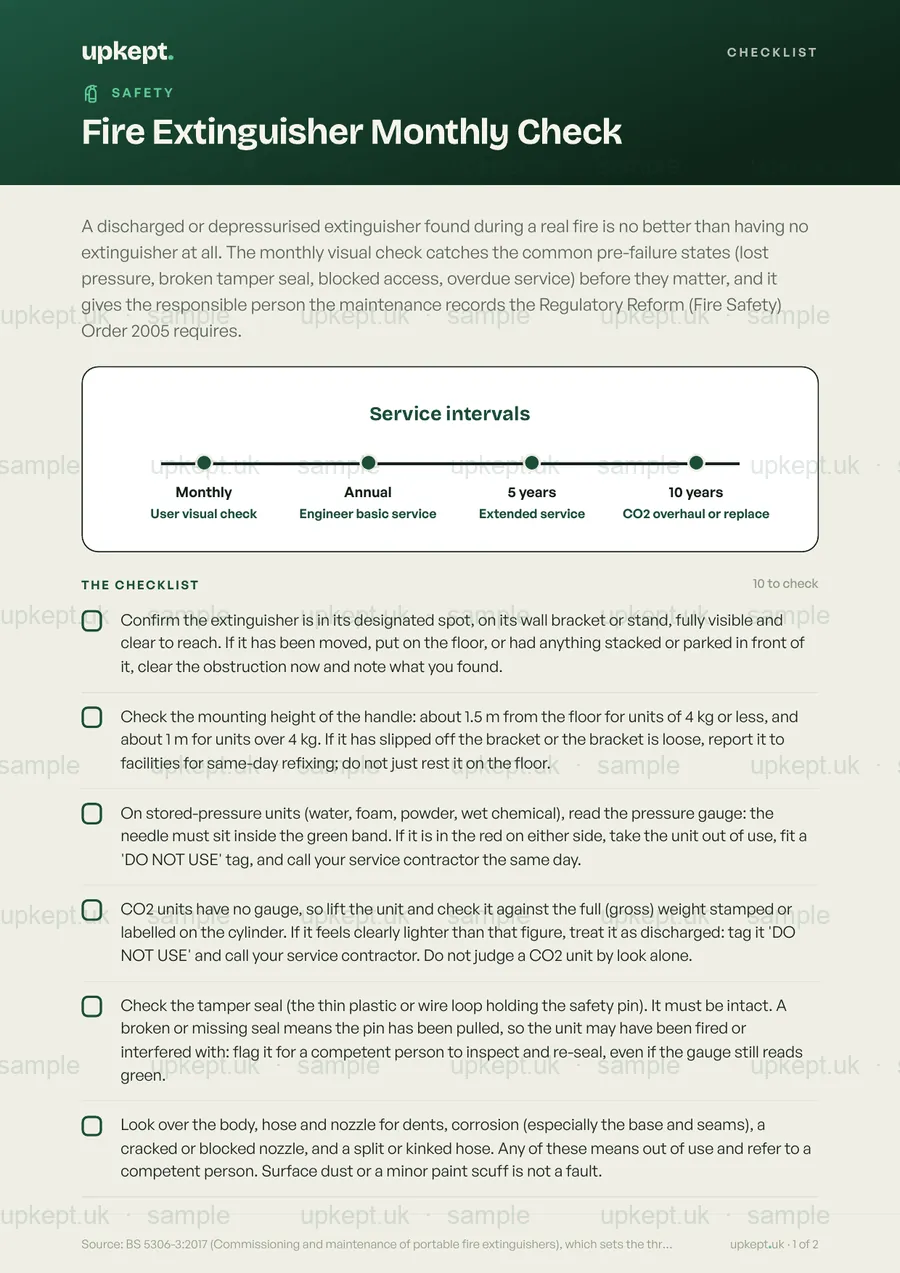
A discharged or depressurised extinguisher found during a real fire is no better than having no extinguisher at all. The monthly visual check catches the common pre-failure states (lost pressure, broken tamper seal, blocked access, overdue service) before they matter, and it gives the responsible person the maintenance records the Regulatory Reform (Fire Safety) Order 2005 requires.

FreeView
Safety

Fire Door Check

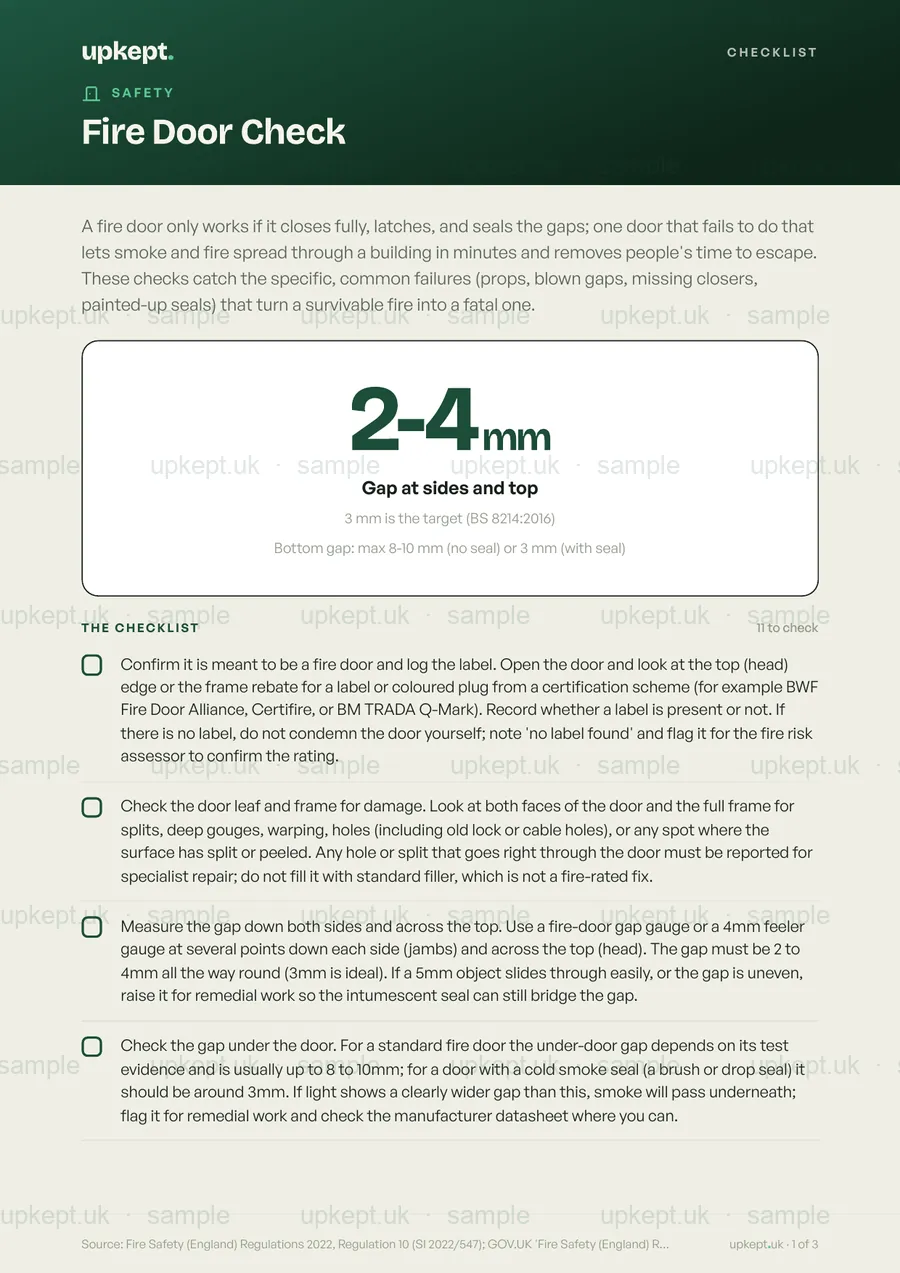
A fire door only works if it closes fully, latches, and seals the gaps; one door that fails to do that lets smoke and fire spread through a building in minutes and removes people's time to escape. These checks catch the specific, common failures (props, blown gaps, missing closers, painted-up seals) that turn a survivable fire into a fatal one.

£14View
Safety

First Aid Kit Check

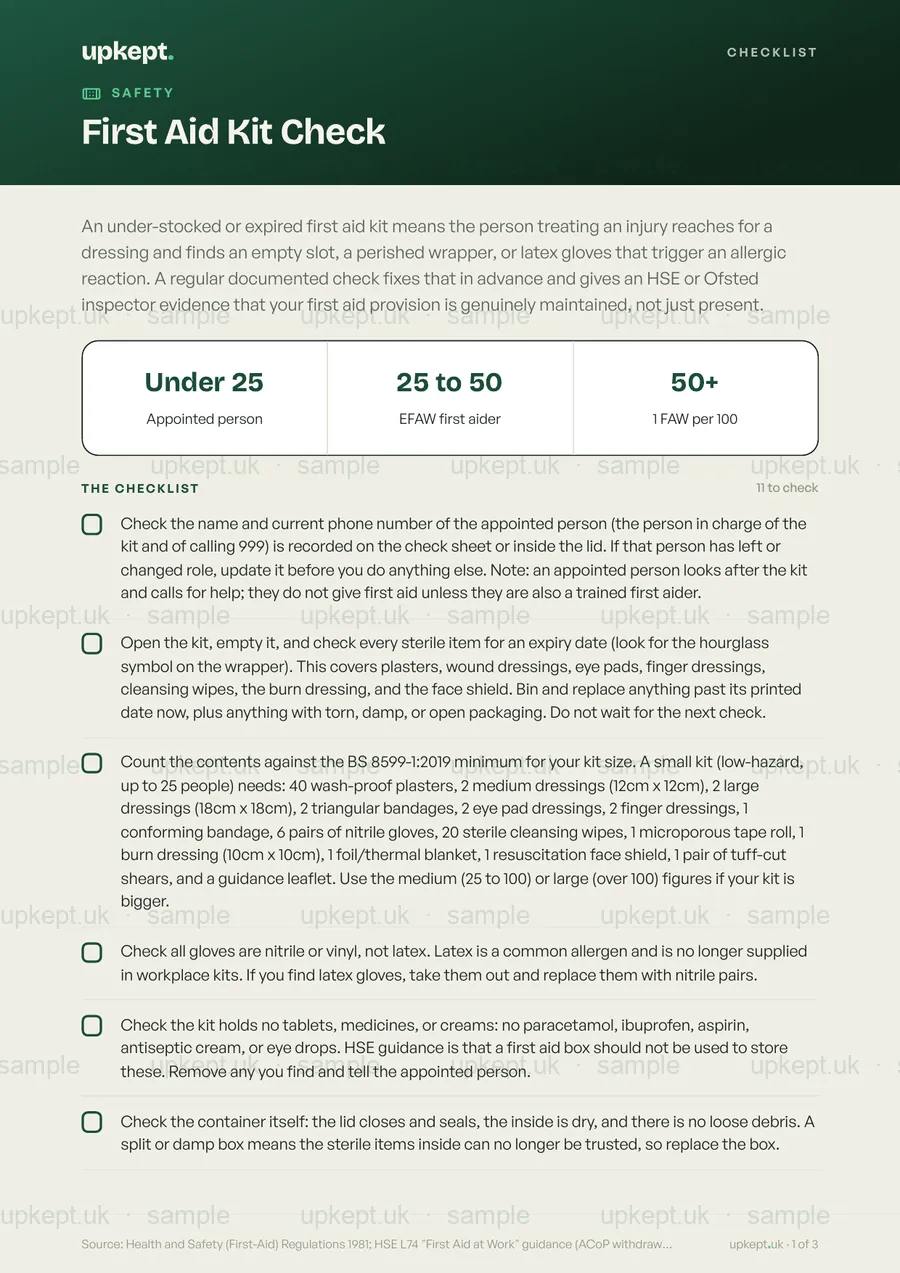
An under-stocked or expired first aid kit means the person treating an injury reaches for a dressing and finds an empty slot, a perished wrapper, or latex gloves that trigger an allergic reaction. A regular documented check fixes that in advance and gives an HSE or Ofsted inspector evidence that your first aid provision is genuinely maintained, not just present.

£14View
Safety

Emergency Lighting Check

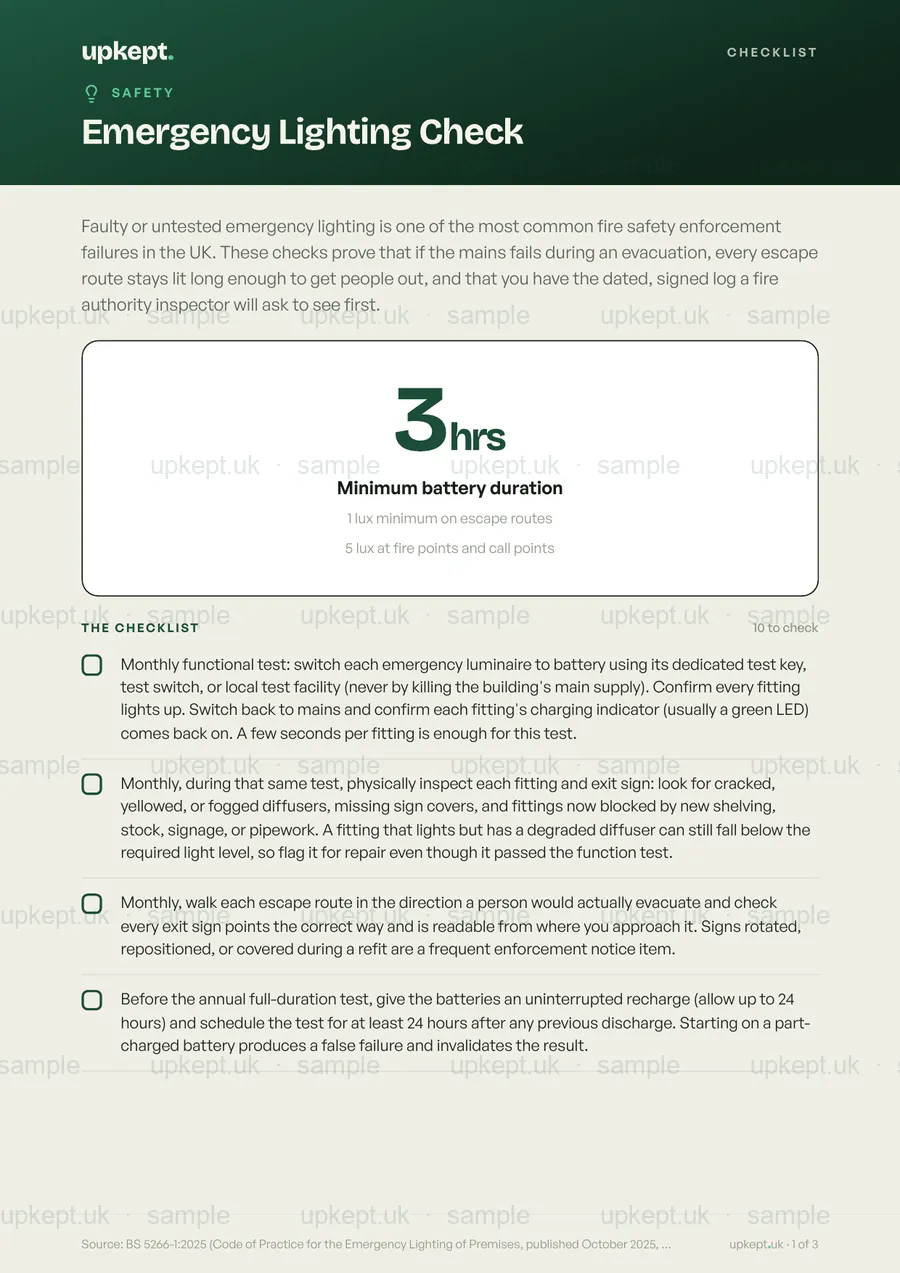
Faulty or untested emergency lighting is one of the most common fire safety enforcement failures in the UK. These checks prove that if the mains fails during an evacuation, every escape route stays lit long enough to get people out, and that you have the dated, signed log a fire authority inspector will ask to see first.

£14View
Cleaning

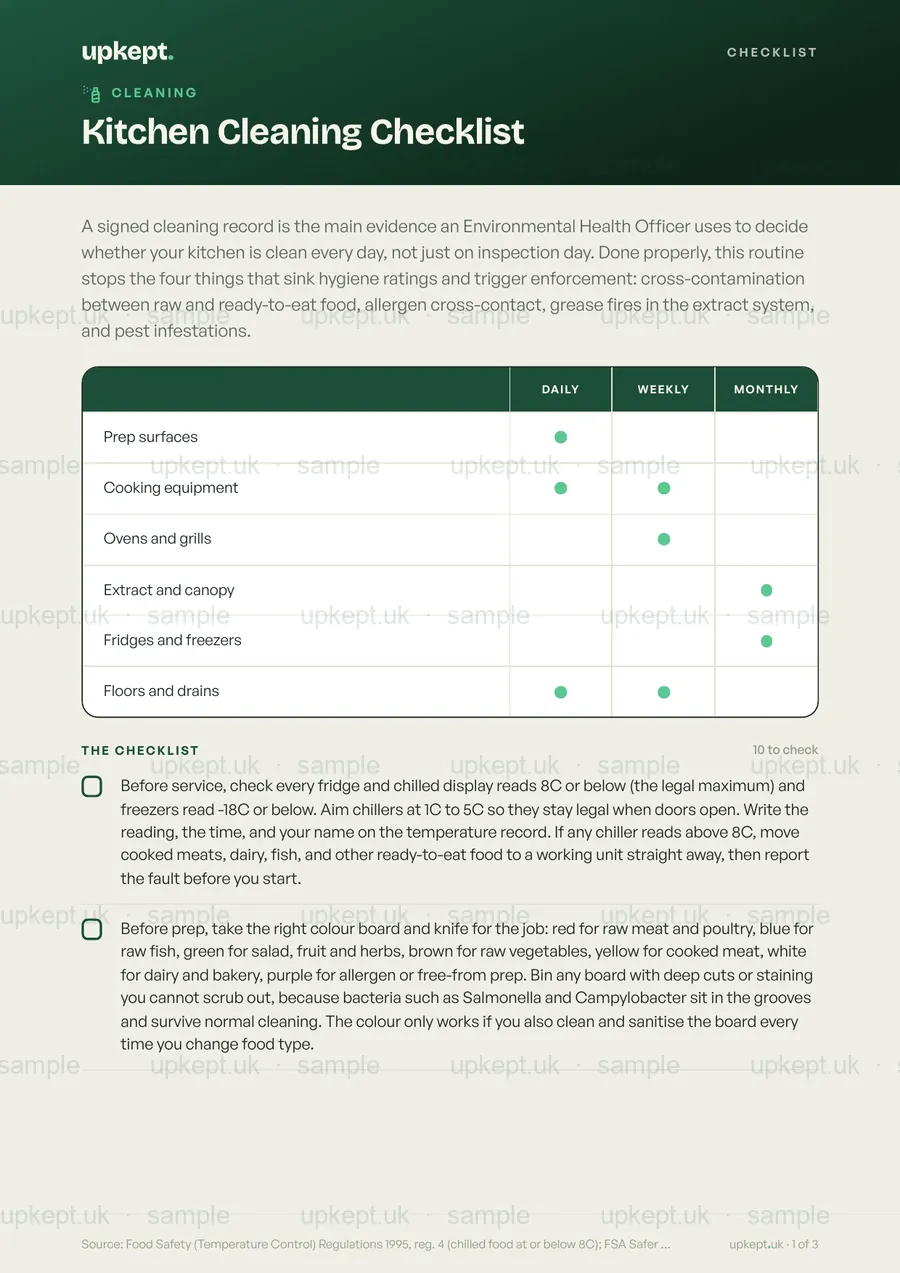
Kitchen Cleaning Checklist

A signed cleaning record is the main evidence an Environmental Health Officer uses to decide whether your kitchen is clean every day, not just on inspection day. Done properly, this routine stops the four things that sink hygiene ratings and trigger enforcement: cross-contamination between raw and ready-to-eat food, allergen cross-contact, grease fires in the extract system, and pest infestations.

£14View
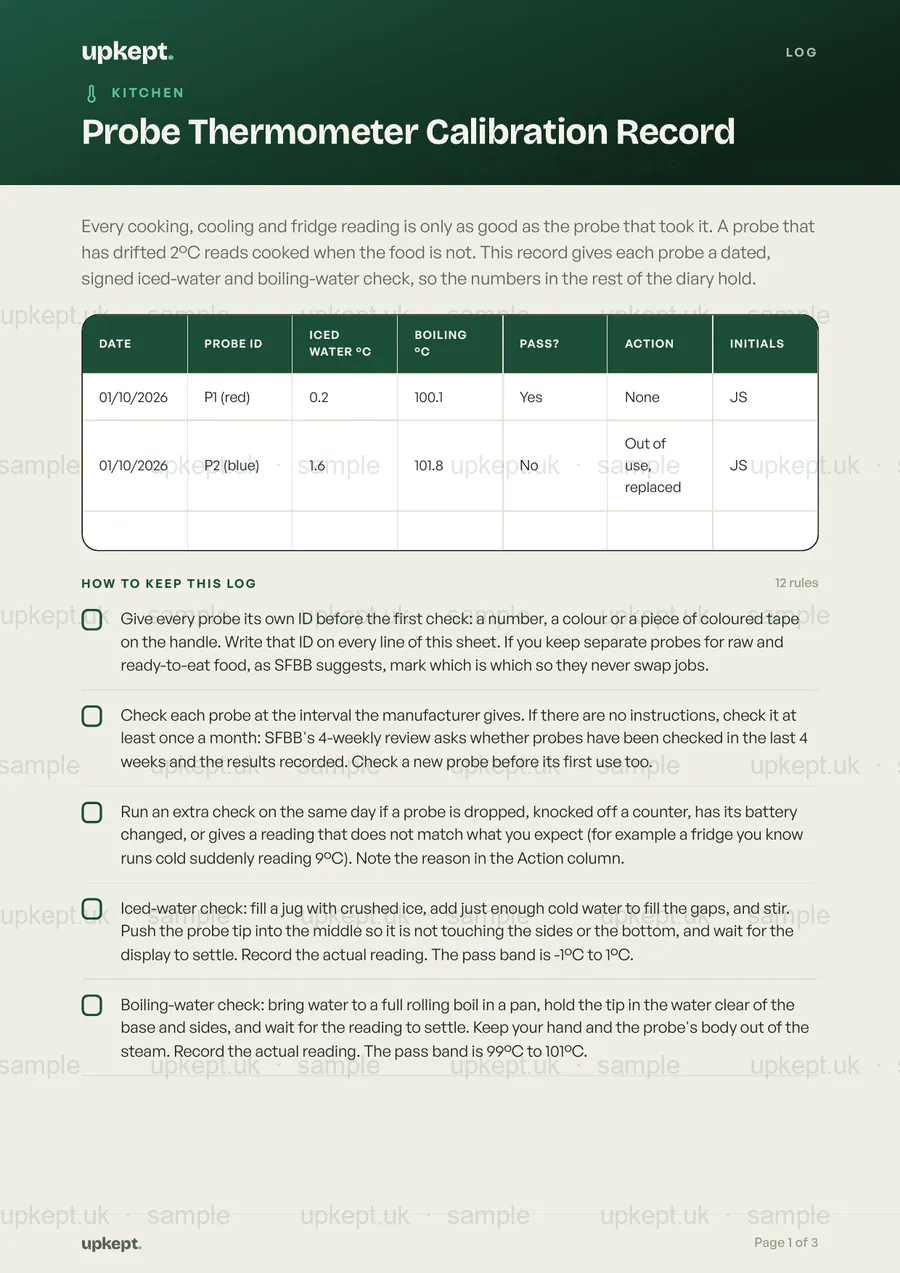
Kitchen

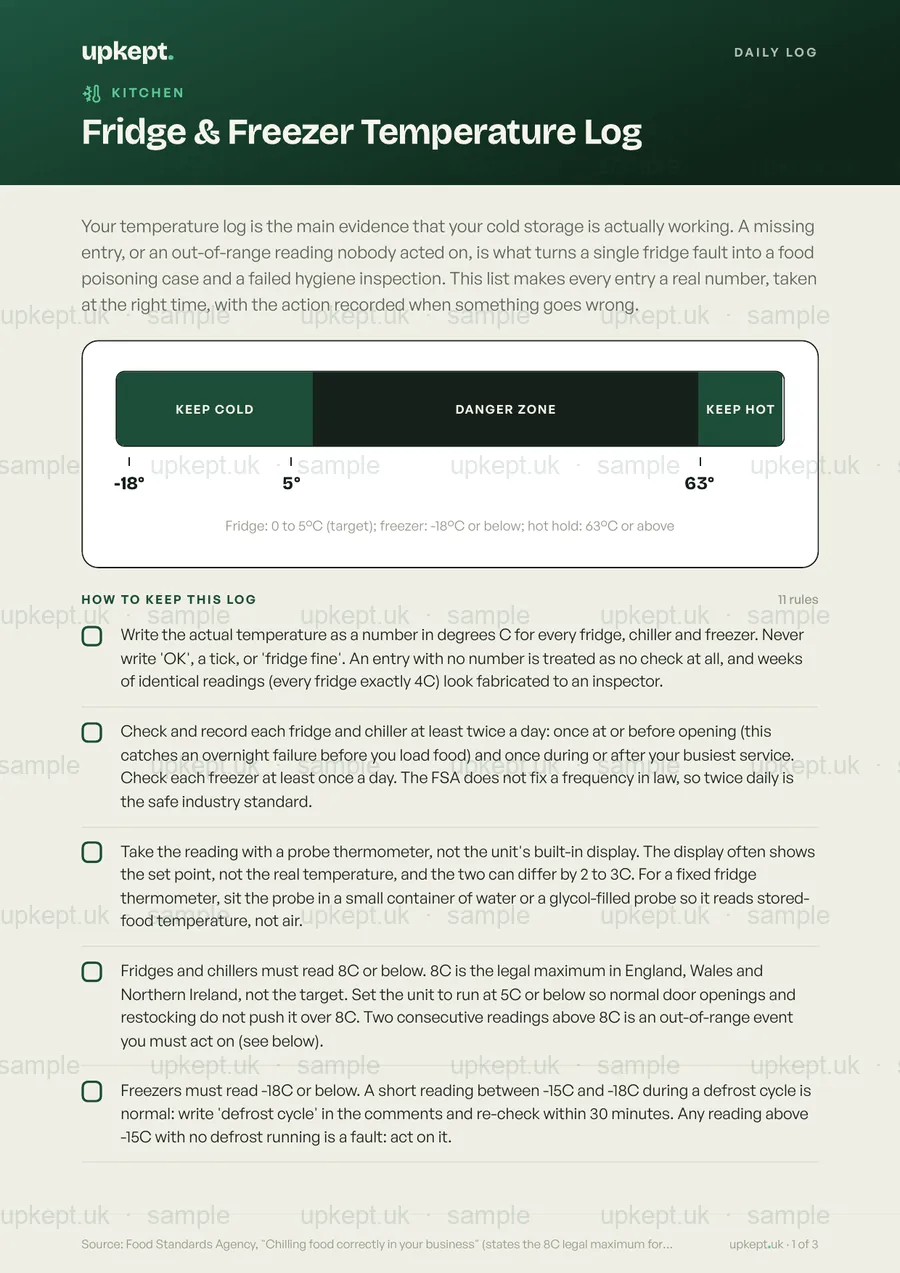
Fridge & Freezer Temperature Log

Your temperature log is the main evidence that your cold storage is actually working. A missing entry, or an out-of-range reading nobody acted on, is what turns a single fridge fault into a food poisoning case and a failed hygiene inspection. This list makes every entry a real number, taken at the right time, with the action recorded when something goes wrong.

£14View
Daily

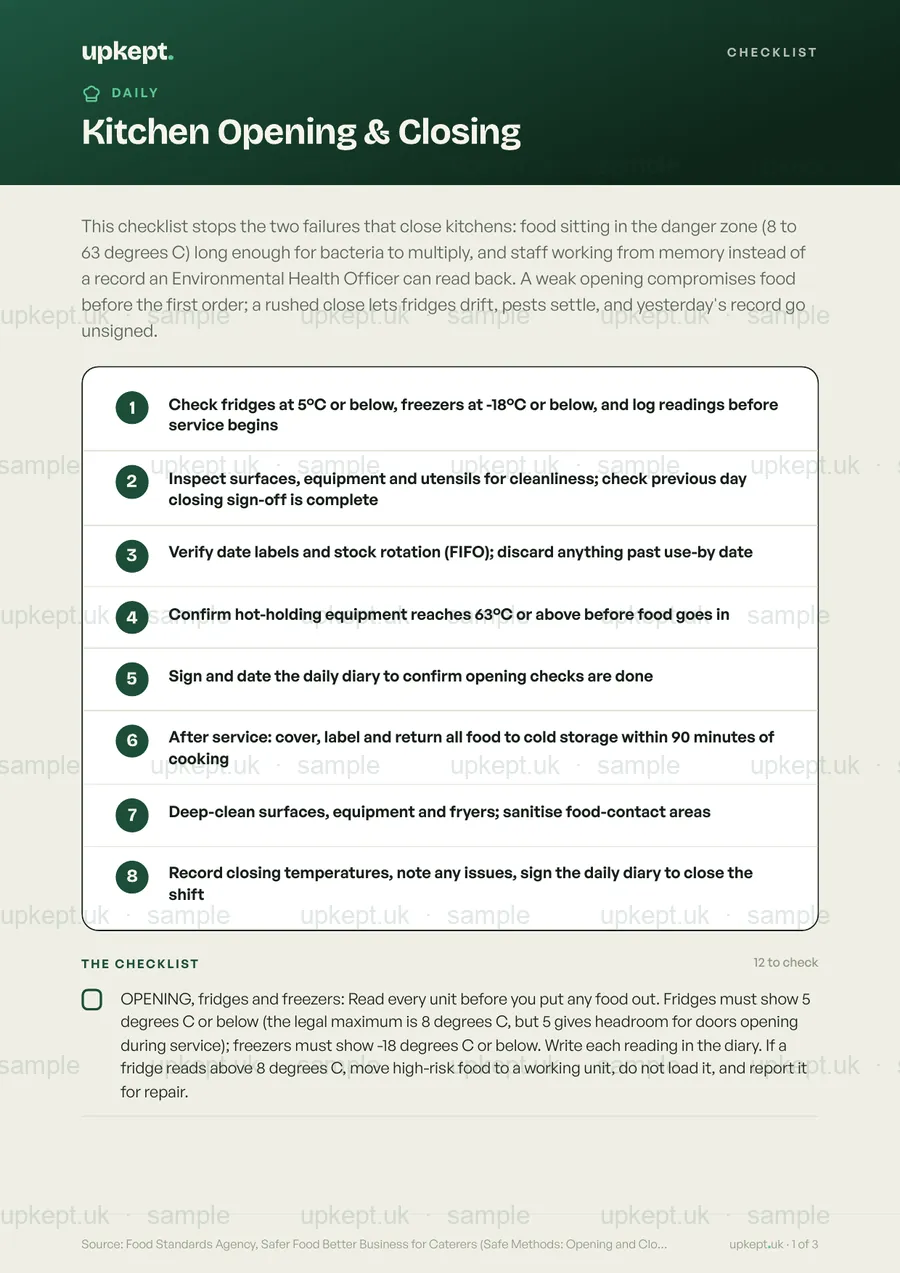
Kitchen Opening & Closing

This checklist stops the two failures that close kitchens: food sitting in the danger zone (8 to 63 degrees C) long enough for bacteria to multiply, and staff working from memory instead of a record an Environmental Health Officer can read back. A weak opening compromises food before the first order; a rushed close lets fridges drift, pests settle, and yesterday's record go unsigned.

£14View
Rooms

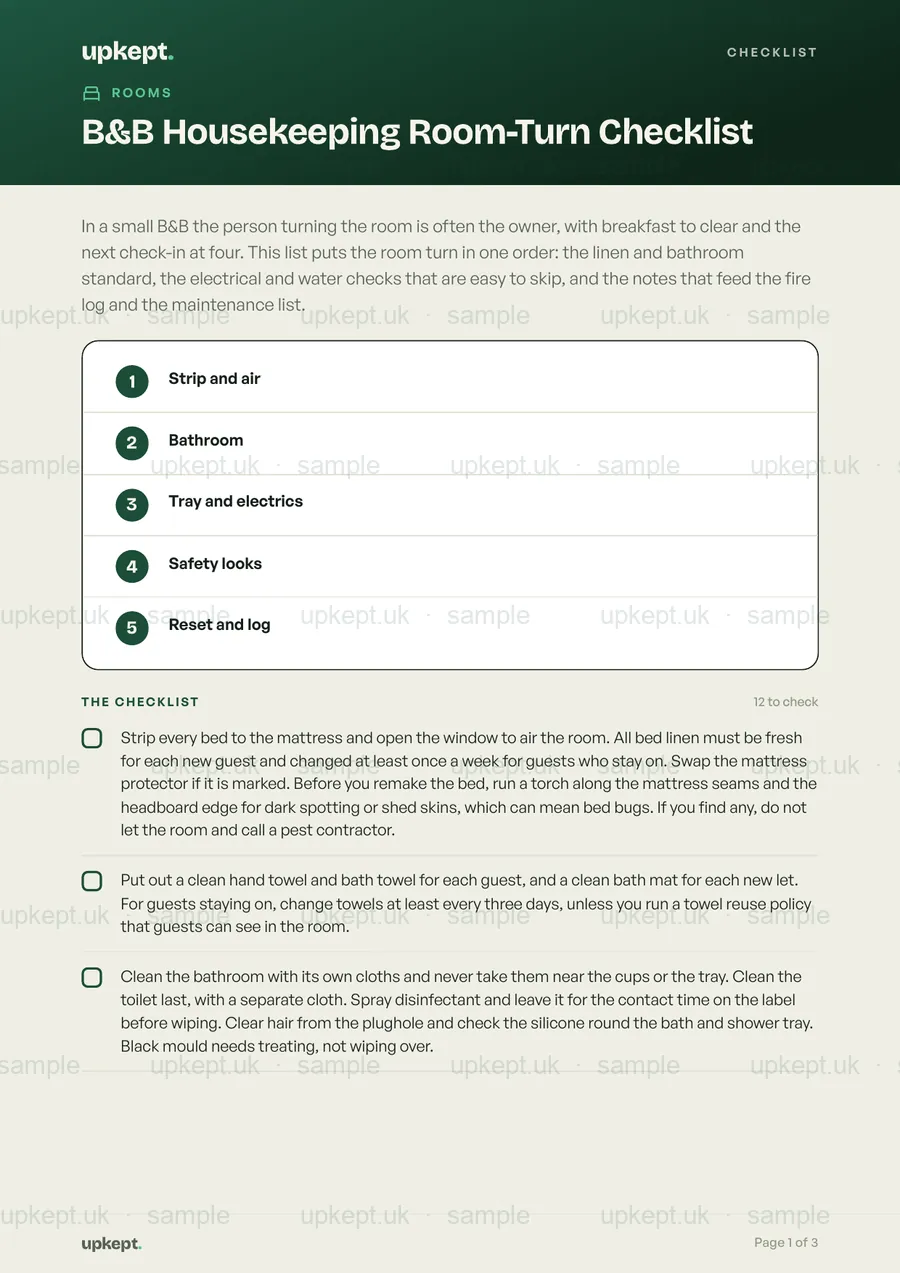
Hotel Room Checklist

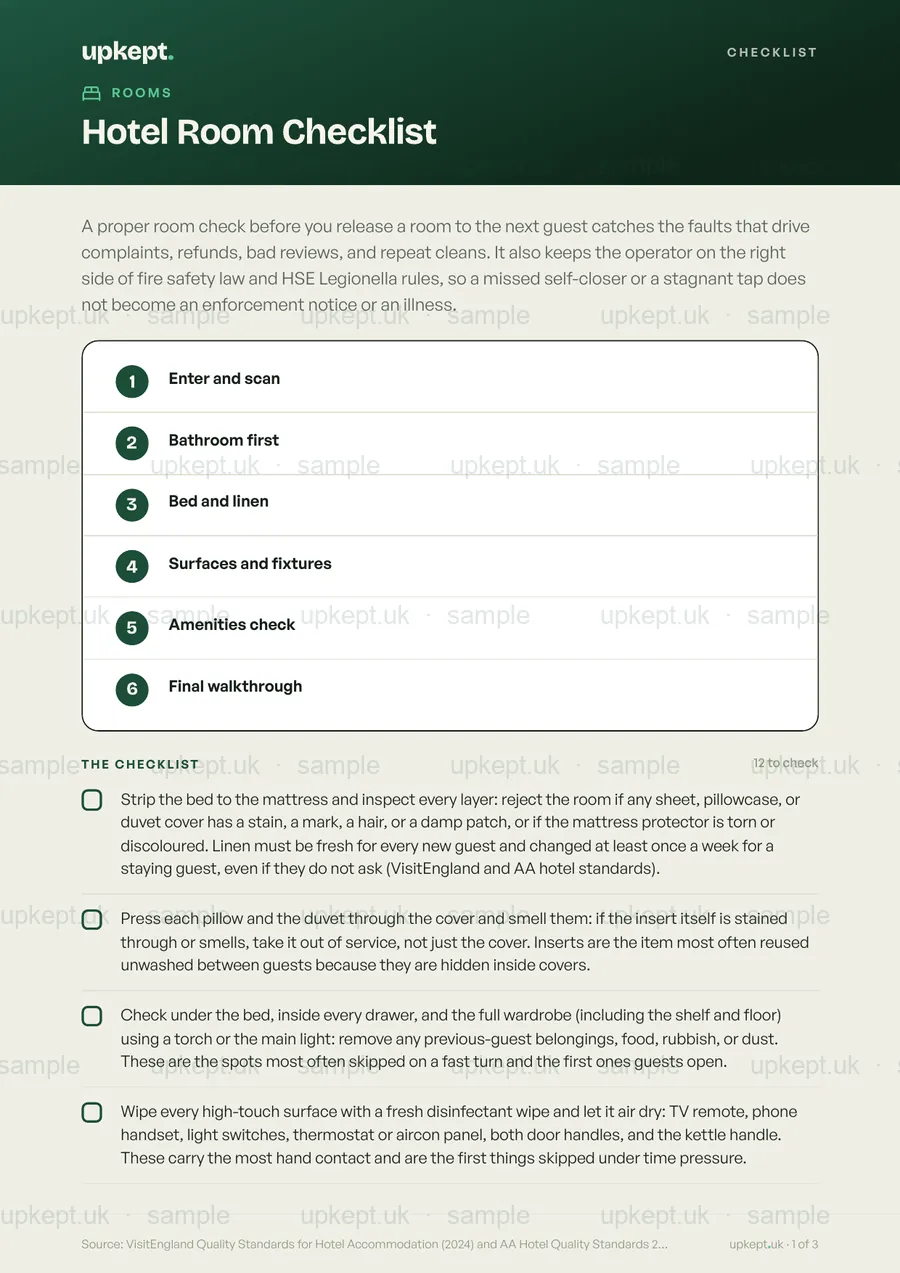
A proper room check before you release a room to the next guest catches the faults that drive complaints, refunds, bad reviews, and repeat cleans. It also keeps the operator on the right side of fire safety law and HSE Legionella rules, so a missed self-closer or a stagnant tap does not become an enforcement notice or an illness.

£14View
Rooms

Guest Bathroom Check

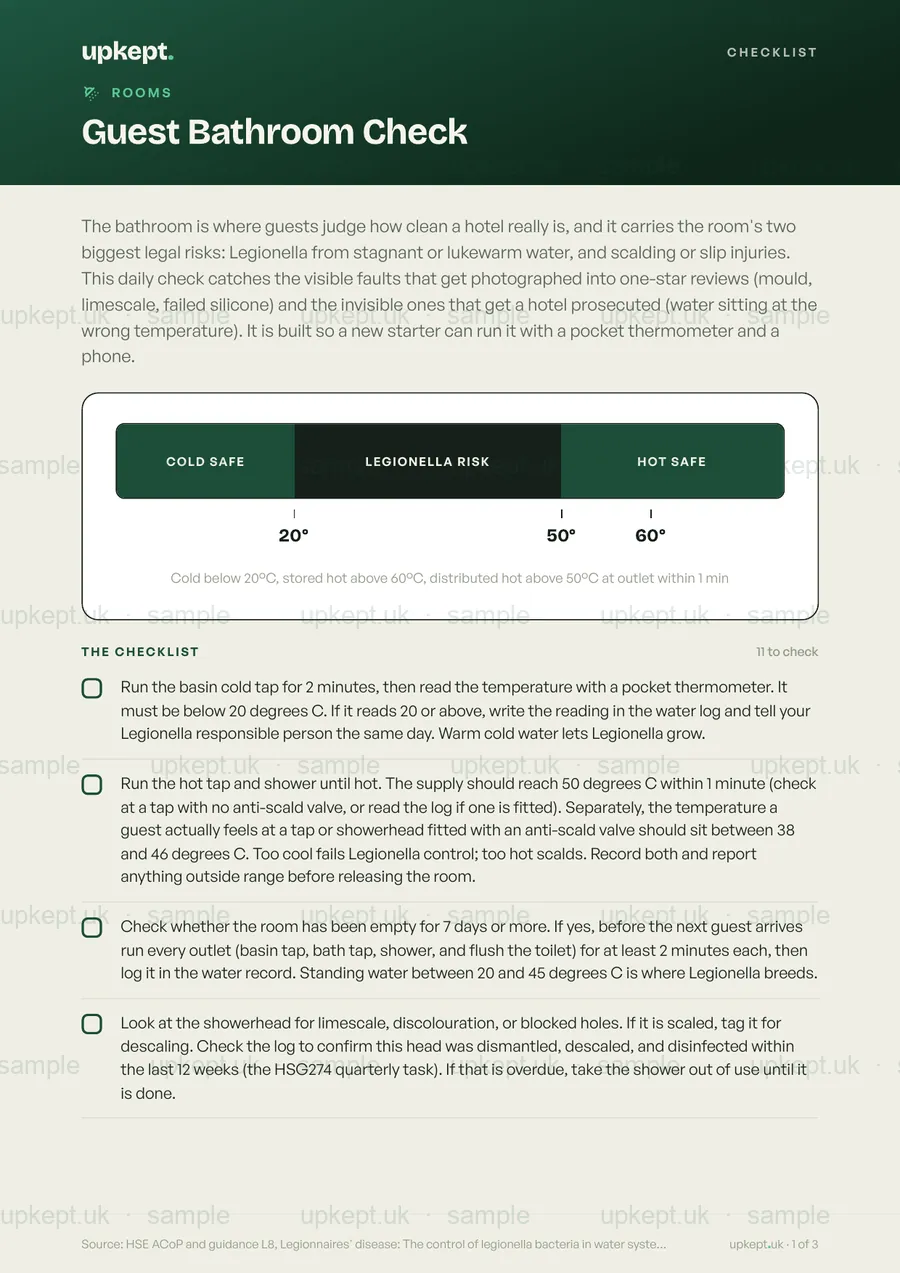
The bathroom is where guests judge how clean a hotel really is, and it carries the room's two biggest legal risks: Legionella from stagnant or lukewarm water, and scalding or slip injuries. This daily check catches the visible faults that get photographed into one-star reviews (mould, limescale, failed silicone) and the invisible ones that get a hotel prosecuted (water sitting at the wrong temperature). It is built so a new starter can run it with a pocket thermometer and a phone.

£14View
Rooms

Housekeeping Daily Checklist

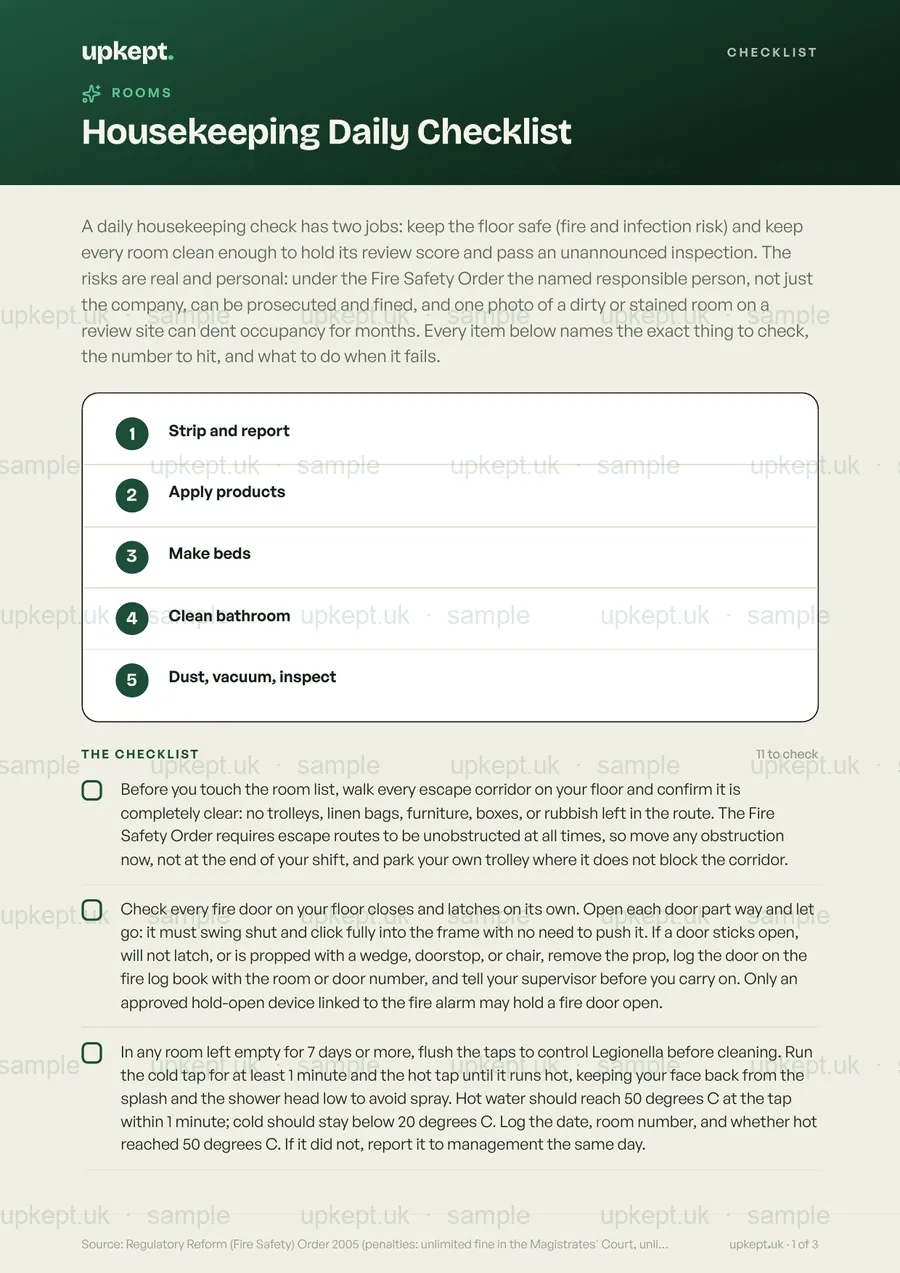
A daily housekeeping check has two jobs: keep the floor safe (fire and infection risk) and keep every room clean enough to hold its review score and pass an unannounced inspection. The risks are real and personal: under the Fire Safety Order the named responsible person, not just the company, can be prosecuted and fined, and one photo of a dirty or stained room on a review site can dent occupancy for months. Every item below names the exact thing to check, the number to hit, and what to do when it fails.

£14View
Free

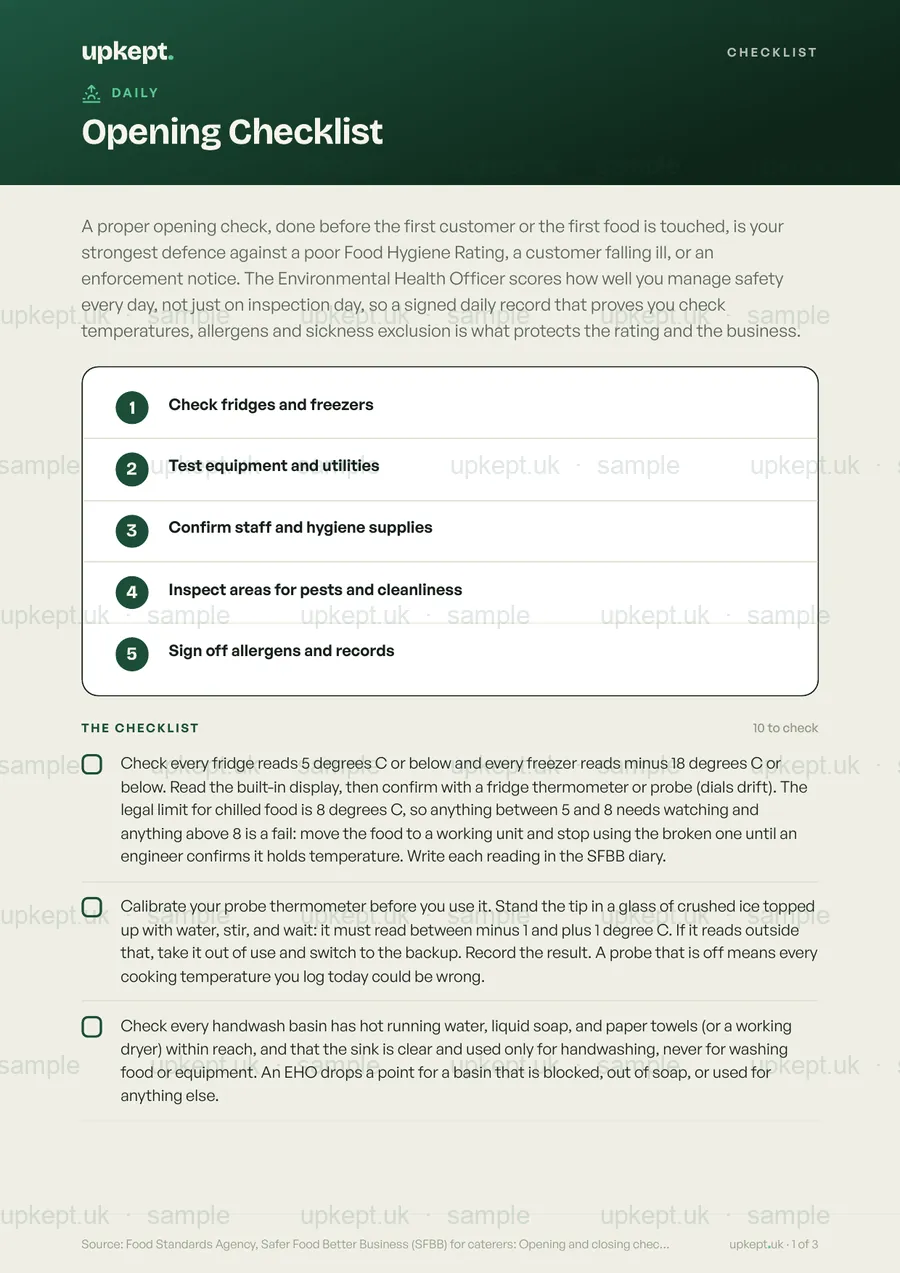
Opening Checklist

A proper opening check, done before the first customer or the first food is touched, is your strongest defence against a poor Food Hygiene Rating, a customer falling ill, or an enforcement notice. The Environmental Health Officer scores how well you manage safety every day, not just on inspection day, so a signed daily record that proves you check temperatures, allergens and sickness exclusion is what protects the rating and the business.

FreeView
Daily

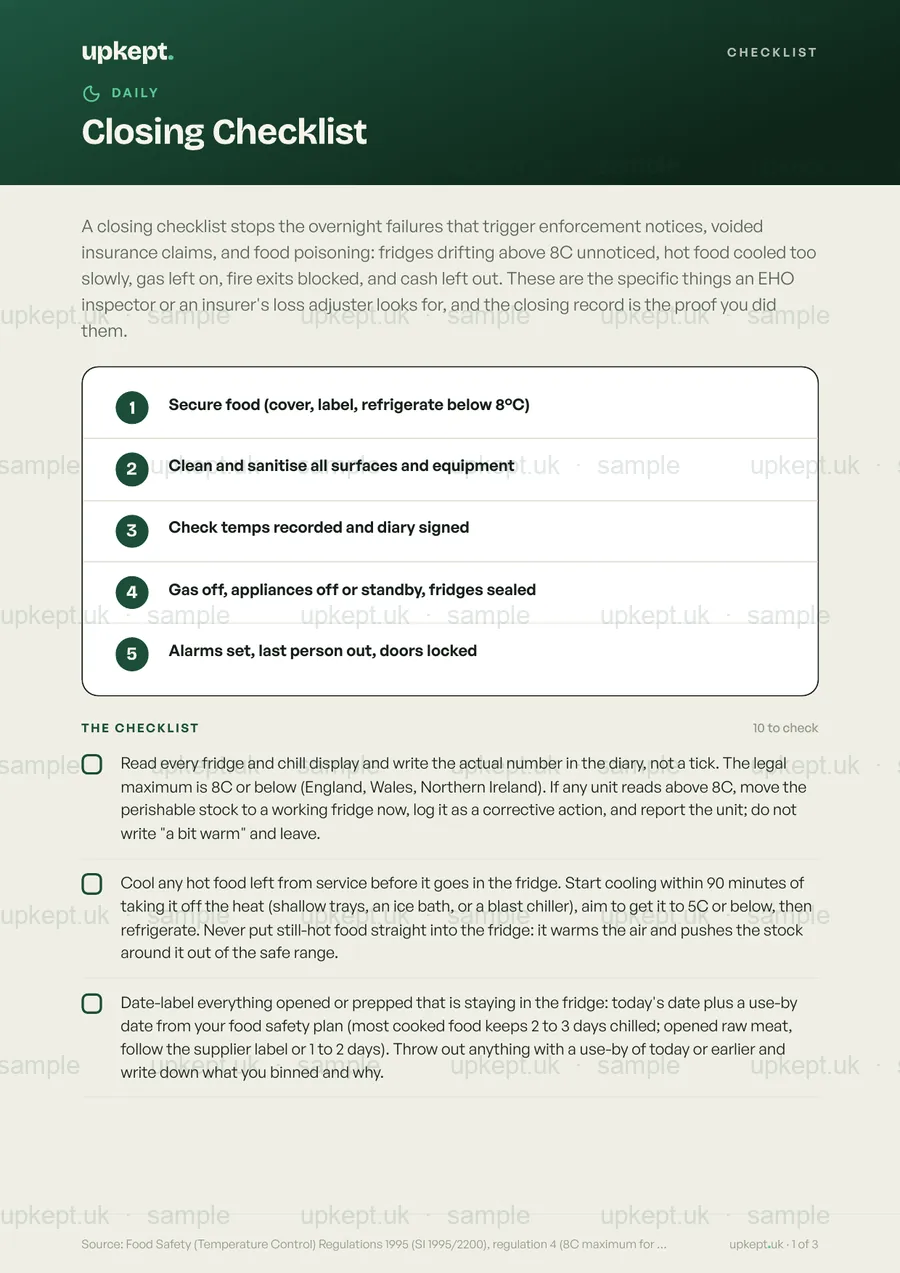
Closing Checklist

A closing checklist stops the overnight failures that trigger enforcement notices, voided insurance claims, and food poisoning: fridges drifting above 8C unnoticed, hot food cooled too slowly, gas left on, fire exits blocked, and cash left out. These are the specific things an EHO inspector or an insurer's loss adjuster looks for, and the closing record is the proof you did them.

£14View
Free

Washroom Hourly Check

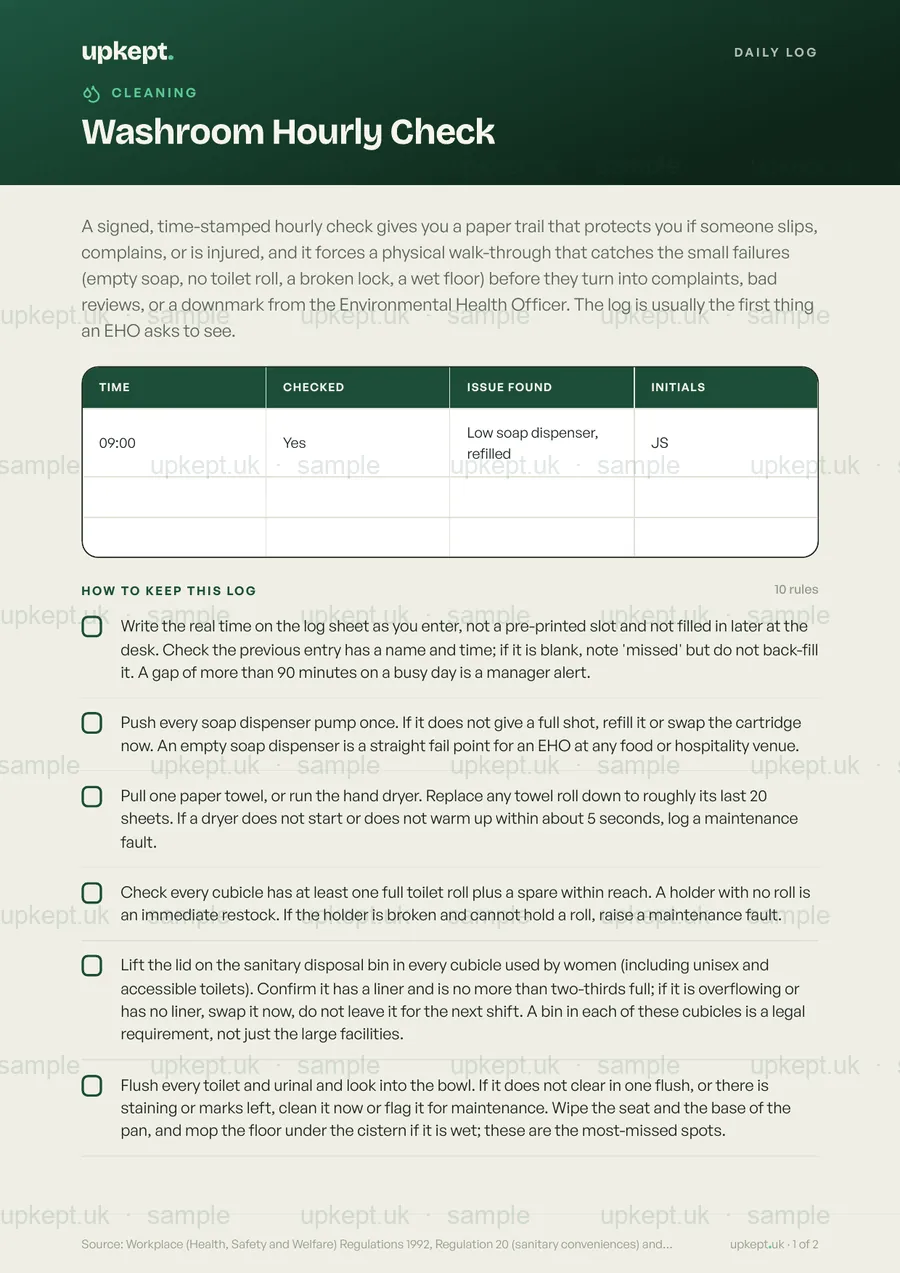
A signed, time-stamped hourly check gives you a paper trail that protects you if someone slips, complains, or is injured, and it forces a physical walk-through that catches the small failures (empty soap, no toilet roll, a broken lock, a wet floor) before they turn into complaints, bad reviews, or a downmark from the Environmental Health Officer. The log is usually the first thing an EHO asks to see.

FreeView
Cleaning

Bin & Waste Area Check

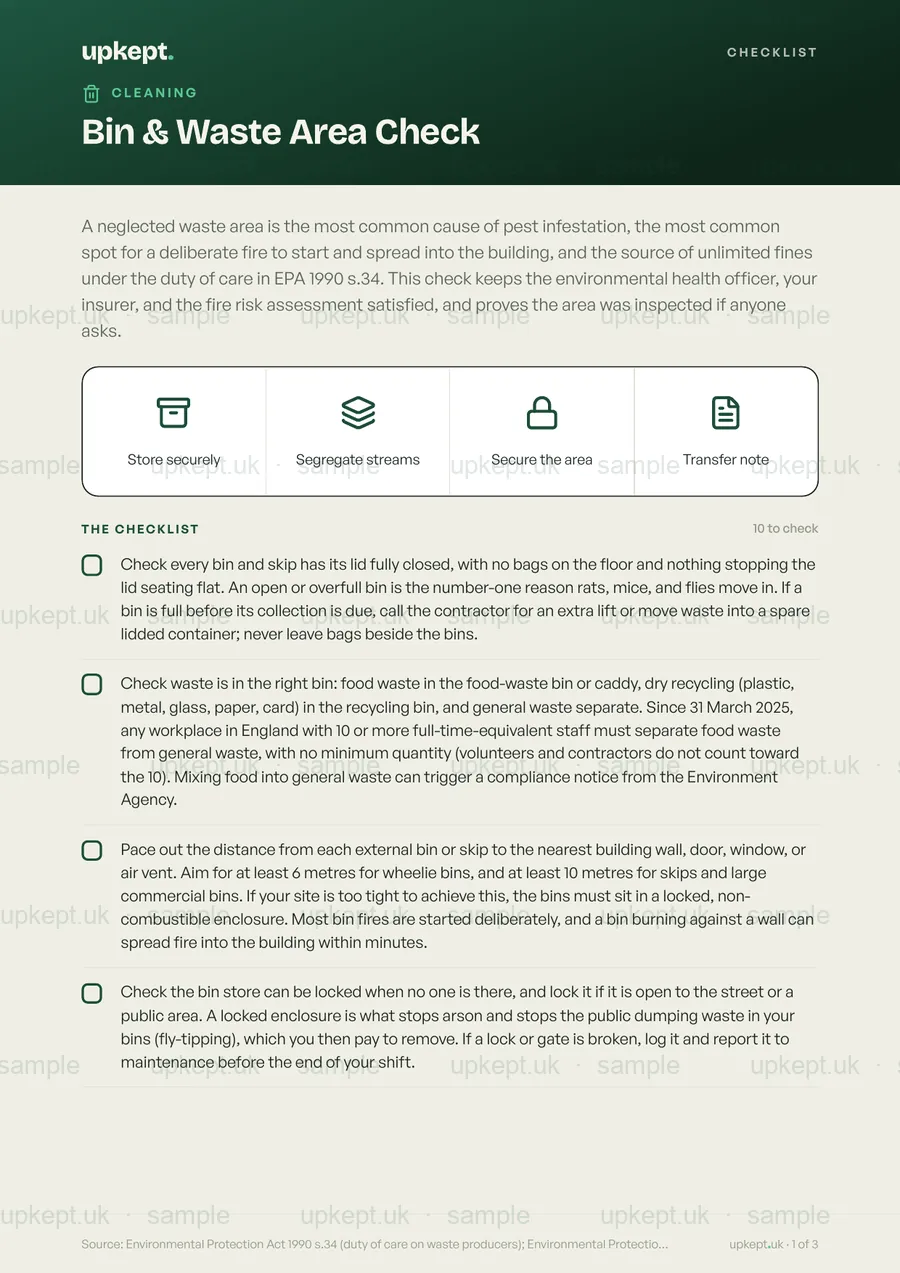
A neglected waste area is the most common cause of pest infestation, the most common spot for a deliberate fire to start and spread into the building, and the source of unlimited fines under the duty of care in EPA 1990 s.34. This check keeps the environmental health officer, your insurer, and the fire risk assessment satisfied, and proves the area was inspected if anyone asks.

£14View
Safety

Entrance & Communal Walk

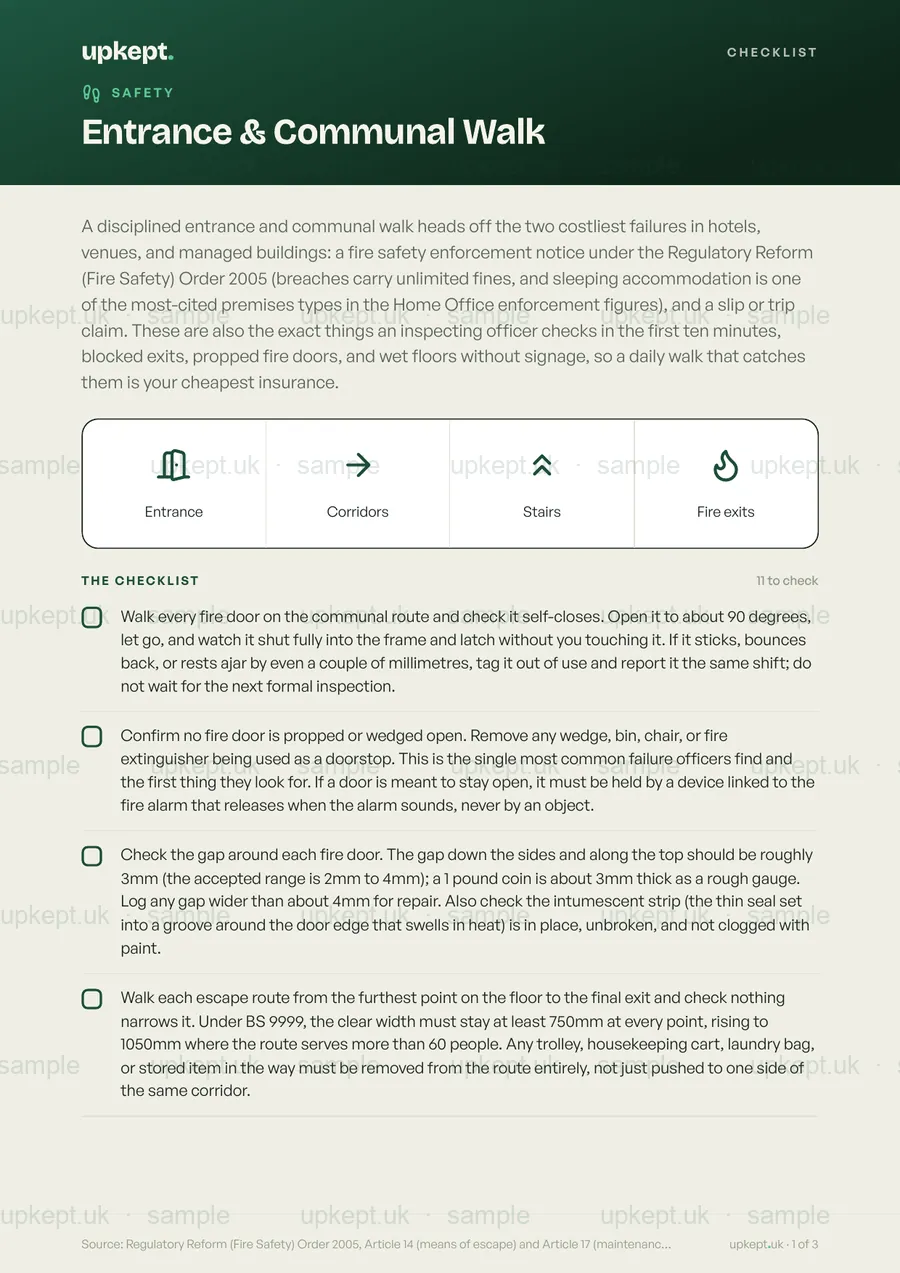
A disciplined entrance and communal walk heads off the two costliest failures in hotels, venues, and managed buildings: a fire safety enforcement notice under the Regulatory Reform (Fire Safety) Order 2005 (breaches carry unlimited fines, and sleeping accommodation is one of the most-cited premises types in the Home Office enforcement figures), and a slip or trip claim. These are also the exact things an inspecting officer checks in the first ten minutes, blocked exits, propped fire doors, and wet floors without signage, so a daily walk that catches them is your cheapest insurance.

£14View
Free

Daily Cleaning Rota

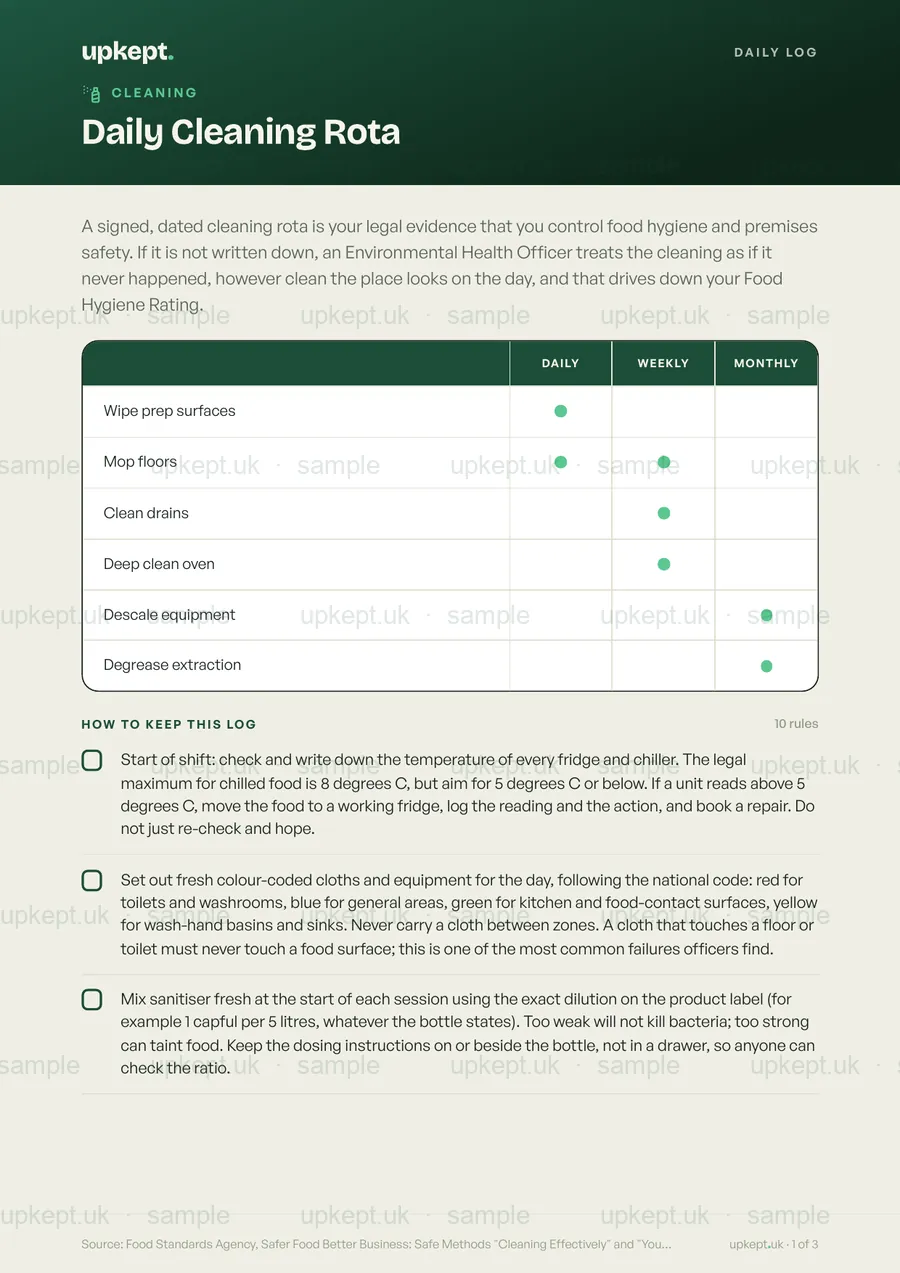
A signed, dated cleaning rota is your legal evidence that you control food hygiene and premises safety. If it is not written down, an Environmental Health Officer treats the cleaning as if it never happened, however clean the place looks on the day, and that drives down your Food Hygiene Rating.

FreeView
Cleaning

Weekly Cleaning Schedule

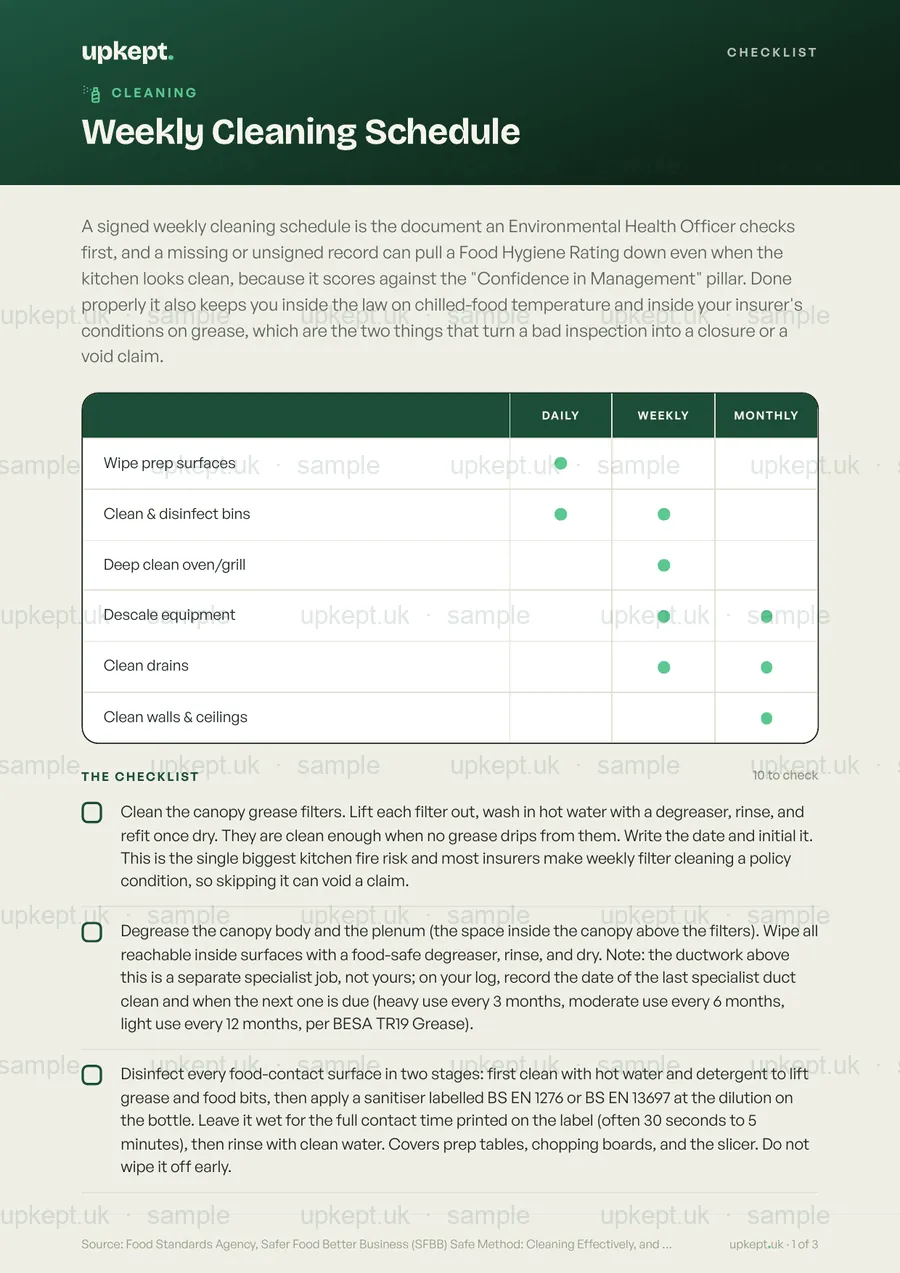
A signed weekly cleaning schedule is the document an Environmental Health Officer checks first, and a missing or unsigned record can pull a Food Hygiene Rating down even when the kitchen looks clean, because it scores against the "Confidence in Management" pillar. Done properly it also keeps you inside the law on chilled-food temperature and inside your insurer's conditions on grease, which are the two things that turn a bad inspection into a closure or a void claim.

£14View
Cleaning

Monthly Deep-Clean Checklist

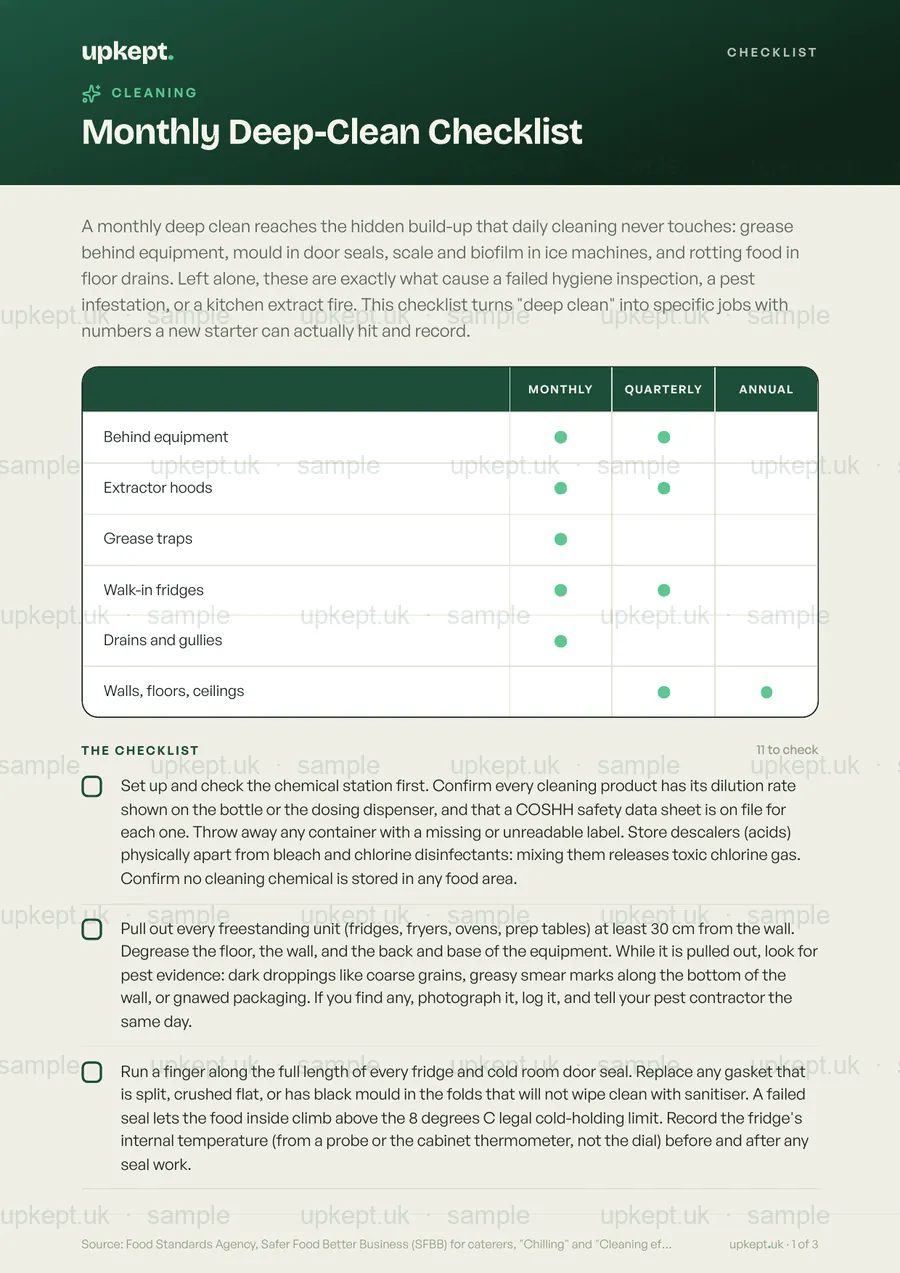
A monthly deep clean reaches the hidden build-up that daily cleaning never touches: grease behind equipment, mould in door seals, scale and biofilm in ice machines, and rotting food in floor drains. Left alone, these are exactly what cause a failed hygiene inspection, a pest infestation, or a kitchen extract fire. This checklist turns "deep clean" into specific jobs with numbers a new starter can actually hit and record.

£14View
Cleaning

Office Cleaning Checklist

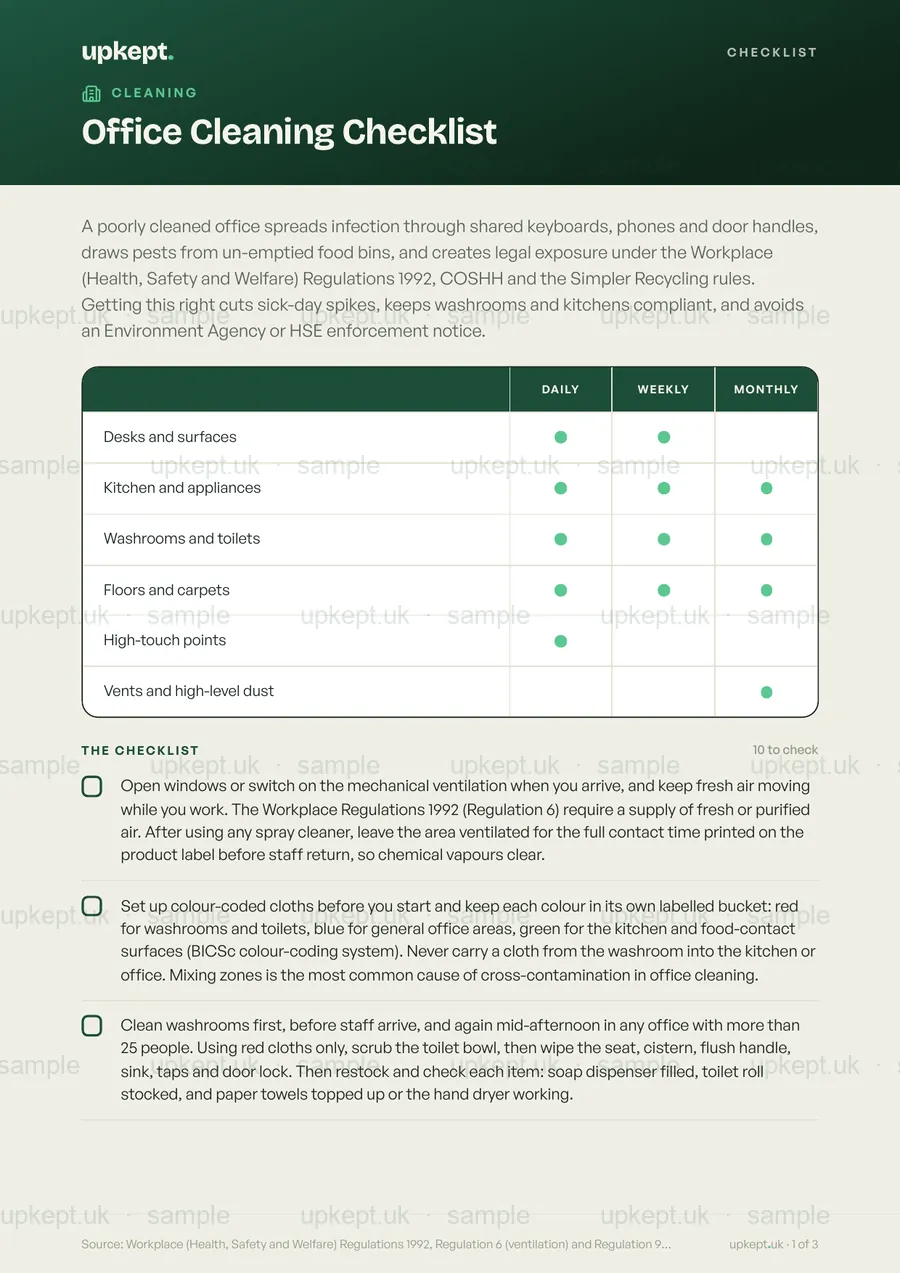
A poorly cleaned office spreads infection through shared keyboards, phones and door handles, draws pests from un-emptied food bins, and creates legal exposure under the Workplace (Health, Safety and Welfare) Regulations 1992, COSHH and the Simpler Recycling rules. Getting this right cuts sick-day spikes, keeps washrooms and kitchens compliant, and avoids an Environment Agency or HSE enforcement notice.

£14View
Cleaning

Cleaning Sign-Off Sheet

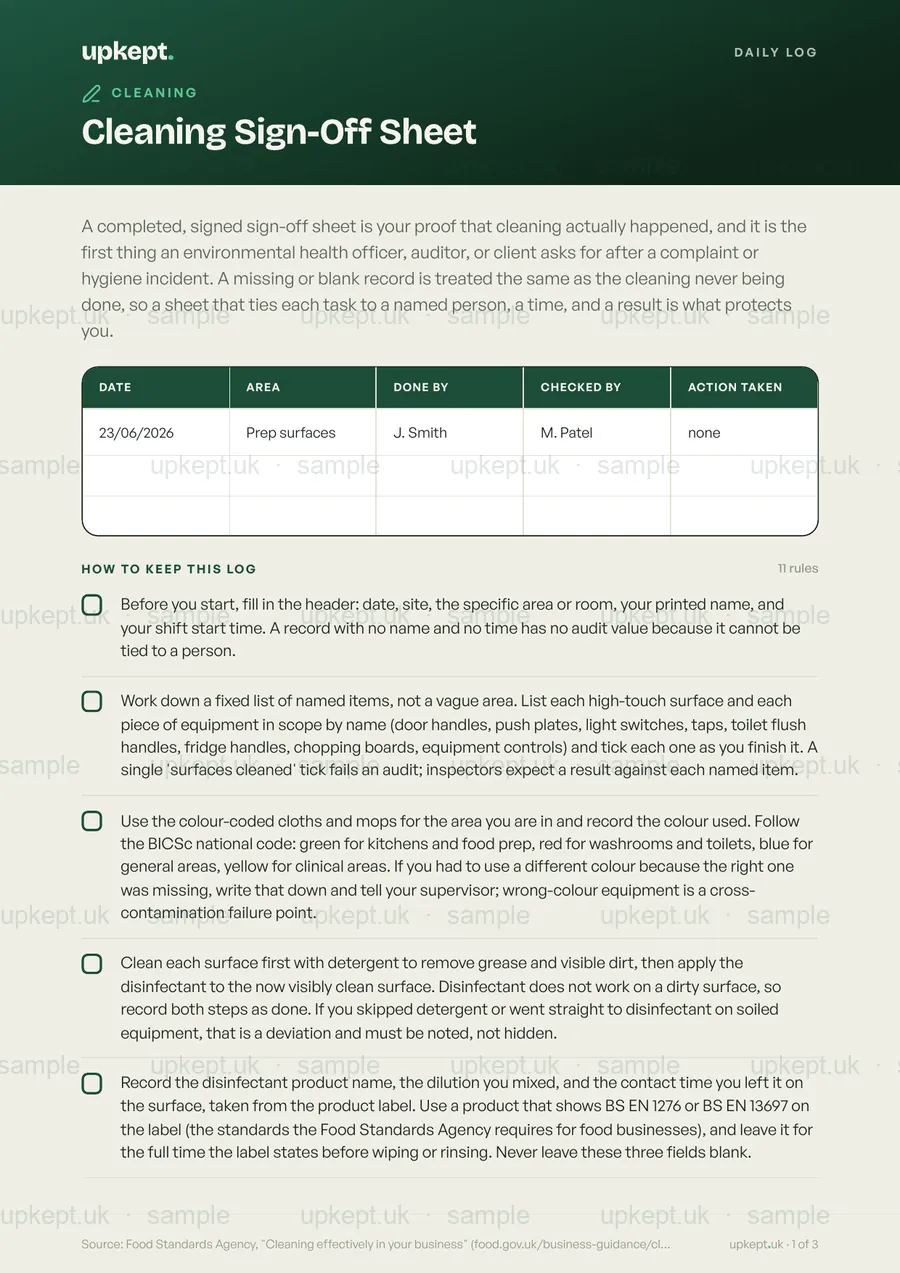
A completed, signed sign-off sheet is your proof that cleaning actually happened, and it is the first thing an environmental health officer, auditor, or client asks for after a complaint or hygiene incident. A missing or blank record is treated the same as the cleaning never being done, so a sheet that ties each task to a named person, a time, and a result is what protects you.

£14View
Cleaning

Nursery Cleaning Checklist

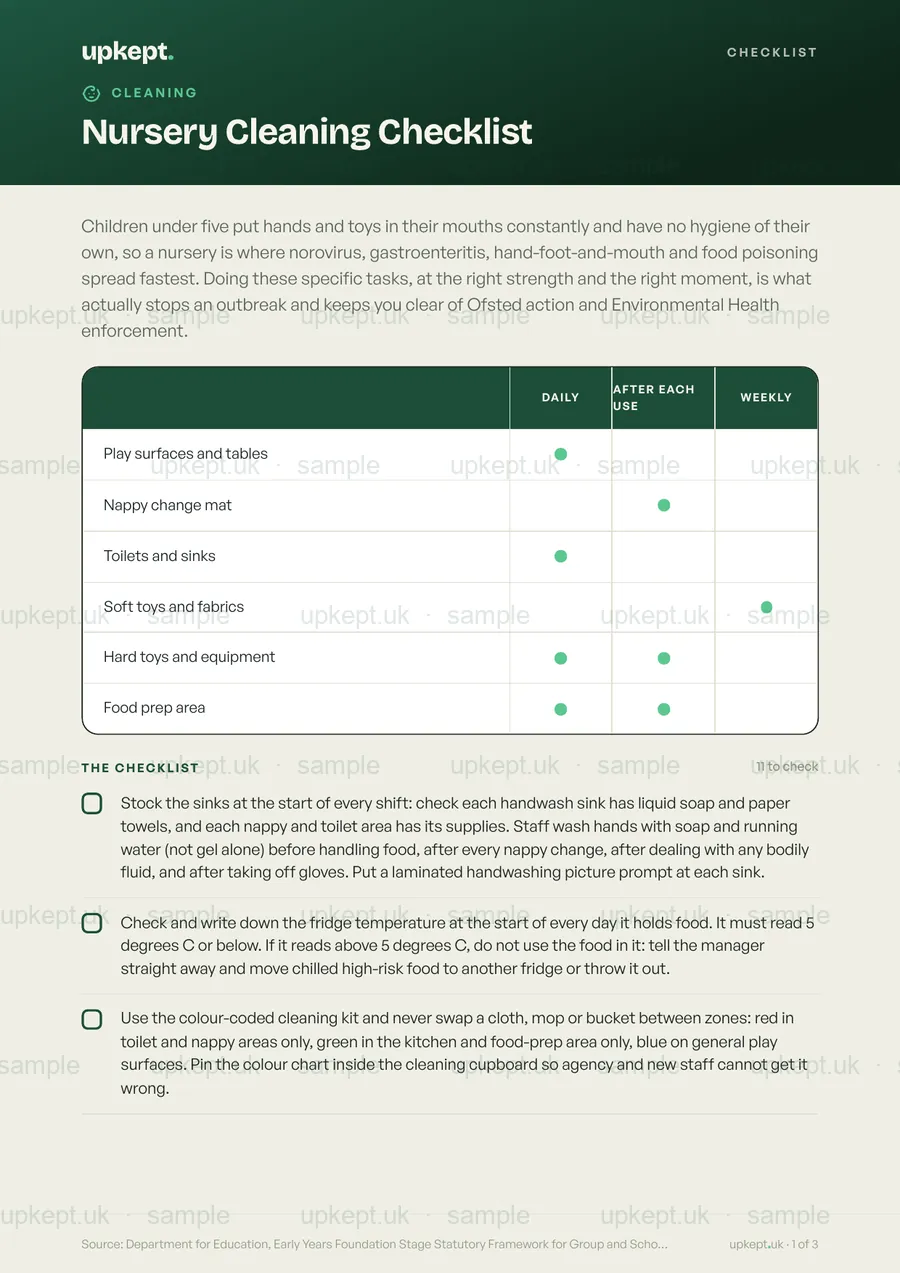
Children under five put hands and toys in their mouths constantly and have no hygiene of their own, so a nursery is where norovirus, gastroenteritis, hand-foot-and-mouth and food poisoning spread fastest. Doing these specific tasks, at the right strength and the right moment, is what actually stops an outbreak and keeps you clear of Ofsted action and Environmental Health enforcement.

£14View
Free

14-Allergen Matrix

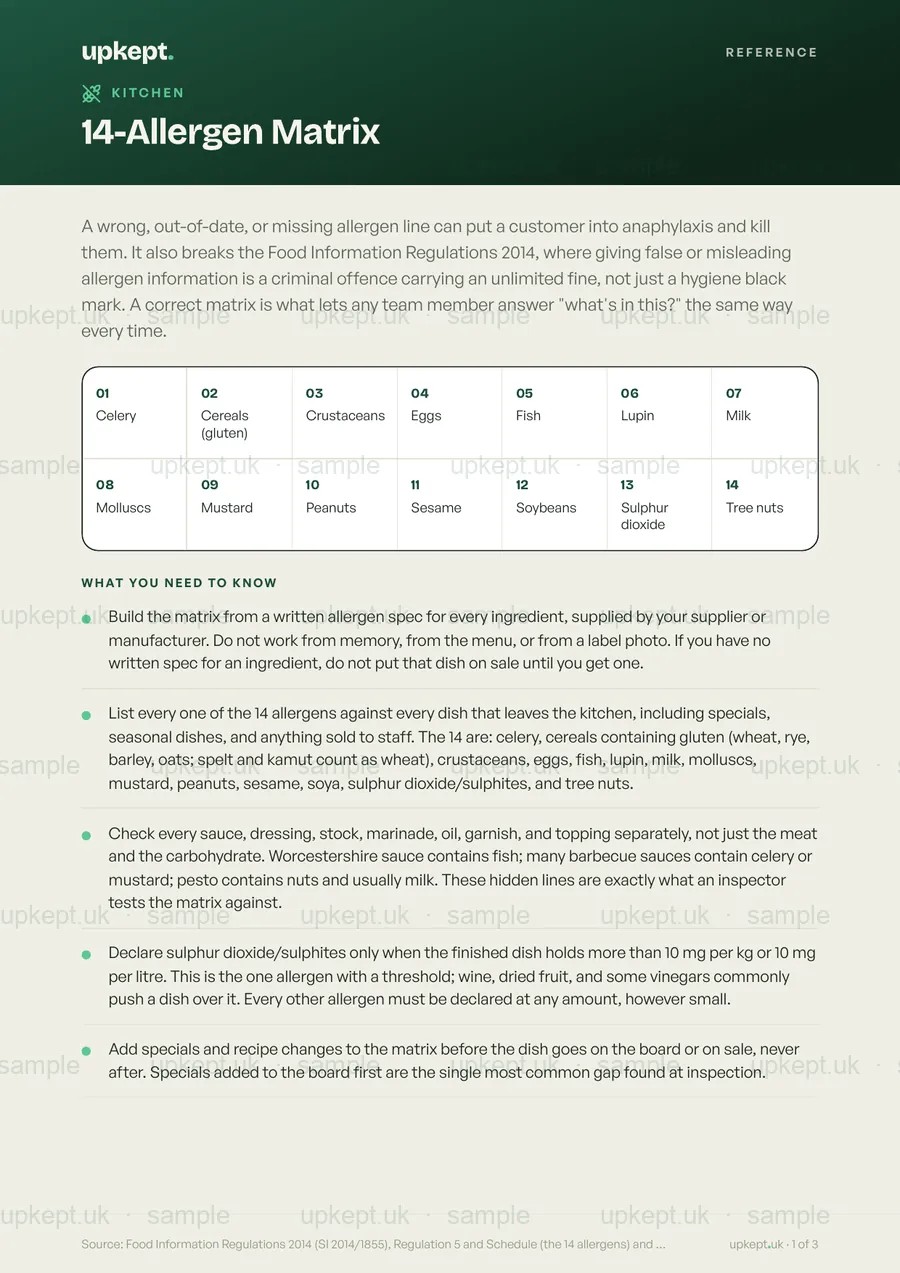
A wrong, out-of-date, or missing allergen line can put a customer into anaphylaxis and kill them. It also breaks the Food Information Regulations 2014, where giving false or misleading allergen information is a criminal offence carrying an unlimited fine, not just a hygiene black mark. A correct matrix is what lets any team member answer "what's in this?" the same way every time.

FreeView
Kitchen

Food Safety Daily Diary

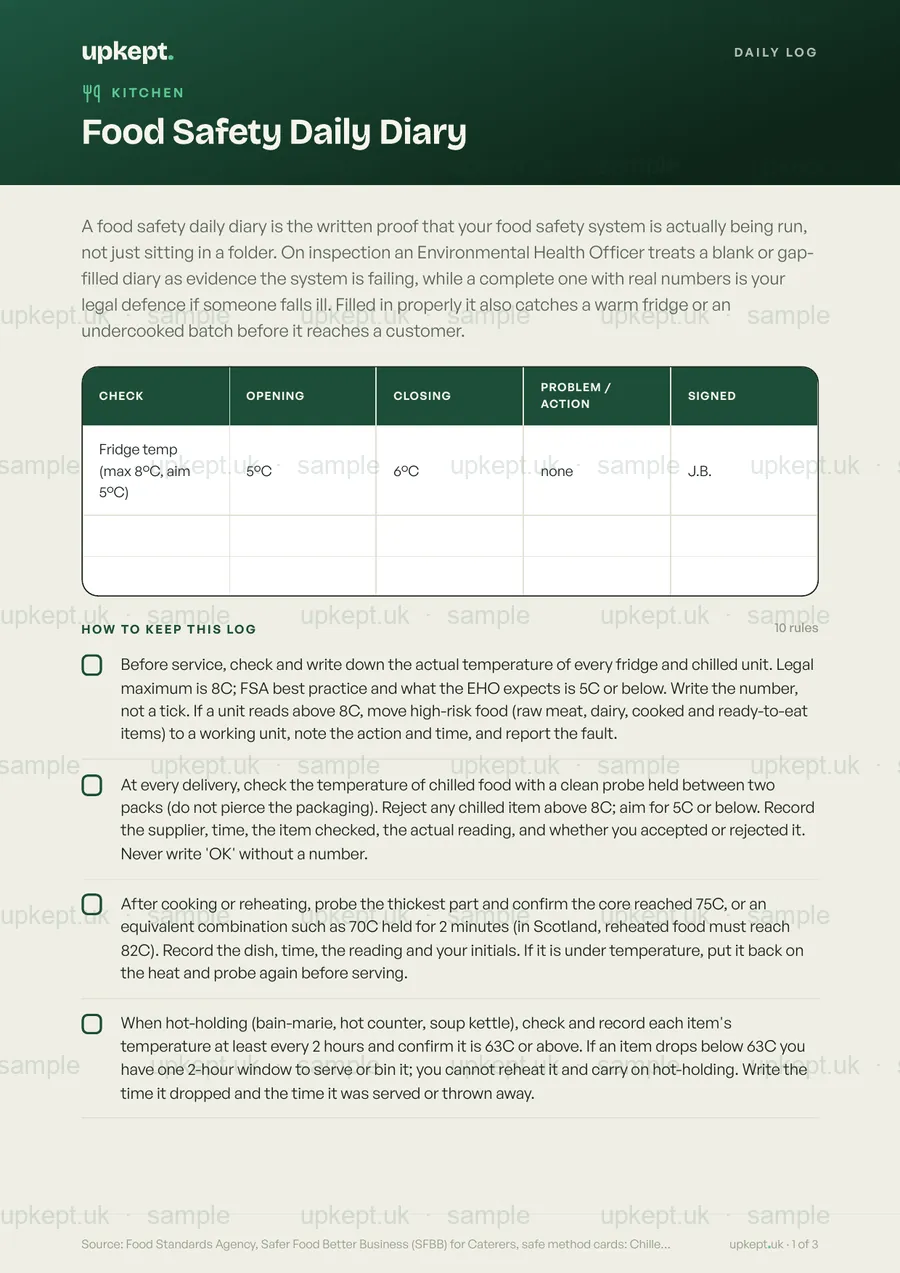
A food safety daily diary is the written proof that your food safety system is actually being run, not just sitting in a folder. On inspection an Environmental Health Officer treats a blank or gap-filled diary as evidence the system is failing, while a complete one with real numbers is your legal defence if someone falls ill. Filled in properly it also catches a warm fridge or an undercooked batch before it reaches a customer.

£14View
Kitchen

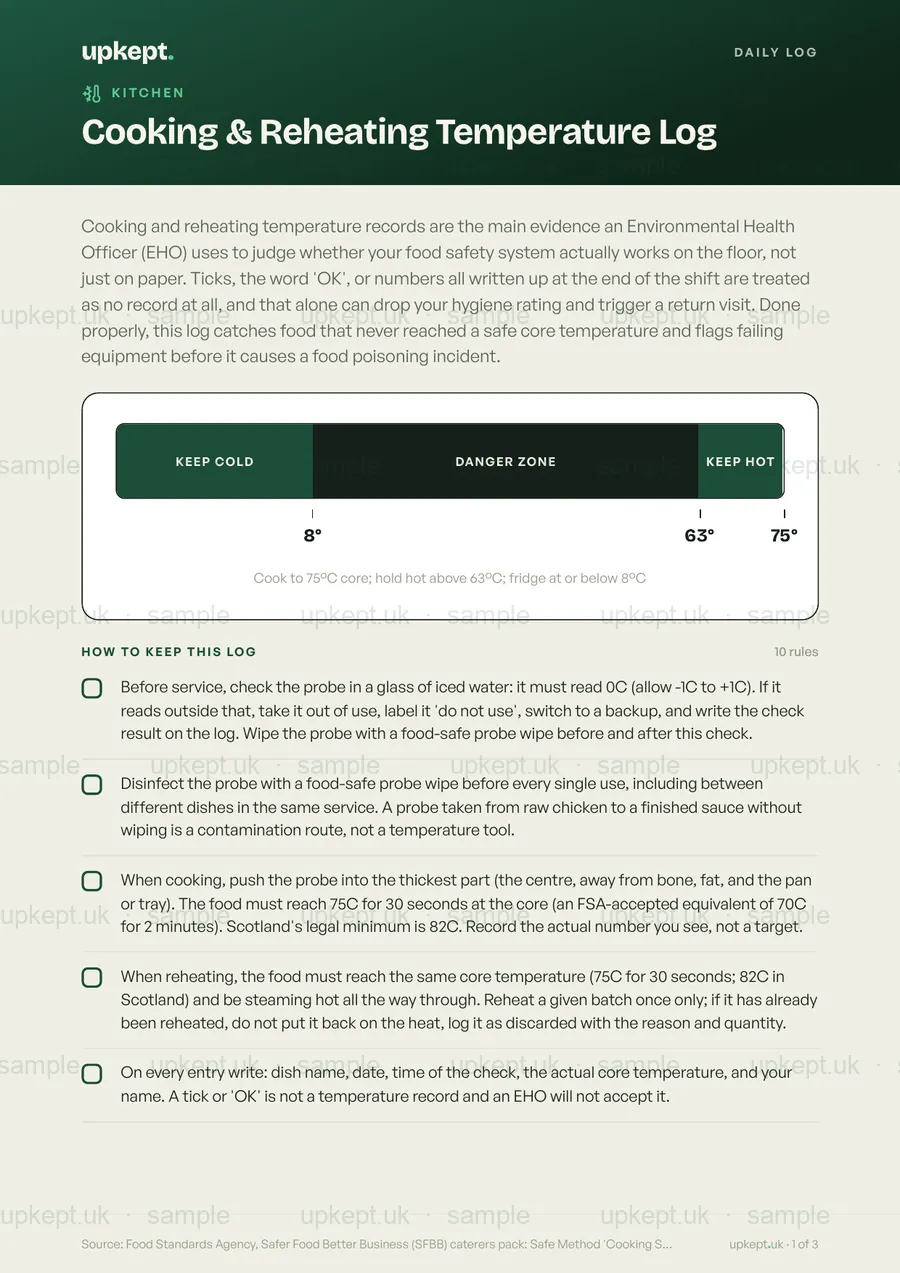
Cooking & Reheating Temperature Log

Cooking and reheating temperature records are the main evidence an Environmental Health Officer (EHO) uses to judge whether your food safety system actually works on the floor, not just on paper. Ticks, the word 'OK', or numbers all written up at the end of the shift are treated as no record at all, and that alone can drop your hygiene rating and trigger a return visit. Done properly, this log catches food that never reached a safe core temperature and flags failing equipment before it causes a food poisoning incident.

£14View
Kitchen

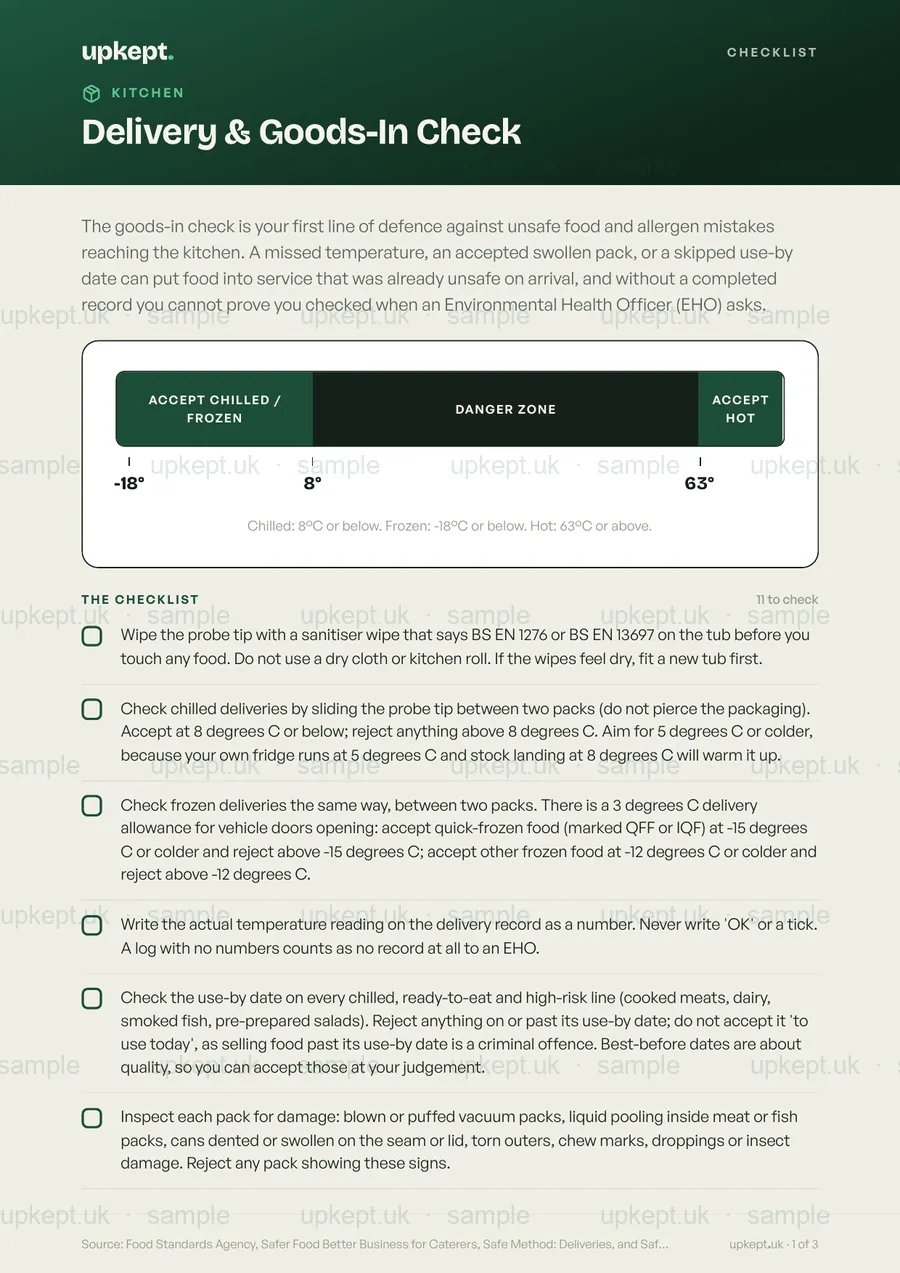
Delivery & Goods-In Check

The goods-in check is your first line of defence against unsafe food and allergen mistakes reaching the kitchen. A missed temperature, an accepted swollen pack, or a skipped use-by date can put food into service that was already unsafe on arrival, and without a completed record you cannot prove you checked when an Environmental Health Officer (EHO) asks.

£14View
Kitchen

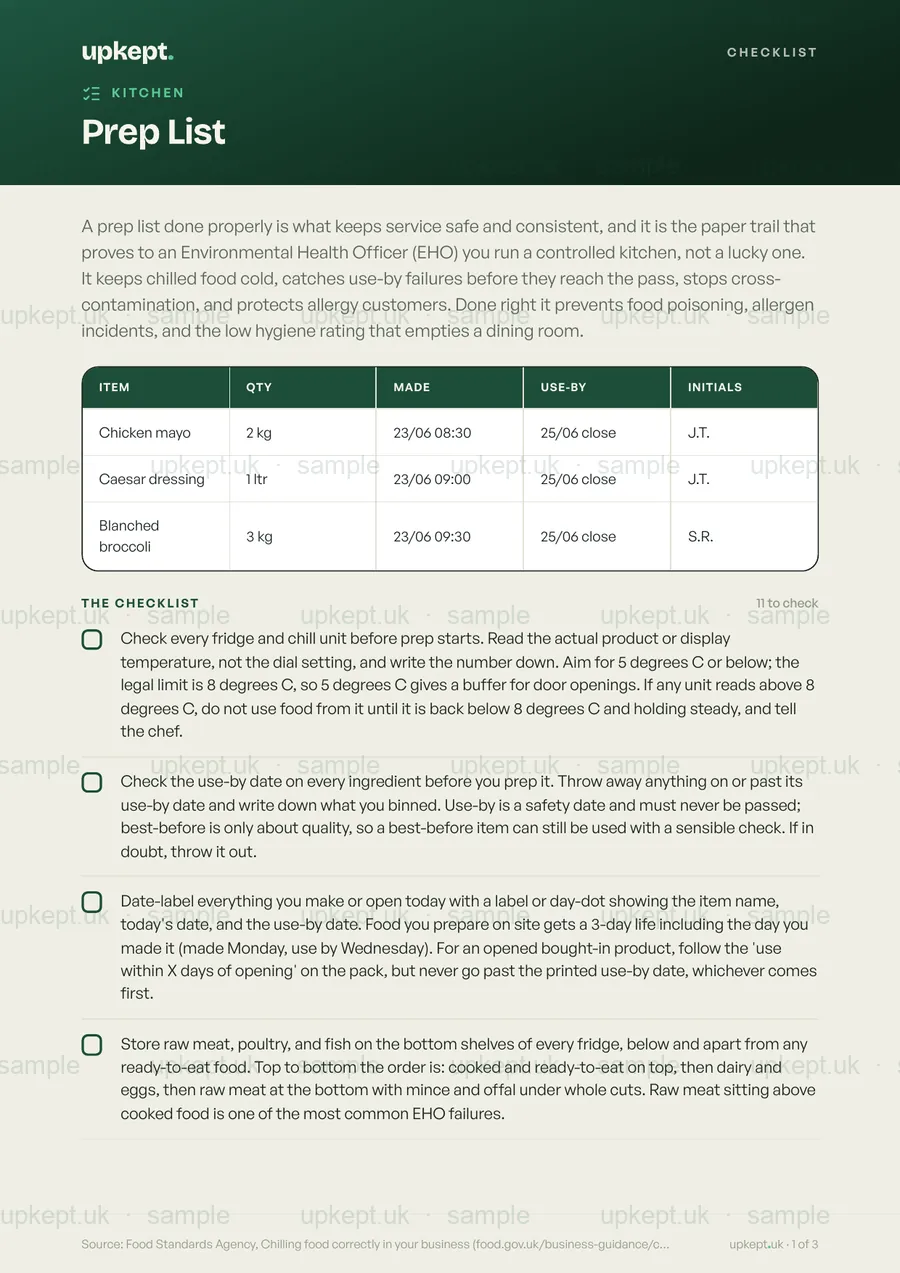
Prep List

A prep list done properly is what keeps service safe and consistent, and it is the paper trail that proves to an Environmental Health Officer (EHO) you run a controlled kitchen, not a lucky one. It keeps chilled food cold, catches use-by failures before they reach the pass, stops cross-contamination, and protects allergy customers. Done right it prevents food poisoning, allergen incidents, and the low hygiene rating that empties a dining room.

£14View
Daily

Cash-Up Sheet

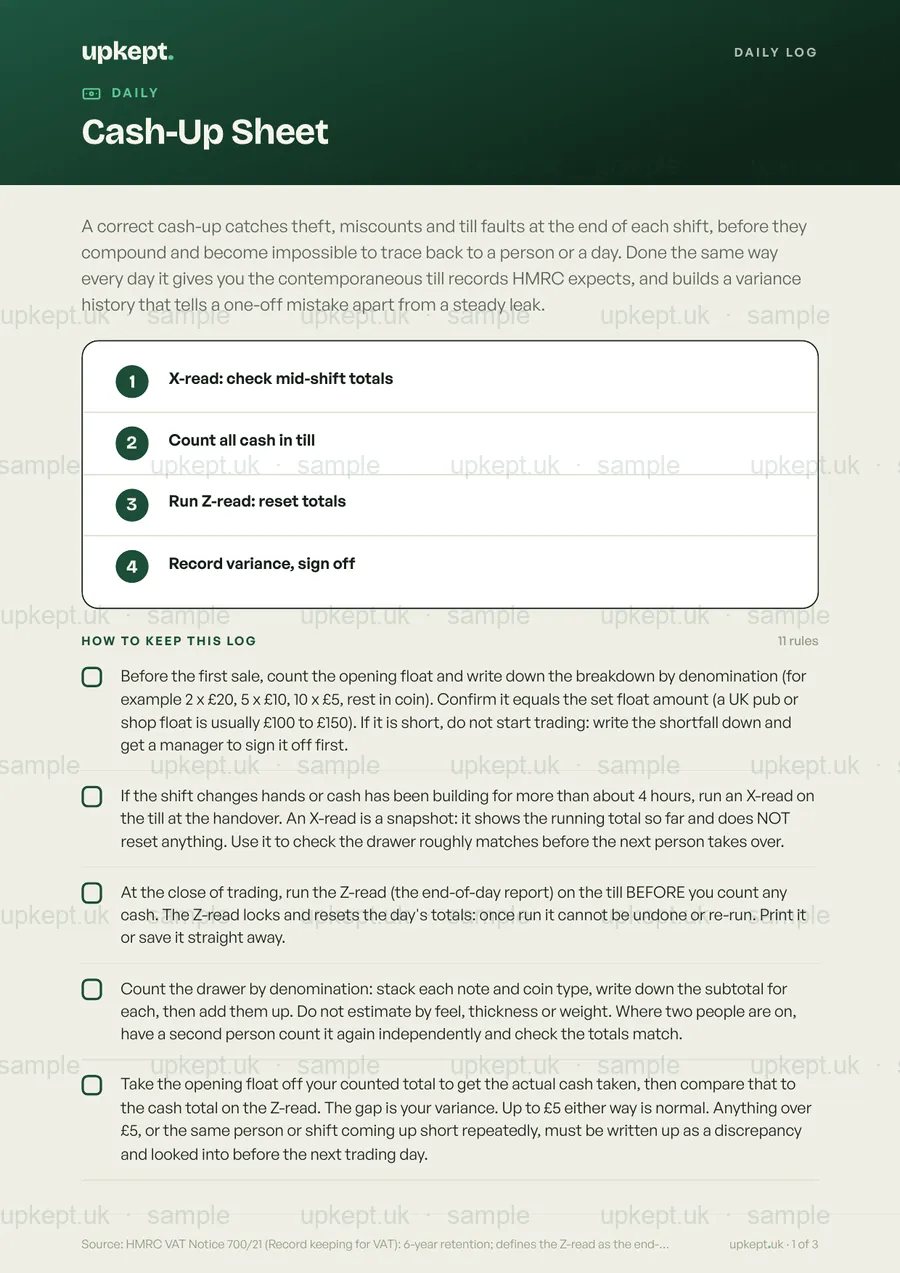
A correct cash-up catches theft, miscounts and till faults at the end of each shift, before they compound and become impossible to trace back to a person or a day. Done the same way every day it gives you the contemporaneous till records HMRC expects, and builds a variance history that tells a one-off mistake apart from a steady leak.

£14View
Cleaning

Cellar & Beer-Line Cleaning Schedule

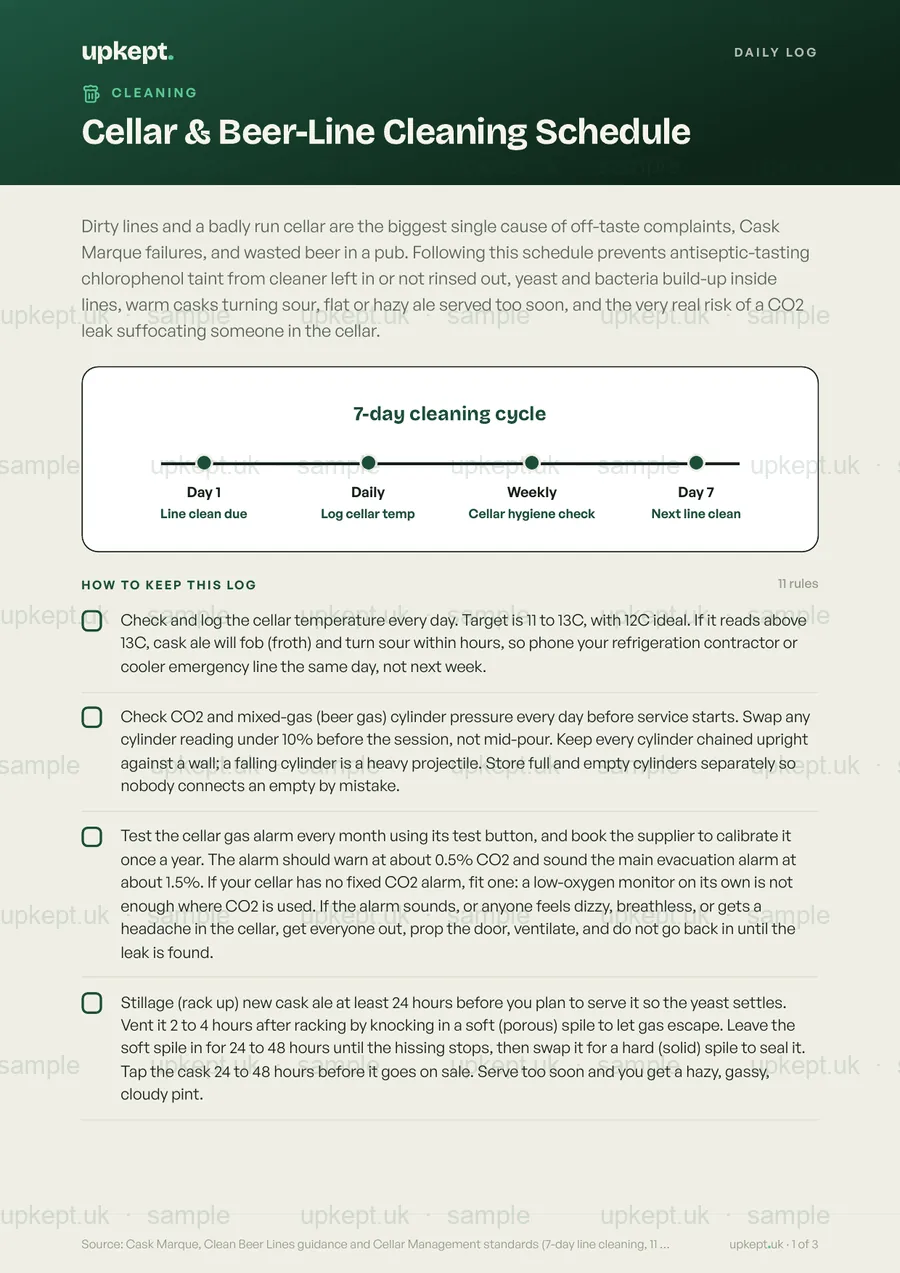
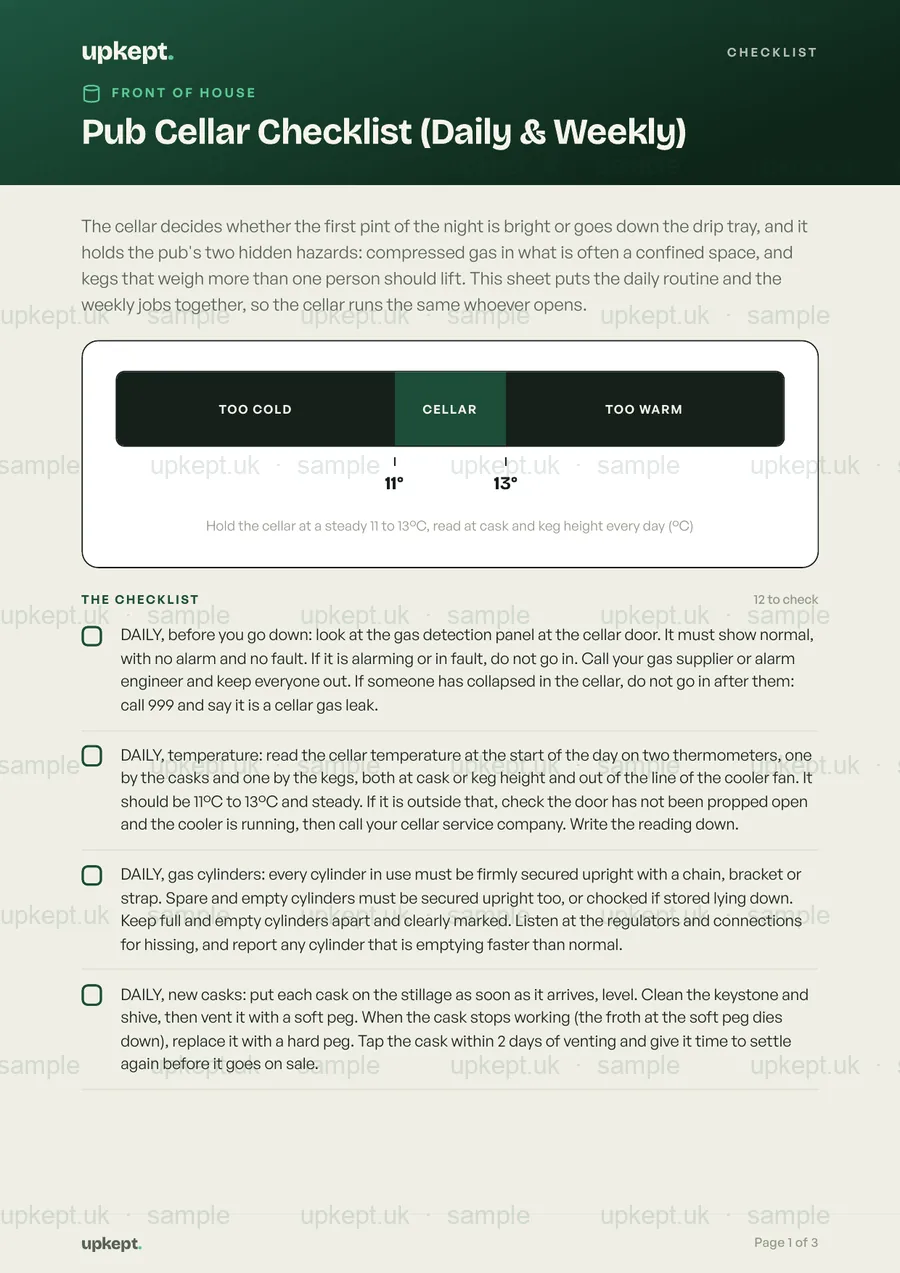
Dirty lines and a badly run cellar are the biggest single cause of off-taste complaints, Cask Marque failures, and wasted beer in a pub. Following this schedule prevents antiseptic-tasting chlorophenol taint from cleaner left in or not rinsed out, yeast and bacteria build-up inside lines, warm casks turning sour, flat or hazy ale served too soon, and the very real risk of a CO2 leak suffocating someone in the cellar.

£14View
Daily

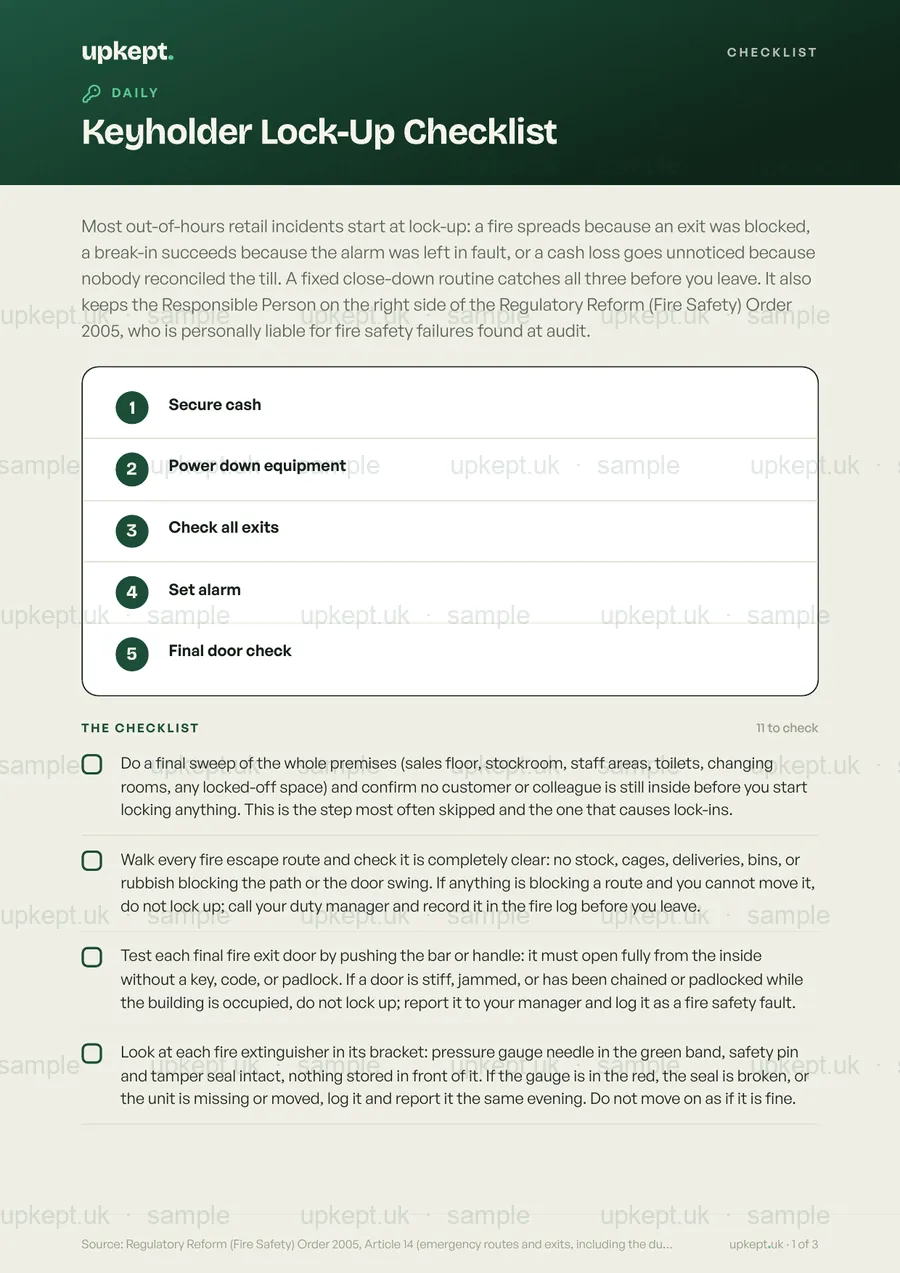
Keyholder Lock-Up Checklist

Most out-of-hours retail incidents start at lock-up: a fire spreads because an exit was blocked, a break-in succeeds because the alarm was left in fault, or a cash loss goes unnoticed because nobody reconciled the till. A fixed close-down routine catches all three before you leave. It also keeps the Responsible Person on the right side of the Regulatory Reform (Fire Safety) Order 2005, who is personally liable for fire safety failures found at audit.

£14View
Daily

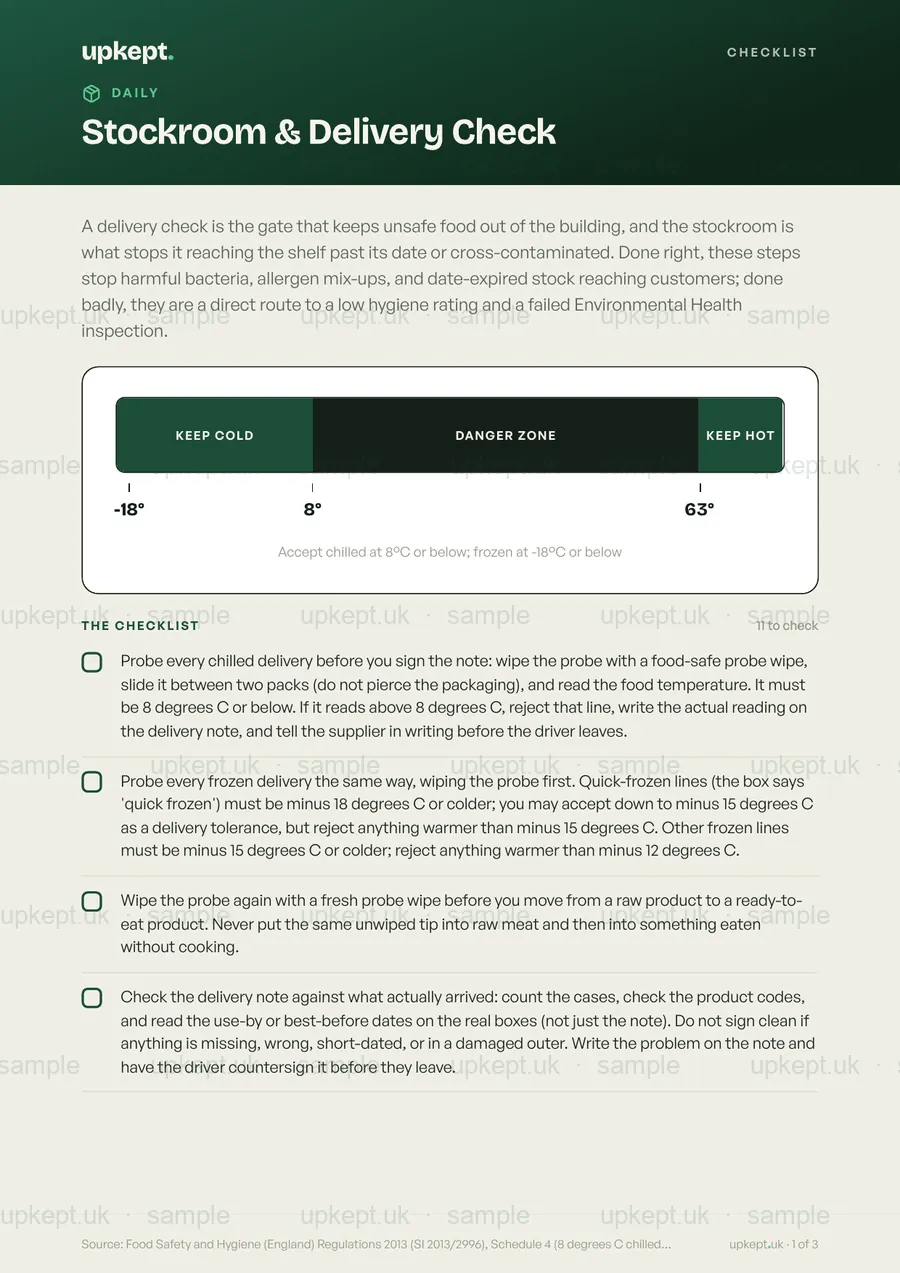
Stockroom & Delivery Check

A delivery check is the gate that keeps unsafe food out of the building, and the stockroom is what stops it reaching the shelf past its date or cross-contaminated. Done right, these steps stop harmful bacteria, allergen mix-ups, and date-expired stock reaching customers; done badly, they are a direct route to a low hygiene rating and a failed Environmental Health inspection.

£14View
Free

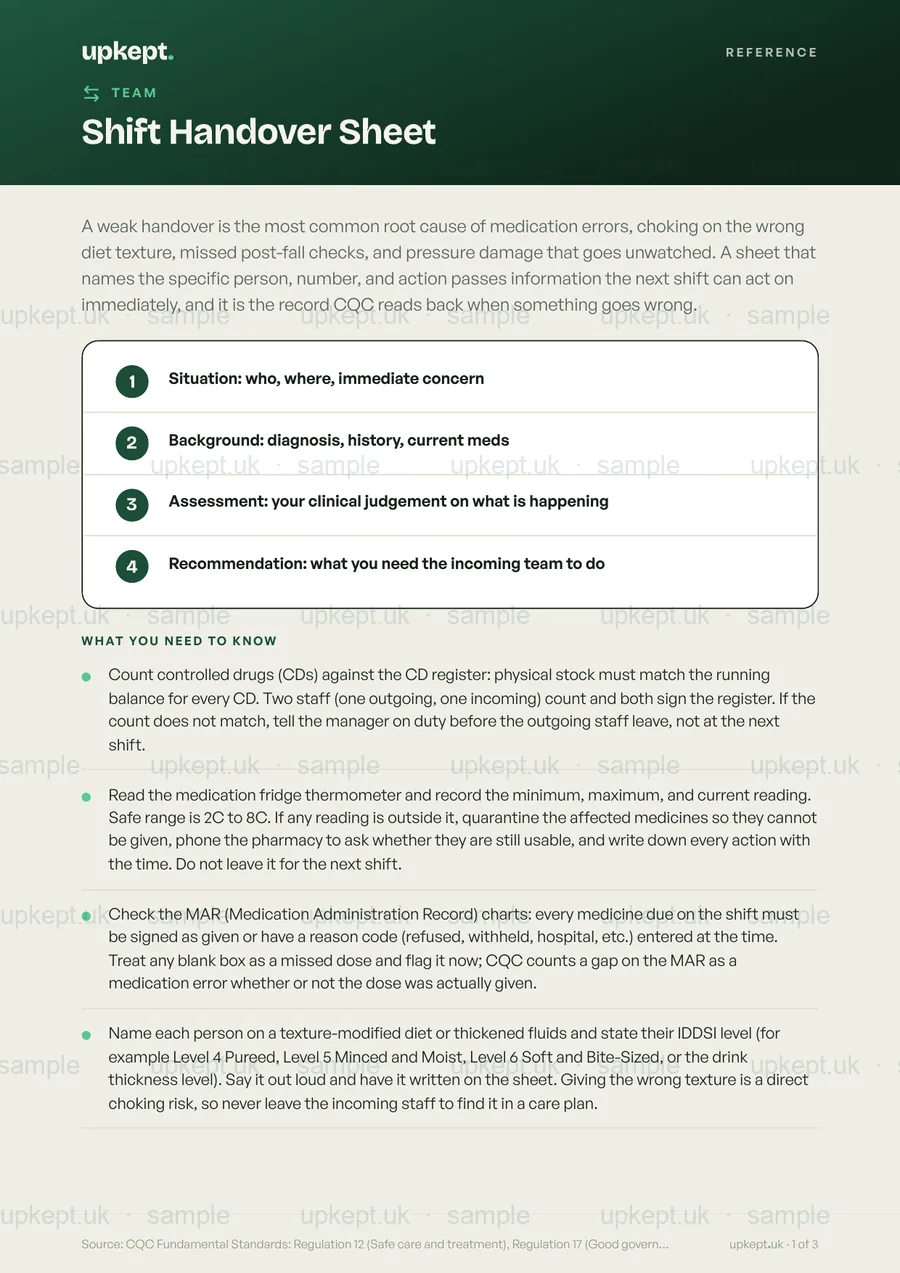
Shift Handover Sheet

A weak handover is the most common root cause of medication errors, choking on the wrong diet texture, missed post-fall checks, and pressure damage that goes unwatched. A sheet that names the specific person, number, and action passes information the next shift can act on immediately, and it is the record CQC reads back when something goes wrong.

FreeView
Daily

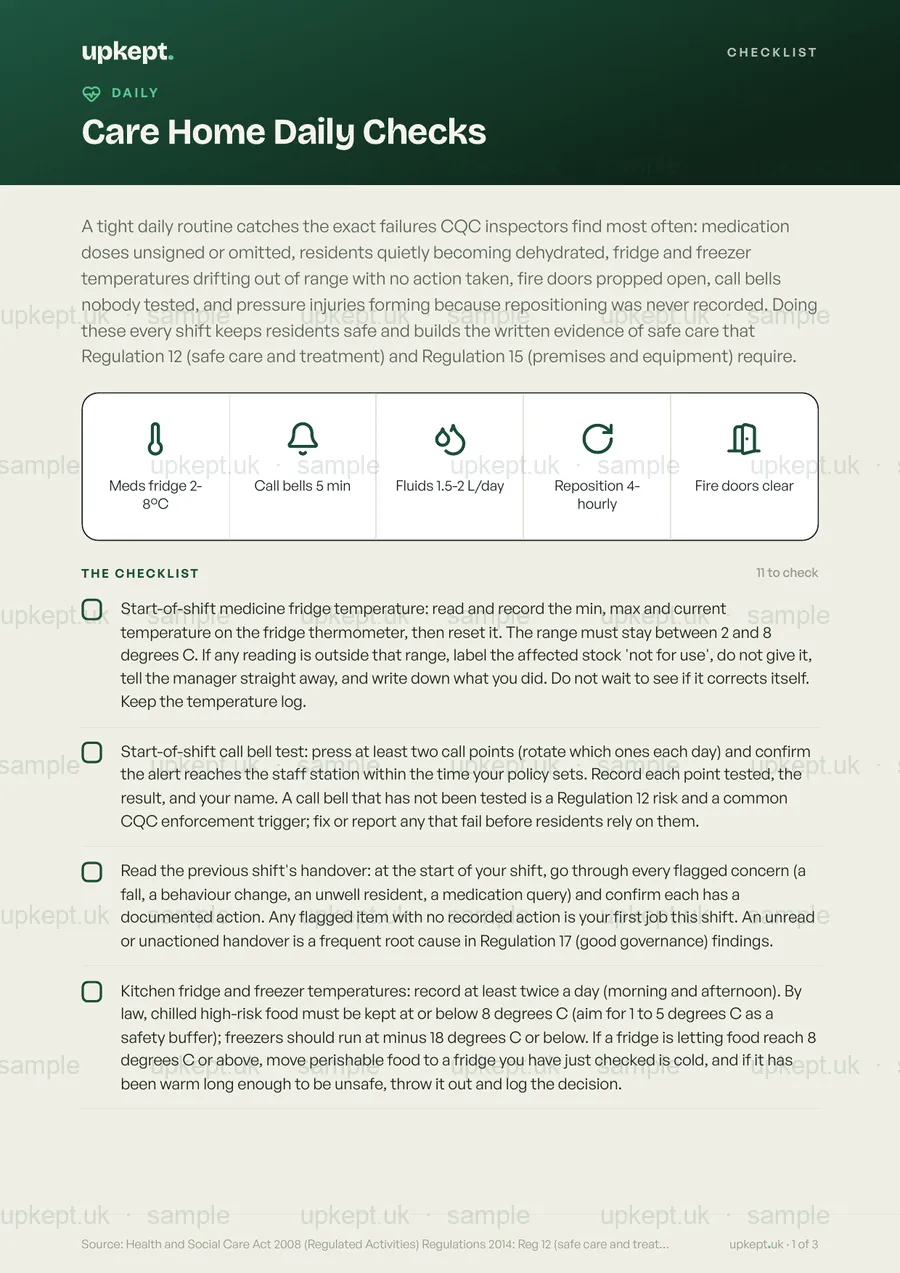
Care Home Daily Checks

A tight daily routine catches the exact failures CQC inspectors find most often: medication doses unsigned or omitted, residents quietly becoming dehydrated, fridge and freezer temperatures drifting out of range with no action taken, fire doors propped open, call bells nobody tested, and pressure injuries forming because repositioning was never recorded. Doing these every shift keeps residents safe and builds the written evidence of safe care that Regulation 12 (safe care and treatment) and Regulation 15 (premises and equipment) require.

£14View
Safety

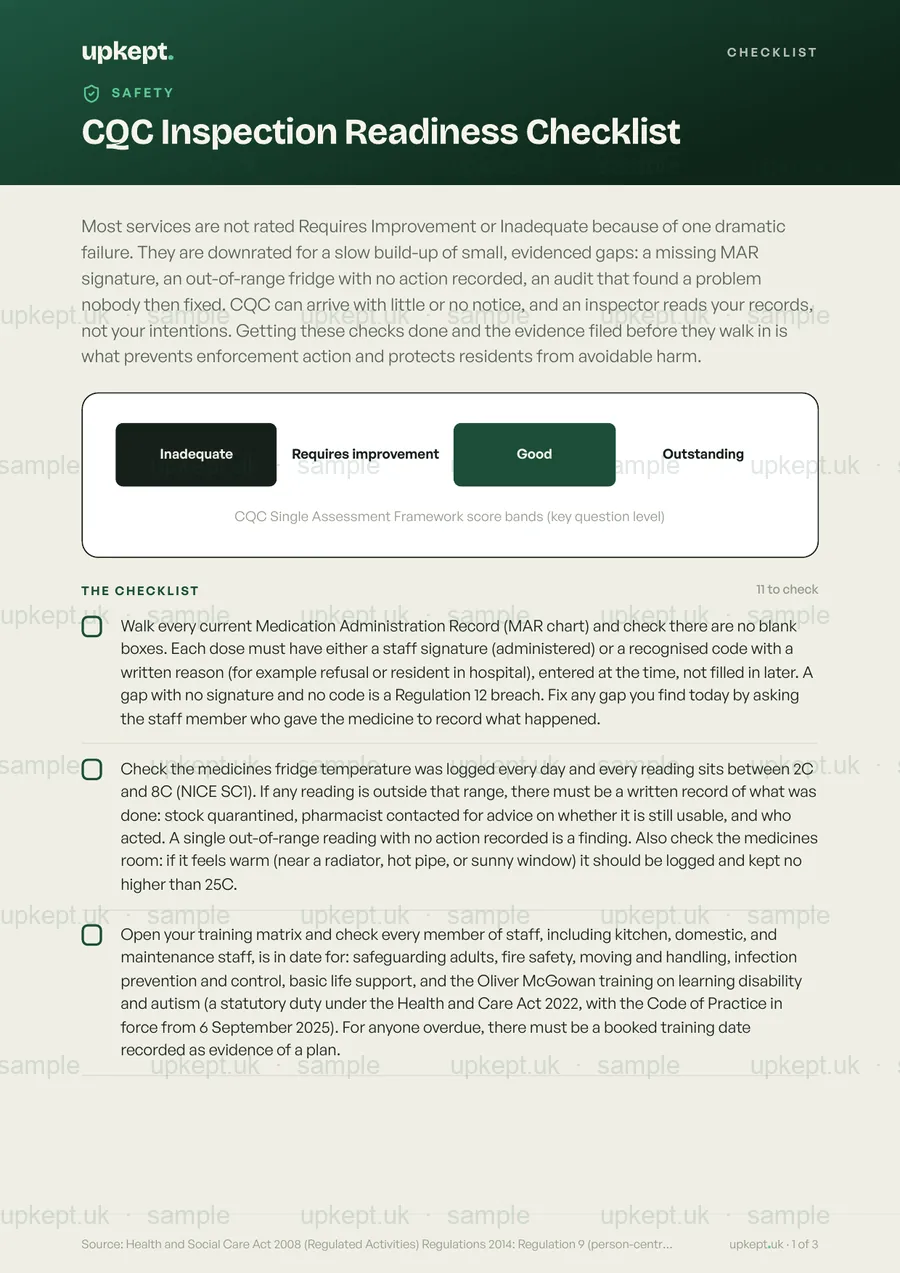
CQC Inspection Readiness Checklist

Most services are not rated Requires Improvement or Inadequate because of one dramatic failure. They are downrated for a slow build-up of small, evidenced gaps: a missing MAR signature, an out-of-range fridge with no action recorded, an audit that found a problem nobody then fixed. CQC can arrive with little or no notice, and an inspector reads your records, not your intentions. Getting these checks done and the evidence filed before they walk in is what prevents enforcement action and protects residents from avoidable harm.

£14View
Safety

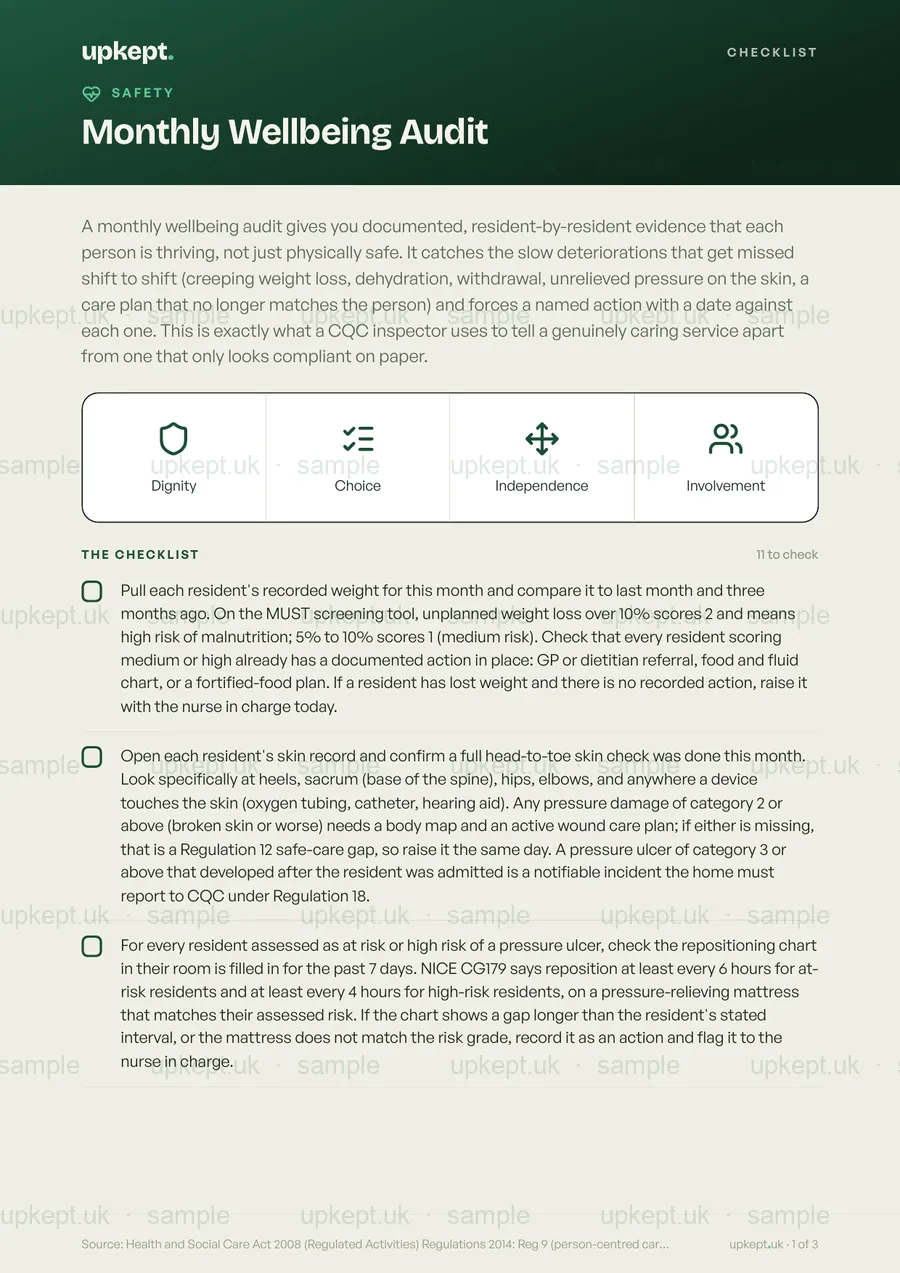
Monthly Wellbeing Audit

A monthly wellbeing audit gives you documented, resident-by-resident evidence that each person is thriving, not just physically safe. It catches the slow deteriorations that get missed shift to shift (creeping weight loss, dehydration, withdrawal, unrelieved pressure on the skin, a care plan that no longer matches the person) and forces a named action with a date against each one. This is exactly what a CQC inspector uses to tell a genuinely caring service apart from one that only looks compliant on paper.

£14View
Daily

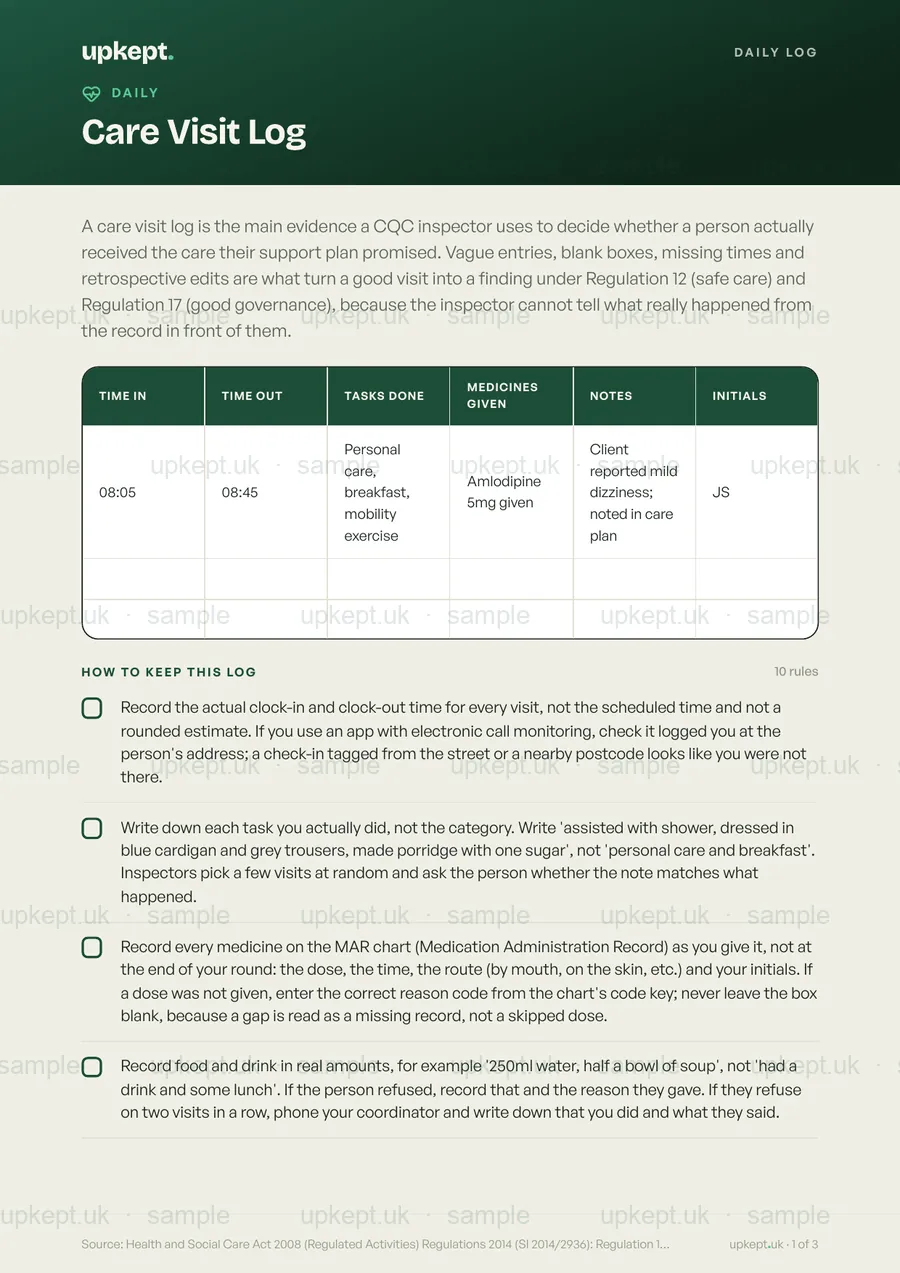
Care Visit Log

A care visit log is the main evidence a CQC inspector uses to decide whether a person actually received the care their support plan promised. Vague entries, blank boxes, missing times and retrospective edits are what turn a good visit into a finding under Regulation 12 (safe care) and Regulation 17 (good governance), because the inspector cannot tell what really happened from the record in front of them.

£14View
Safety

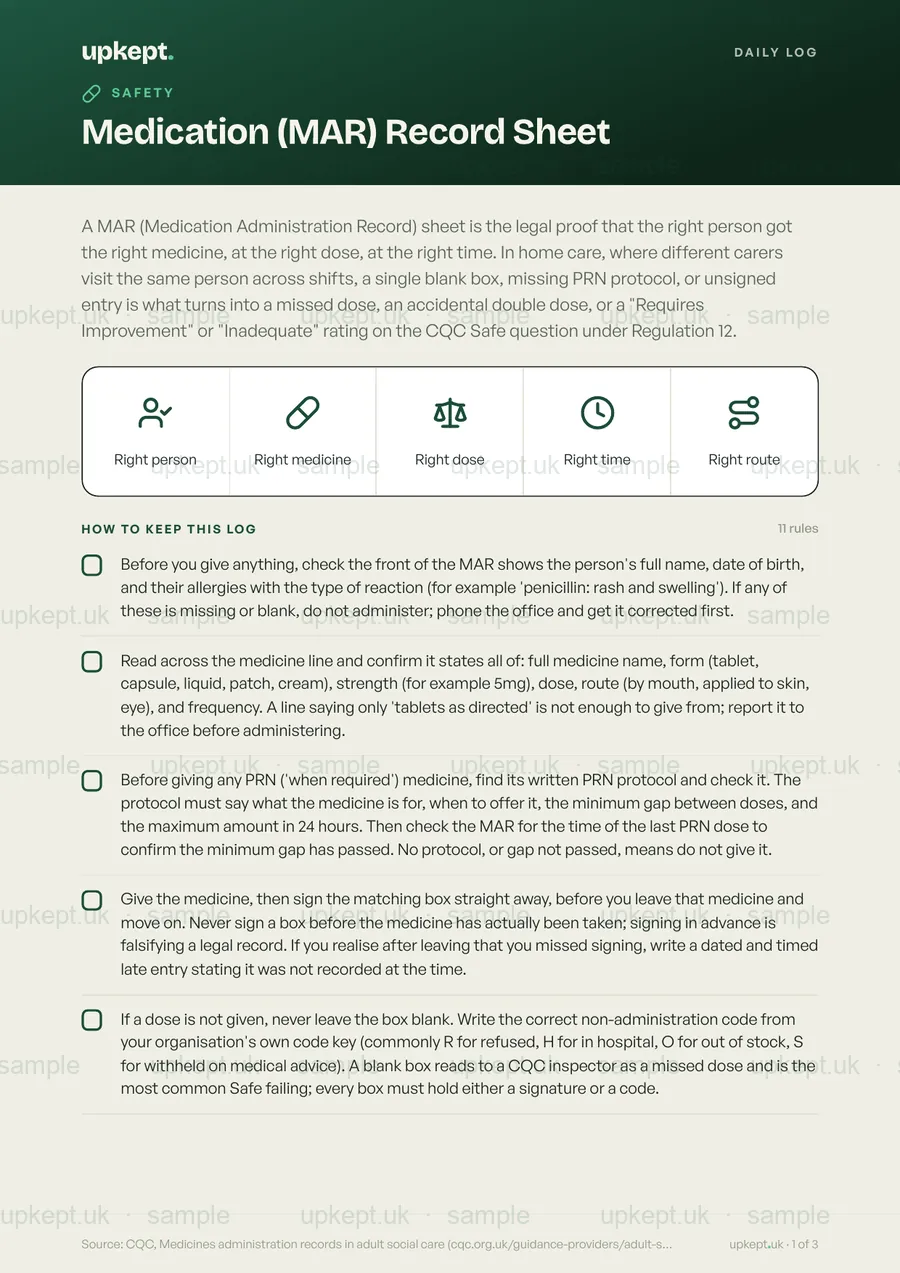
Medication (MAR) Record Sheet

A MAR (Medication Administration Record) sheet is the legal proof that the right person got the right medicine, at the right dose, at the right time. In home care, where different carers visit the same person across shifts, a single blank box, missing PRN protocol, or unsigned entry is what turns into a missed dose, an accidental double dose, or a "Requires Improvement" or "Inadequate" rating on the CQC Safe question under Regulation 12.

£14View
Safety

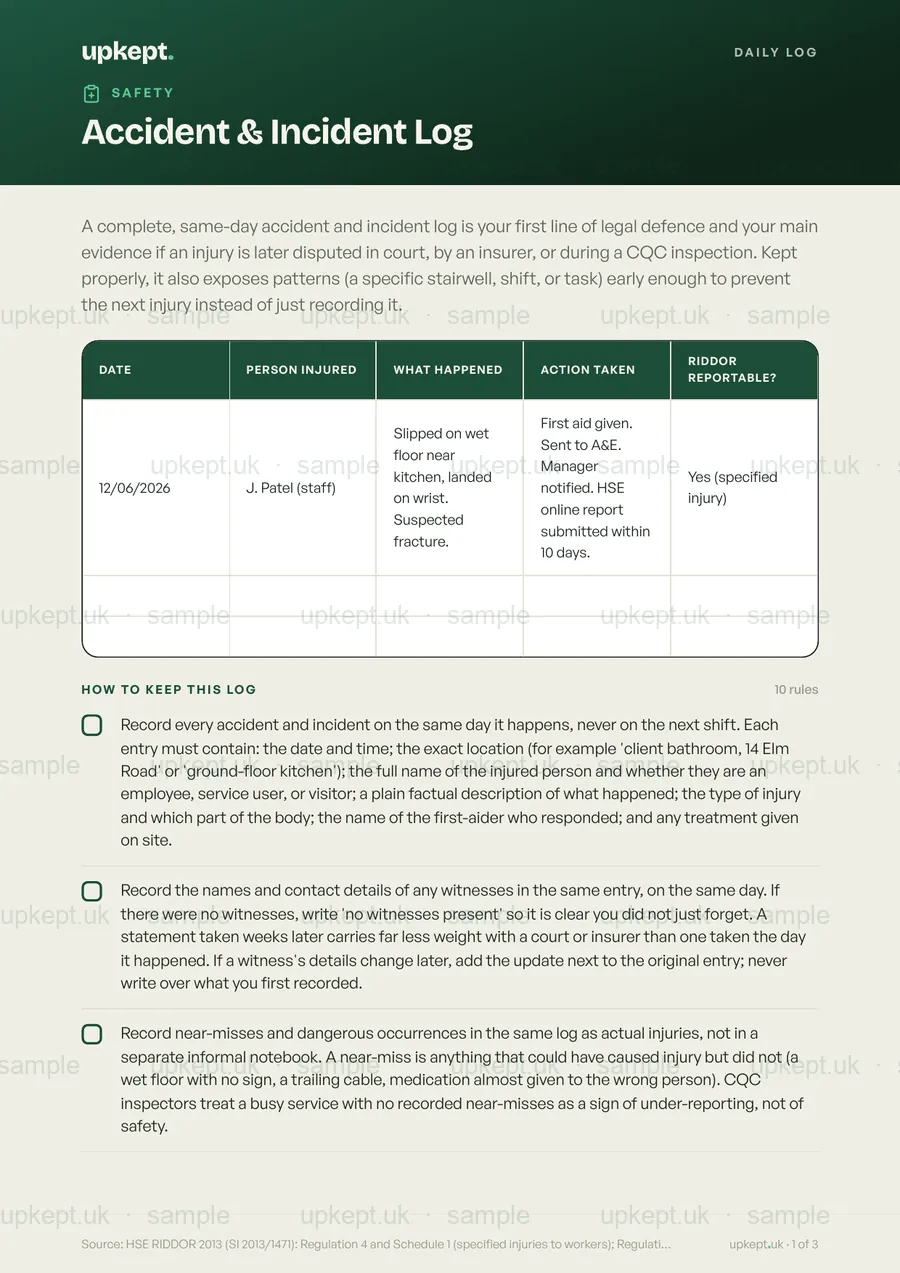
Accident & Incident Log

A complete, same-day accident and incident log is your first line of legal defence and your main evidence if an injury is later disputed in court, by an insurer, or during a CQC inspection. Kept properly, it also exposes patterns (a specific stairwell, shift, or task) early enough to prevent the next injury instead of just recording it.

£14View
Rooms

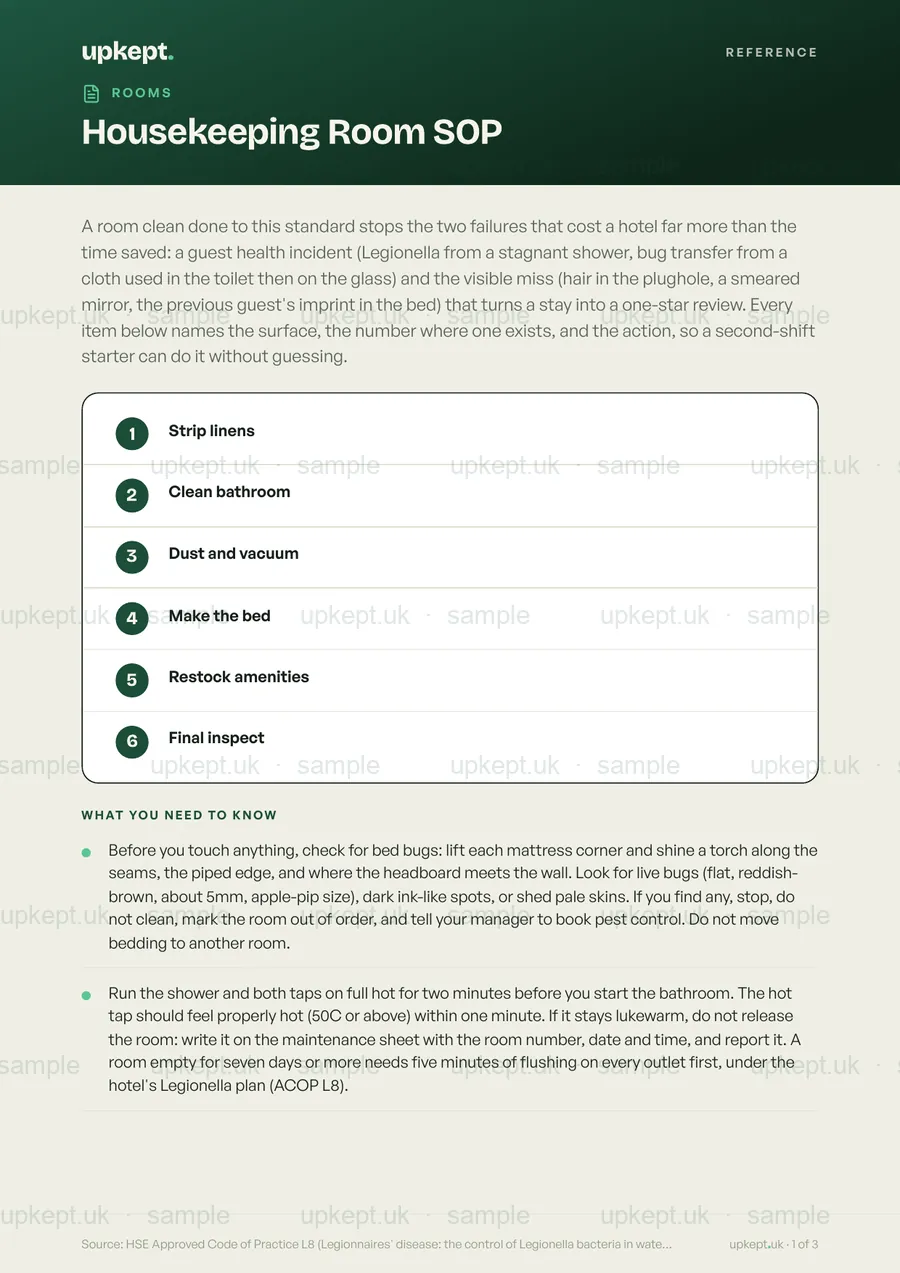
Housekeeping Room SOP

A room clean done to this standard stops the two failures that cost a hotel far more than the time saved: a guest health incident (Legionella from a stagnant shower, bug transfer from a cloth used in the toilet then on the glass) and the visible miss (hair in the plughole, a smeared mirror, the previous guest's imprint in the bed) that turns a stay into a one-star review. Every item below names the surface, the number where one exists, and the action, so a second-shift starter can do it without guessing.

£14View
Team

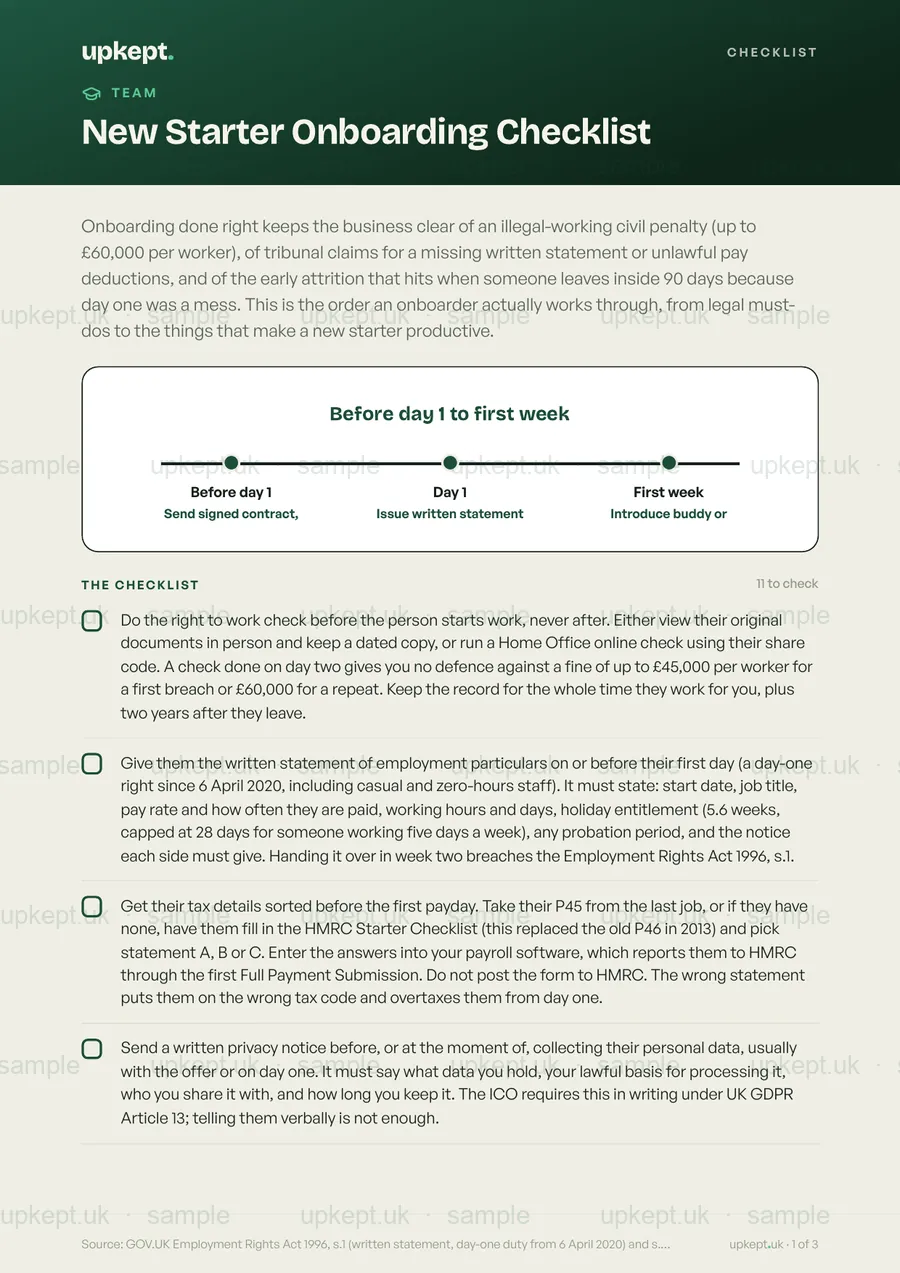
New Starter Onboarding Checklist

Onboarding done right keeps the business clear of an illegal-working civil penalty (up to £60,000 per worker), of tribunal claims for a missing written statement or unlawful pay deductions, and of the early attrition that hits when someone leaves inside 90 days because day one was a mess. This is the order an onboarder actually works through, from legal must-dos to the things that make a new starter productive.

£14View
Team

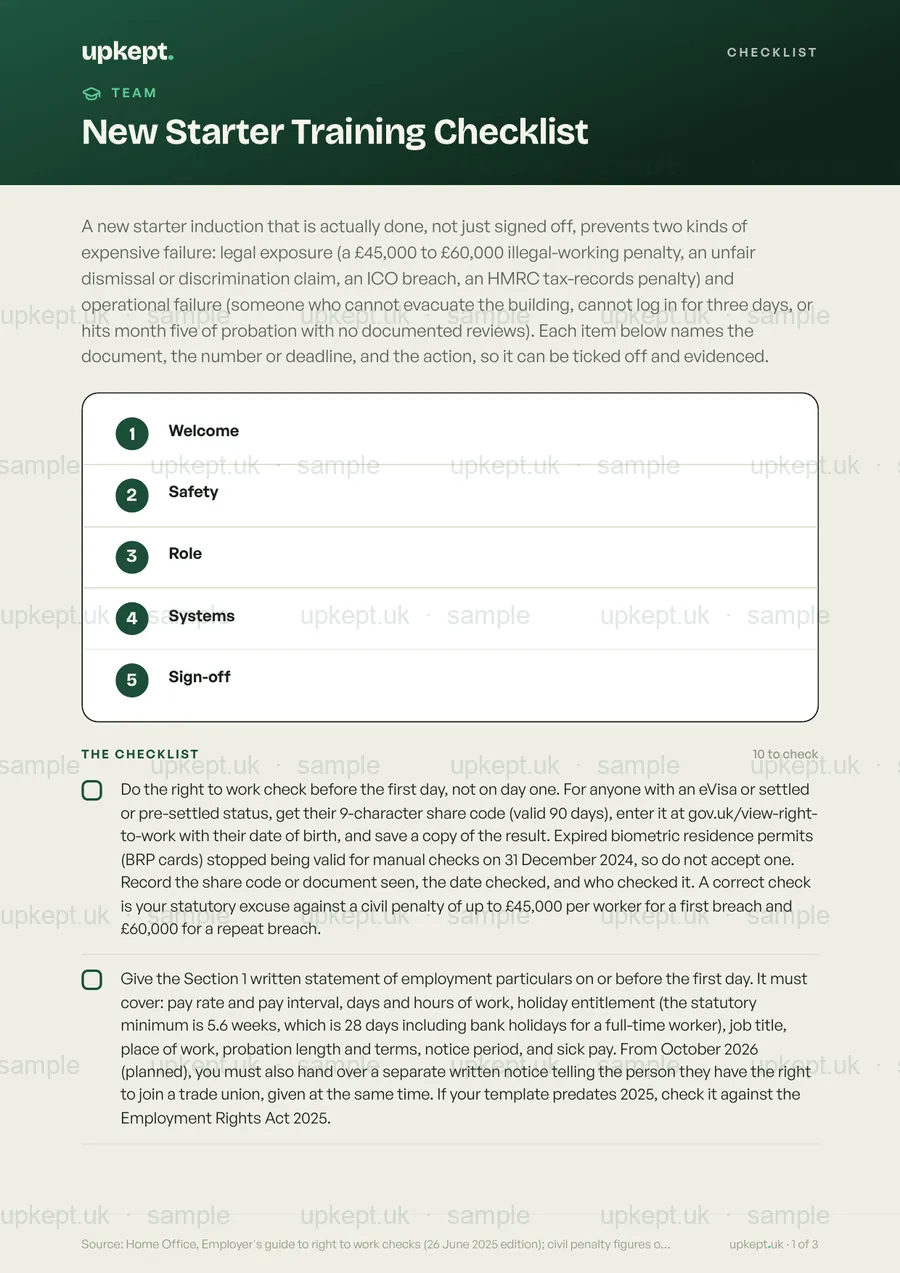
New Starter Training Checklist

A new starter induction that is actually done, not just signed off, prevents two kinds of expensive failure: legal exposure (a £45,000 to £60,000 illegal-working penalty, an unfair dismissal or discrimination claim, an ICO breach, an HMRC tax-records penalty) and operational failure (someone who cannot evacuate the building, cannot log in for three days, or hits month five of probation with no documented reviews). Each item below names the document, the number or deadline, and the action, so it can be ticked off and evidenced.

£14View
Team

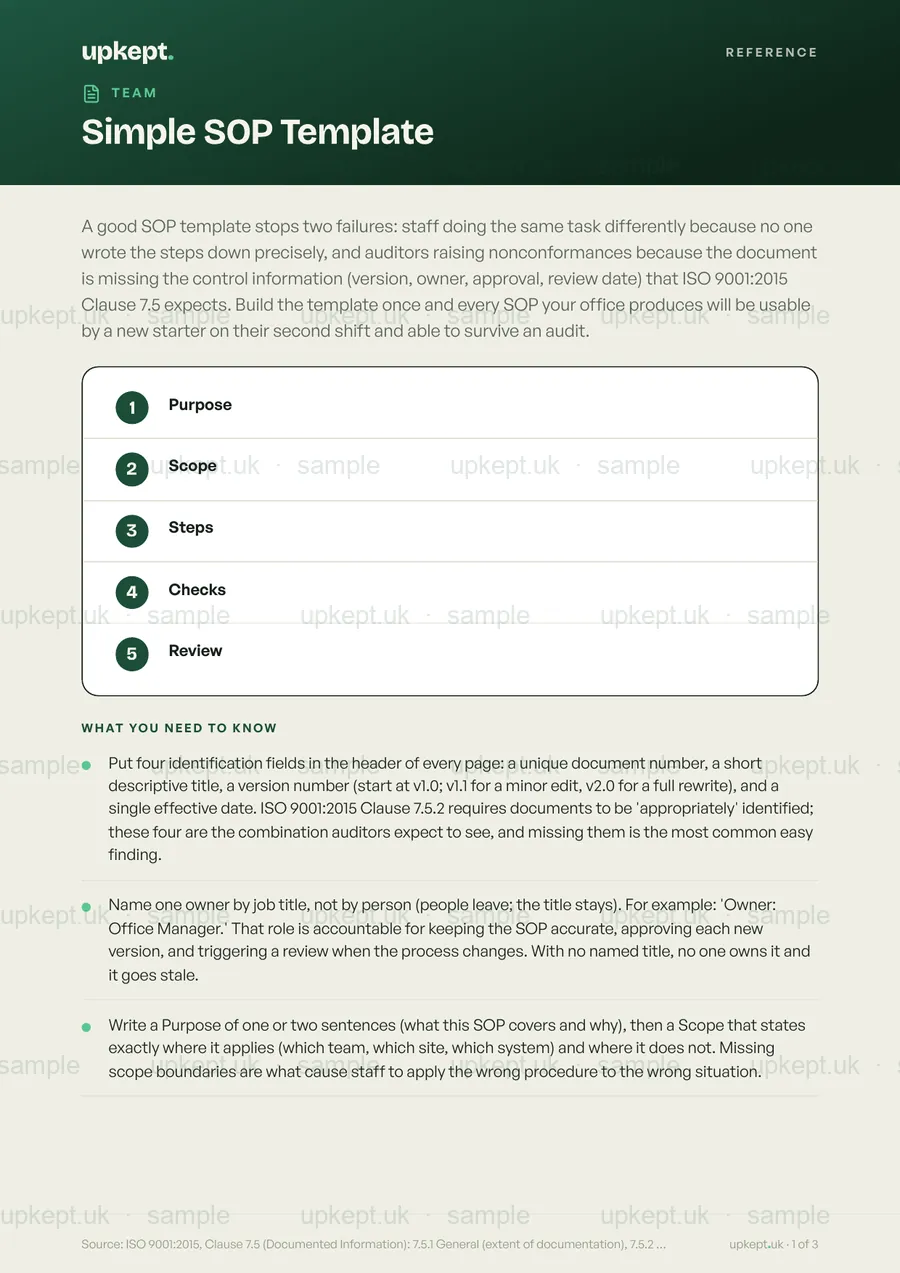
Simple SOP Template

A good SOP template stops two failures: staff doing the same task differently because no one wrote the steps down precisely, and auditors raising nonconformances because the document is missing the control information (version, owner, approval, review date) that ISO 9001:2015 Clause 7.5 expects. Build the template once and every SOP your office produces will be usable by a new starter on their second shift and able to survive an audit.

£14View
Team

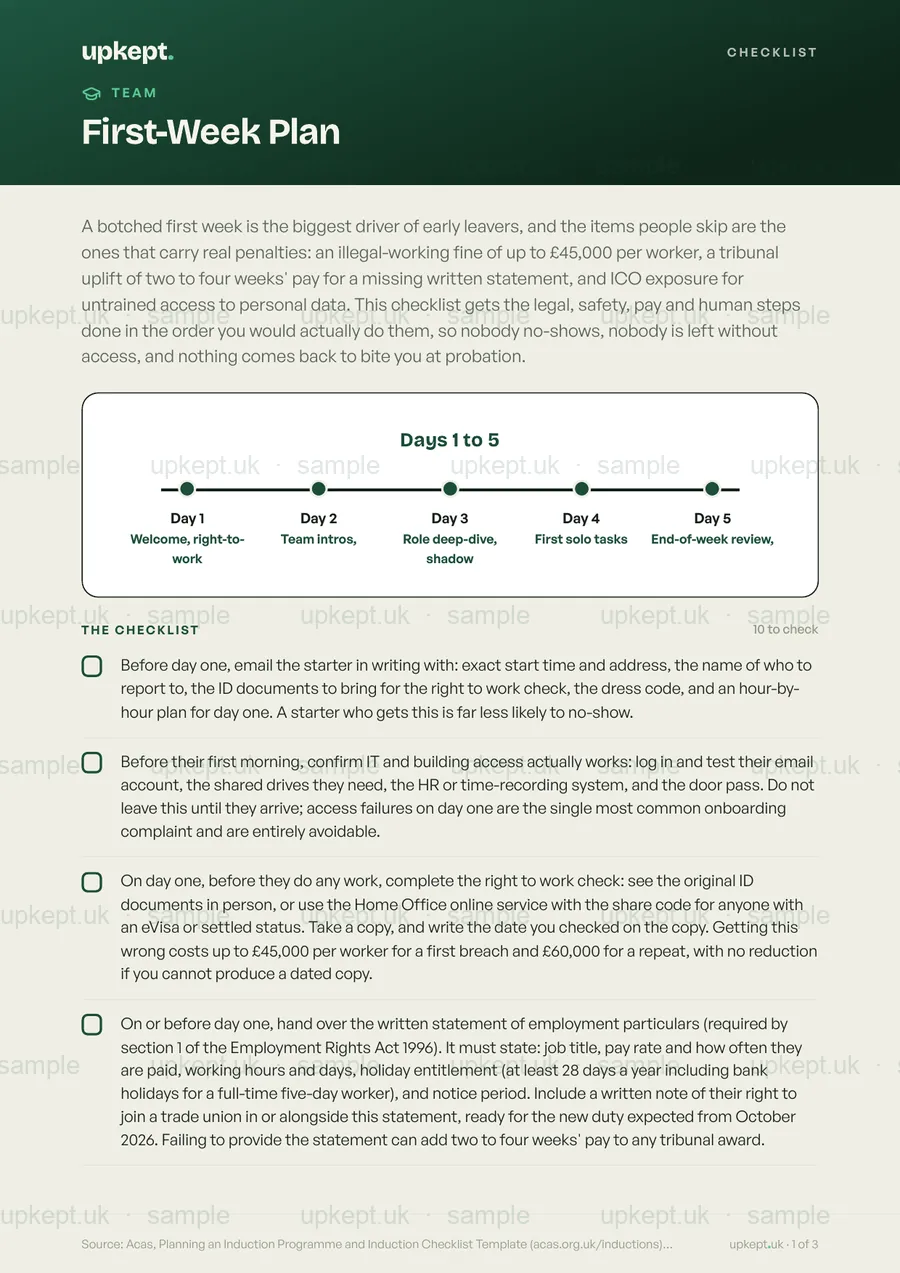
First-Week Plan

A botched first week is the biggest driver of early leavers, and the items people skip are the ones that carry real penalties: an illegal-working fine of up to £45,000 per worker, a tribunal uplift of two to four weeks' pay for a missing written statement, and ICO exposure for untrained access to personal data. This checklist gets the legal, safety, pay and human steps done in the order you would actually do them, so nobody no-shows, nobody is left without access, and nothing comes back to bite you at probation.

£14View
Team

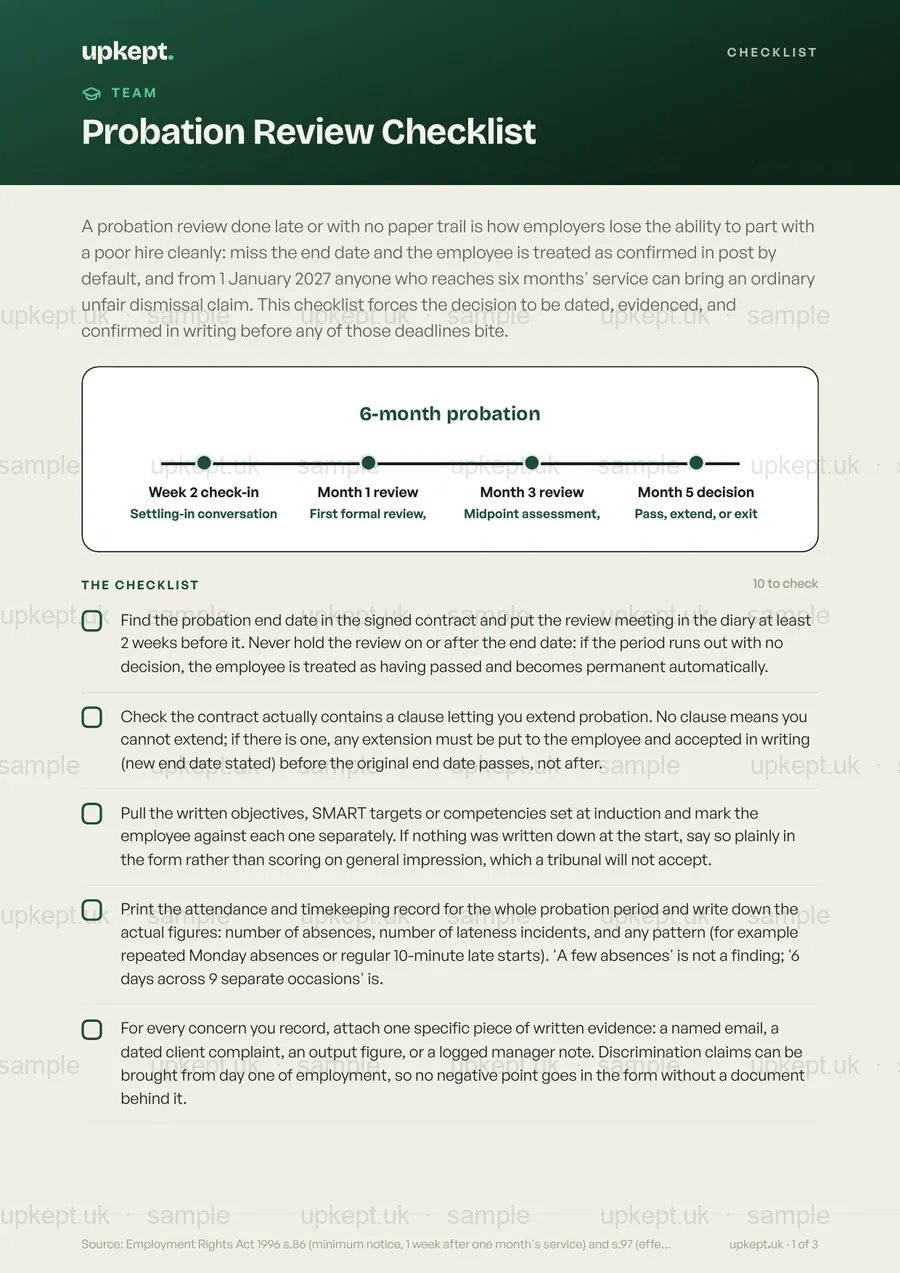
Probation Review Checklist

A probation review done late or with no paper trail is how employers lose the ability to part with a poor hire cleanly: miss the end date and the employee is treated as confirmed in post by default, and from 1 January 2027 anyone who reaches six months' service can bring an ordinary unfair dismissal claim. This checklist forces the decision to be dated, evidenced, and confirmed in writing before any of those deadlines bite.
£14View
Free

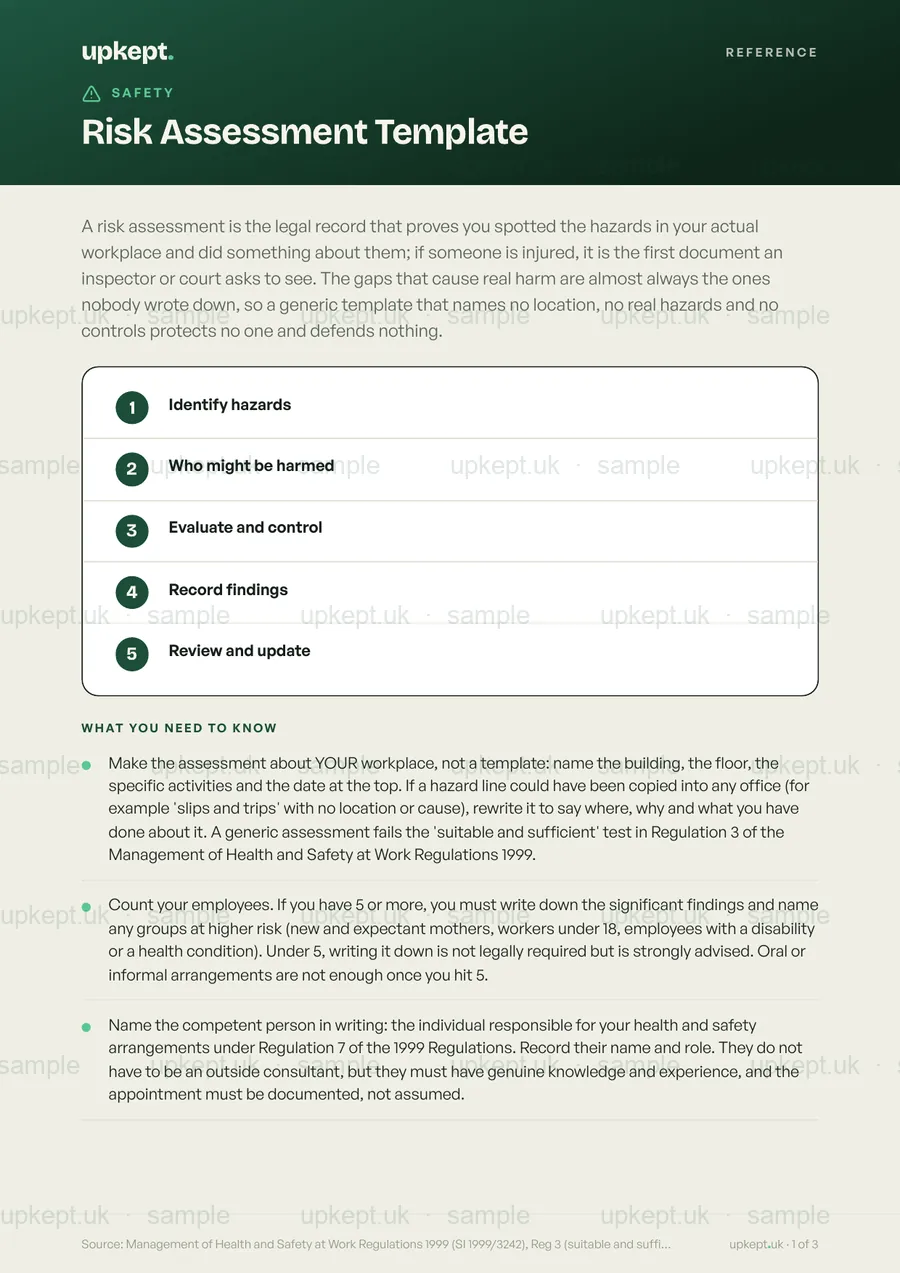
Risk Assessment Template

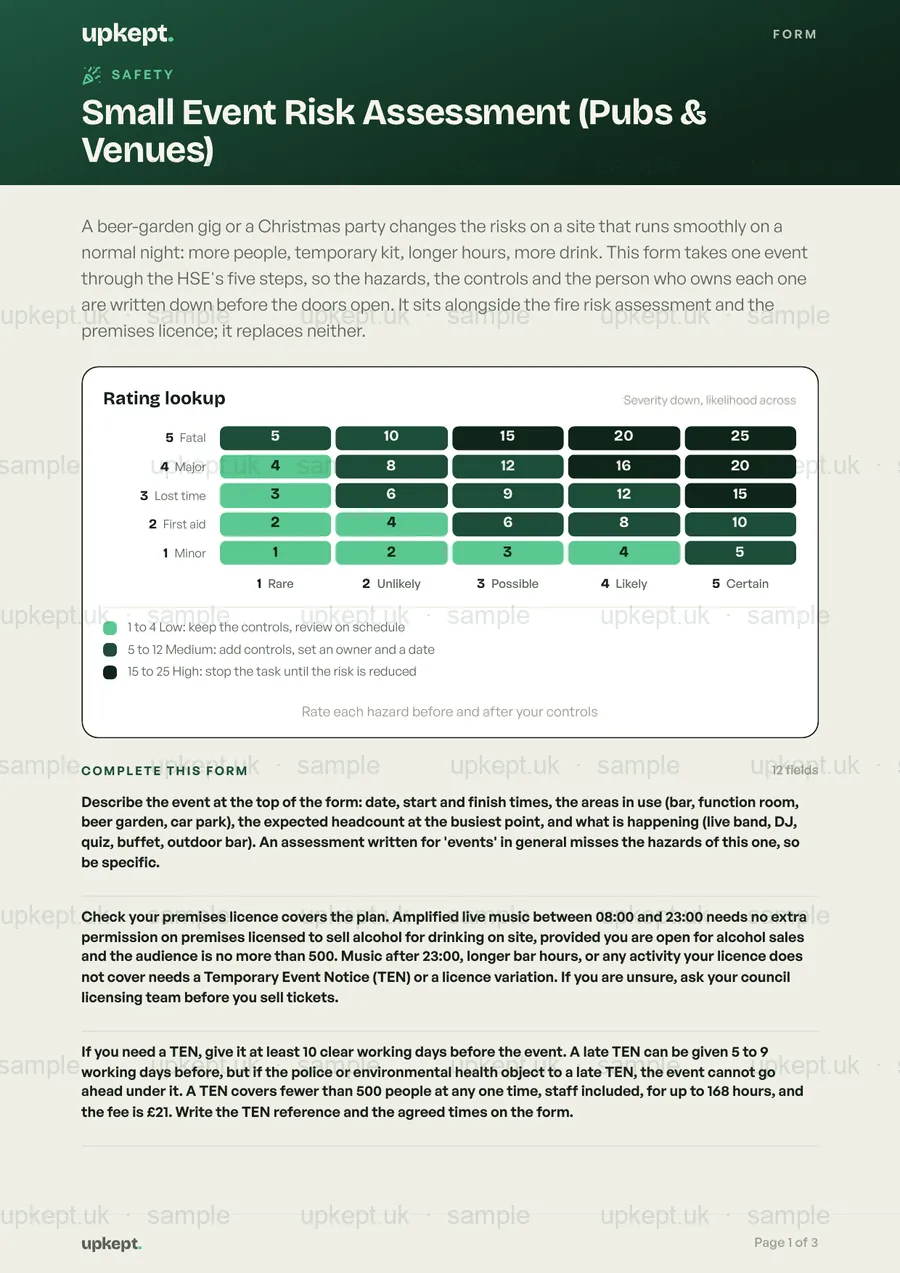
A risk assessment is the legal record that proves you spotted the hazards in your actual workplace and did something about them; if someone is injured, it is the first document an inspector or court asks to see. The gaps that cause real harm are almost always the ones nobody wrote down, so a generic template that names no location, no real hazards and no controls protects no one and defends nothing.

FreeView
Daily

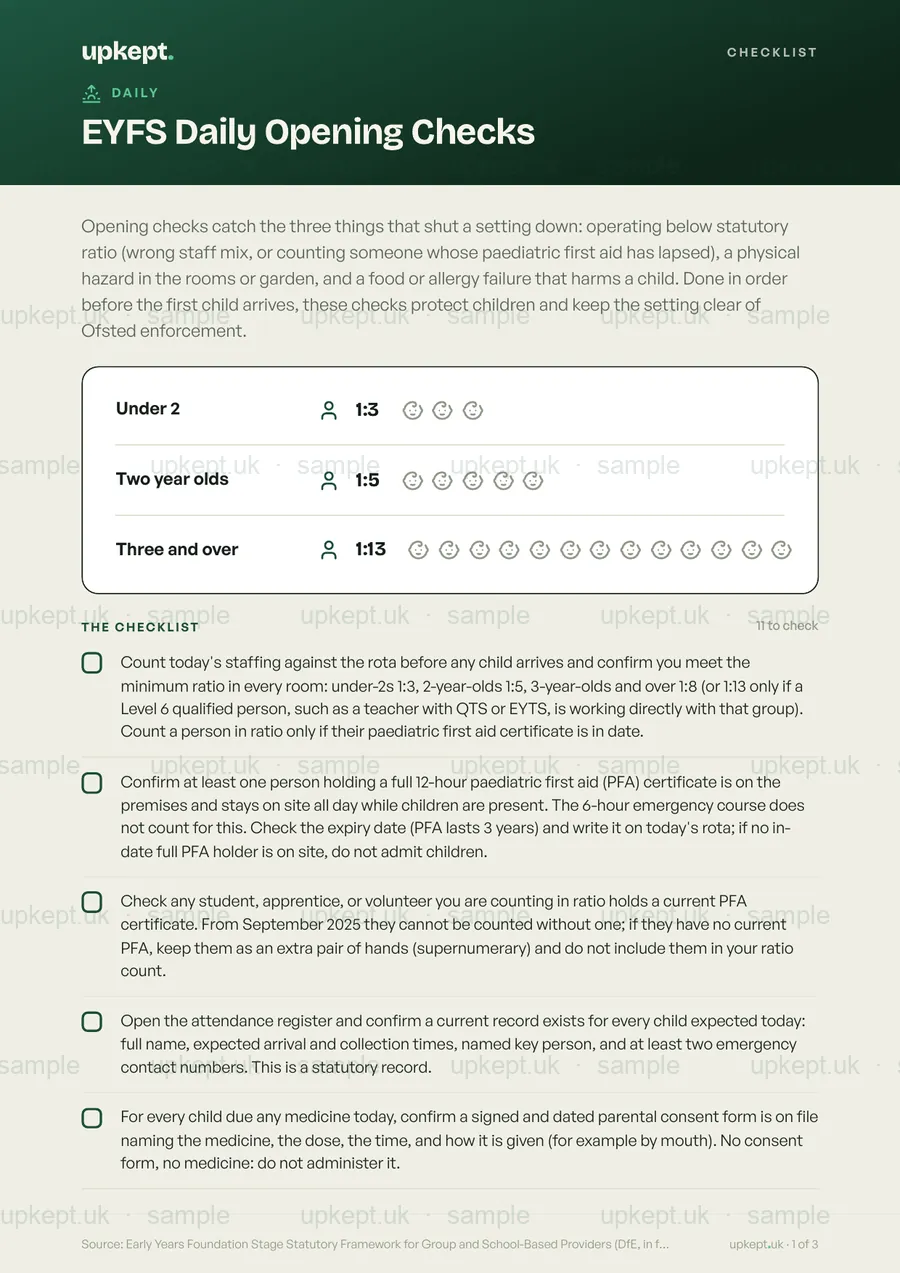
EYFS Daily Opening Checks

Opening checks catch the three things that shut a setting down: operating below statutory ratio (wrong staff mix, or counting someone whose paediatric first aid has lapsed), a physical hazard in the rooms or garden, and a food or allergy failure that harms a child. Done in order before the first child arrives, these checks protect children and keep the setting clear of Ofsted enforcement.

£14View
Daily

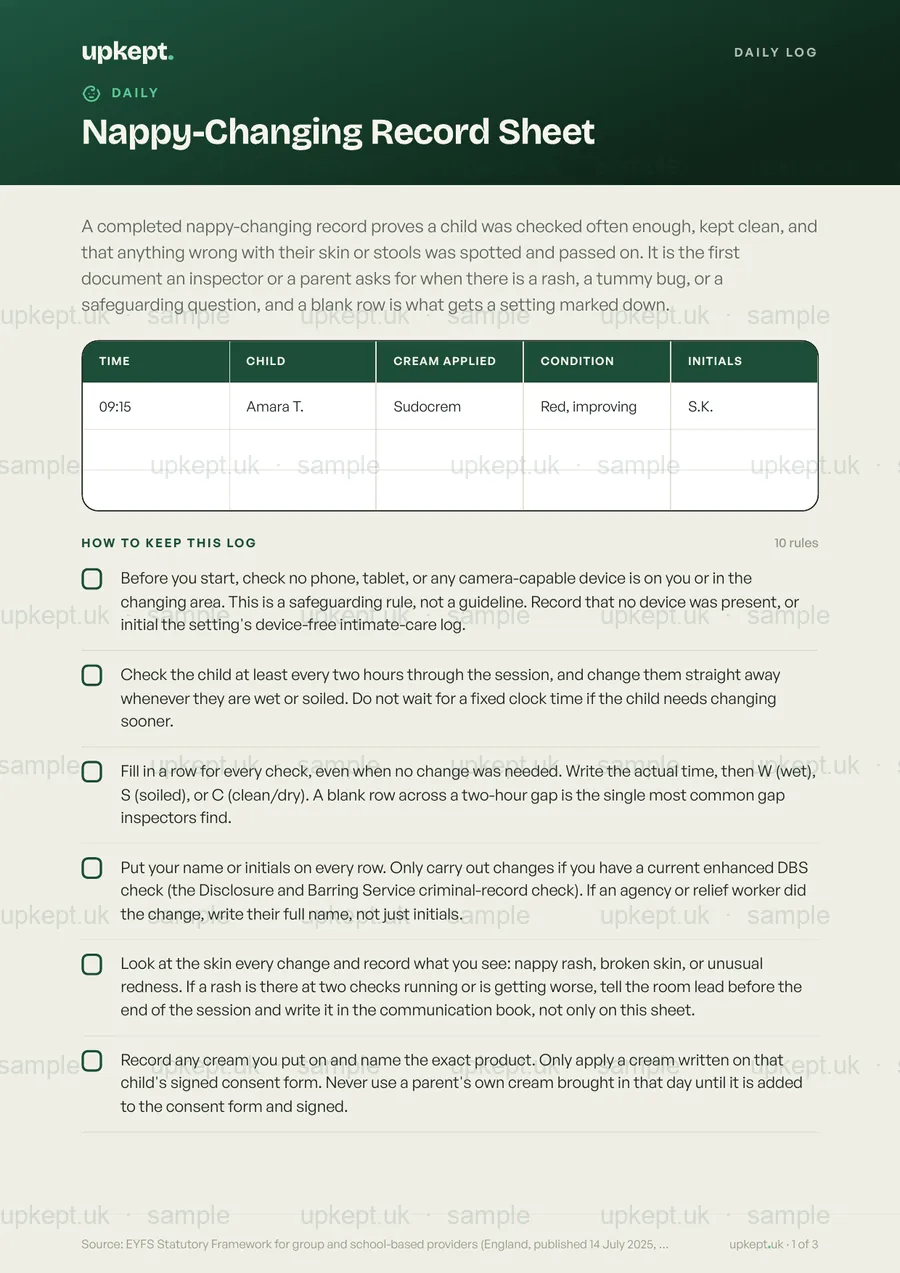
Nappy-Changing Record Sheet

A completed nappy-changing record proves a child was checked often enough, kept clean, and that anything wrong with their skin or stools was spotted and passed on. It is the first document an inspector or a parent asks for when there is a rash, a tummy bug, or a safeguarding question, and a blank row is what gets a setting marked down.

£14View
Safety

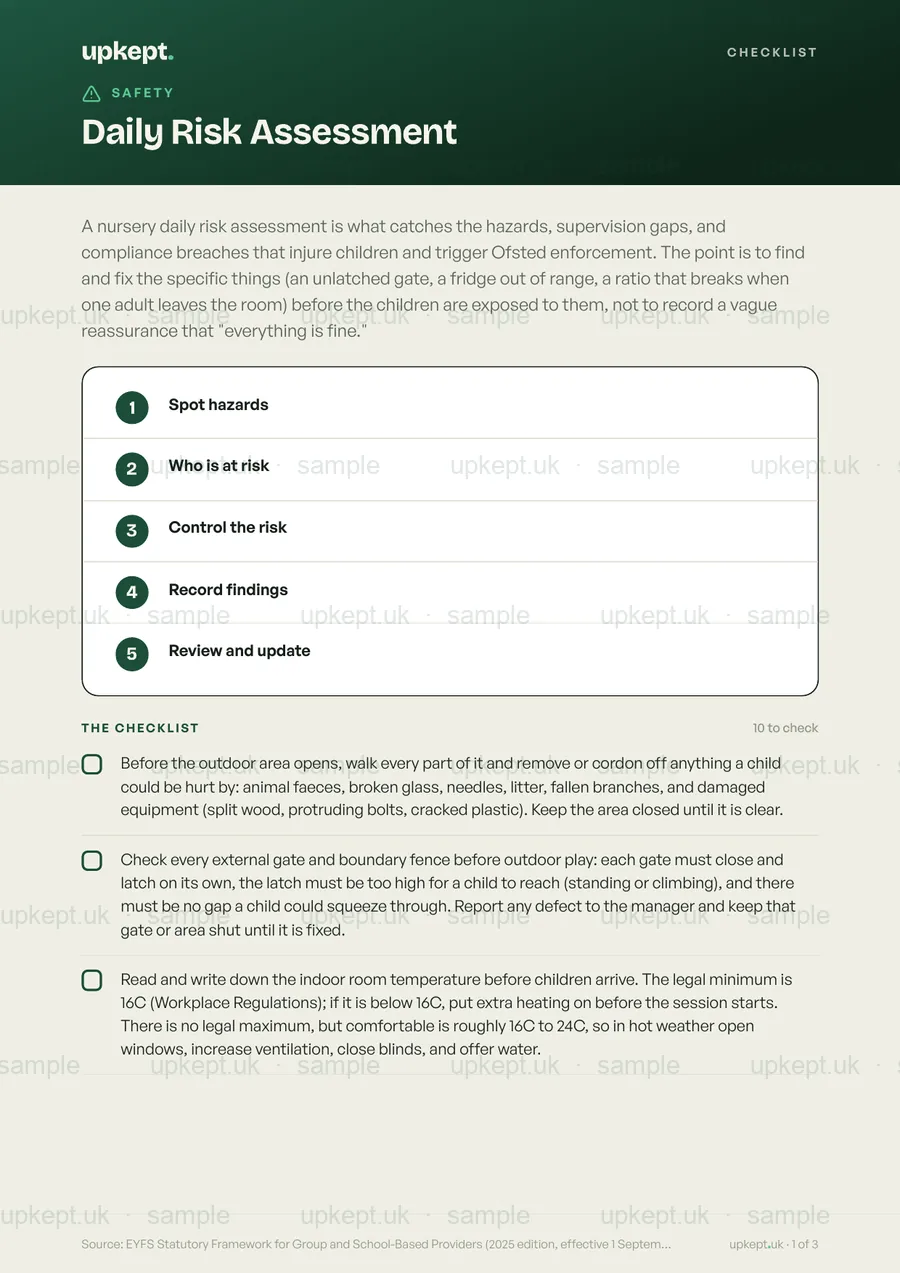
Daily Risk Assessment

A nursery daily risk assessment is what catches the hazards, supervision gaps, and compliance breaches that injure children and trigger Ofsted enforcement. The point is to find and fix the specific things (an unlatched gate, a fridge out of range, a ratio that breaks when one adult leaves the room) before the children are exposed to them, not to record a vague reassurance that "everything is fine."
£14View
Cleaning

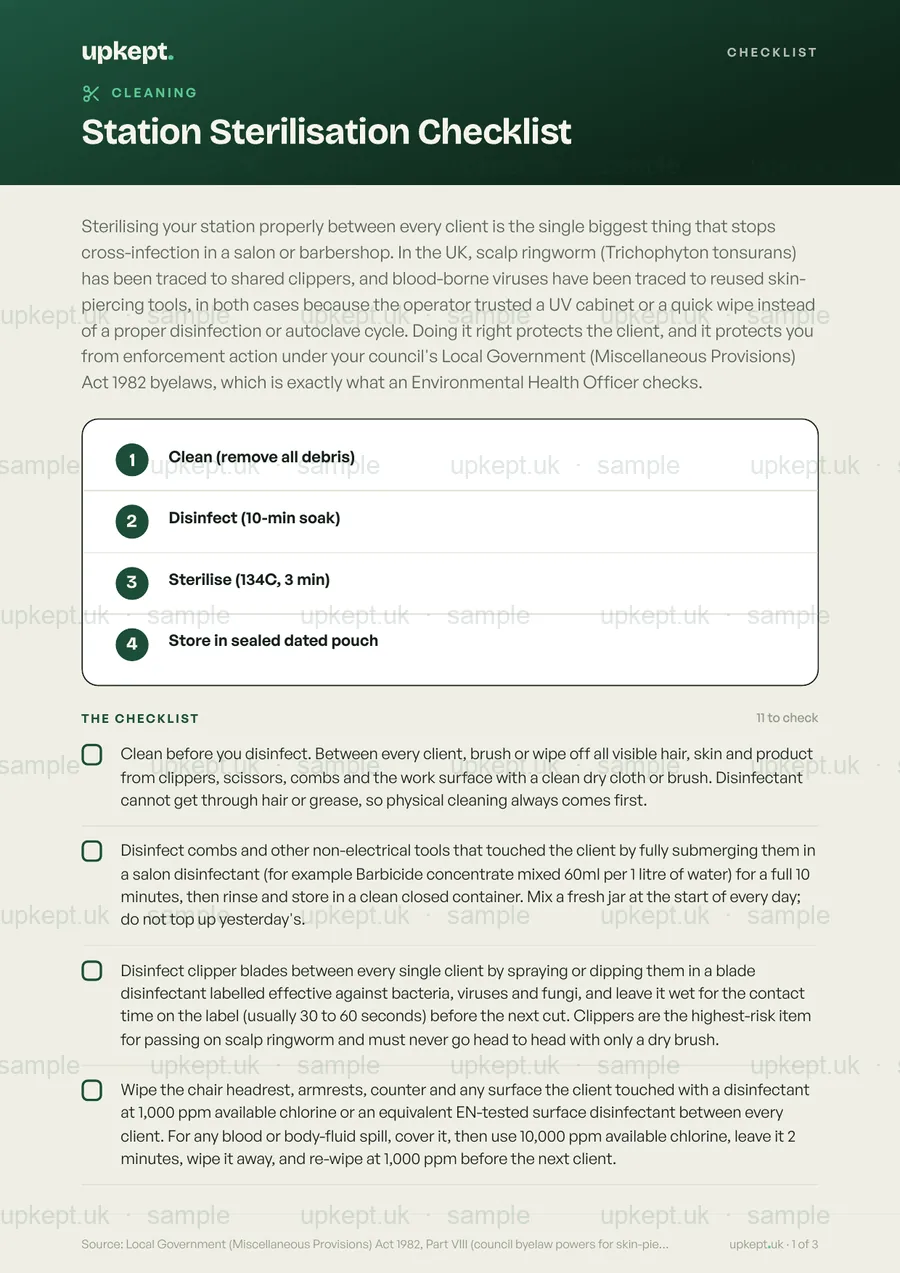
Station Sterilisation Checklist

Sterilising your station properly between every client is the single biggest thing that stops cross-infection in a salon or barbershop. In the UK, scalp ringworm (Trichophyton tonsurans) has been traced to shared clippers, and blood-borne viruses have been traced to reused skin-piercing tools, in both cases because the operator trusted a UV cabinet or a quick wipe instead of a proper disinfection or autoclave cycle. Doing it right protects the client, and it protects you from enforcement action under your council's Local Government (Miscellaneous Provisions) Act 1982 byelaws, which is exactly what an Environmental Health Officer checks.

£14View
Daily

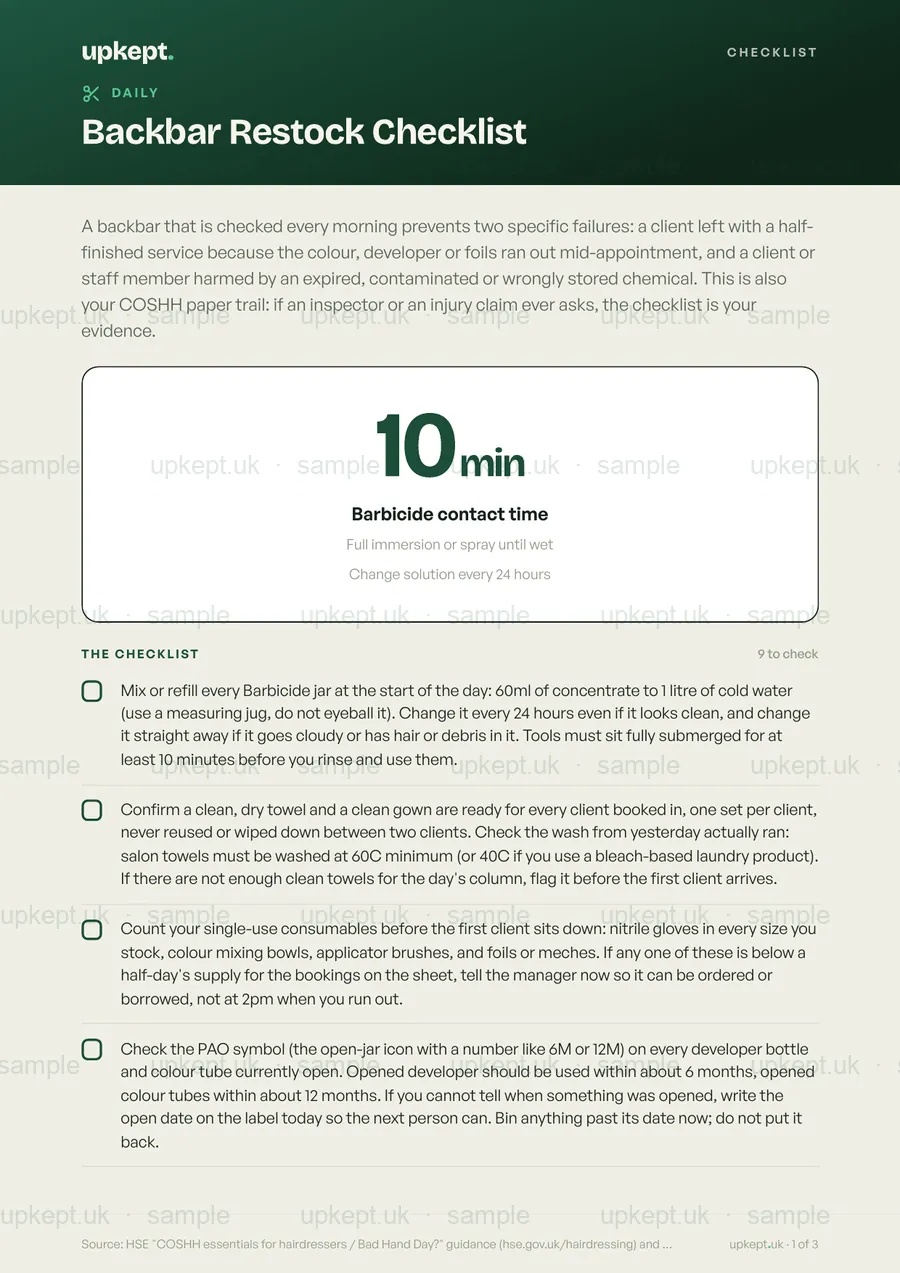
Backbar Restock Checklist

A backbar that is checked every morning prevents two specific failures: a client left with a half-finished service because the colour, developer or foils ran out mid-appointment, and a client or staff member harmed by an expired, contaminated or wrongly stored chemical. This is also your COSHH paper trail: if an inspector or an injury claim ever asks, the checklist is your evidence.

£14View
Cleaning

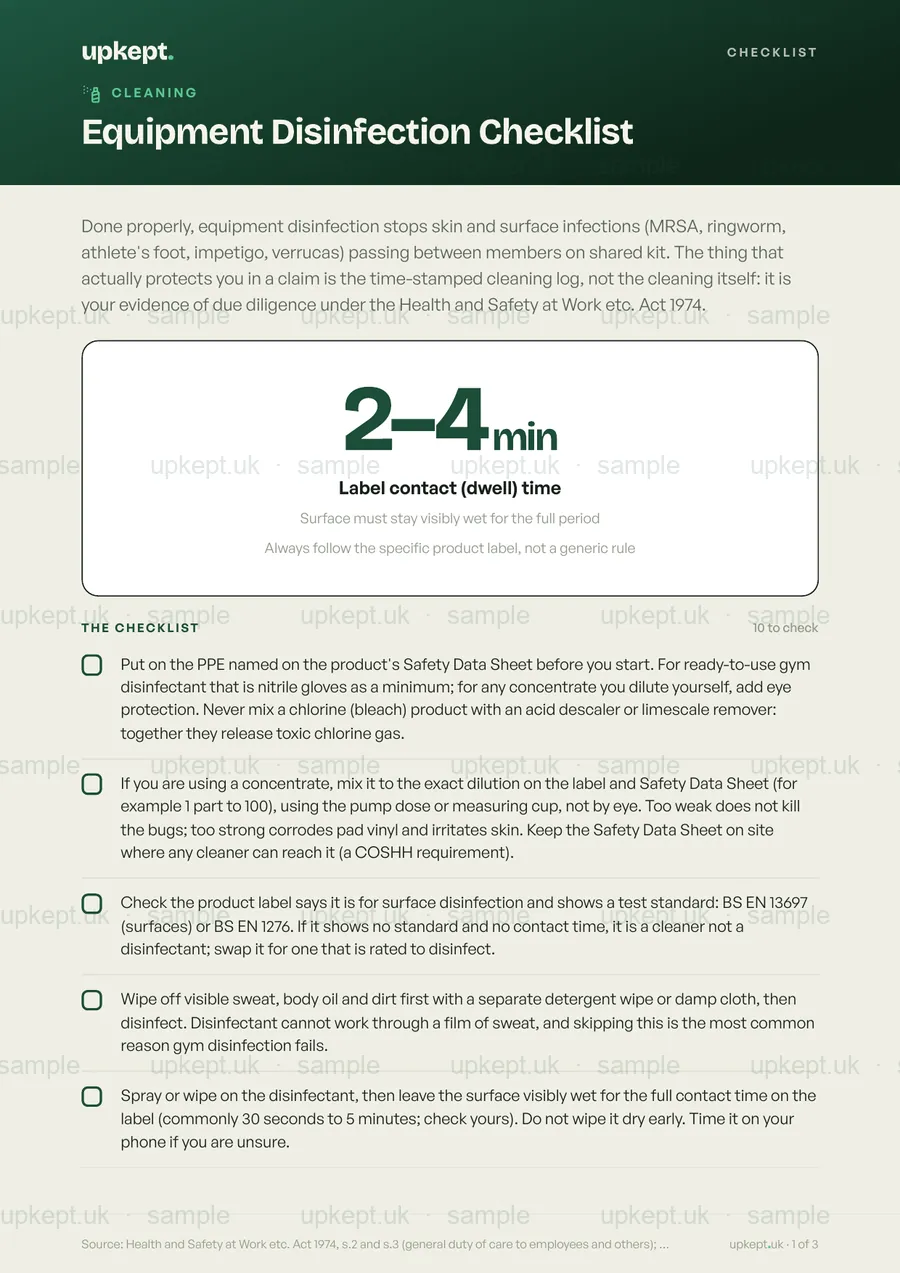
Equipment Disinfection Checklist

Done properly, equipment disinfection stops skin and surface infections (MRSA, ringworm, athlete's foot, impetigo, verrucas) passing between members on shared kit. The thing that actually protects you in a claim is the time-stamped cleaning log, not the cleaning itself: it is your evidence of due diligence under the Health and Safety at Work etc. Act 1974.

£14View
Safety

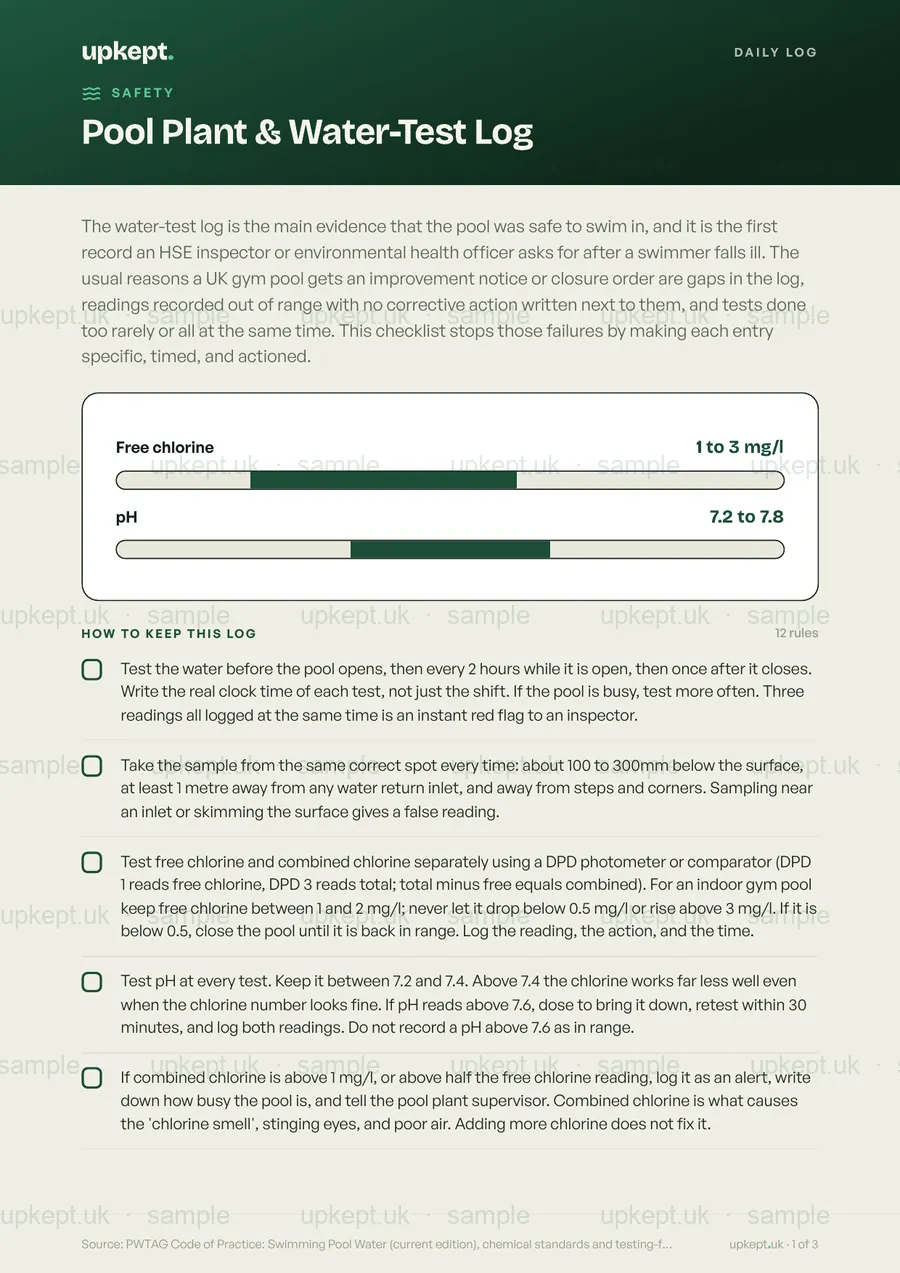
Pool Plant & Water-Test Log

The water-test log is the main evidence that the pool was safe to swim in, and it is the first record an HSE inspector or environmental health officer asks for after a swimmer falls ill. The usual reasons a UK gym pool gets an improvement notice or closure order are gaps in the log, readings recorded out of range with no corrective action written next to them, and tests done too rarely or all at the same time. This checklist stops those failures by making each entry specific, timed, and actioned.

£14View
Safety

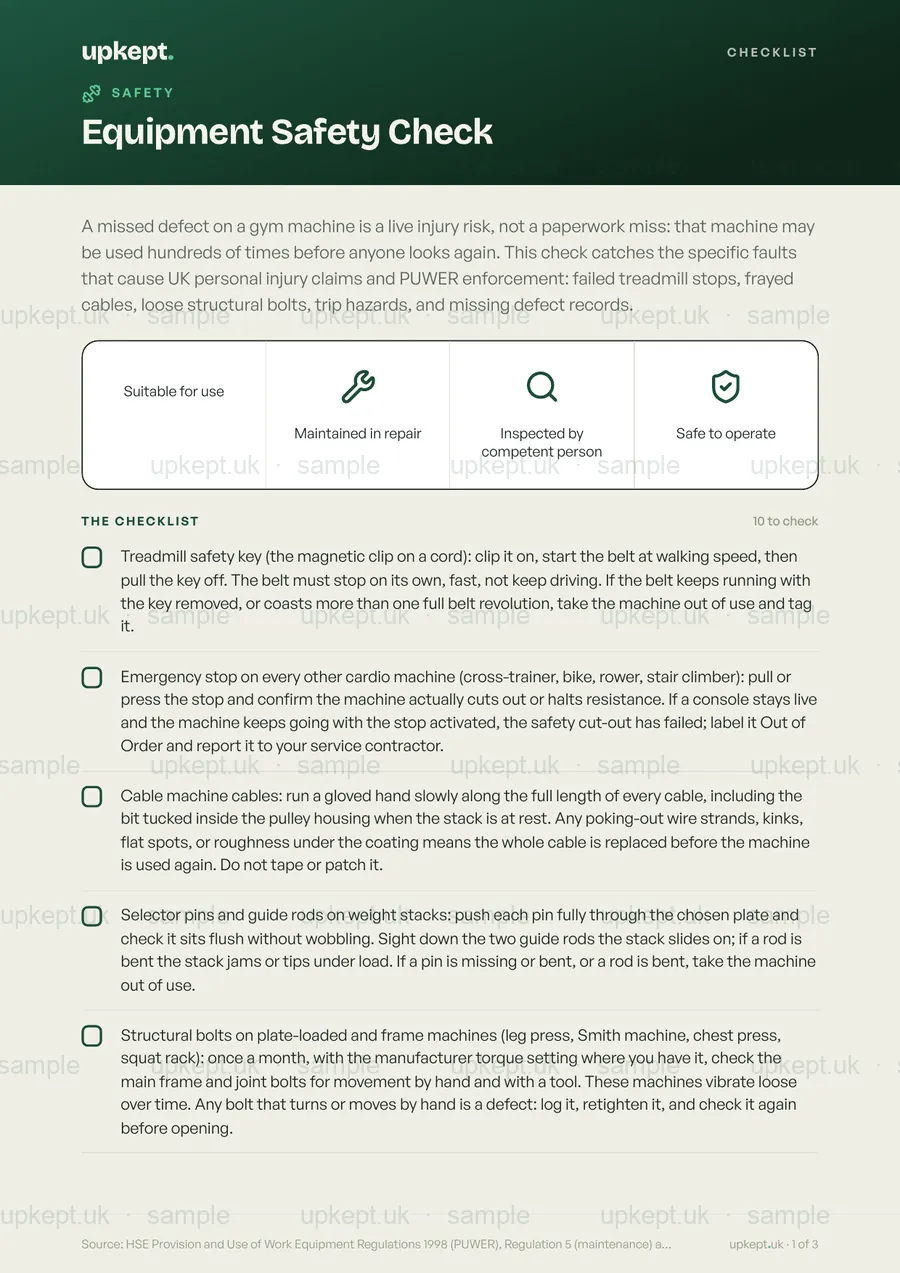
Equipment Safety Check

A missed defect on a gym machine is a live injury risk, not a paperwork miss: that machine may be used hundreds of times before anyone looks again. This check catches the specific faults that cause UK personal injury claims and PUWER enforcement: failed treadmill stops, frayed cables, loose structural bolts, trip hazards, and missing defect records.

£14View
Daily

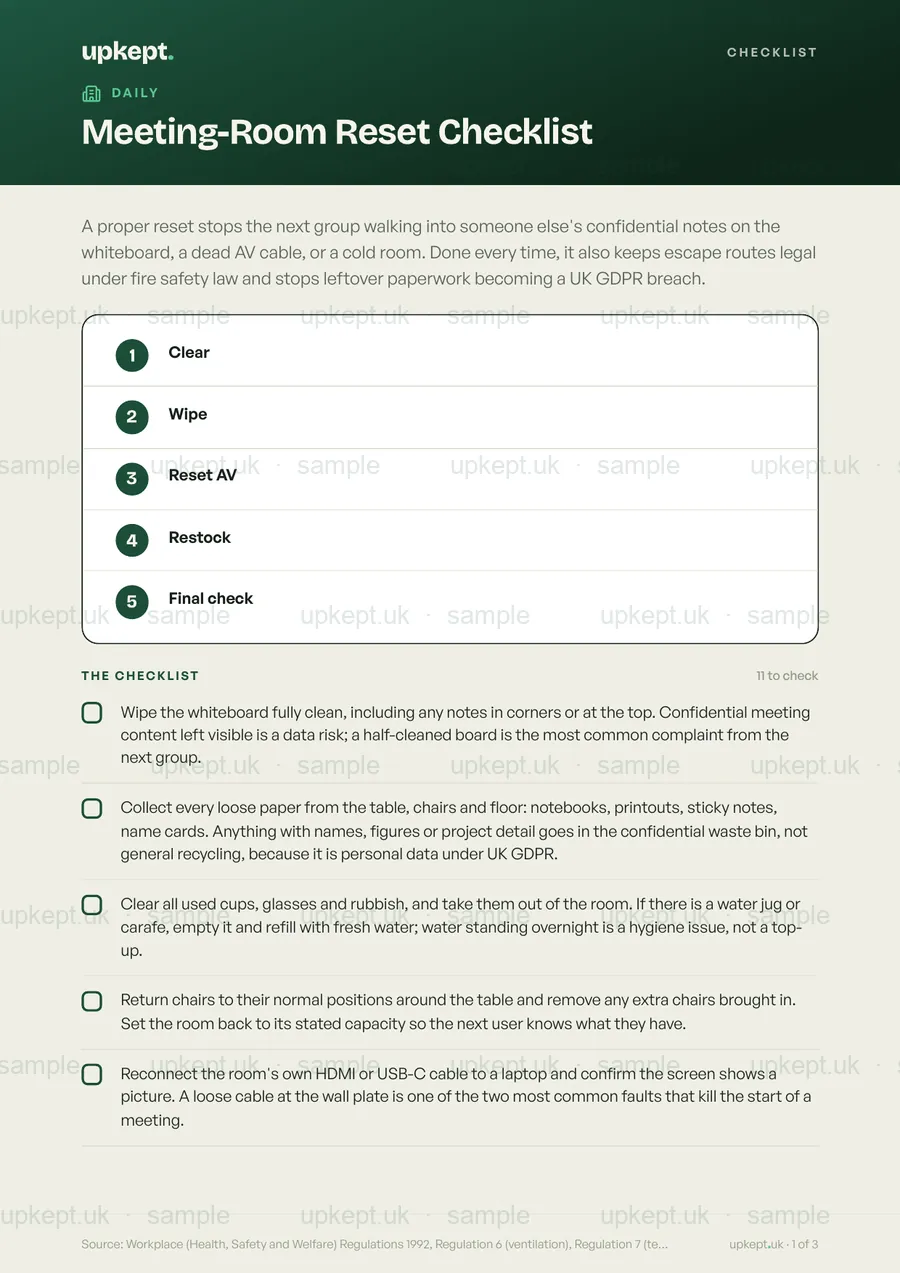
Meeting-Room Reset Checklist

A proper reset stops the next group walking into someone else's confidential notes on the whiteboard, a dead AV cable, or a cold room. Done every time, it also keeps escape routes legal under fire safety law and stops leftover paperwork becoming a UK GDPR breach.

£14View
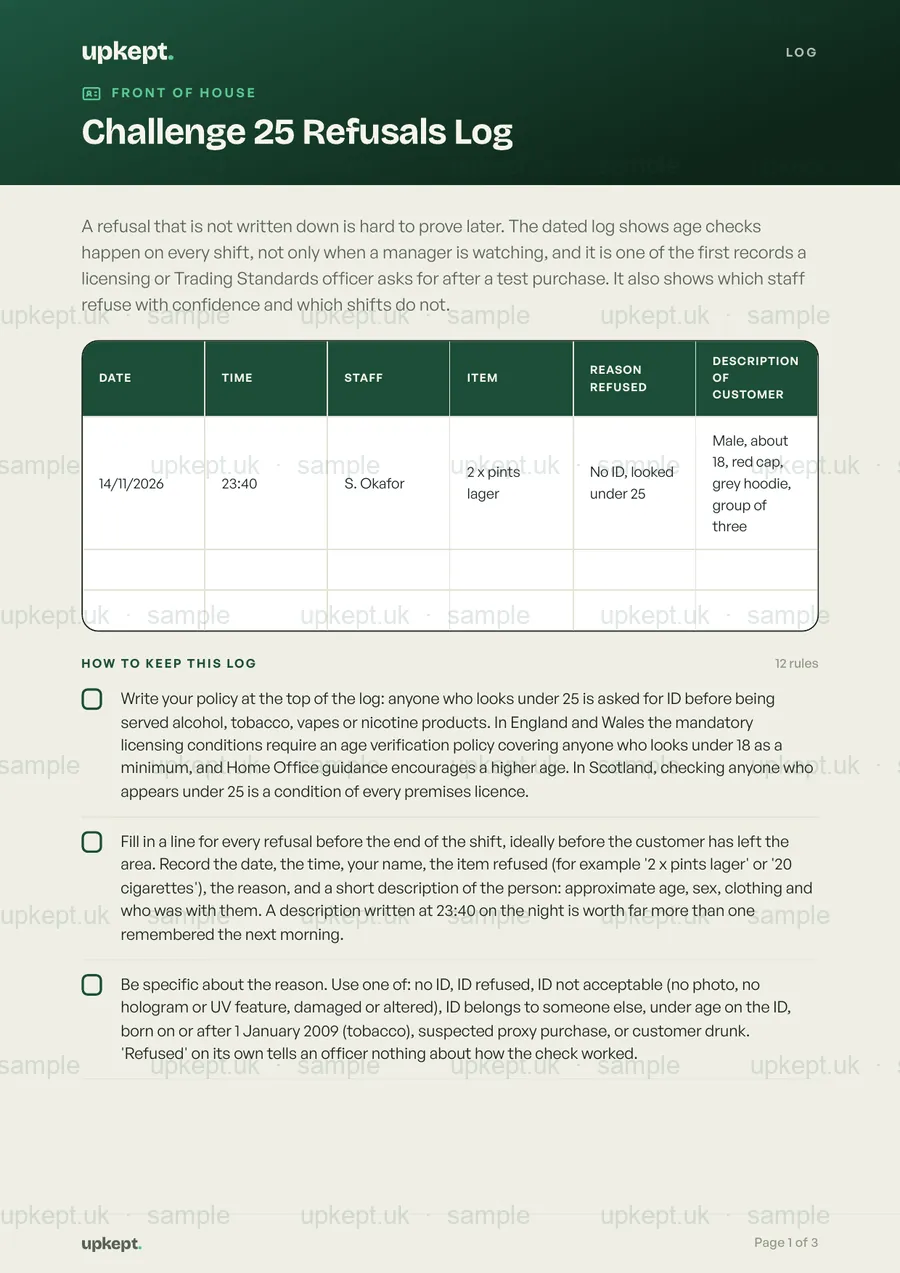
Front of House

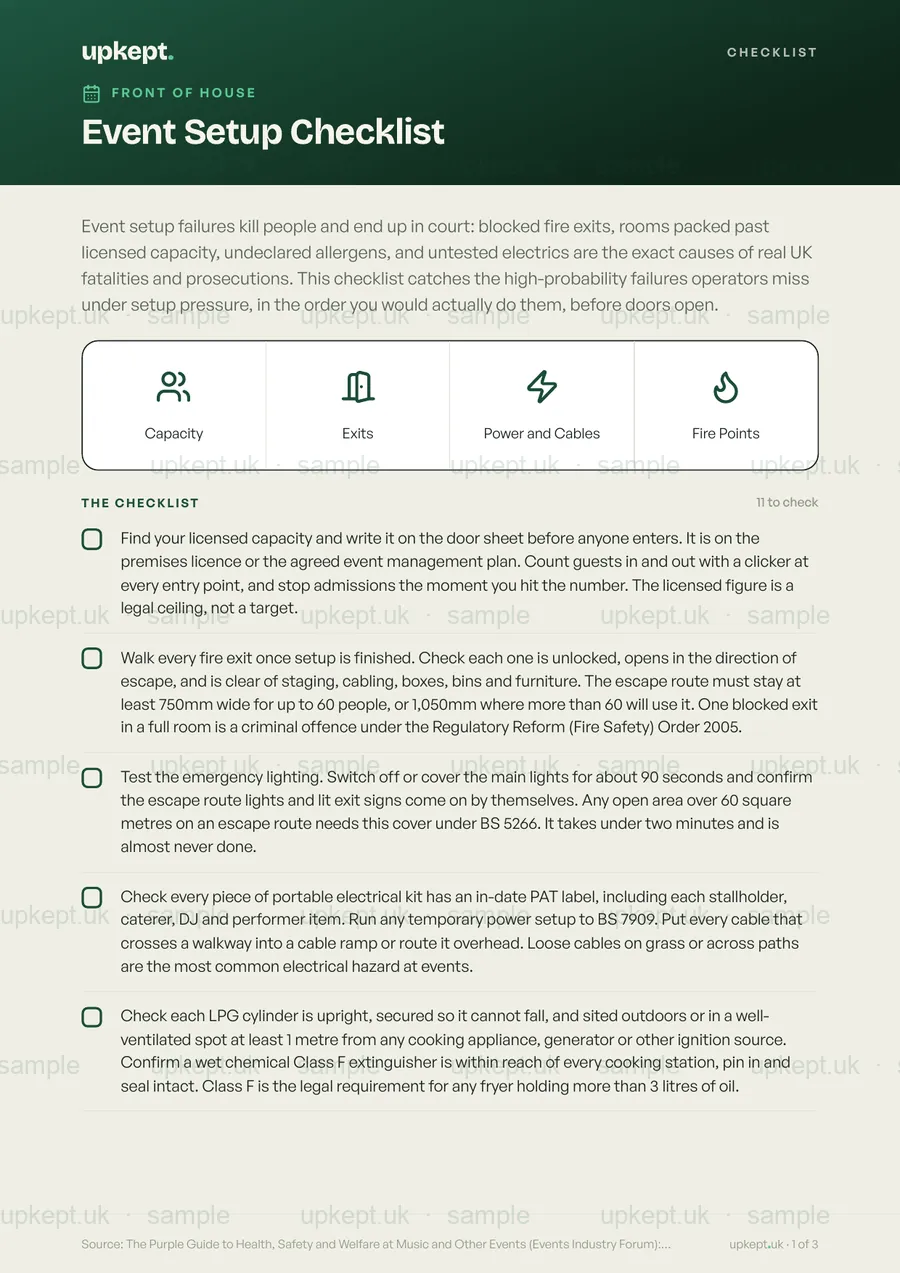
Event Setup Checklist

Event setup failures kill people and end up in court: blocked fire exits, rooms packed past licensed capacity, undeclared allergens, and untested electrics are the exact causes of real UK fatalities and prosecutions. This checklist catches the high-probability failures operators miss under setup pressure, in the order you would actually do them, before doors open.

£14View
Maintenance

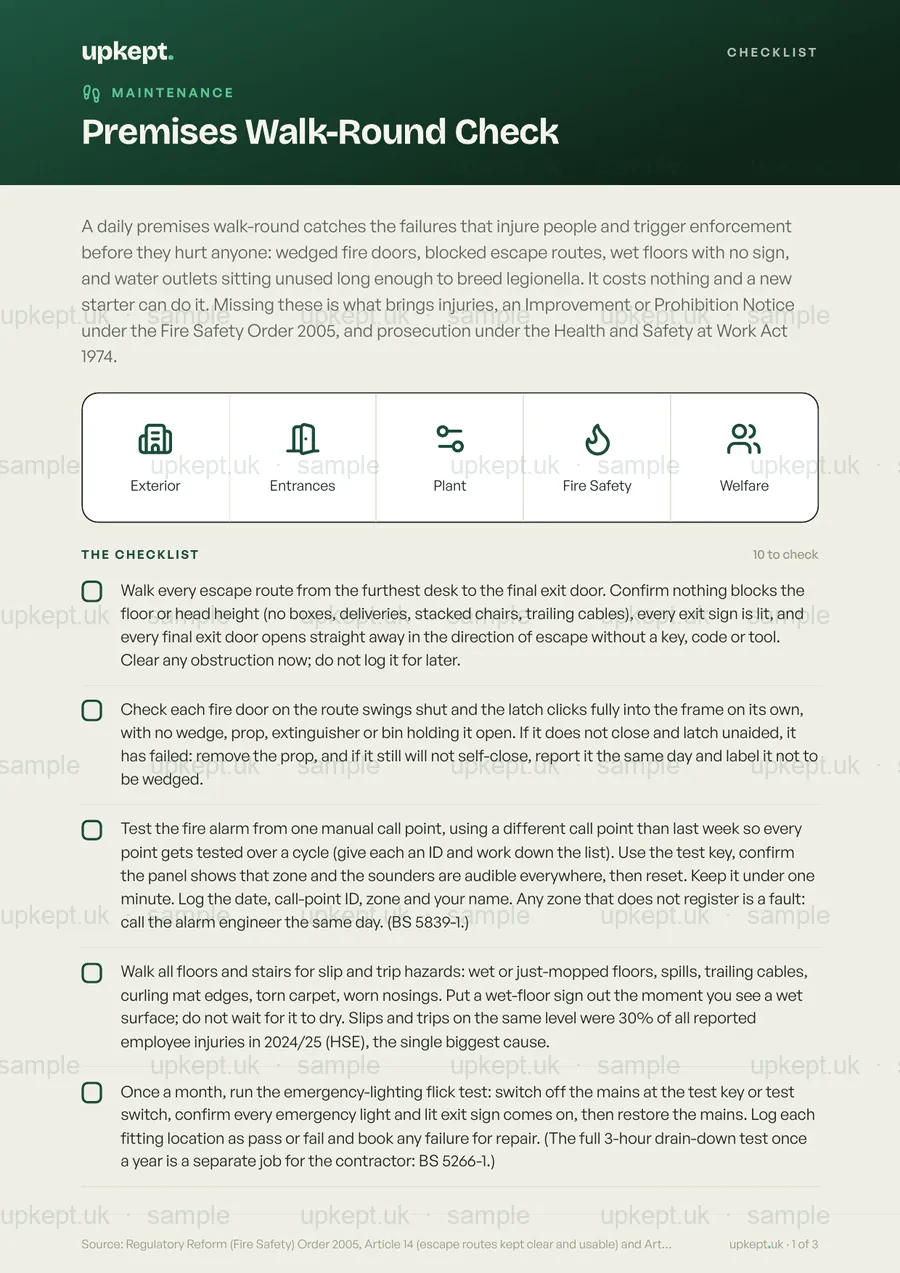
Premises Walk-Round Check

A daily premises walk-round catches the failures that injure people and trigger enforcement before they hurt anyone: wedged fire doors, blocked escape routes, wet floors with no sign, and water outlets sitting unused long enough to breed legionella. It costs nothing and a new starter can do it. Missing these is what brings injuries, an Improvement or Prohibition Notice under the Fire Safety Order 2005, and prosecution under the Health and Safety at Work Act 1974.

£14View
Maintenance

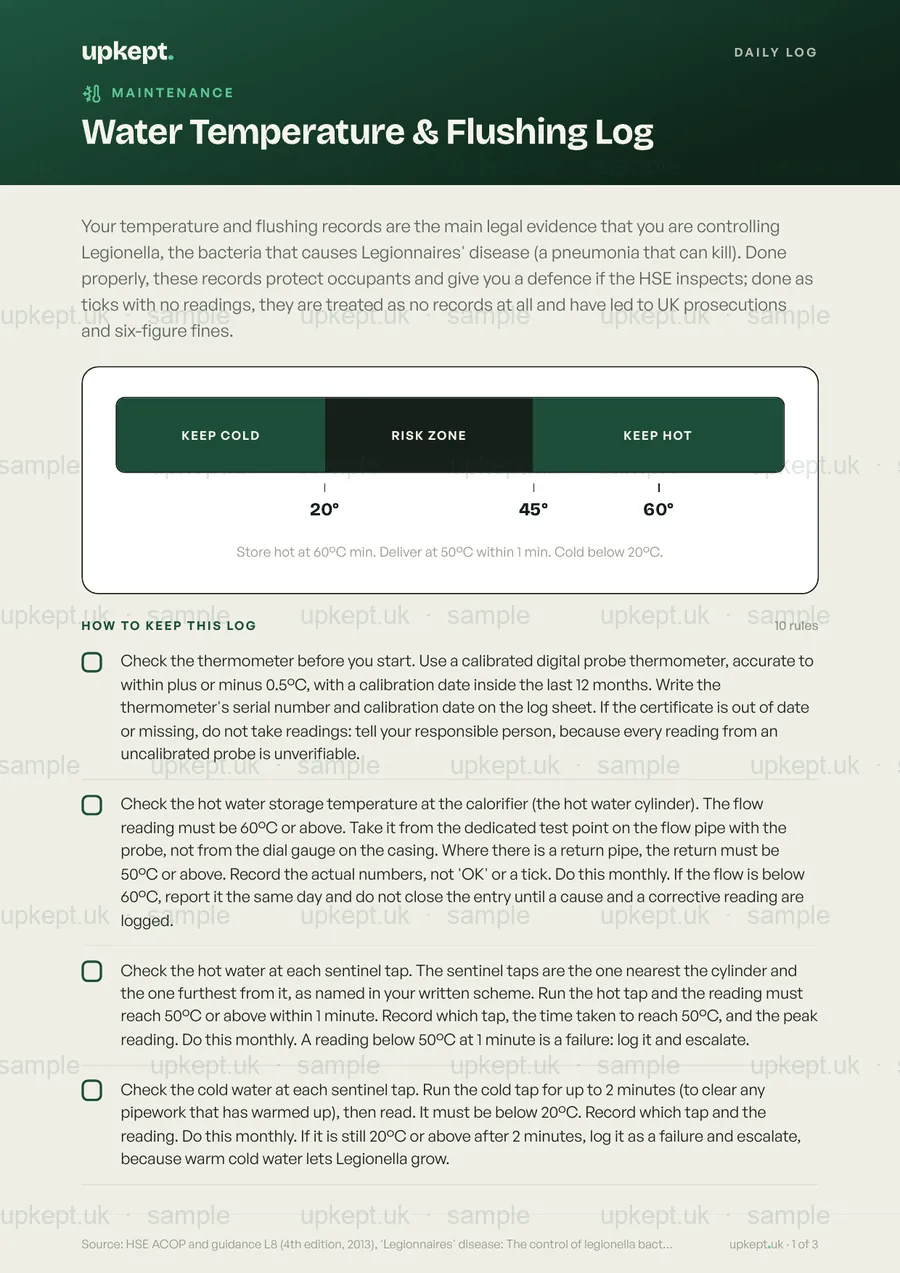
Water Temperature & Flushing Log

Your temperature and flushing records are the main legal evidence that you are controlling Legionella, the bacteria that causes Legionnaires' disease (a pneumonia that can kill). Done properly, these records protect occupants and give you a defence if the HSE inspects; done as ticks with no readings, they are treated as no records at all and have led to UK prosecutions and six-figure fines.

£14View
Safety

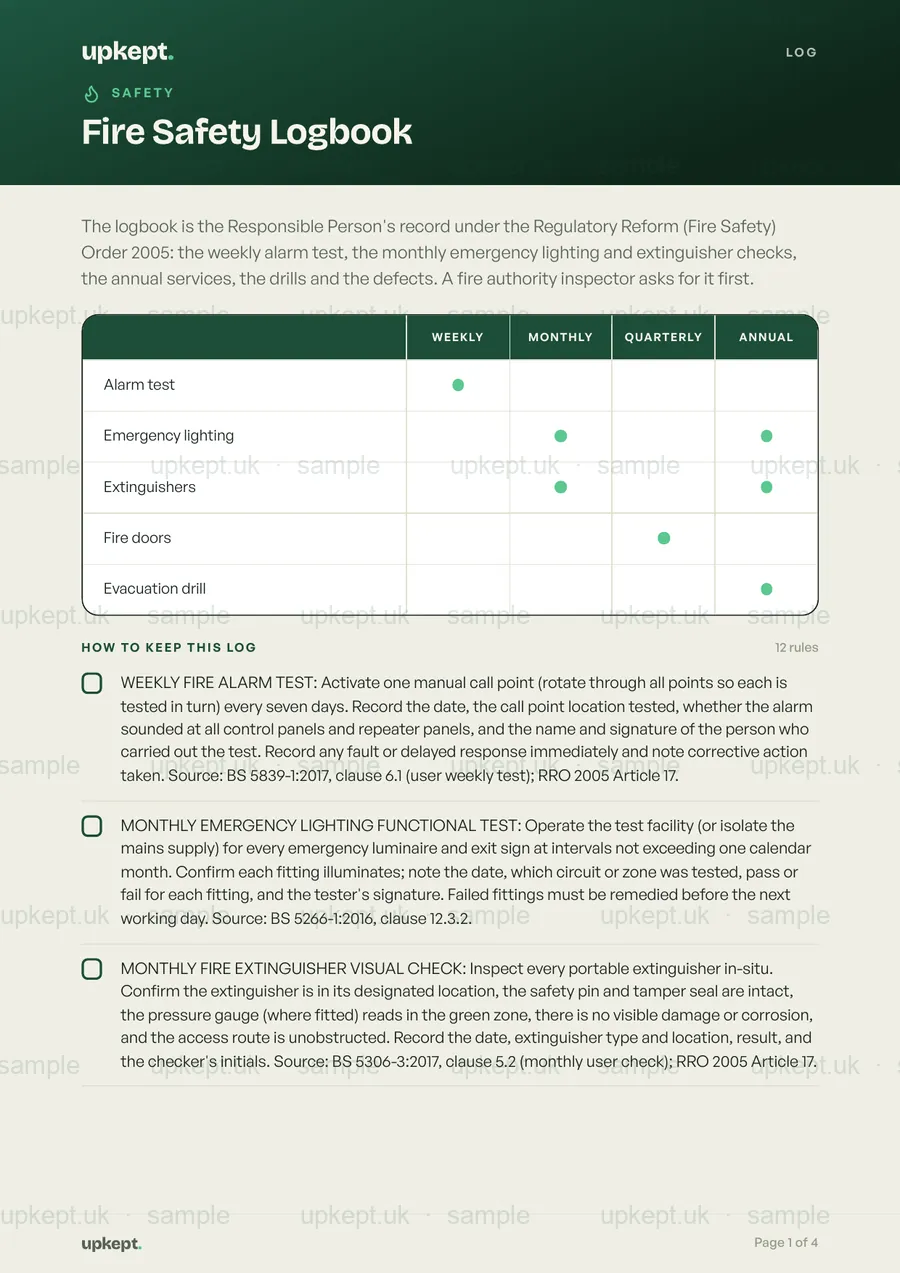
Fire Safety Logbook

This logbook is the Responsible Person's written proof of compliance with the Regulatory Reform (Fire Safety) Order 2005: without it, a fire authority inspector has no evidence that your fire precautions are being maintained, and you face enforcement action up to unlimited fines or two years' imprisonment under Article 32 of the Order.

£34View
Safety

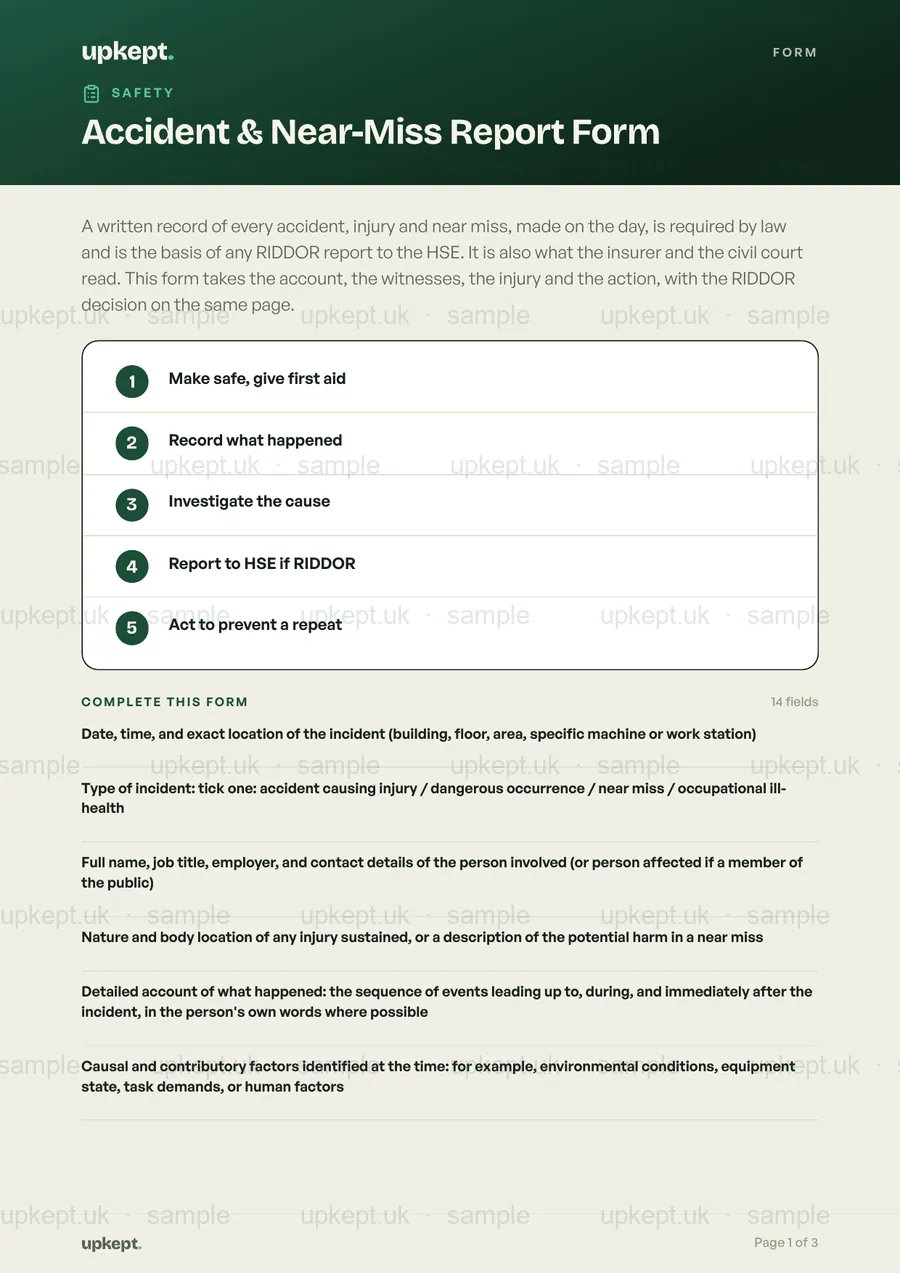
Accident & Near-Miss Report Form

A contemporaneous written record of every accident, injury, or near miss, required by law and the foundation of any RIDDOR report to the HSE. Without it, you have no defence against a civil claim, no evidence for your insurer, and no way to demonstrate you investigated and acted: a gap an HSE inspector will treat as proof of a failed safety management system.

£34View
Safety

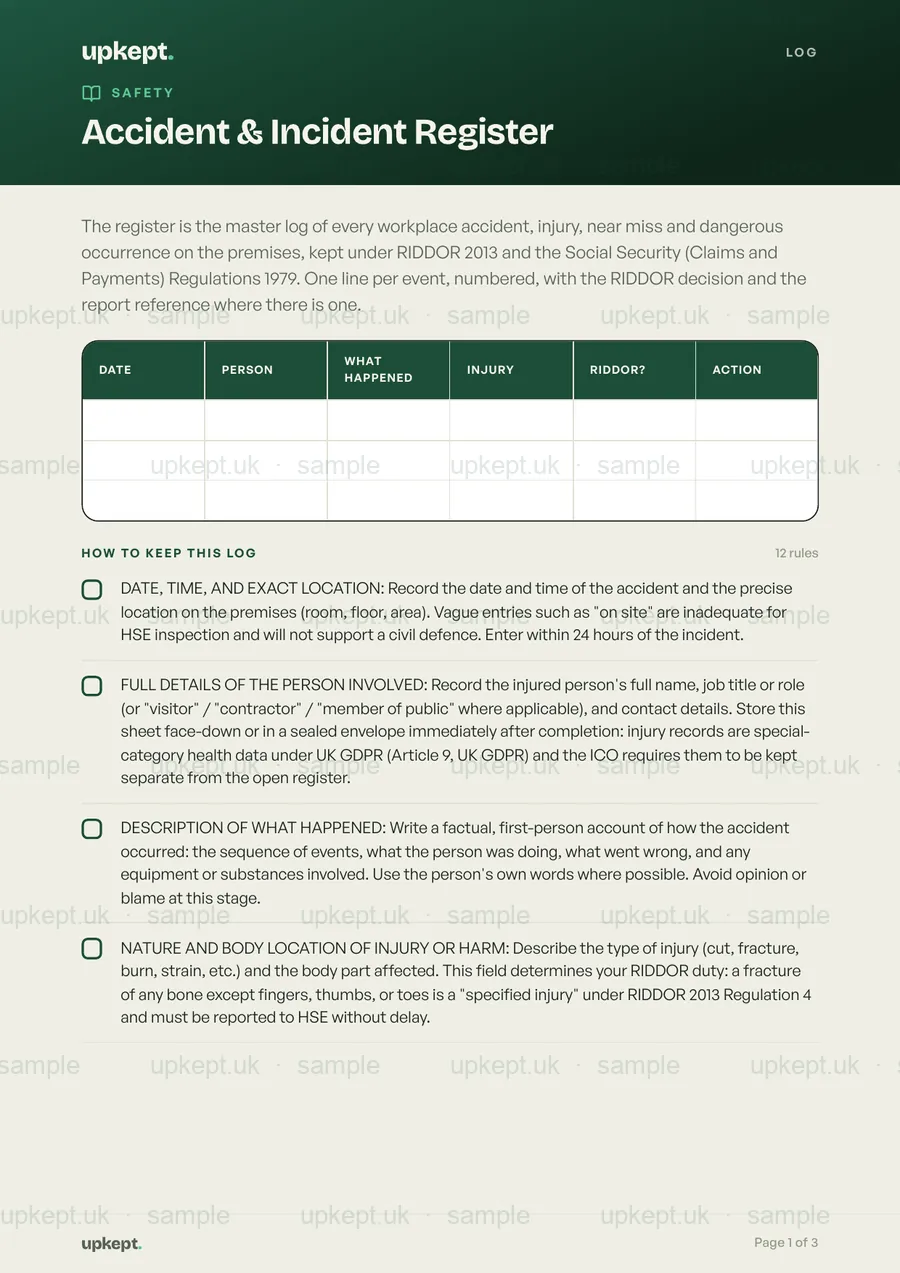
Accident & Incident Register

The Accident and Incident Register is the bound master log of every workplace accident, injury, near miss, and dangerous occurrence on the premises, maintained as the primary legal record under RIDDOR 2013 and the Social Security (Claims and Payments) Regulations 1979. Without it, you face criminal prosecution, unlimited fines, and no defence when an injured person brings a civil claim.

£34View
Safety

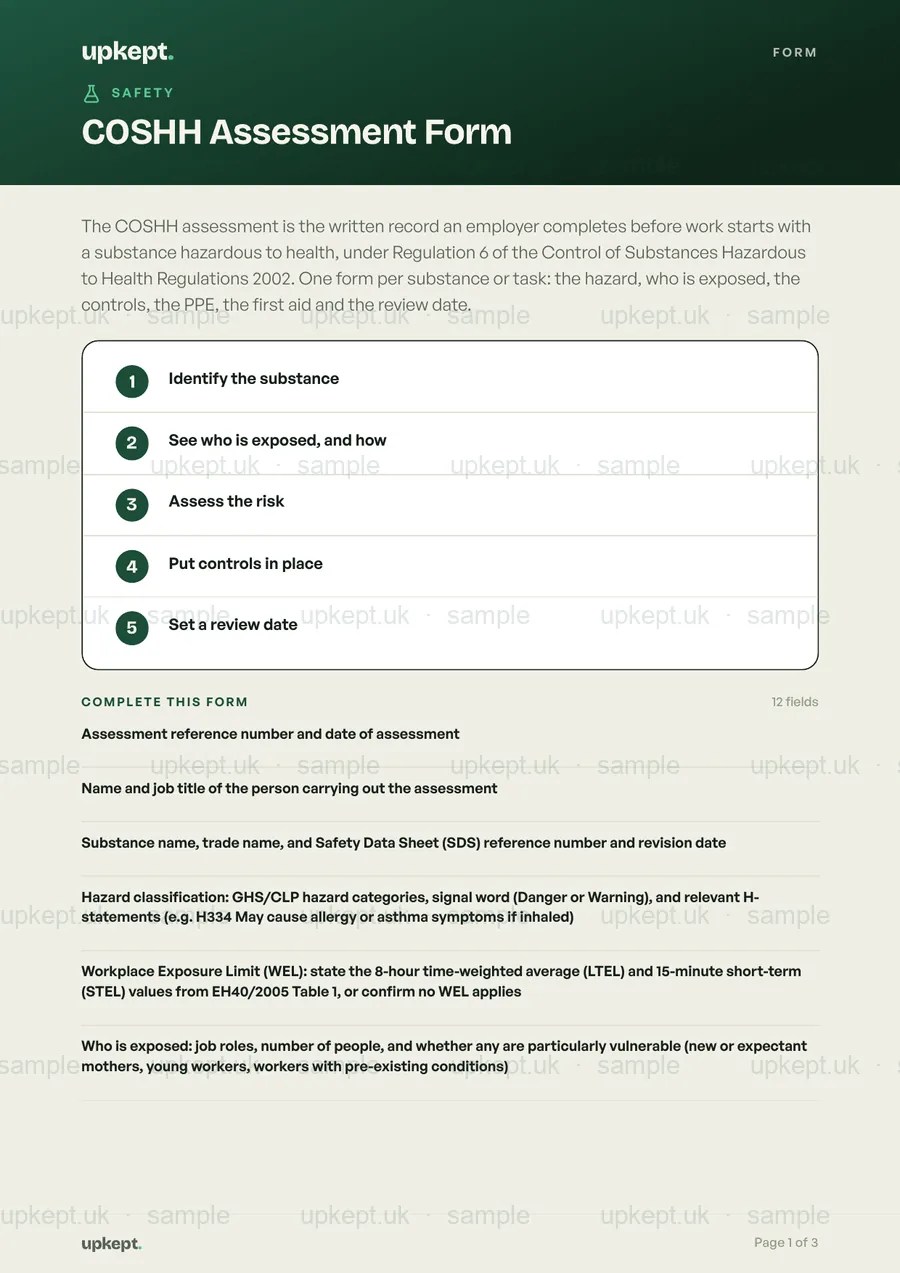
COSHH Assessment Form

A COSHH Assessment Form is the written record an employer must complete before work begins with any substance hazardous to health, as required by Regulation 6 of the Control of Substances Hazardous to Health Regulations 2002. Without it, the HSE can issue an improvement or prohibition notice, pursue an unlimited fine, and publish the breach on its public enforcement register for five years.

£34View
Safety

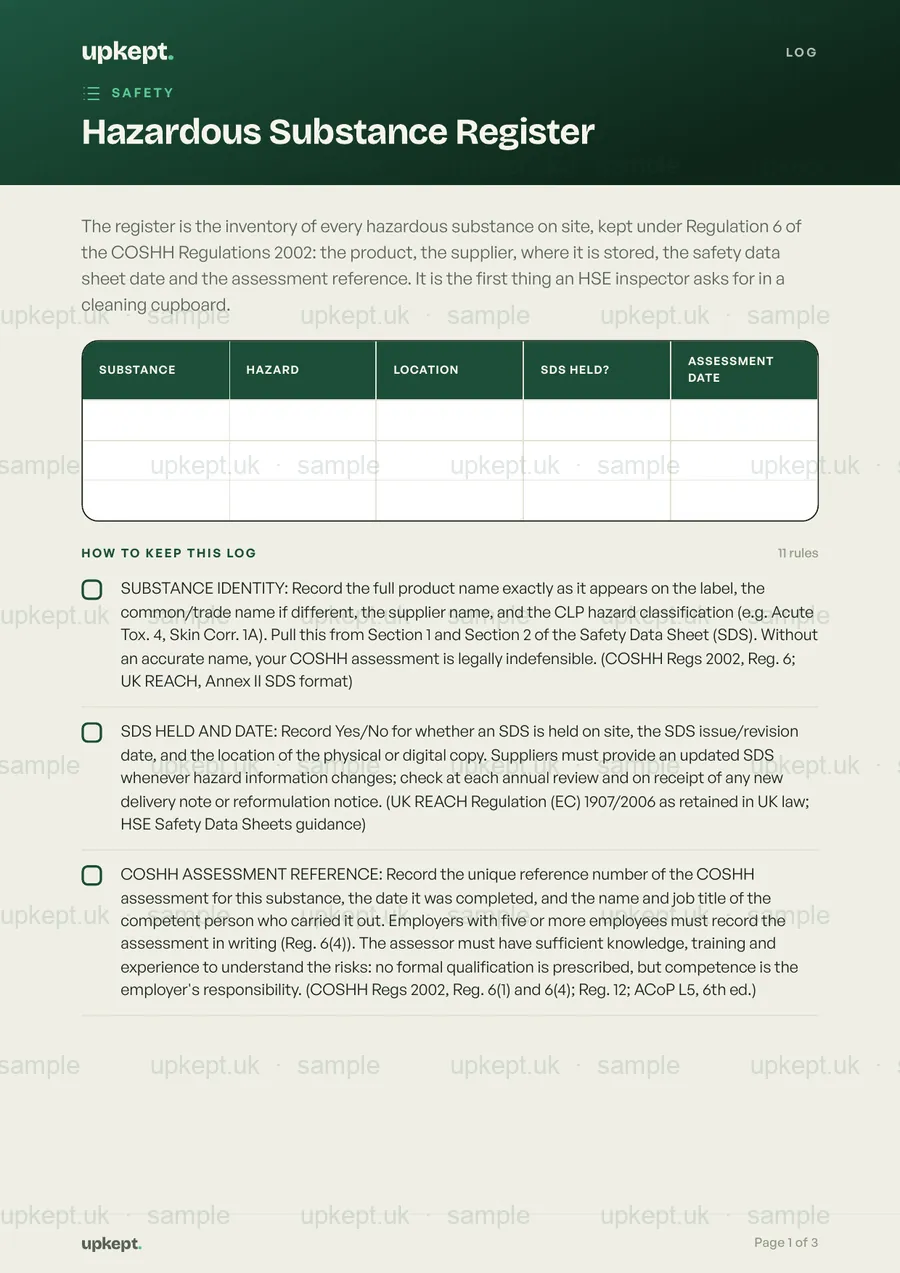
Hazardous Substance Register

This register is the master inventory of every hazardous substance on site, required under Regulation 6 of the Control of Substances Hazardous to Health Regulations 2002 (SI 2002/2677). Without it, an HSE inspector can issue an Improvement Notice on the spot, and a prosecution following a worker injury or illness can result in an unlimited fine under the Health and Safety at Work etc. Act 1974, s.33.

£34View
Maintenance

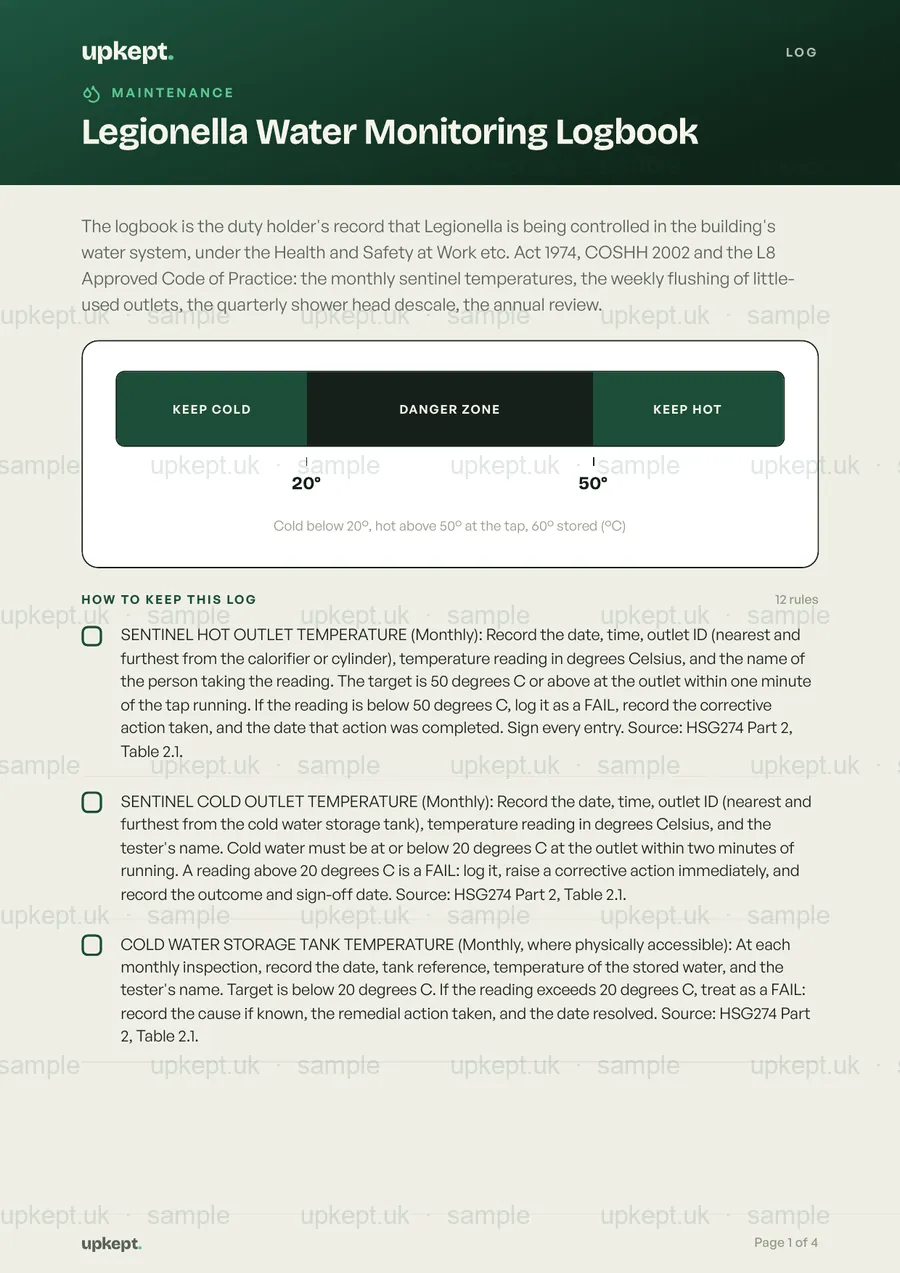
Legionella Water Monitoring Logbook

This logbook is the duty holder's running proof that Legionella bacteria are being actively controlled in the building's water system, as required under the Health and Safety at Work etc. Act 1974, COSHH Regulations 2002, and the L8 Approved Code of Practice. Without it, an HSE inspector has no evidence that legal duties have been met, and a confirmed case of Legionnaires' disease on premises with no records can lead to prosecution, unlimited fines, and imprisonment for up to two years.

£34View
Safety

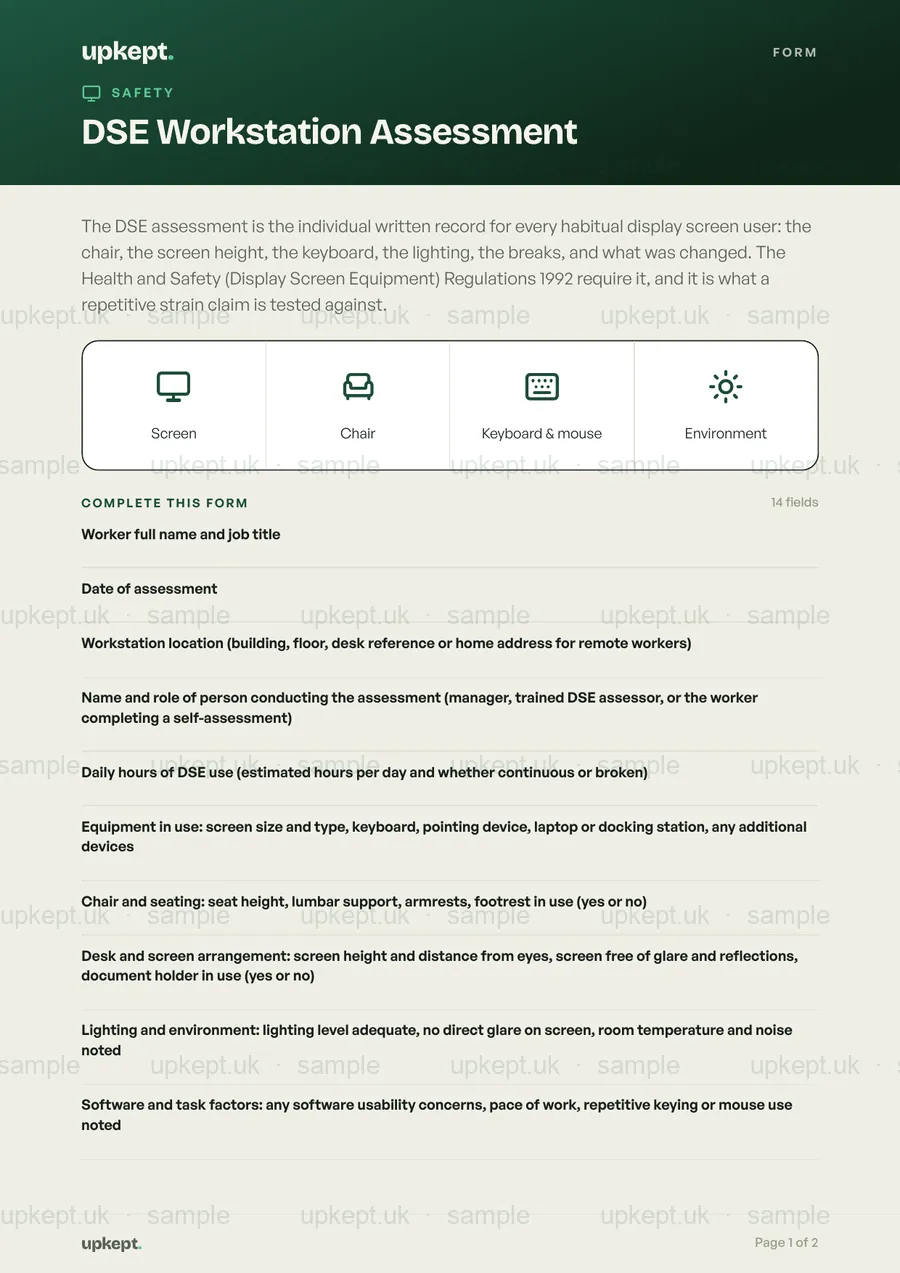
DSE Workstation Assessment

A DSE Workstation Assessment is the individual written record an employer must complete and keep for every habitual display screen equipment user, proving their workstation has been analysed and any risks reduced so far as is reasonably practicable. Without it, an employer cannot defend a civil claim for repetitive strain injury or musculoskeletal disorder, and an HSE inspector can issue an Improvement Notice on the spot.

£34View
Safety

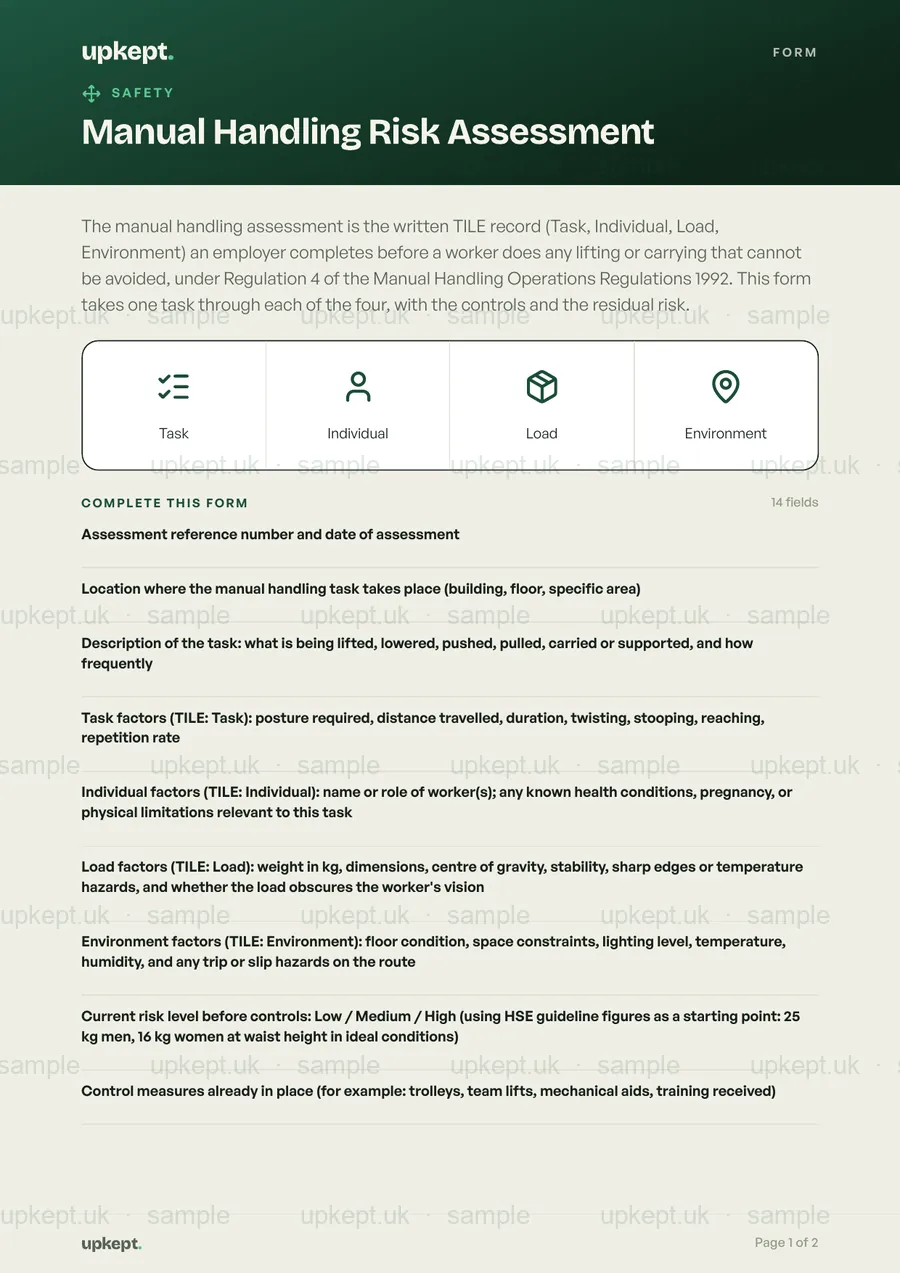
Manual Handling Risk Assessment

A Manual Handling Risk Assessment is the written TILE-based record (Task, Individual, Load, Environment) that an employer must complete before a worker carries out any hazardous lifting or carrying activity that cannot be avoided. Without it, the employer is in criminal breach of Regulation 4(1)(b)(i) of the Manual Handling Operations Regulations 1992, exposing the business to HSE prosecution, unlimited fines, and civil liability if a worker is injured.

£34View
Maintenance

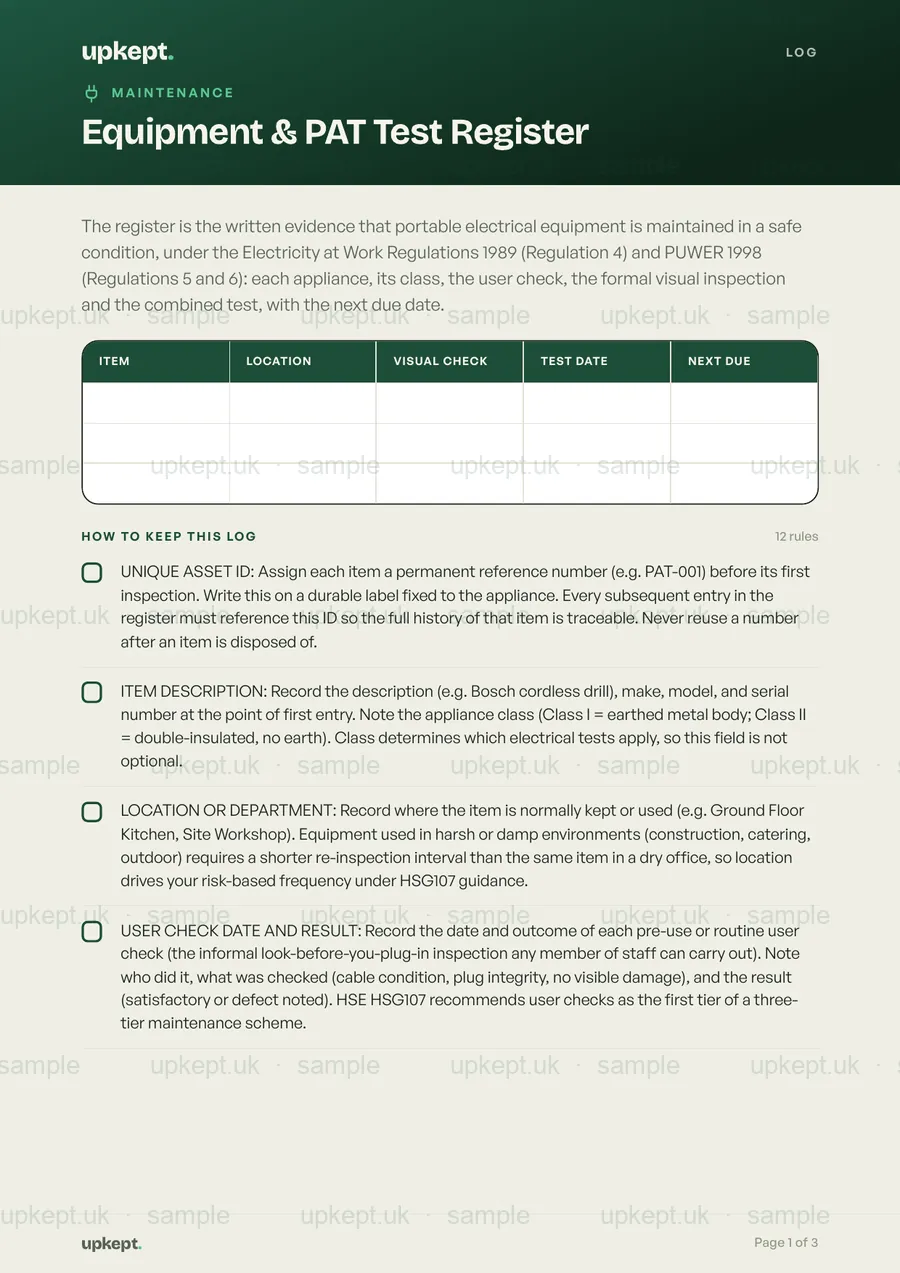
Equipment & PAT Test Register

This register is the written evidence that your portable electrical equipment is being maintained in a safe condition, as required by the Electricity at Work Regulations 1989 (Regulation 4) and PUWER 1998 (Regulations 5 and 6). Without it, a single electrical incident or HSE inspection can leave you unable to demonstrate compliance, exposing the duty holder to unlimited criminal liability under the Health and Safety at Work etc. Act 1974.

£34View
Team

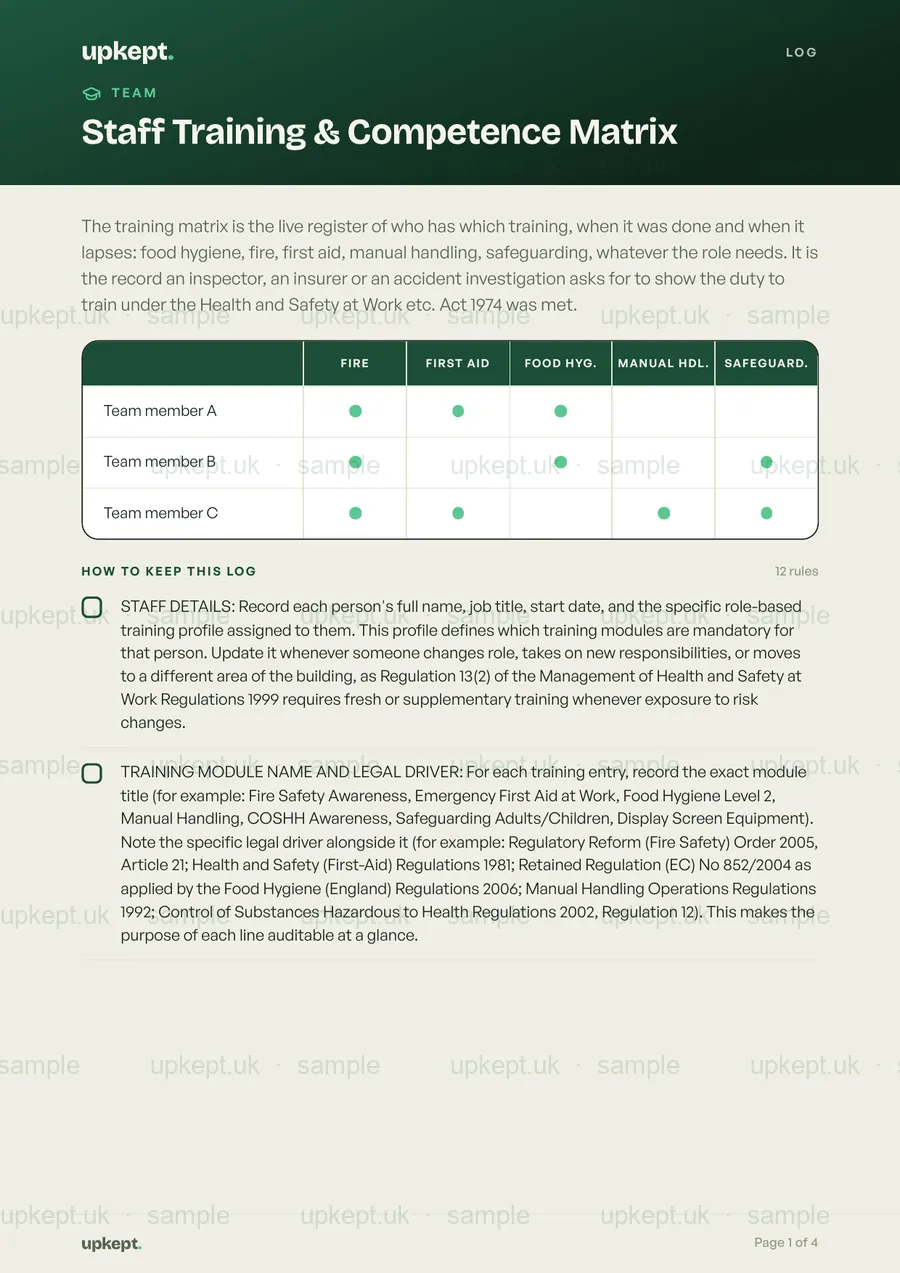
Staff Training & Competence Matrix
A Staff Training and Competence Matrix is the live register that proves every person on your team has the right training for their role and that nothing has lapsed. Without it, a single enforcement visit, accident investigation, or insurance claim can expose you to unlimited fines under the Health and Safety at Work etc. Act 1974 and leave you with no due-diligence defence.

£34View
Safety

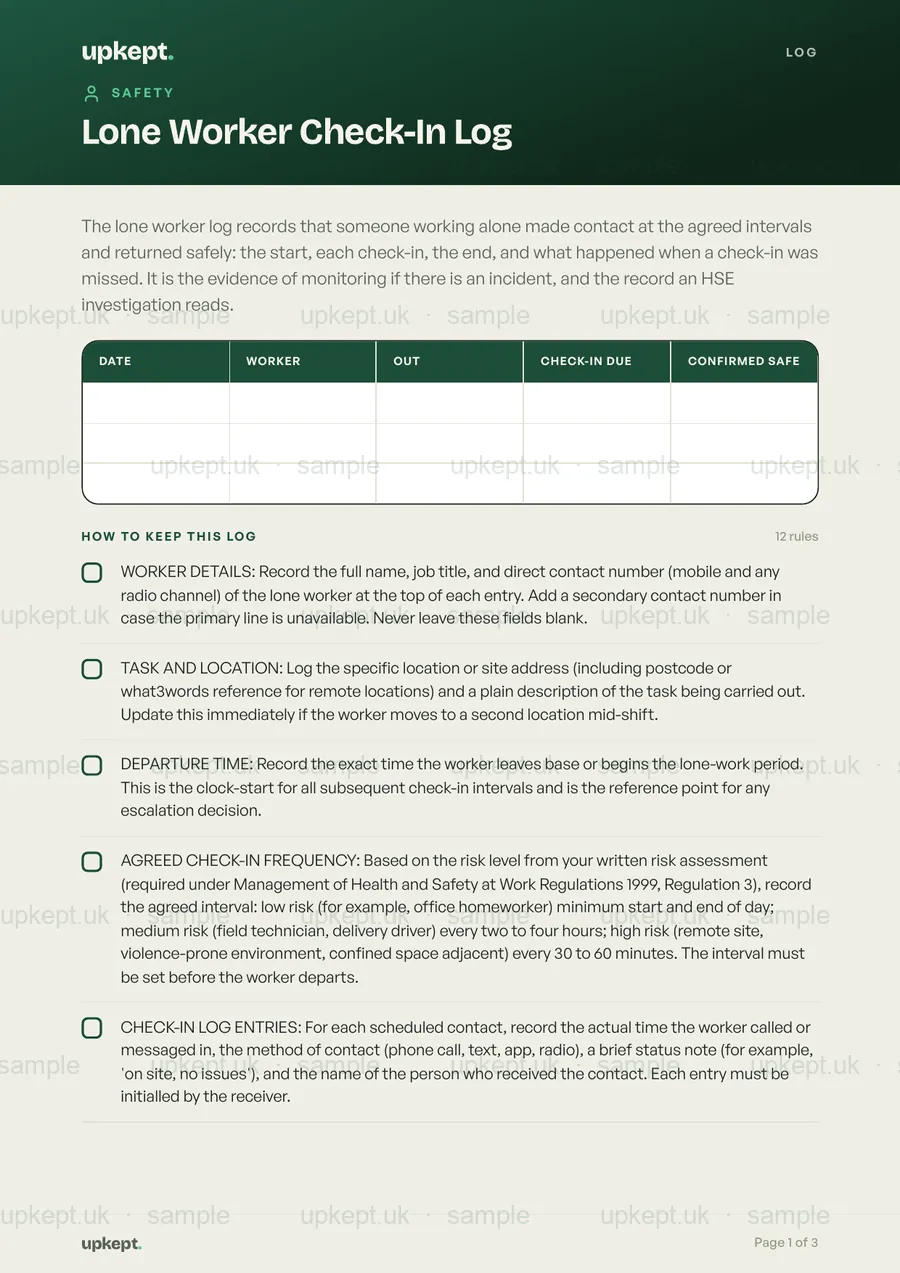
Lone Worker Check-In Log

A Lone Worker Check-In Log is the written record an employer keeps to confirm that employees working alone have made contact at agreed intervals and returned safely from their task. Without it, you have no evidence of monitoring if an incident occurs, leaving you exposed to unlimited fines under the Health and Safety at Work etc. Act 1974 and unable to defend an HSE investigation or civil claim.

£34View
Safety

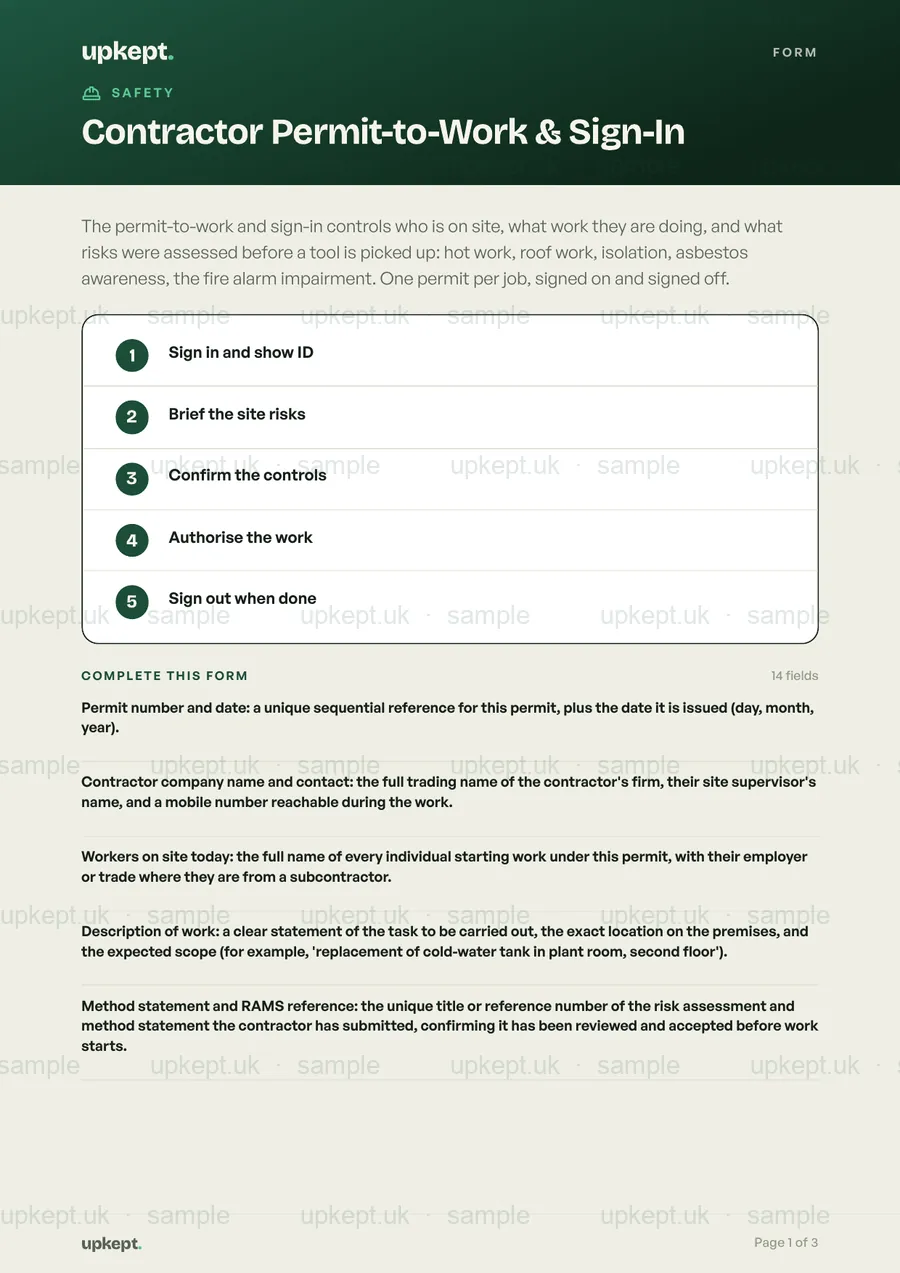
Contractor Permit-to-Work & Sign-In

A Contractor Permit-to-Work and Sign-In is the written authorisation that controls who is on site, what work they are doing, and what risks have been assessed and controlled before a single tool is picked up. Without it, an operator has no defence against an HSE improvement or prohibition notice, and unlimited fines under the Health and Safety at Work etc. Act 1974 become a real possibility.

£34View
Safety

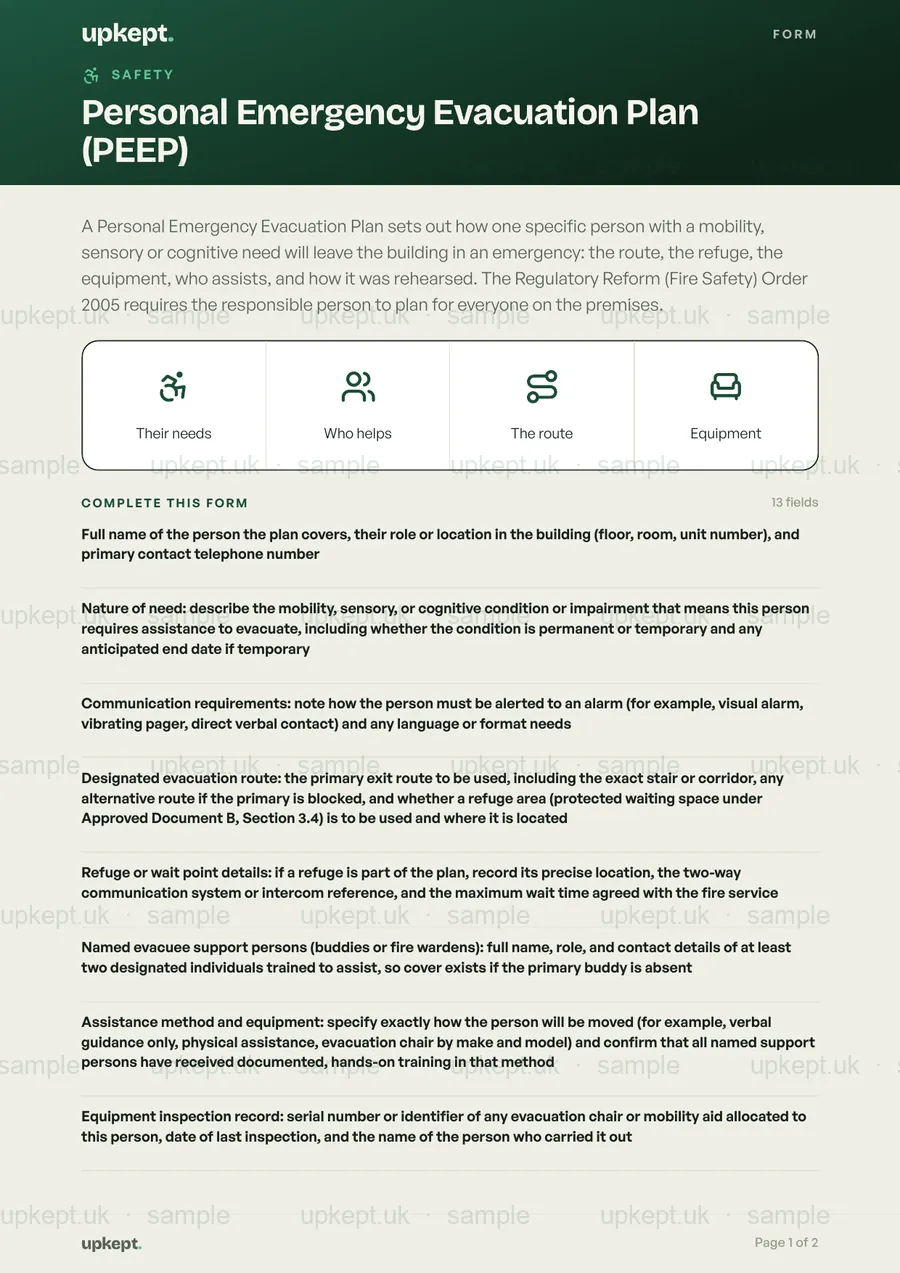
Personal Emergency Evacuation Plan (PEEP)

A Personal Emergency Evacuation Plan is a legally required, individually tailored record that sets out how a specific person with mobility, sensory, or cognitive needs will be evacuated from the premises in an emergency. Without one, the responsible person is in breach of the Regulatory Reform (Fire Safety) Order 2005 and risks prohibition or improvement notices, unlimited fines, and up to two years imprisonment under Article 32 of that Order.

£34View
Team

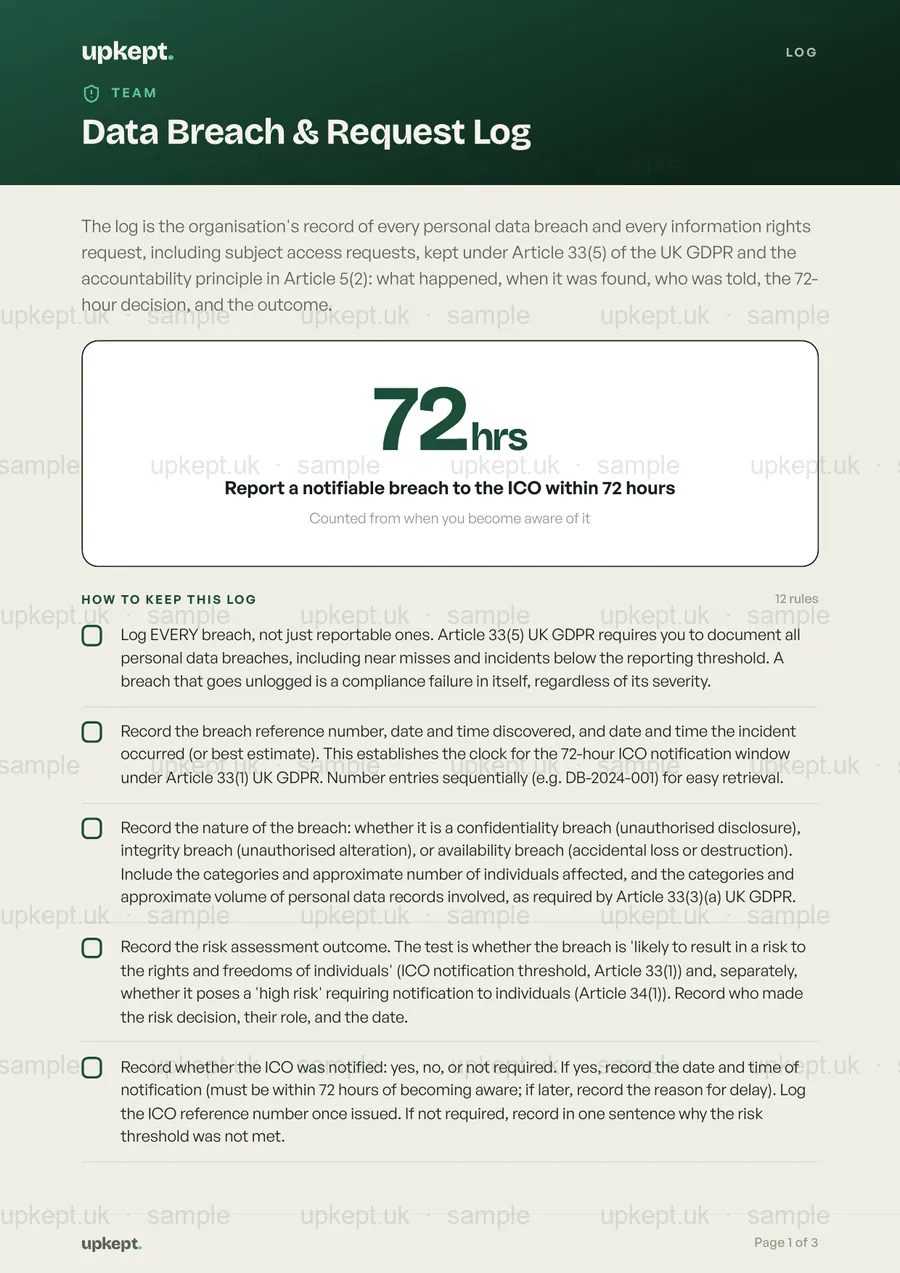
Data Breach & Request Log

This log is the organisation's centralised record of every personal data breach and information rights request (including subject access requests), kept to satisfy Article 33(5) of the UK GDPR and the accountability principle under Article 5(2). Without it, the ICO has no evidence of compliance: fines of up to £17.5 million (or 4% of global annual turnover, whichever is higher) and enforcement notices are the cost of a gap.

£34View
Safety

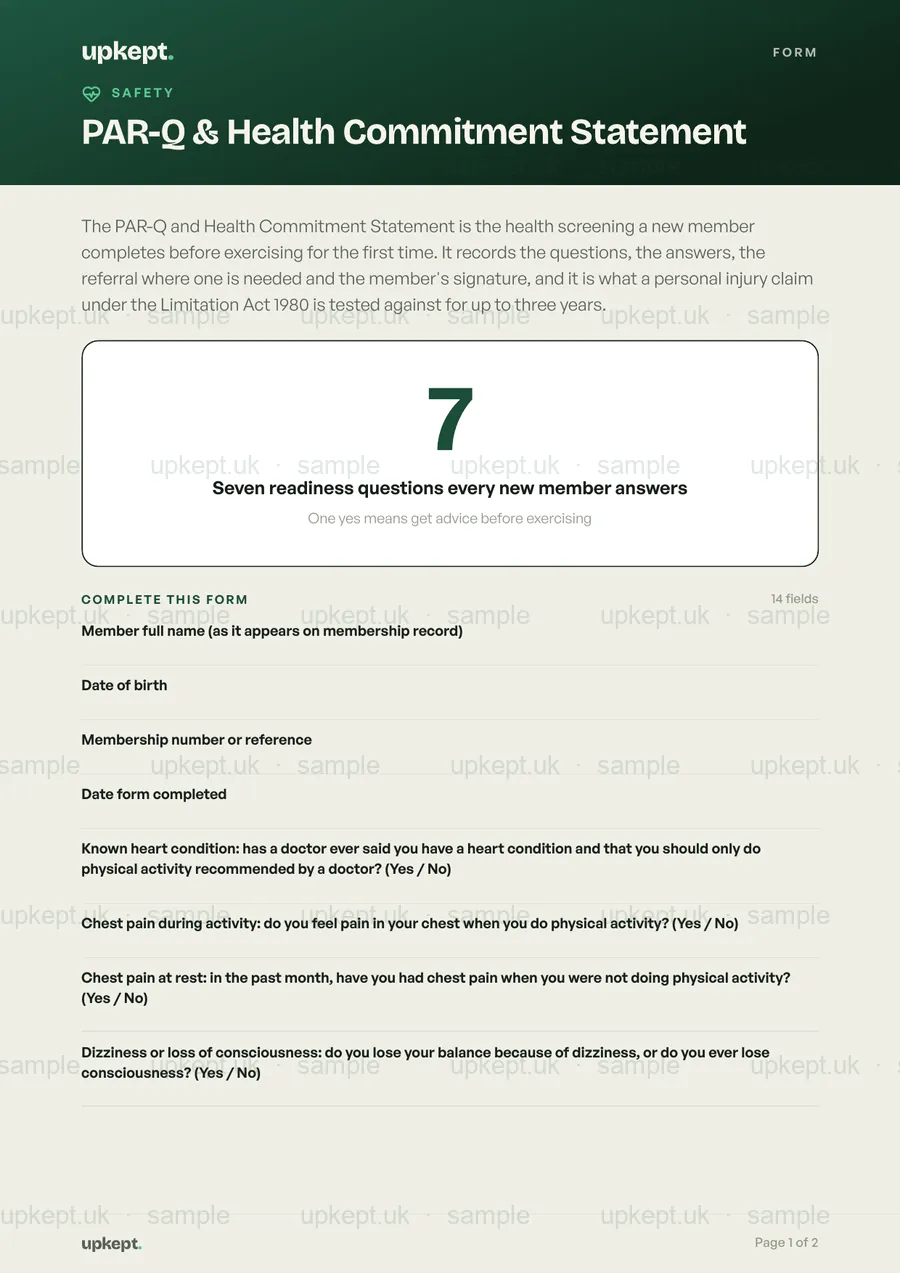
PAR-Q & Health Commitment Statement

The PAR-Q and Health Commitment Statement is the pre-activity health screening record a new gym or leisure facility member completes before exercising for the first time. Without it, an operator has no documented evidence of meeting their duty of care under the Health and Safety at Work etc. Act 1974 (sections 2 and 3) and no defence against a personal injury claim that could be brought up to three years from the date of the incident under the Limitation Act 1980 (section 11).

£34View
Safety

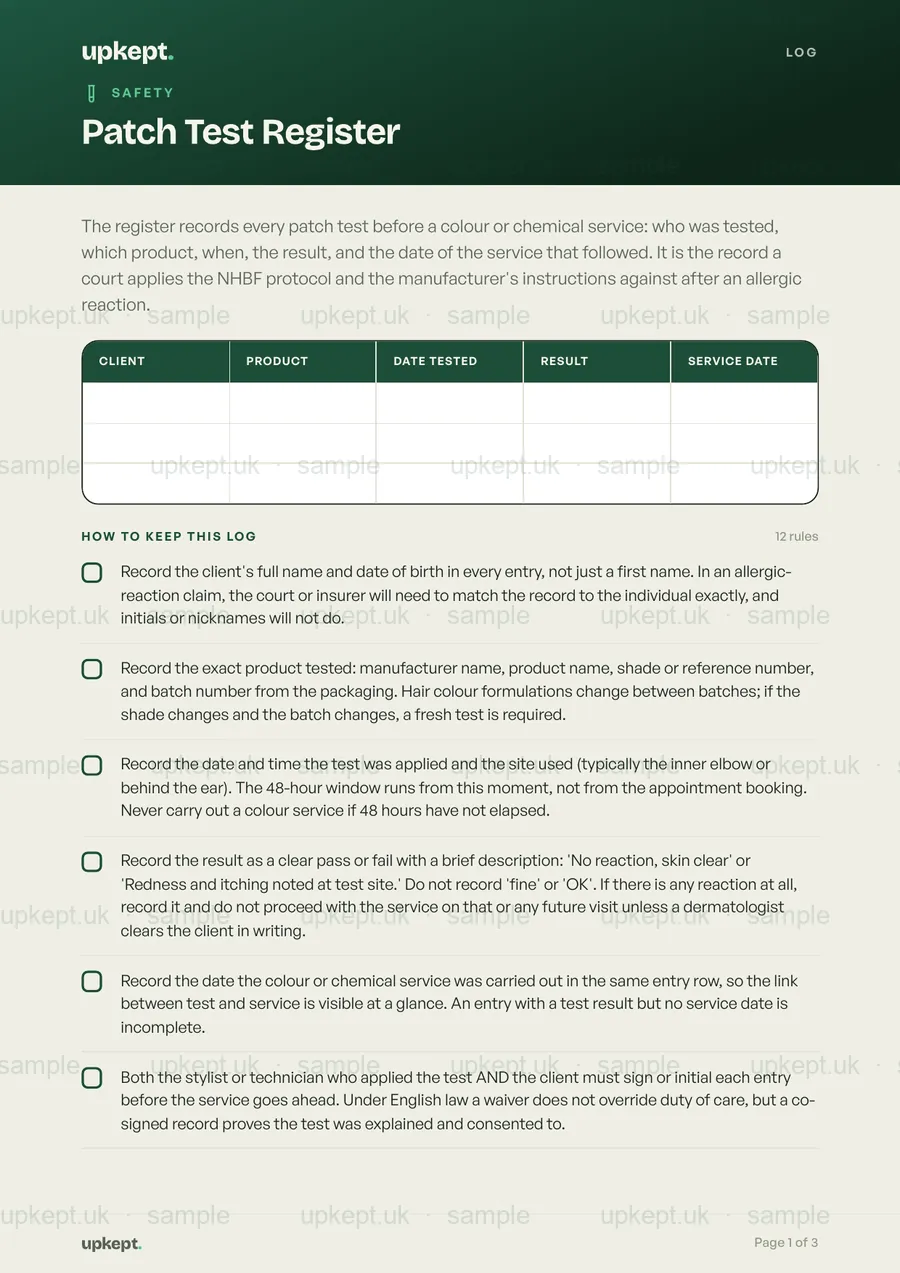
Patch Test Register

This register records every patch test carried out before a colour or chemical service: who was tested, what product was used, when the test was done, the result, and the date of the service that followed. Without it, you have no evidence that you met your duty of care under the Health and Safety at Work etc. Act 1974 s.3 and COSHH Regulations 2002, and a single allergic-reaction claim can exceed five figures with no insurer willing to defend you.

£34View
Daily

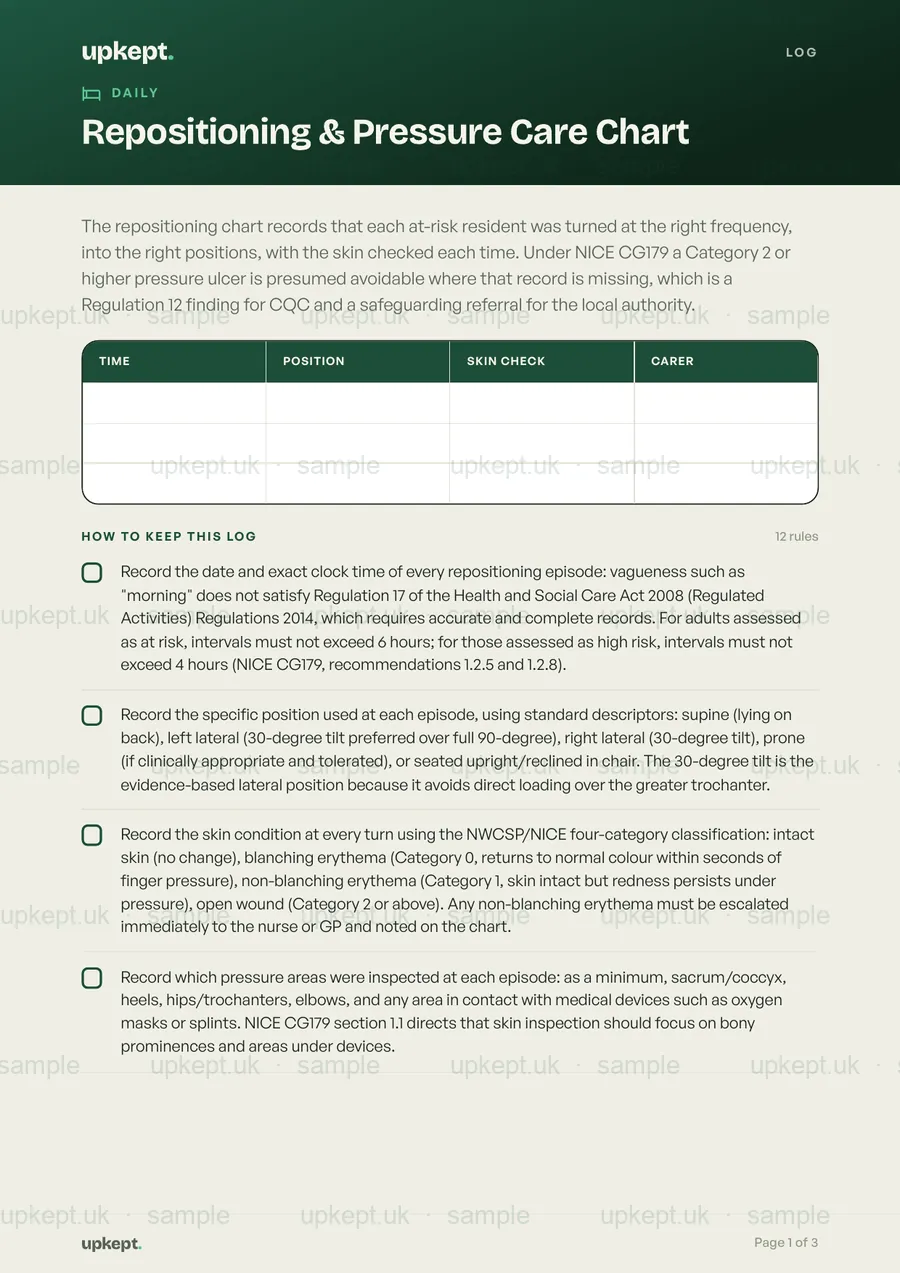
Repositioning & Pressure Care Chart

A repositioning and pressure care chart is the contemporaneous record that proves each at-risk resident or service user was turned or repositioned at the correct frequency, in the right positions, with skin checked at every episode. Without it, a Category 2 or above pressure ulcer becomes legally presumed avoidable under NICE CG179, exposing the provider to CQC enforcement under Regulation 12 (safe care and treatment) of the Health and Social Care Act 2008 (Regulated Activities) Regulations 2014, and potentially to safeguarding investigation by the local authority.

£34View
Safety

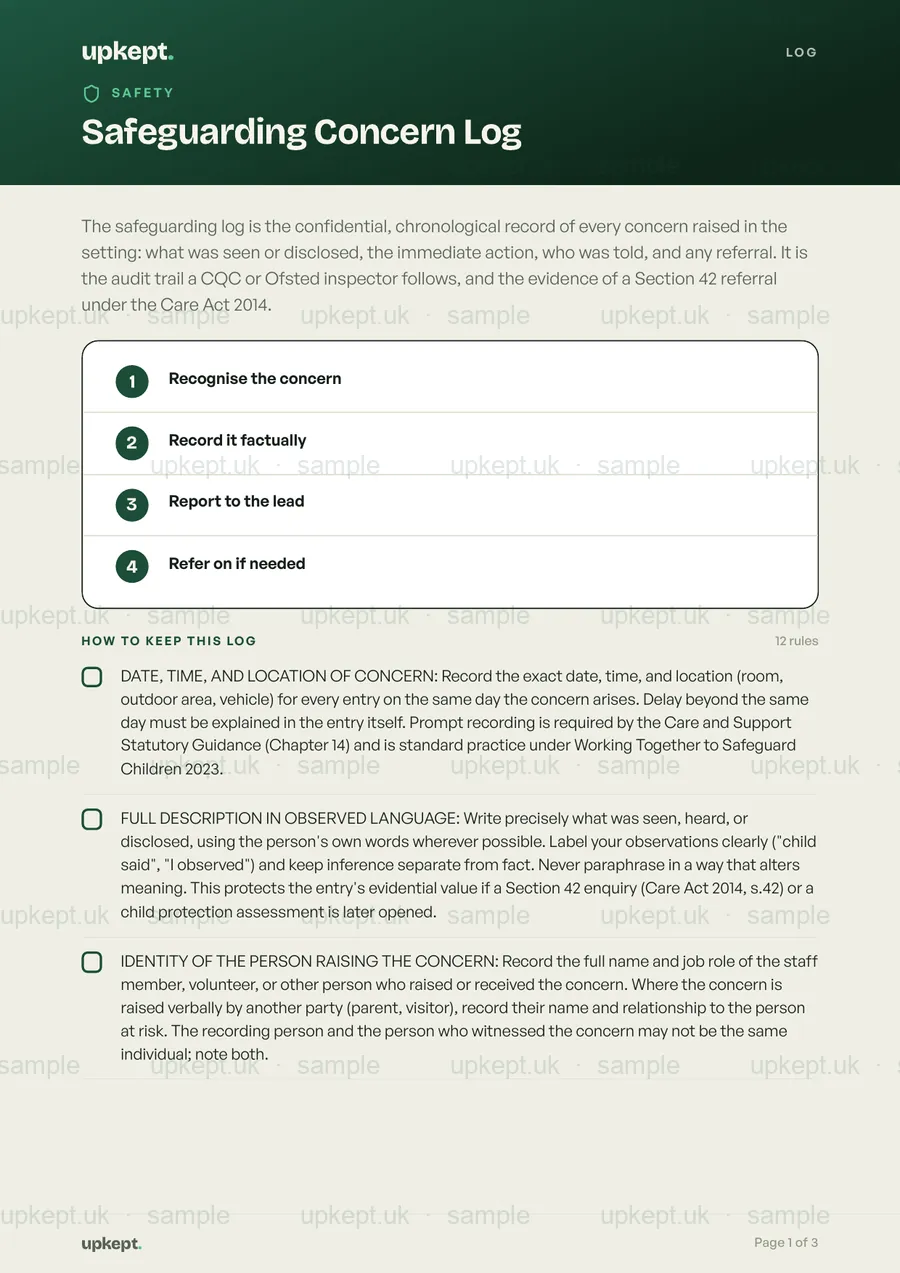
Safeguarding Concern Log

A confidential, chronological record of every safeguarding concern raised in the setting: what was seen or disclosed, the immediate action taken, who was told, and any referral made. Without it, a CQC or Ofsted inspector has no audit trail, the setting cannot demonstrate compliance with Regulation 13 of the Health and Social Care Act 2008 (Regulated Activities) Regulations 2014 or the EYFS Statutory Framework 2025, and any failure to report a Section 42 concern under the Care Act 2014 becomes impossible to defend.

£34View
Daily

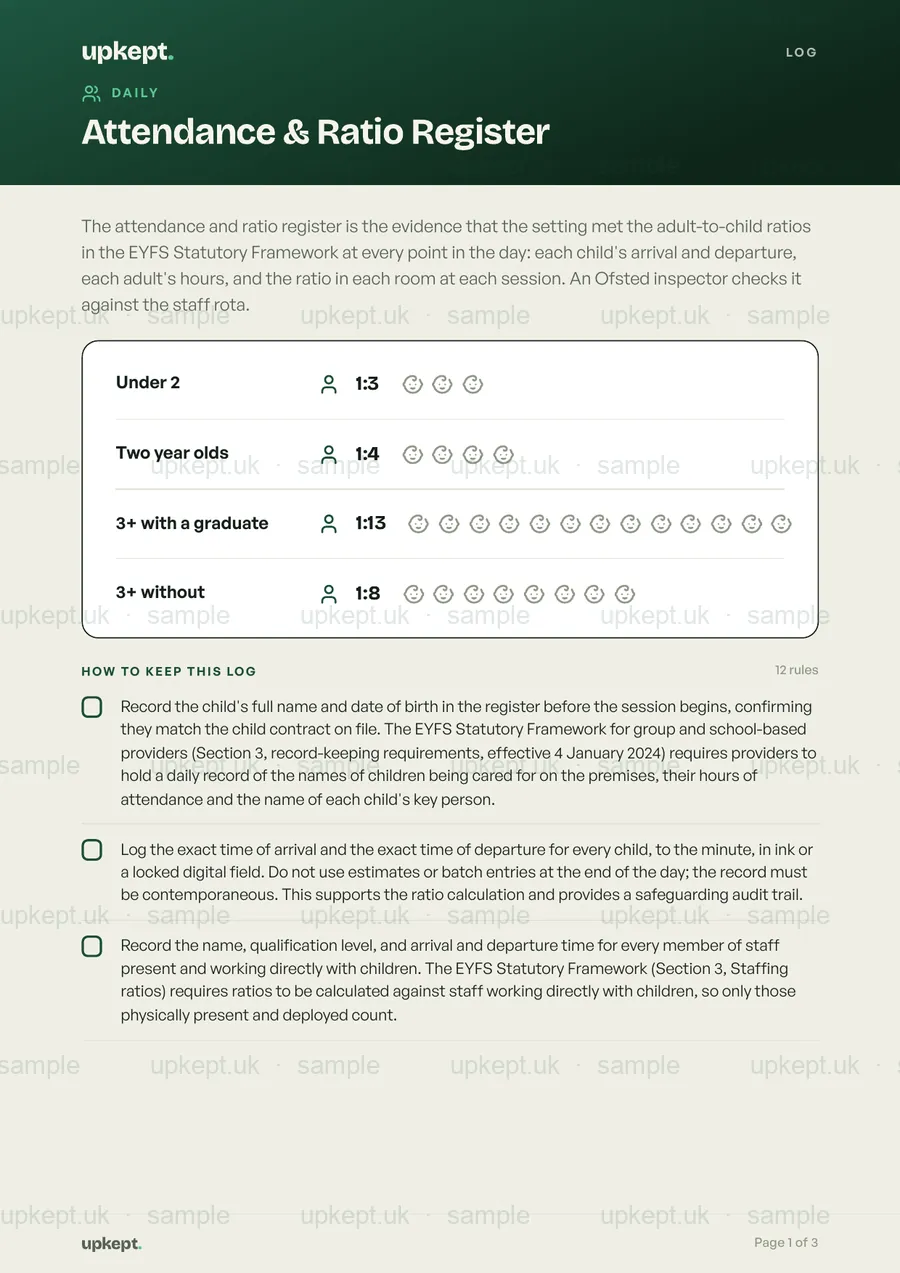
Attendance & Ratio Register

A daily Attendance and Ratio Register is the primary evidence that your setting is keeping children safe by meeting the legally required adult-to-child ratios at all times, as set out in the EYFS Statutory Framework (effective 4 January 2024, updated 1 September 2025). Without an accurate, contemporaneous register, an Ofsted inspector cannot verify compliance with the ratios; a single unexplained gap is sufficient grounds for an "Urgent improvement" or "Inadequate" welfare judgement and can trigger enforcement action under the Childcare Act 2006, section 40.

£34View

Train the team

Toolbox talks

All talks & bundles