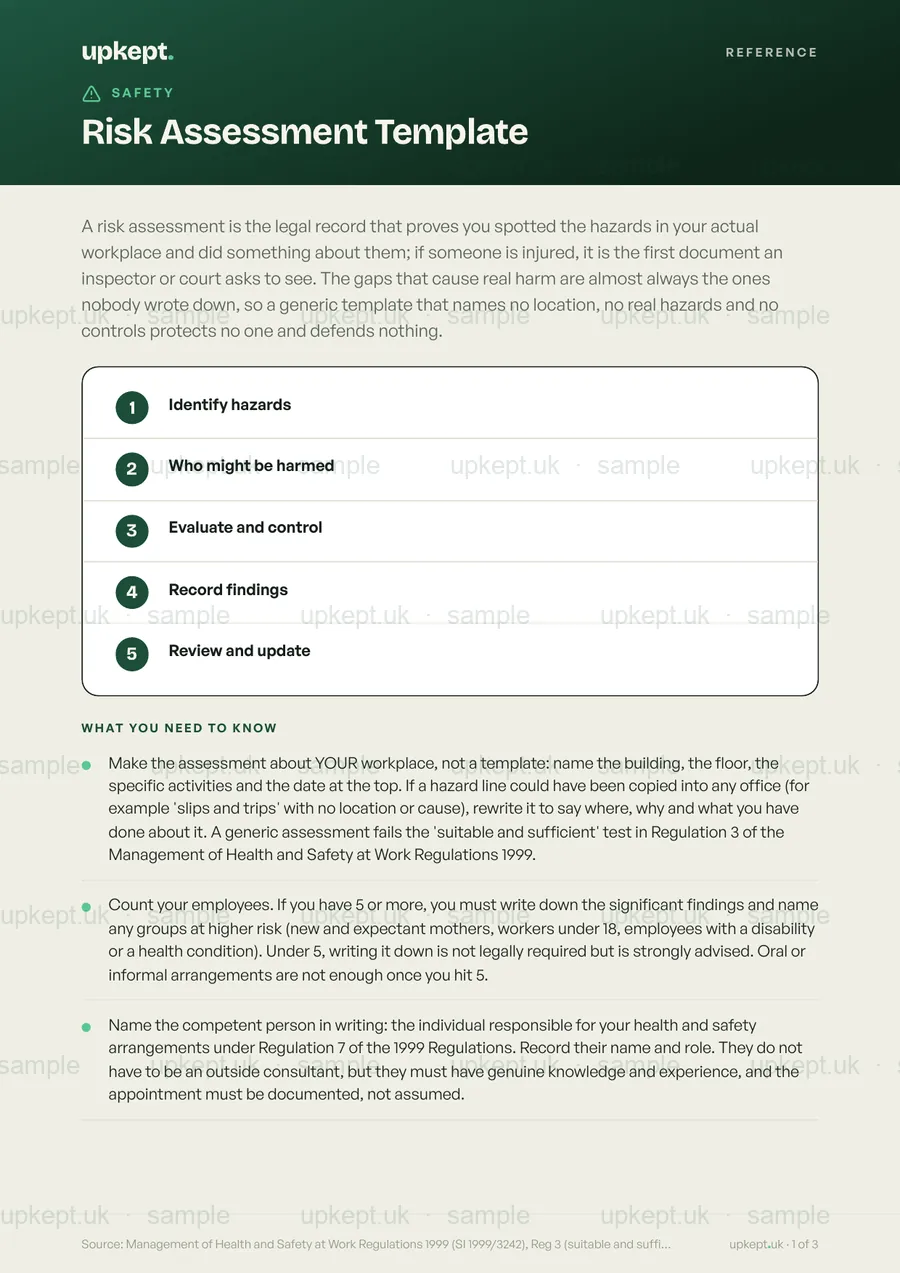
A risk assessment is the legal record that proves you spotted the hazards in your actual workplace and did something about them; if someone is injured, it is the first document an inspector or court asks to see. The gaps that cause real harm are almost always the ones nobody wrote down, so a generic template that names no location, no real hazards and no controls protects no one and defends nothing.
This free risk assessment template walks the HSE's five steps: spot the hazards, decide who might be harmed and how, put sensible controls in place, record what you found, and review it when things change. Download it free, no card needed.
11 checksPDF + phoneReviewed August 2026
Built on published UK guidance Show sources
Management of Health and Safety at Work Regulations 1999 (SI 1999/3242), Reg 3 (suitable and sufficient assessment), Reg 3(6) (written-record threshold of 5 employees), Reg 7 (competent person); Health and Safety (Display Screen Equipment) Regulations 1992 (SI 1992/2792), Regs 2 and 4, with HSE guidance L26 and hse.gov.uk DSE work-routine guidance (5 to 10 minute break per 50 to 60 minutes); Regulatory Reform (Fire Safety) Order 2005 (SI 2005/1541), Arts 9 and 18, as amended by the Fire Safety Act 2021 and the Fire Safety (England) Regulations 2022, with the recording duty in force from 1 October 2023; Reporting of Injuries, Diseases and Dangerous Occurrences Regulations 2013 (SI 2013/1471), Regs 4 and 12 (over-7-day reportable within 15 days vs over-3-day recordable); HSE guidance INDG163 (Risk assessment) and the HSE Management Standards for work-related stress.
Freeno card needed
Replaces a DIY doc, and you get every future update free when the guidance changes.
3 for 2 on documents and packs. Add 3 and your cheapest is free.
A clean one-page PDF, ready to print
Opens and ticks off on any phone
Clear, no jargon, easy to follow
Free updates whenever the guidance changes
Secure checkout30-day money-backInstant downloadNo subscriptionCard & Apple Pay
Made for places like this
What’s on it
11 things to check.
Everything that matters, nothing that does not. Here is the full list, exactly as it appears on the template.
1Make the assessment about YOUR workplace, not a template: name the building, the floor, the specific activities and the date at the top. If a hazard line could have been copied into any office (for example 'slips and trips' with no location or cause), rewrite it to say where, why and what you have done about it. A generic assessment fails the 'suitable and sufficient' test in Regulation 3 of the Management of Health and Safety at Work Regulations 1999.
2Count your employees. If you have 5 or more, you must write down the significant findings and name any groups at higher risk (new and expectant mothers, workers under 18, employees with a disability or a health condition). Under 5, writing it down is not legally required but is strongly advised. Oral or informal arrangements are not enough once you hit 5.
3Name the competent person in writing: the individual responsible for your health and safety arrangements under Regulation 7 of the 1999 Regulations. Record their name and role. They do not have to be an outside consultant, but they must have genuine knowledge and experience, and the appointment must be documented, not assumed.
4Do a separate one-to-one DSE (Display Screen Equipment) workstation assessment for every person who uses a screen for a significant part of their normal work, including anyone who regularly works from home. One office-wide DSE assessment does not meet the Health and Safety (Display Screen Equipment) Regulations 1992. Re-do it when the workstation or their role changes, or when they report aches, eye strain or discomfort.
5Plan screen work so DSE users get regular short breaks away from the screen. HSE guidance is a 5 to 10 minute break after every 50 to 60 minutes of continuous screen or keyboard work, taken often rather than one long break later. The law (Regulation 4) does not fix a duration but requires work to be 'periodically interrupted', so several unbroken hours at the screen is not compliant.
6Do a separate fire risk assessment under the Regulatory Reform (Fire Safety) Order 2005 and write it down (recording the fire risk assessment is a legal duty for all responsible persons since 1 October 2023, whatever your headcount). Confirm: escape routes and fire exits are clear and openable from the inside without a key during occupancy; exit signs are in place; there is a named responsible person; and you review it after any change to the layout, headcount, use or activities of the premises.
7Write down your lone working arrangements: who works alone, when, in which areas, and exactly how they check in. If anyone works alone after hours or in an isolated part of the building, set a live check-in (a timed call, a buddy who confirms they got home, or monitored entry and exit), not just a file note saying lone working is allowed.
8Name work-related stress as a hazard in the assessment, with its causes and your controls. Cover the six HSE Management Standards areas: demands, control, support, relationships, role and change. You do not have to run the full HSE survey, but a risk assessment with no stress entry at all is a recognised red flag to inspectors.
9Keep an accident book and record every injury that keeps an employee off work or unable to do their normal duties for more than 3 consecutive days, not counting the day of the accident. This is a record you hold, not yet a report to the HSE.
10Report to the HSE (online at riddor.hse.gov.uk) any work injury that keeps a worker off normal duties for more than 7 consecutive days, not counting the day of the accident but counting weekends and rest days. You must report it within 15 days of the accident date. The over-3-day record and the over-7-day report are two separate RIDDOR 2013 duties and are widely confused.
11Review and update the whole assessment whenever something significant changes: new equipment, a layout change, a move to hybrid or home working, a new starter in a higher-risk role, a near miss or an injury. An annual check is a sensible baseline but does not replace a change-triggered review. If your assessment predates your switch to hybrid working, it is almost certainly out of date for much of your team.
Good to know
The written-record duty does not apply to every employer: under Regulation 3(6) of the Management of Health and Safety at Work Regulations 1999 it only starts once you have 5 or more employees. Below that there is no legal duty to write it down (though it is good practice). The catch runs the other way too: at 5 or more, the written record must specifically name any groups at heightened risk, and informal arrangements no longer count. Note the separate fire rule: since 1 October 2023 the fire risk assessment must be recorded regardless of how many people you employ.
Source: Management of Health and Safety at Work Regulations 1999 (SI 1999/3242), Reg 3 (suitable and sufficient assessment), Reg 3(6) (written-record threshold of 5 employees), Reg 7 (competent person); Health and Safety (Display Screen Equipment) Regulations 1992 (SI 1992/2792), Regs 2 and 4, with HSE guidance L26 and hse.gov.uk DSE work-routine guidance (5 to 10 minute break per 50 to 60 minutes); Regulatory Reform (Fire Safety) Order 2005 (SI 2005/1541), Arts 9 and 18, as amended by the Fire Safety Act 2021 and the Fire Safety (England) Regulations 2022, with the recording duty in force from 1 October 2023; Reporting of Injuries, Diseases and Dangerous Occurrences Regulations 2013 (SI 2013/1471), Regs 4 and 12 (over-7-day reportable within 15 days vs over-3-day recordable); HSE guidance INDG163 (Risk assessment) and the HSE Management Standards for work-related stress.
Good to know
Questions, answered
Is this risk assessment template really free?
Yes. The download is free and it is the full template, not a sample. If you want the matching daily version with a place to sign every shift, the Daily Risk Assessment is available as a single, and the sector packs include the full set for your kind of place.
What are the five steps of a risk assessment?
Identify the hazards; decide who might be harmed and how; evaluate the risks and decide on control measures; record your significant findings; and review the assessment when anything changes. That is the structure HSE guidance describes, and it is exactly how this template is laid out.
What is the Risk Assessment Template?
A risk assessment is the legal record that proves you spotted the hazards in your actual workplace and did something about them; if someone is injured, it is the first document an inspector or court asks to see. The gaps that cause real harm are almost always the ones nobody wrote down, so a generic template that names no location, no real hazards and no controls protects no one and defends nothing.
Why does it matter?
The written-record duty does not apply to every employer: under Regulation 3(6) of the Management of Health and Safety at Work Regulations 1999 it only starts once you have 5 or more employees. Below that there is no legal duty to write it down (though it is good practice). The catch runs the other way too: at 5 or more, the written record must specifically name any groups at heightened risk, and informal arrangements no longer count. Note the separate fire rule: since 1 October 2023 the fire risk assessment must be recorded regardless of how many people you employ.
How do I get it, and is it up to date?
The PDF downloads the moment you check out, prints sharp in black and white, and opens on any phone. It is reviewed for August 2026 and you get any future update free when the official guidance changes.
A discharged or depressurised extinguisher found during a real fire is no better than having no extinguisher at all. The monthly visual check catches the common pre-failure states (lost pressure, broken tamper seal, blocked access, overdue service) before they matter, and it gives the responsible person the maintenance records the Regulatory Reform (Fire Safety) Order 2005 requires.
A fire door only works if it closes fully, latches, and seals the gaps; one door that fails to do that lets smoke and fire spread through a building in minutes and removes people's time to escape. These checks catch the specific, common failures (props, blown gaps, missing closers, painted-up seals) that turn a survivable fire into a fatal one.
An under-stocked or expired first aid kit means the person treating an injury reaches for a dressing and finds an empty slot, a perished wrapper, or latex gloves that trigger an allergic reaction. A regular documented check fixes that in advance and gives an HSE or Ofsted inspector evidence that your first aid provision is genuinely maintained, not just present.