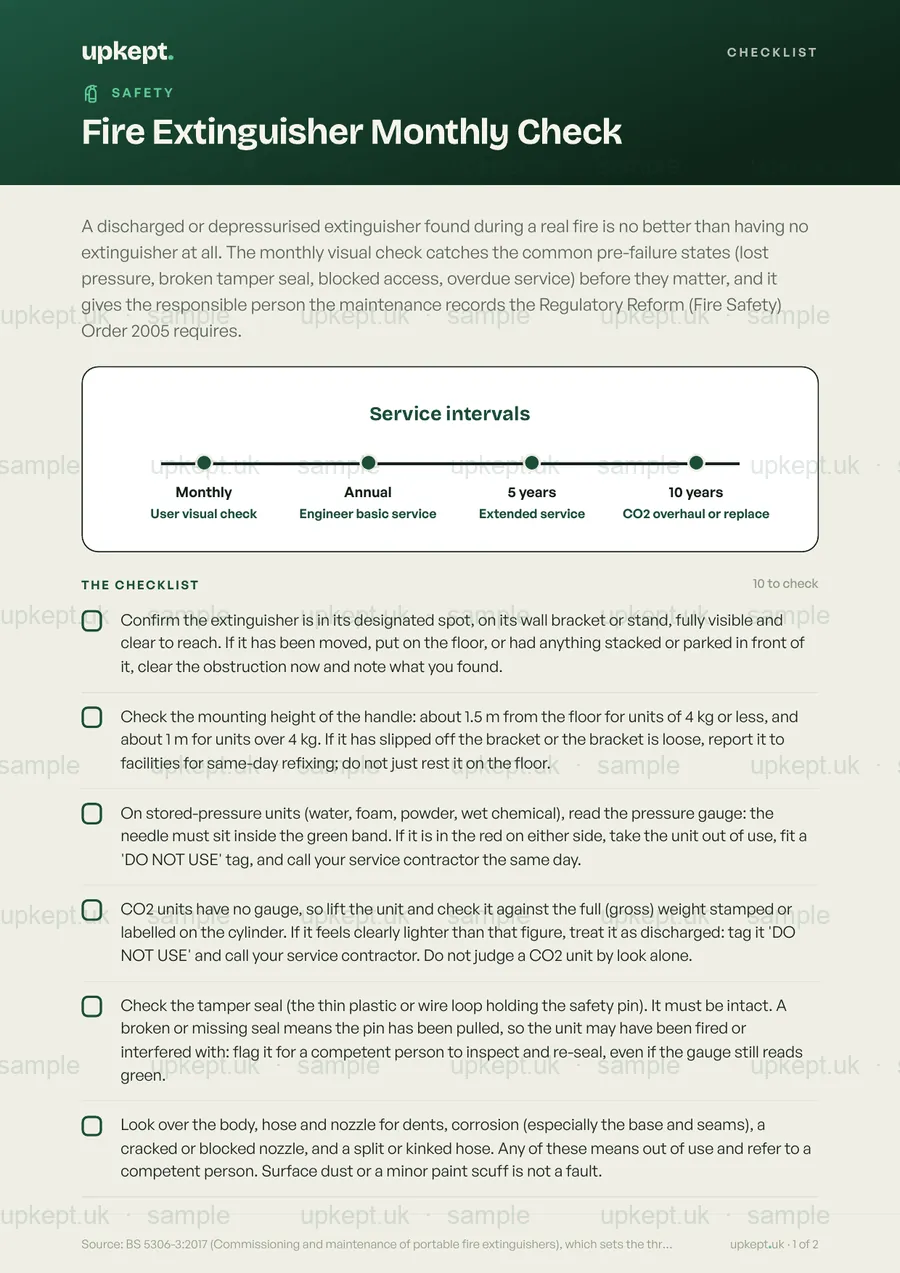
A discharged or depressurised extinguisher found during a real fire is no better than having no extinguisher at all. The monthly visual check catches the common pre-failure states (lost pressure, broken tamper seal, blocked access, overdue service) before they matter, and it gives the responsible person the maintenance records the Regulatory Reform (Fire Safety) Order 2005 requires.
10 checksPDF + phoneReviewed August 2026
Built on published UK guidance Show sources
BS 5306-3:2017 (Commissioning and maintenance of portable fire extinguishers), which sets the three-tier regime: monthly user inspection, annual basic service by a competent person, and extended service (water, foam and powder at 5 years) or overhaul (CO2 at 10 years). Mounting heights from BS 5306-8:2023 (Selection and positioning of portable fire extinguishers): handle about 1.5 m for units up to 4 kg, about 1 m for heavier units. Legal duty to keep fire-fighting equipment in efficient working order and in good repair sits in Article 17 of the Regulatory Reform (Fire Safety) Order 2005 (England and Wales), with equivalent duties under the Fire (Scotland) Act 2005 and the Fire and Rescue Services (Northern Ireland) Order 2006.
Freeno card needed
Replaces a DIY doc, and you get every future update free when the guidance changes.
3 for 2 on documents and packs. Add 3 and your cheapest is free.
A clean one-page PDF, ready to print
Opens and ticks off on any phone
Clear, no jargon, easy to follow
Free updates whenever the guidance changes
Secure checkout30-day money-backInstant downloadNo subscriptionCard & Apple Pay
Made for places like this
What’s on it
10 things to check.
Everything that matters, nothing that does not. Here is the full list, exactly as it appears on the template.
1Confirm the extinguisher is in its designated spot, on its wall bracket or stand, fully visible and clear to reach. If it has been moved, put on the floor, or had anything stacked or parked in front of it, clear the obstruction now and note what you found.
2Check the mounting height of the handle: about 1.5 m from the floor for units of 4 kg or less, and about 1 m for units over 4 kg. If it has slipped off the bracket or the bracket is loose, report it to facilities for same-day refixing; do not just rest it on the floor.
3On stored-pressure units (water, foam, powder, wet chemical), read the pressure gauge: the needle must sit inside the green band. If it is in the red on either side, take the unit out of use, fit a 'DO NOT USE' tag, and call your service contractor the same day.
4CO2 units have no gauge, so lift the unit and check it against the full (gross) weight stamped or labelled on the cylinder. If it feels clearly lighter than that figure, treat it as discharged: tag it 'DO NOT USE' and call your service contractor. Do not judge a CO2 unit by look alone.
5Check the tamper seal (the thin plastic or wire loop holding the safety pin). It must be intact. A broken or missing seal means the pin has been pulled, so the unit may have been fired or interfered with: flag it for a competent person to inspect and re-seal, even if the gauge still reads green.
6Look over the body, hose and nozzle for dents, corrosion (especially the base and seams), a cracked or blocked nozzle, and a split or kinked hose. Any of these means out of use and refer to a competent person. Surface dust or a minor paint scuff is not a fault.
7Check the operating-instructions label on the body is legible and facing outward, so someone can read it under pressure. If it is peeling, faded, or turned to face the wall, fix it. A label nobody can read in a few seconds has failed.
8Check the service label for the last basic service date: it must be within the past 12 months. If it is overdue, do not wait for next month; log it and book the annual service now. Note the extended-service tier too: water, foam and powder need extended service at 5 years, CO2 needs an overhaul at 10 years. If the date is unclear, ask your contractor to confirm from their records.
9Check the fire-extinguisher location sign above or beside the unit is present, unobstructed, and readable from across the room. If it is missing, covered, or illegible, replace it the same day.
10Record the check in writing (paper or digital) with the date, each extinguisher's location, the result (pass or action needed), and your name. The Regulatory Reform (Fire Safety) Order 2005 requires the responsible person to keep maintenance records: an unrecorded check legally did not happen.
Good to know
CO2 extinguishers have no pressure gauge, so a check that only reads gauges will pass a fully discharged CO2 unit every month. The only reliable test is to lift it and compare against the full weight marked on the cylinder. This is the single most common type-specific inspection miss in premises with mixed extinguisher stock.
Source: BS 5306-3:2017 (Commissioning and maintenance of portable fire extinguishers), which sets the three-tier regime: monthly user inspection, annual basic service by a competent person, and extended service (water, foam and powder at 5 years) or overhaul (CO2 at 10 years). Mounting heights from BS 5306-8:2023 (Selection and positioning of portable fire extinguishers): handle about 1.5 m for units up to 4 kg, about 1 m for heavier units. Legal duty to keep fire-fighting equipment in efficient working order and in good repair sits in Article 17 of the Regulatory Reform (Fire Safety) Order 2005 (England and Wales), with equivalent duties under the Fire (Scotland) Act 2005 and the Fire and Rescue Services (Northern Ireland) Order 2006.
Good to know
Questions, answered
What is the Fire Extinguisher Monthly Check?
A discharged or depressurised extinguisher found during a real fire is no better than having no extinguisher at all. The monthly visual check catches the common pre-failure states (lost pressure, broken tamper seal, blocked access, overdue service) before they matter, and it gives the responsible person the maintenance records the Regulatory Reform (Fire Safety) Order 2005 requires.
Why does it matter?
CO2 extinguishers have no pressure gauge, so a check that only reads gauges will pass a fully discharged CO2 unit every month. The only reliable test is to lift it and compare against the full weight marked on the cylinder. This is the single most common type-specific inspection miss in premises with mixed extinguisher stock.
How do I get it, and is it up to date?
The PDF downloads the moment you check out, prints sharp in black and white, and opens on any phone. It is reviewed for August 2026 and you get any future update free when the official guidance changes.
A fire door only works if it closes fully, latches, and seals the gaps; one door that fails to do that lets smoke and fire spread through a building in minutes and removes people's time to escape. These checks catch the specific, common failures (props, blown gaps, missing closers, painted-up seals) that turn a survivable fire into a fatal one.
An under-stocked or expired first aid kit means the person treating an injury reaches for a dressing and finds an empty slot, a perished wrapper, or latex gloves that trigger an allergic reaction. A regular documented check fixes that in advance and gives an HSE or Ofsted inspector evidence that your first aid provision is genuinely maintained, not just present.
Faulty or untested emergency lighting is one of the most common fire safety enforcement failures in the UK. These checks prove that if the mains fails during an evacuation, every escape route stays lit long enough to get people out, and that you have the dated, signed log a fire authority inspector will ask to see first.