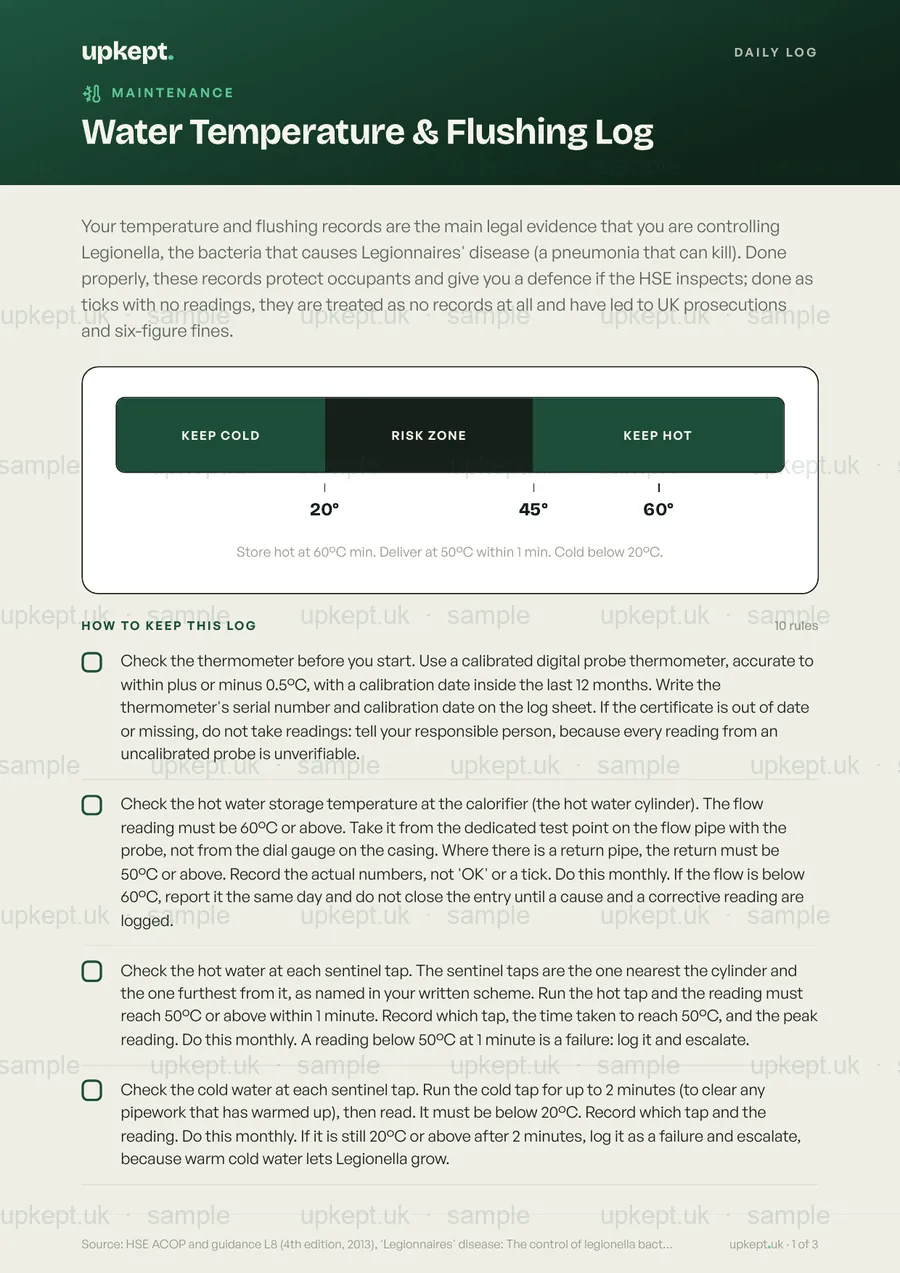
Your temperature and flushing records are the main legal evidence that you are controlling Legionella, the bacteria that causes Legionnaires' disease (a pneumonia that can kill). Done properly, these records protect occupants and give you a defence if the HSE inspects; done as ticks with no readings, they are treated as no records at all and have led to UK prosecutions and six-figure fines.
10 checksPDF + phoneReviewed August 2026
Built on published UK guidance Show sources
HSE ACOP and guidance L8 (4th edition, 2013), 'Legionnaires' disease: The control of legionella bacteria in water systems'; HSE HSG274 Part 2 (2014), 'The control of legionella bacteria in hot and cold water systems', specifically Table 2.1 (checklist of inspection tasks and frequencies). Key figures used: hot storage/calorifier flow 60°C or above and return 50°C or above, checked monthly; hot sentinel outlets 50°C within 1 minute, monthly; cold sentinel outlets below 20°C within 2 minutes, monthly; cold water storage tank inspected/temperature-checked at least annually; little-used outlets flushed weekly; showerheads and hoses dismantled, cleaned, descaled and disinfected quarterly. Record retention minimum of 5 years per HSE guidance at hse.gov.uk/legionnaires/what-you-must-do/keeping-records.htm.
£14one-off, yours forever
Replaces a DIY doc, and you get every future update free when the guidance changes.
3 for 2 on documents and packs. Add 3 and your cheapest is free.
A clean one-page PDF, ready to print
Opens and ticks off on any phone
Clear, no jargon, easy to follow
Free updates whenever the guidance changes
Secure checkout30-day money-backInstant downloadNo subscriptionCard & Apple Pay
Best valueSave 42%
Or get all 56 templates
The Everything Bundle: every template today and every future one.£399 one-off, instead of £686 bought separately.
Made for places like this
What’s on it
10 things to check.
Everything that matters, nothing that does not. Here is the full list, exactly as it appears on the template.
1Check the thermometer before you start. Use a calibrated digital probe thermometer, accurate to within plus or minus 0.5°C, with a calibration date inside the last 12 months. Write the thermometer's serial number and calibration date on the log sheet. If the certificate is out of date or missing, do not take readings: tell your responsible person, because every reading from an uncalibrated probe is unverifiable.
2Check the hot water storage temperature at the calorifier (the hot water cylinder). The flow reading must be 60°C or above. Take it from the dedicated test point on the flow pipe with the probe, not from the dial gauge on the casing. Where there is a return pipe, the return must be 50°C or above. Record the actual numbers, not 'OK' or a tick. Do this monthly. If the flow is below 60°C, report it the same day and do not close the entry until a cause and a corrective reading are logged.
3Check the hot water at each sentinel tap. The sentinel taps are the one nearest the cylinder and the one furthest from it, as named in your written scheme. Run the hot tap and the reading must reach 50°C or above within 1 minute. Record which tap, the time taken to reach 50°C, and the peak reading. Do this monthly. A reading below 50°C at 1 minute is a failure: log it and escalate.
4Check the cold water at each sentinel tap. Run the cold tap for up to 2 minutes (to clear any pipework that has warmed up), then read. It must be below 20°C. Record which tap and the reading. Do this monthly. If it is still 20°C or above after 2 minutes, log it as a failure and escalate, because warm cold water lets Legionella grow.
5Check the cold water storage tank temperature at least once a year, ideally in summer when it is warmest. Take the reading in the tank, or at the tap closest to it, and it must be below 20°C. Also record the incoming mains temperature. If the tank is 20°C or above, report it immediately for investigation.
6Flush every little-used outlet weekly and log each one. Any tap, shower, or hose point not used in the past 7 days must be run for at least 2 minutes. Record the outlet reference, date, time, who flushed it, and how long. For showers, point the head into the tray and start the water before you lean in, so you do not breathe in the spray.
7Dismantle, clean, descale, and disinfect every showerhead and flexible hose quarterly (every 3 months) and log it. Record the asset reference, date, who did it, what you found (scale, slime/biofilm, debris), and whether the head was refitted or replaced. Showerheads are high risk: scale and biofilm inside the rose give Legionella somewhere to live, and the spray makes a breathable mist.
8Flush any outlet for at least 5 minutes before it goes back into use after a shutdown or vacancy of 7 days or more, and record it. This covers rooms, floors, or whole buildings reopening after holiday closures, refurbishment, or low occupancy (common in hotels, schools, and leisure). This step is the one inspectors most often find missing.
9Record a corrective action against every failed reading. When any reading is out of range (hot storage below 60°C, hot outlet below 50°C at 1 minute, cold above 20°C), the entry must show the reading, the date and who you reported it to, what was done to fix it, and a retest reading with its date. A log showing failures with no follow-up is treated as worse than no log.
10Keep all completed log sheets for at least 5 years, in date order, in one water logbook (paper or digital). This is the HSE minimum. If an inspector asks and you cannot produce the last 5 years, that gap is non-compliance even if the work was actually done.
Good to know
Hot water feeling hot at the tap is not proof of compliance. HSG274 Part 2 sets two separate tests that must both pass: the outlet must reach 50°C within 1 minute of running, AND the calorifier must store at 60°C or above. A cylinder sitting at 55°C can still deliver a hot-feeling tap, but 55°C is not hot enough to kill Legionella in the stored volume, so the system fails even though the tap test looks fine. The targets are deliberately above the danger zone: Legionella multiplies roughly between 20°C and 45°C.
Source: HSE ACOP and guidance L8 (4th edition, 2013), 'Legionnaires' disease: The control of legionella bacteria in water systems'; HSE HSG274 Part 2 (2014), 'The control of legionella bacteria in hot and cold water systems', specifically Table 2.1 (checklist of inspection tasks and frequencies). Key figures used: hot storage/calorifier flow 60°C or above and return 50°C or above, checked monthly; hot sentinel outlets 50°C within 1 minute, monthly; cold sentinel outlets below 20°C within 2 minutes, monthly; cold water storage tank inspected/temperature-checked at least annually; little-used outlets flushed weekly; showerheads and hoses dismantled, cleaned, descaled and disinfected quarterly. Record retention minimum of 5 years per HSE guidance at hse.gov.uk/legionnaires/what-you-must-do/keeping-records.htm.
Good to know
Questions, answered
What is the Water Temperature & Flushing Log?
Your temperature and flushing records are the main legal evidence that you are controlling Legionella, the bacteria that causes Legionnaires' disease (a pneumonia that can kill). Done properly, these records protect occupants and give you a defence if the HSE inspects; done as ticks with no readings, they are treated as no records at all and have led to UK prosecutions and six-figure fines.
Why does it matter?
Hot water feeling hot at the tap is not proof of compliance. HSG274 Part 2 sets two separate tests that must both pass: the outlet must reach 50°C within 1 minute of running, AND the calorifier must store at 60°C or above. A cylinder sitting at 55°C can still deliver a hot-feeling tap, but 55°C is not hot enough to kill Legionella in the stored volume, so the system fails even though the tap test looks fine. The targets are deliberately above the danger zone: Legionella multiplies roughly between 20°C and 45°C.
How do I get it, and is it up to date?
The PDF downloads the moment you check out, prints sharp in black and white, and opens on any phone. It is reviewed for August 2026 and you get any future update free when the official guidance changes.
A daily premises walk-round catches the failures that injure people and trigger enforcement before they hurt anyone: wedged fire doors, blocked escape routes, wet floors with no sign, and water outlets sitting unused long enough to breed legionella. It costs nothing and a new starter can do it. Missing these is what brings injuries, an Improvement or Prohibition Notice under the Fire Safety Order 2005, and prosecution under the Health and Safety at Work Act 1974.
This logbook is the duty holder's running proof that Legionella bacteria are being actively controlled in the building's water system, as required under the Health and Safety at Work etc. Act 1974, COSHH Regulations 2002, and the L8 Approved Code of Practice. Without it, an HSE inspector has no evidence that legal duties have been met, and a confirmed case of Legionnaires' disease on premises with no records can lead to prosecution, unlimited fines, and imprisonment for up to two years.
This register is the written evidence that your portable electrical equipment is being maintained in a safe condition, as required by the Electricity at Work Regulations 1989 (Regulation 4) and PUWER 1998 (Regulations 5 and 6). Without it, a single electrical incident or HSE inspection can leave you unable to demonstrate compliance, exposing the duty holder to unlimited criminal liability under the Health and Safety at Work etc. Act 1974.