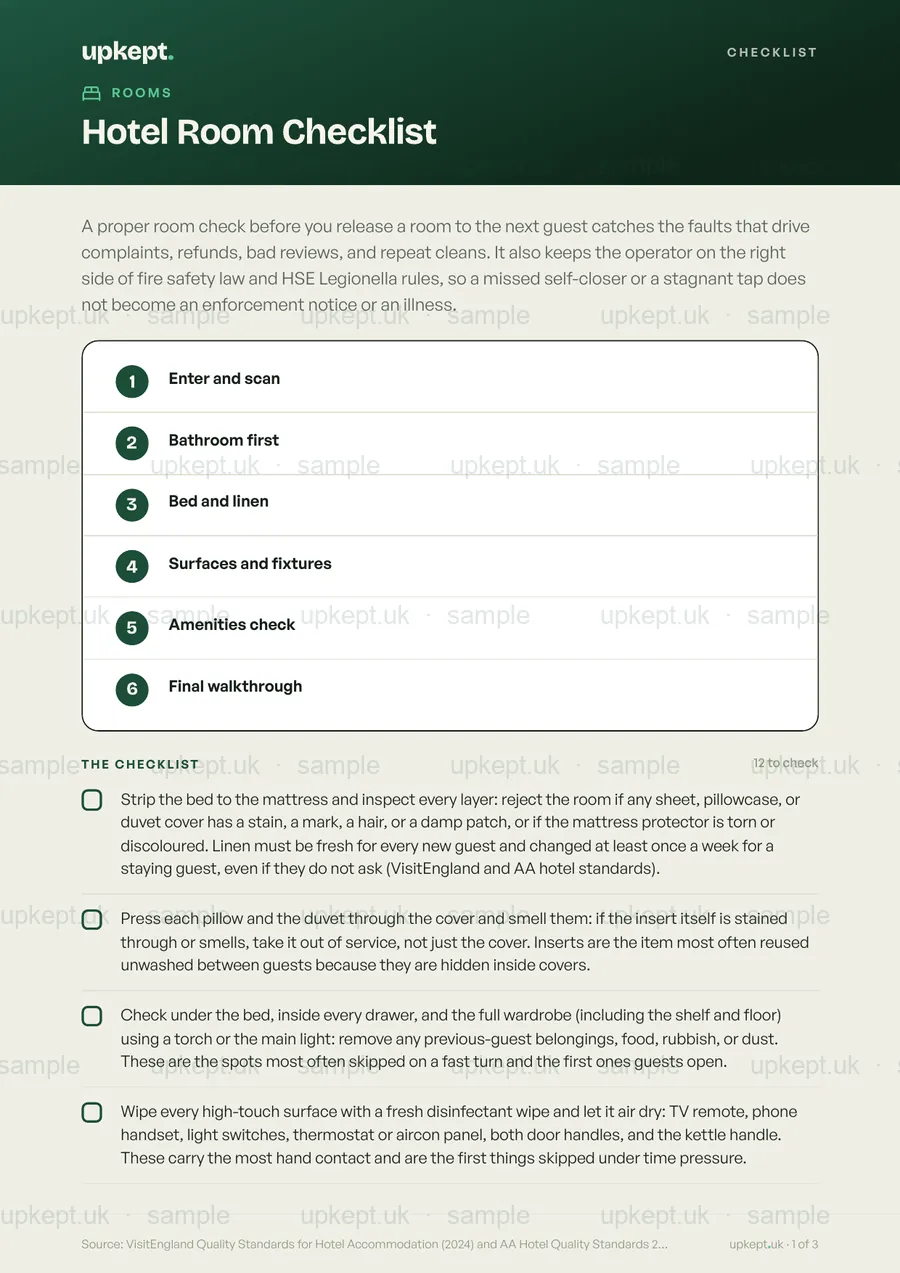
A proper room check before you release a room to the next guest catches the faults that drive complaints, refunds, bad reviews, and repeat cleans. It also keeps the operator on the right side of fire safety law and HSE Legionella rules, so a missed self-closer or a stagnant tap does not become an enforcement notice or an illness.
12 checksPDF + phoneReviewed August 2026
Built on published UK guidance Show sources
VisitEngland Quality Standards for Hotel Accommodation (2024) and AA Hotel Quality Standards 2018 (bed linen fresh for each new guest and changed at least weekly for continuing stays). HSE HSG274 Part 2 (control of Legionella in hot and cold water systems): hot water at least 50C at the outlet within one minute, cold water below 20C within two minutes, and flushing of outlets unused for seven days or more before reoccupation. Regulatory Reform (Fire Safety) Order 2005 with the GOV.UK fire safety risk assessment guidance for sleeping accommodation (self-closing fire doors to bedrooms in hotels). BS 5839-1:2025 (fire detection and alarm systems in non-domestic premises): weekly user test and competent-person servicing at intervals not exceeding six months.
£14one-off, yours forever
Replaces a DIY doc, and you get every future update free when the guidance changes.
3 for 2 on documents and packs. Add 3 and your cheapest is free.
A clean one-page PDF, ready to print
Opens and ticks off on any phone
Clear, no jargon, easy to follow
Free updates whenever the guidance changes
Secure checkout30-day money-backInstant downloadNo subscriptionCard & Apple Pay
Best valueSave 42%
Or get all 56 templates
The Everything Bundle: every template today and every future one.£399 one-off, instead of £686 bought separately.
Made for places like this
What’s on it
12 things to check.
Everything that matters, nothing that does not. Here is the full list, exactly as it appears on the template.
1Strip the bed to the mattress and inspect every layer: reject the room if any sheet, pillowcase, or duvet cover has a stain, a mark, a hair, or a damp patch, or if the mattress protector is torn or discoloured. Linen must be fresh for every new guest and changed at least once a week for a staying guest, even if they do not ask (VisitEngland and AA hotel standards).
2Press each pillow and the duvet through the cover and smell them: if the insert itself is stained through or smells, take it out of service, not just the cover. Inserts are the item most often reused unwashed between guests because they are hidden inside covers.
3Check under the bed, inside every drawer, and the full wardrobe (including the shelf and floor) using a torch or the main light: remove any previous-guest belongings, food, rubbish, or dust. These are the spots most often skipped on a fast turn and the first ones guests open.
4Wipe every high-touch surface with a fresh disinfectant wipe and let it air dry: TV remote, phone handset, light switches, thermostat or aircon panel, both door handles, and the kettle handle. These carry the most hand contact and are the first things skipped under time pressure.
5If the room has been empty for seven days or more, run the basin tap, bath tap, and shower on full for at least two minutes each before releasing it, and log the date, room number, and your name. Stagnant water in unused rooms is the main Legionella risk in hotels (HSE HSG274 Part 2, flushing of infrequently used outlets).
6Run the shower and hold your wrist under it: hot water should feel properly hot (the standard is at least 50C at the outlet within one minute), and the cold tap should run genuinely cold (below 20C within two minutes). If hot runs lukewarm or cold runs warm, log it and report to maintenance; do not release the room.
7Open the bathroom fully to the light and check the silicone and grout at the shower tray edge, around the bath, and behind the taps: any black mould must be properly treated and removed before release, not wiped over. Then fill the shower tray a little and confirm it drains within about ten seconds with no standing water.
8Open the bedroom door to 90 degrees and let go: the self-closer must pull it fully shut and the latch must click home on its own, with no gap at the frame. A bedroom fire door that does not self-close and latch is a fire safety breach in sleeping accommodation; do not release the room until maintenance has fixed it.
9Look up at the smoke detector: confirm it is in place, has nothing draped over it or stored under it, and is not hanging loose. Report any detector that is missing, covered, damaged, or showing a fault or flashing red light (fire alarm systems are tested weekly and serviced at least every six months under BS 5839-1, but a covered or missing head in a room is yours to flag now).
10Switch on every light source one at a time and replace any that fail: bedside lamps, desk lamp, overhead, wardrobe, bathroom, and mirror light. One dead bulb makes a clean room read as neglected.
11Set the room to your property's standard pack and count it: correct towels per guest, fresh toilet roll with a folded end plus a spare on show, soap and toiletries, and any branded items (folder, pen, pad) present, clean, and undamaged. Missing basics are one of the most common guest complaints.
12Draw the curtains or blinds fully shut and check for gaps, tears, or broken runners, then open them and confirm the window opens, closes, and locks. A window that will not lock is a security and insurance problem; report it before releasing the room.
Good to know
Many operators think bed linen only needs changing at checkout. The VisitEngland and AA hotel quality standards both require linen to be fresh for every new guest AND changed at least once every seven days for anyone on a continuing stay, whether or not they request it. Skipping the mid-stay change on a long booking is a recognised grading failure, not a courtesy you can drop.
Source: VisitEngland Quality Standards for Hotel Accommodation (2024) and AA Hotel Quality Standards 2018 (bed linen fresh for each new guest and changed at least weekly for continuing stays). HSE HSG274 Part 2 (control of Legionella in hot and cold water systems): hot water at least 50C at the outlet within one minute, cold water below 20C within two minutes, and flushing of outlets unused for seven days or more before reoccupation. Regulatory Reform (Fire Safety) Order 2005 with the GOV.UK fire safety risk assessment guidance for sleeping accommodation (self-closing fire doors to bedrooms in hotels). BS 5839-1:2025 (fire detection and alarm systems in non-domestic premises): weekly user test and competent-person servicing at intervals not exceeding six months.
Good to know
Questions, answered
What is the Hotel Room Checklist?
A proper room check before you release a room to the next guest catches the faults that drive complaints, refunds, bad reviews, and repeat cleans. It also keeps the operator on the right side of fire safety law and HSE Legionella rules, so a missed self-closer or a stagnant tap does not become an enforcement notice or an illness.
Why does it matter?
Many operators think bed linen only needs changing at checkout. The VisitEngland and AA hotel quality standards both require linen to be fresh for every new guest AND changed at least once every seven days for anyone on a continuing stay, whether or not they request it. Skipping the mid-stay change on a long booking is a recognised grading failure, not a courtesy you can drop.
How do I get it, and is it up to date?
The PDF downloads the moment you check out, prints sharp in black and white, and opens on any phone. It is reviewed for August 2026 and you get any future update free when the official guidance changes.
The bathroom is where guests judge how clean a hotel really is, and it carries the room's two biggest legal risks: Legionella from stagnant or lukewarm water, and scalding or slip injuries. This daily check catches the visible faults that get photographed into one-star reviews (mould, limescale, failed silicone) and the invisible ones that get a hotel prosecuted (water sitting at the wrong temperature). It is built so a new starter can run it with a pocket thermometer and a phone.
A daily housekeeping check has two jobs: keep the floor safe (fire and infection risk) and keep every room clean enough to hold its review score and pass an unannounced inspection. The risks are real and personal: under the Fire Safety Order the named responsible person, not just the company, can be prosecuted and fined, and one photo of a dirty or stained room on a review site can dent occupancy for months. Every item below names the exact thing to check, the number to hit, and what to do when it fails.
A room clean done to this standard stops the two failures that cost a hotel far more than the time saved: a guest health incident (Legionella from a stagnant shower, bug transfer from a cloth used in the toilet then on the glass) and the visible miss (hair in the plughole, a smeared mirror, the previous guest's imprint in the bed) that turns a stay into a one-star review. Every item below names the surface, the number where one exists, and the action, so a second-shift starter can do it without guessing.