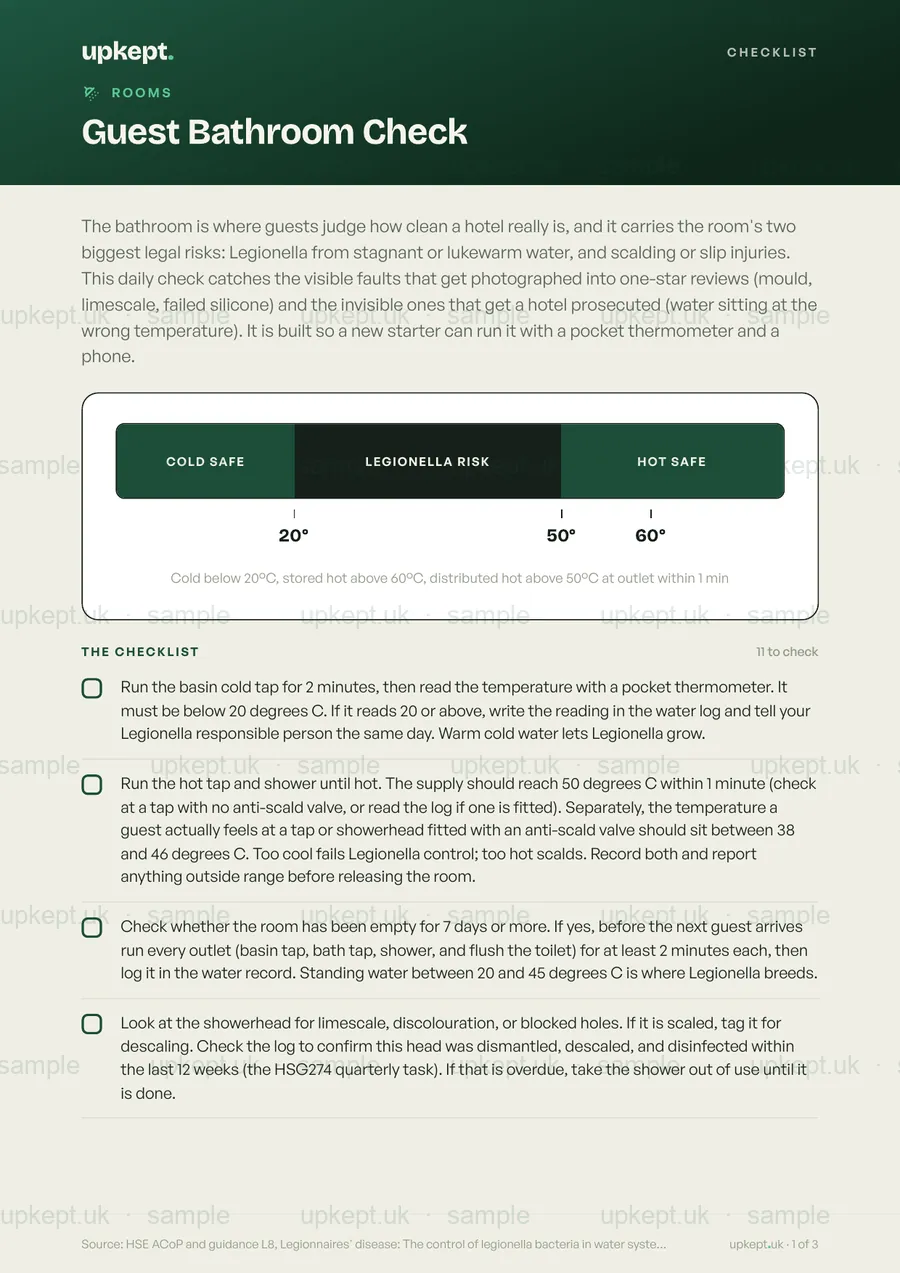
The bathroom is where guests judge how clean a hotel really is, and it carries the room's two biggest legal risks: Legionella from stagnant or lukewarm water, and scalding or slip injuries. This daily check catches the visible faults that get photographed into one-star reviews (mould, limescale, failed silicone) and the invisible ones that get a hotel prosecuted (water sitting at the wrong temperature). It is built so a new starter can run it with a pocket thermometer and a phone.
11 checksPDF + phoneReviewed August 2026
Built on published UK guidance Show sources
HSE ACoP and guidance L8, Legionnaires' disease: The control of legionella bacteria in water systems (4th edition, 2013), temperature control: hot water 60 degrees C stored, 50 degrees C at the outlet within 1 minute, cold below 20 degrees C. HSG274 Part 2 (HSE, 2014), showerheads dismantled, cleaned, descaled and disinfected quarterly (every 12 weeks), and the same outlet temperature targets. HSE hot and cold water systems guidance (hse.gov.uk/legionnaires/hot-and-cold.htm). Approved Document F, Volume 1: Dwellings (2021 edition, in force 15 June 2022), Table 1.3: minimum 15 litres per second intermittent extract for a bathroom (with or without a WC).
£14one-off, yours forever
Replaces a DIY doc, and you get every future update free when the guidance changes.
3 for 2 on documents and packs. Add 3 and your cheapest is free.
A clean one-page PDF, ready to print
Opens and ticks off on any phone
Clear, no jargon, easy to follow
Free updates whenever the guidance changes
Secure checkout30-day money-backInstant downloadNo subscriptionCard & Apple Pay
Best valueSave 42%
Or get all 56 templates
The Everything Bundle: every template today and every future one.£399 one-off, instead of £686 bought separately.
Made for places like this
What’s on it
11 things to check.
Everything that matters, nothing that does not. Here is the full list, exactly as it appears on the template.
1Run the basin cold tap for 2 minutes, then read the temperature with a pocket thermometer. It must be below 20 degrees C. If it reads 20 or above, write the reading in the water log and tell your Legionella responsible person the same day. Warm cold water lets Legionella grow.
2Run the hot tap and shower until hot. The supply should reach 50 degrees C within 1 minute (check at a tap with no anti-scald valve, or read the log if one is fitted). Separately, the temperature a guest actually feels at a tap or showerhead fitted with an anti-scald valve should sit between 38 and 46 degrees C. Too cool fails Legionella control; too hot scalds. Record both and report anything outside range before releasing the room.
3Check whether the room has been empty for 7 days or more. If yes, before the next guest arrives run every outlet (basin tap, bath tap, shower, and flush the toilet) for at least 2 minutes each, then log it in the water record. Standing water between 20 and 45 degrees C is where Legionella breeds.
4Look at the showerhead for limescale, discolouration, or blocked holes. If it is scaled, tag it for descaling. Check the log to confirm this head was dismantled, descaled, and disinfected within the last 12 weeks (the HSG274 quarterly task). If that is overdue, take the shower out of use until it is done.
5Check the extractor fan actually pulls air: switch it on and hold a single sheet of toilet tissue flat to the grille. If the suction holds the tissue, air is moving; if it drops, the fan is weak or blocked, so log it and report it. This is a quick presence check, not a measured airflow test (the regulated minimum is 15 litres per second, which only a meter can confirm).
6Switch the light off and confirm the fan keeps running afterwards (most have an overrun timer of a few minutes). If it stops the instant the light goes off, log it for maintenance. Without overrun, damp air stays in the room and mould returns within weeks.
7Inspect every grout line and silicone bead at the shower tray, bath edge, and where the floor meets the wall. Any black mould, cracked or lifting silicone, or grout that has gone dark is a fail. Flag it for same-day resealing. Mould here is the most photographed bathroom complaint and means the room is not drying out between guests.
8Test the drain: fill the basin to half depth, pull the plug, and confirm it empties within 30 seconds. A slow drain means a partial blockage that will back up during a guest's shower. Report it for clearing.
9Check the bath or shower mat. If it is a fabric mat, confirm it is freshly laundered and not left from the last guest. If it is a fixed rubber anti-slip mat, confirm it lies flat with no curled edges and no mould underneath. A curled or slimy mat is a slip-fall claim waiting to happen.
10Wipe and check every mirror, tap, and the toilet flush handle for limescale and watermarks. Scale on taps is one of the most photographed bathroom complaints and reads as neglect however clean the rest of the room is.
11Lock and unlock the bathroom door from the inside. It must lock fully and release fully without sticking. A sticking lock is a safety problem (a guest must be able to get out in an emergency) and a guaranteed complaint.
Good to know
Many operators think the hot-water duty stops at the cylinder: store it at 60 degrees C and you are done. It does not. Under ACoP L8 and HSG274 Part 2 the control runs all the way to the outlet: hot water must reach 50 degrees C within one minute at sentinel taps. Where an anti-scald valve (TMV) blends the water down to a safe 38 to 46 degrees C at the point of use, that is not a get-out: the TMV is an extra control that needs its own scheduled maintenance and temperature records, and the hot supply feeding it must still prove 50 degrees C in the pipework behind it.
Source: HSE ACoP and guidance L8, Legionnaires' disease: The control of legionella bacteria in water systems (4th edition, 2013), temperature control: hot water 60 degrees C stored, 50 degrees C at the outlet within 1 minute, cold below 20 degrees C. HSG274 Part 2 (HSE, 2014), showerheads dismantled, cleaned, descaled and disinfected quarterly (every 12 weeks), and the same outlet temperature targets. HSE hot and cold water systems guidance (hse.gov.uk/legionnaires/hot-and-cold.htm). Approved Document F, Volume 1: Dwellings (2021 edition, in force 15 June 2022), Table 1.3: minimum 15 litres per second intermittent extract for a bathroom (with or without a WC).
Good to know
Questions, answered
What is the Guest Bathroom Check?
The bathroom is where guests judge how clean a hotel really is, and it carries the room's two biggest legal risks: Legionella from stagnant or lukewarm water, and scalding or slip injuries. This daily check catches the visible faults that get photographed into one-star reviews (mould, limescale, failed silicone) and the invisible ones that get a hotel prosecuted (water sitting at the wrong temperature). It is built so a new starter can run it with a pocket thermometer and a phone.
Why does it matter?
Many operators think the hot-water duty stops at the cylinder: store it at 60 degrees C and you are done. It does not. Under ACoP L8 and HSG274 Part 2 the control runs all the way to the outlet: hot water must reach 50 degrees C within one minute at sentinel taps. Where an anti-scald valve (TMV) blends the water down to a safe 38 to 46 degrees C at the point of use, that is not a get-out: the TMV is an extra control that needs its own scheduled maintenance and temperature records, and the hot supply feeding it must still prove 50 degrees C in the pipework behind it.
How do I get it, and is it up to date?
The PDF downloads the moment you check out, prints sharp in black and white, and opens on any phone. It is reviewed for August 2026 and you get any future update free when the official guidance changes.
A proper room check before you release a room to the next guest catches the faults that drive complaints, refunds, bad reviews, and repeat cleans. It also keeps the operator on the right side of fire safety law and HSE Legionella rules, so a missed self-closer or a stagnant tap does not become an enforcement notice or an illness.
A daily housekeeping check has two jobs: keep the floor safe (fire and infection risk) and keep every room clean enough to hold its review score and pass an unannounced inspection. The risks are real and personal: under the Fire Safety Order the named responsible person, not just the company, can be prosecuted and fined, and one photo of a dirty or stained room on a review site can dent occupancy for months. Every item below names the exact thing to check, the number to hit, and what to do when it fails.
A room clean done to this standard stops the two failures that cost a hotel far more than the time saved: a guest health incident (Legionella from a stagnant shower, bug transfer from a cloth used in the toilet then on the glass) and the visible miss (hair in the plughole, a smeared mirror, the previous guest's imprint in the bed) that turns a stay into a one-star review. Every item below names the surface, the number where one exists, and the action, so a second-shift starter can do it without guessing.