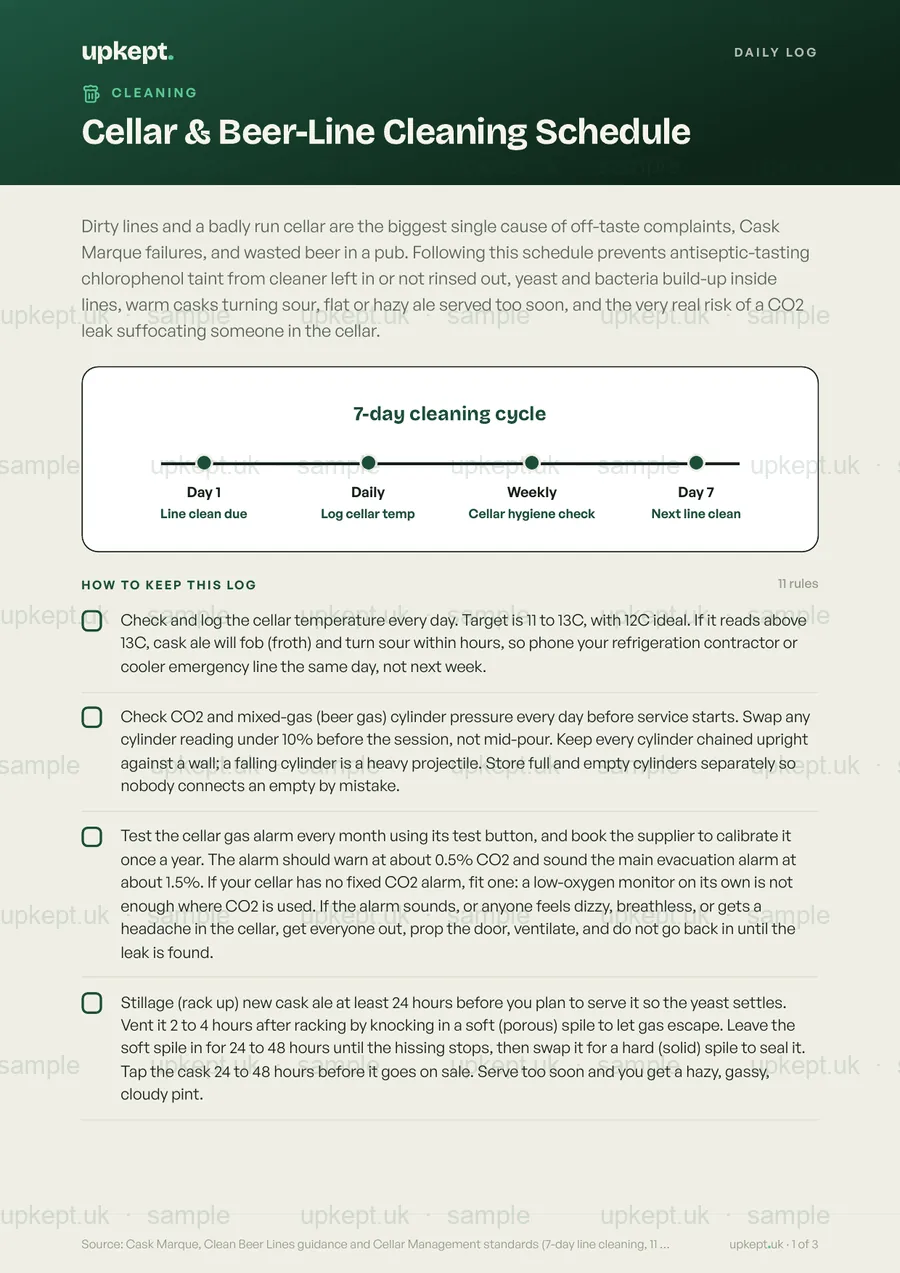
Dirty lines and a badly run cellar are the biggest single cause of off-taste complaints, Cask Marque failures, and wasted beer in a pub. Following this schedule prevents antiseptic-tasting chlorophenol taint from cleaner left in or not rinsed out, yeast and bacteria build-up inside lines, warm casks turning sour, flat or hazy ale served too soon, and the very real risk of a CO2 leak suffocating someone in the cellar.
11 checksPDF + phoneReviewed August 2026
Built on published UK guidance Show sources
Cask Marque, Clean Beer Lines guidance and Cellar Management standards (7-day line cleaning, 11 to 13C cellar temperature, 3-day cask serving window); BCGA Guidance Note 30 (GN30) "The Safe Use of Gases in the Beverage Dispense Industry", produced with the British Beer and Pub Association (CO2 cylinder handling, gas detection, and confined-space requirements); Confined Spaces Regulations 1997 (cellar risk assessment); Food Safety Act 1990 (cleaning records, stock dating, and beer as a food product); industry-standard CO2 cellar alarm setpoints (pre-alarm ~0.5%, main alarm ~1.5% by volume).
£14one-off, yours forever
Replaces a DIY doc, and you get every future update free when the guidance changes.
3 for 2 on documents and packs. Add 3 and your cheapest is free.
A clean one-page PDF, ready to print
Opens and ticks off on any phone
Clear, no jargon, easy to follow
Free updates whenever the guidance changes
Secure checkout30-day money-backInstant downloadNo subscriptionCard & Apple Pay
Best valueSave 42%
Or get all 56 templates
The Everything Bundle: every template today and every future one.£399 one-off, instead of £686 bought separately.
Made for places like this
What’s on it
11 things to check.
Everything that matters, nothing that does not. Here is the full list, exactly as it appears on the template.
1Check and log the cellar temperature every day. Target is 11 to 13C, with 12C ideal. If it reads above 13C, cask ale will fob (froth) and turn sour within hours, so phone your refrigeration contractor or cooler emergency line the same day, not next week.
2Check CO2 and mixed-gas (beer gas) cylinder pressure every day before service starts. Swap any cylinder reading under 10% before the session, not mid-pour. Keep every cylinder chained upright against a wall; a falling cylinder is a heavy projectile. Store full and empty cylinders separately so nobody connects an empty by mistake.
3Test the cellar gas alarm every month using its test button, and book the supplier to calibrate it once a year. The alarm should warn at about 0.5% CO2 and sound the main evacuation alarm at about 1.5%. If your cellar has no fixed CO2 alarm, fit one: a low-oxygen monitor on its own is not enough where CO2 is used. If the alarm sounds, or anyone feels dizzy, breathless, or gets a headache in the cellar, get everyone out, prop the door, ventilate, and do not go back in until the leak is found.
4Stillage (rack up) new cask ale at least 24 hours before you plan to serve it so the yeast settles. Vent it 2 to 4 hours after racking by knocking in a soft (porous) spile to let gas escape. Leave the soft spile in for 24 to 48 hours until the hissing stops, then swap it for a hard (solid) spile to seal it. Tap the cask 24 to 48 hours before it goes on sale. Serve too soon and you get a hazy, gassy, cloudy pint.
5Clean every beer line every 7 days, no exceptions, even in a quiet week. Mix the line cleaner to the exact dilution on the product label using a measuring jug, never a guessed splash. Pull it through until each line is full, then leave it to soak for the time on the label (usually 20 to 30 minutes). Never leave cleaner in longer than 2 hours: that causes antiseptic, TCP-like chlorophenol taint.
6After soaking, flush every line through with clean cold water until it runs clear and tests pH 7 (neutral) on a pH strip. Then smell and taste the water from each tap before you reconnect the beer. Any chemical smell or taste means flush again. Reconnecting a line with cleaner still in it is the most common cause of a tainted first pint.
7Log every line clean straight away: date, time started, product name and batch number, dilution used, soak time, who did it, and a yes/no that the pH-neutral rinse was confirmed. An Environmental Health Officer can ask to see this under the Food Safety Act 1990, and a blank or gappy log counts against you.
8Strip down and clean tap heads, fonts, drip trays, nozzles, and the python (the insulated bundle of lines from cellar to bar) as part of every weekly clean. Take tap heads apart, scrub the inside, and soak the parts in sanitiser. Biofilm grows inside tap heads even when the lines themselves are clean, and it taints the beer in a way staff struggle to trace.
9Write the tap date on every cask in chalk pen and pull it off sale within 3 days of first serving. Once a cask is venting through a soft spile in service, air is drawn in on every pull and quality drops fast after day three. If casks regularly outlast 3 days, order smaller ones or look at fitting a cask breather.
10On every delivery, rotate stock: new kegs and casks to the back, older stock to the front. Check the best-before date on every container as it comes in and refuse anything already out of date. Serving out-of-date draught is a food safety offence under the Food Safety Act 1990.
11Deep clean the cellar floor, walls, drains, and stillage every week, ideally just before a delivery. Scrub drains with a food-safe disinfectant. Blocked or smelly drains are the most common thing an EHO flags on a cellar visit and are a direct route for pests and contamination to reach your beer.
Good to know
The 7-day clean is the Cask Marque standard, but the real failure mode is not frequency, it is incomplete rinsing. Alkaline line cleaner left behind reacts with chlorine in tap water to form chlorophenol, which tastes of antiseptic at only a few parts per billion. You can clean daily and still serve tainted beer if you do not confirm a clear, pH-neutral, odourless rinse from every tap before reconnecting.
Source: Cask Marque, Clean Beer Lines guidance and Cellar Management standards (7-day line cleaning, 11 to 13C cellar temperature, 3-day cask serving window); BCGA Guidance Note 30 (GN30) "The Safe Use of Gases in the Beverage Dispense Industry", produced with the British Beer and Pub Association (CO2 cylinder handling, gas detection, and confined-space requirements); Confined Spaces Regulations 1997 (cellar risk assessment); Food Safety Act 1990 (cleaning records, stock dating, and beer as a food product); industry-standard CO2 cellar alarm setpoints (pre-alarm ~0.5%, main alarm ~1.5% by volume).
Good to know
Questions, answered
What is the Cellar & Beer-Line Cleaning Schedule?
Dirty lines and a badly run cellar are the biggest single cause of off-taste complaints, Cask Marque failures, and wasted beer in a pub. Following this schedule prevents antiseptic-tasting chlorophenol taint from cleaner left in or not rinsed out, yeast and bacteria build-up inside lines, warm casks turning sour, flat or hazy ale served too soon, and the very real risk of a CO2 leak suffocating someone in the cellar.
Why does it matter?
The 7-day clean is the Cask Marque standard, but the real failure mode is not frequency, it is incomplete rinsing. Alkaline line cleaner left behind reacts with chlorine in tap water to form chlorophenol, which tastes of antiseptic at only a few parts per billion. You can clean daily and still serve tainted beer if you do not confirm a clear, pH-neutral, odourless rinse from every tap before reconnecting.
How do I get it, and is it up to date?
The PDF downloads the moment you check out, prints sharp in black and white, and opens on any phone. It is reviewed for August 2026 and you get any future update free when the official guidance changes.
A signed cleaning record is the main evidence an Environmental Health Officer uses to decide whether your kitchen is clean every day, not just on inspection day. Done properly, this routine stops the four things that sink hygiene ratings and trigger enforcement: cross-contamination between raw and ready-to-eat food, allergen cross-contact, grease fires in the extract system, and pest infestations.
A signed, time-stamped hourly check gives you a paper trail that protects you if someone slips, complains, or is injured, and it forces a physical walk-through that catches the small failures (empty soap, no toilet roll, a broken lock, a wet floor) before they turn into complaints, bad reviews, or a downmark from the Environmental Health Officer. The log is usually the first thing an EHO asks to see.
A neglected waste area is the most common cause of pest infestation, the most common spot for a deliberate fire to start and spread into the building, and the source of unlimited fines under the duty of care in EPA 1990 s.34. This check keeps the environmental health officer, your insurer, and the fire risk assessment satisfied, and proves the area was inspected if anyone asks.