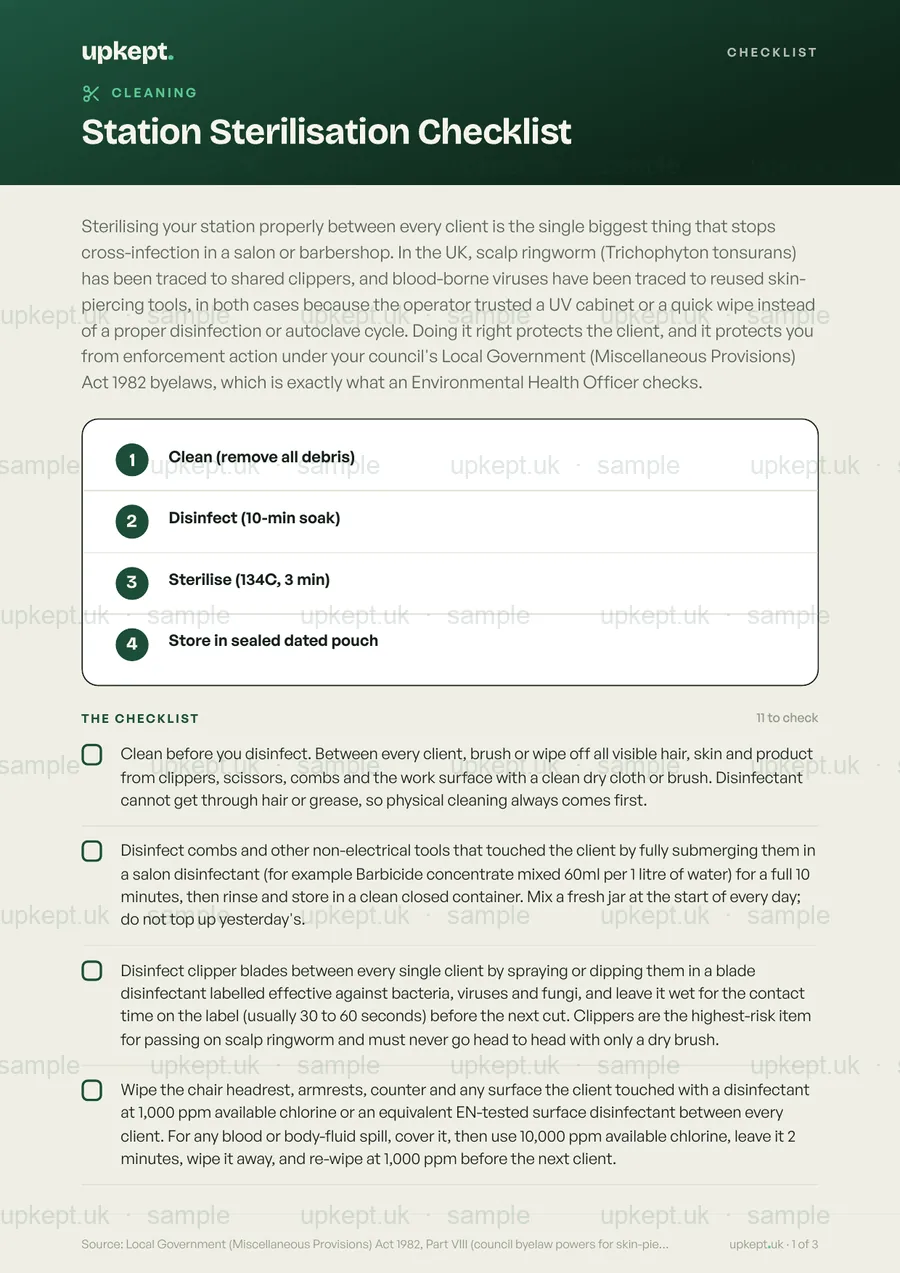
Sterilising your station properly between every client is the single biggest thing that stops cross-infection in a salon or barbershop. In the UK, scalp ringworm (Trichophyton tonsurans) has been traced to shared clippers, and blood-borne viruses have been traced to reused skin-piercing tools, in both cases because the operator trusted a UV cabinet or a quick wipe instead of a proper disinfection or autoclave cycle. Doing it right protects the client, and it protects you from enforcement action under your council's Local Government (Miscellaneous Provisions) Act 1982 byelaws, which is exactly what an Environmental Health Officer checks.
11 checksPDF + phoneReviewed August 2026
Built on published UK guidance Show sources
Local Government (Miscellaneous Provisions) Act 1982, Part VIII (council byelaw powers for skin-piercing premises); BS EN 13060 (small steam sterilisers, Class B cycle: 134 degrees C, 3 minutes); Ealing Council and Wyre Council skin-piercing guidance notes (134 degrees C / 3 minutes at approx 2.1 bar as the accepted standard); HSE PM73 and the Pressure Systems Safety Regulations 2000 (annual written scheme of examination for autoclaves); Derby City Council cosmetic piercing guidance (2-year record-keeping); NHS infection prevention guidance on blood and body-fluid spillages (1,000 ppm routine / 10,000 ppm for blood spills); NHBF Salons and Barbershops Code of Practice (tool disinfection and clinical-waste disposal); barbershop tinea capitis evidence linking T. tonsurans transmission to electric clippers (Mueller et al., Mycoses 2021; Shen et al., JEADV 2026).
£14one-off, yours forever
Replaces a DIY doc, and you get every future update free when the guidance changes.
3 for 2 on documents and packs. Add 3 and your cheapest is free.
A clean one-page PDF, ready to print
Opens and ticks off on any phone
Clear, no jargon, easy to follow
Free updates whenever the guidance changes
Secure checkout30-day money-backInstant downloadNo subscriptionCard & Apple Pay
Best valueSave 42%
Or get all 56 templates
The Everything Bundle: every template today and every future one.£399 one-off, instead of £686 bought separately.
Made for places like this
What’s on it
11 things to check.
Everything that matters, nothing that does not. Here is the full list, exactly as it appears on the template.
1Clean before you disinfect. Between every client, brush or wipe off all visible hair, skin and product from clippers, scissors, combs and the work surface with a clean dry cloth or brush. Disinfectant cannot get through hair or grease, so physical cleaning always comes first.
2Disinfect combs and other non-electrical tools that touched the client by fully submerging them in a salon disinfectant (for example Barbicide concentrate mixed 60ml per 1 litre of water) for a full 10 minutes, then rinse and store in a clean closed container. Mix a fresh jar at the start of every day; do not top up yesterday's.
3Disinfect clipper blades between every single client by spraying or dipping them in a blade disinfectant labelled effective against bacteria, viruses and fungi, and leave it wet for the contact time on the label (usually 30 to 60 seconds) before the next cut. Clippers are the highest-risk item for passing on scalp ringworm and must never go head to head with only a dry brush.
4Wipe the chair headrest, armrests, counter and any surface the client touched with a disinfectant at 1,000 ppm available chlorine or an equivalent EN-tested surface disinfectant between every client. For any blood or body-fluid spill, cover it, then use 10,000 ppm available chlorine, leave it 2 minutes, wipe it away, and re-wipe at 1,000 ppm before the next client.
5Autoclave anything that pierced or cut skin (electrolysis, acupuncture, microblading or ear-piercing instruments) after every use, at 134 degrees C held for at least 3 minutes, in a Class B autoclave to BS EN 13060. A UV cabinet does not sterilise; it is storage only. Single-use needles are used once and dropped straight into a yellow sharps bin, never re-sheathed or re-used.
6After every autoclave cycle, check the printout or indicator strip confirms it reached and held 134 degrees C at about 2.1 bar for the full cycle time. If it failed, or there is no reading, do not use that load. Check the water level, the door seal, and that instruments were not overloaded or loaded wet, then re-run.
7Log every autoclave cycle: date, time, temperature reached, pass or fail, and your initials. Inspectors can ask to see this. Keep the records for at least 2 years.
8Store sterilised instruments in sealed autoclave pouches or a clean, closed, labelled container, and check the pouch indicator has changed colour before you use them. Never leave them loose on the bench, in an open tray, or in a UV cabinet, because re-contamination starts the moment they are exposed to air and touch.
9For any service involving skin contact, broken skin or blood, wash your hands for 20 seconds with soap and water, then put on fresh single-use nitrile gloves, and change them between every client. Gloves do not replace hand washing and are never reused.
10Have the autoclave serviced and pressure-tested at least once a year by a competent person under a written scheme of examination (Pressure Systems Safety Regulations 2000), and keep the engineer's certificate on site. An autoclave without a current certificate is being used illegally even if it seems to work fine.
11At the end of each day, empty, clean and dry the disinfectant jar, the spray bottle and any soaking pot, and record the daily clean in your station log. Never store instruments in soaking solution overnight.
Good to know
A UV cabinet is not a steriliser and does not meet the UK legal standard for skin-piercing tools. Under the guidance councils use to enforce Local Government (Miscellaneous Provisions) Act 1982 byelaws, only moist-heat sterilisation in an autoclave (134 degrees C held for 3 minutes) is accepted for reusable items that contact skin or blood. Storing already-sterilised tools in a UV cabinet between clients is fine; putting an unsterile tool in and calling it done is both an infection hazard and an enforcement risk.
Source: Local Government (Miscellaneous Provisions) Act 1982, Part VIII (council byelaw powers for skin-piercing premises); BS EN 13060 (small steam sterilisers, Class B cycle: 134 degrees C, 3 minutes); Ealing Council and Wyre Council skin-piercing guidance notes (134 degrees C / 3 minutes at approx 2.1 bar as the accepted standard); HSE PM73 and the Pressure Systems Safety Regulations 2000 (annual written scheme of examination for autoclaves); Derby City Council cosmetic piercing guidance (2-year record-keeping); NHS infection prevention guidance on blood and body-fluid spillages (1,000 ppm routine / 10,000 ppm for blood spills); NHBF Salons and Barbershops Code of Practice (tool disinfection and clinical-waste disposal); barbershop tinea capitis evidence linking T. tonsurans transmission to electric clippers (Mueller et al., Mycoses 2021; Shen et al., JEADV 2026).
Good to know
Questions, answered
What is the Station Sterilisation Checklist?
Sterilising your station properly between every client is the single biggest thing that stops cross-infection in a salon or barbershop. In the UK, scalp ringworm (Trichophyton tonsurans) has been traced to shared clippers, and blood-borne viruses have been traced to reused skin-piercing tools, in both cases because the operator trusted a UV cabinet or a quick wipe instead of a proper disinfection or autoclave cycle. Doing it right protects the client, and it protects you from enforcement action under your council's Local Government (Miscellaneous Provisions) Act 1982 byelaws, which is exactly what an Environmental Health Officer checks.
Why does it matter?
A UV cabinet is not a steriliser and does not meet the UK legal standard for skin-piercing tools. Under the guidance councils use to enforce Local Government (Miscellaneous Provisions) Act 1982 byelaws, only moist-heat sterilisation in an autoclave (134 degrees C held for 3 minutes) is accepted for reusable items that contact skin or blood. Storing already-sterilised tools in a UV cabinet between clients is fine; putting an unsterile tool in and calling it done is both an infection hazard and an enforcement risk.
How do I get it, and is it up to date?
The PDF downloads the moment you check out, prints sharp in black and white, and opens on any phone. It is reviewed for August 2026 and you get any future update free when the official guidance changes.
A signed cleaning record is the main evidence an Environmental Health Officer uses to decide whether your kitchen is clean every day, not just on inspection day. Done properly, this routine stops the four things that sink hygiene ratings and trigger enforcement: cross-contamination between raw and ready-to-eat food, allergen cross-contact, grease fires in the extract system, and pest infestations.
A signed, time-stamped hourly check gives you a paper trail that protects you if someone slips, complains, or is injured, and it forces a physical walk-through that catches the small failures (empty soap, no toilet roll, a broken lock, a wet floor) before they turn into complaints, bad reviews, or a downmark from the Environmental Health Officer. The log is usually the first thing an EHO asks to see.
A neglected waste area is the most common cause of pest infestation, the most common spot for a deliberate fire to start and spread into the building, and the source of unlimited fines under the duty of care in EPA 1990 s.34. This check keeps the environmental health officer, your insurer, and the fire risk assessment satisfied, and proves the area was inspected if anyone asks.