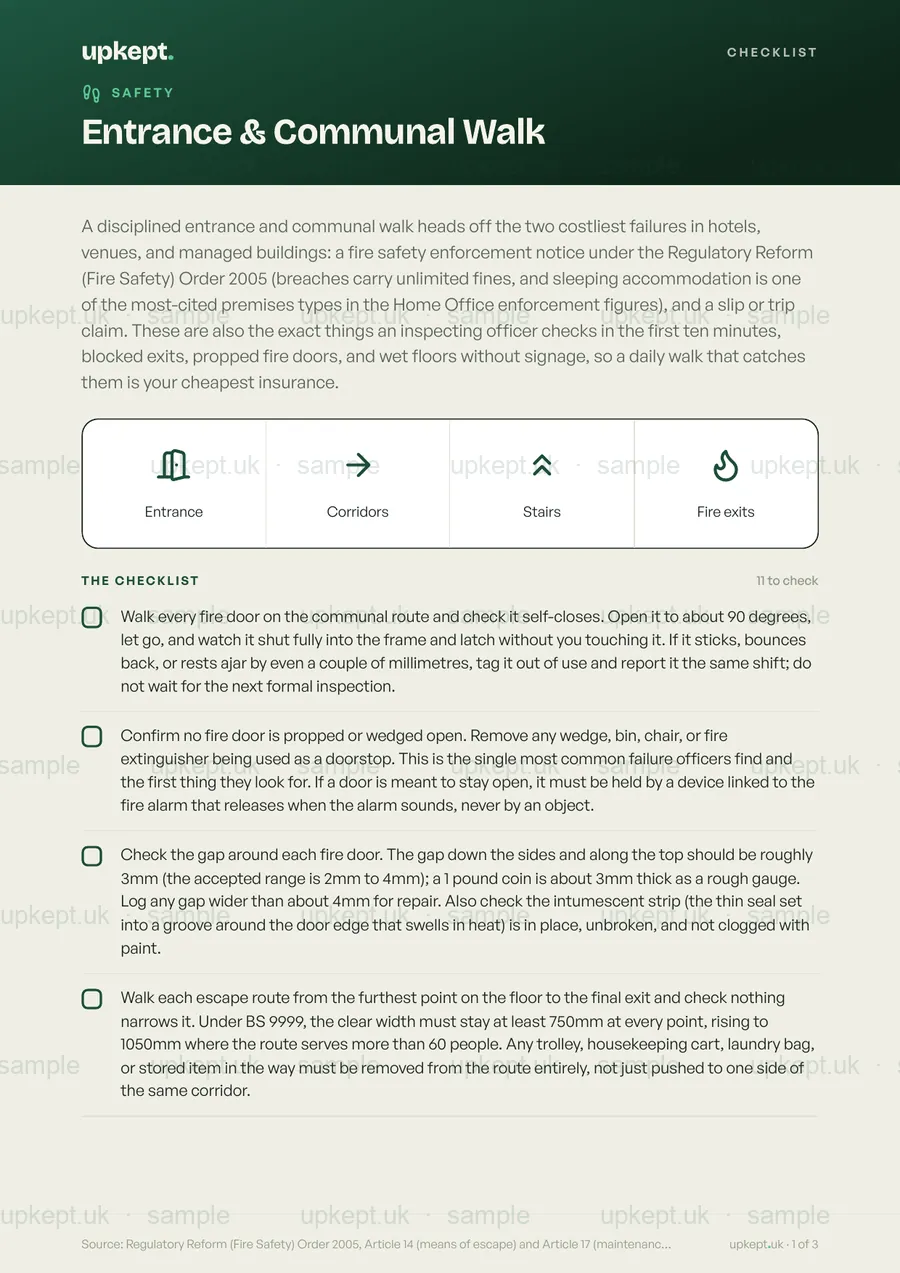
A disciplined entrance and communal walk heads off the two costliest failures in hotels, venues, and managed buildings: a fire safety enforcement notice under the Regulatory Reform (Fire Safety) Order 2005 (breaches carry unlimited fines, and sleeping accommodation is one of the most-cited premises types in the Home Office enforcement figures), and a slip or trip claim. These are also the exact things an inspecting officer checks in the first ten minutes, blocked exits, propped fire doors, and wet floors without signage, so a daily walk that catches them is your cheapest insurance.
11 checksPDF + phoneReviewed August 2026
Built on published UK guidance Show sources
Regulatory Reform (Fire Safety) Order 2005, Article 14 (means of escape) and Article 17 (maintenance); Fire Safety (England) Regulations 2022, Regulation 10 (quarterly checks of communal fire doors in residential buildings over 11m); BS 5266-1:2025 (emergency lighting code of practice: minimum 1 lux on escape routes, 3-hour duration for sleeping and entertainment premises); BS 8214 (fire door gap tolerance, 2mm to 4mm at head and jambs); BS 9999:2017 (escape widths: 750mm minimum, 1050mm for routes serving more than 60 persons); BS 5306-3 (annual fire extinguisher service); Workplace (Health, Safety and Welfare) Regulations 1992, Regulation 12 (floors) with HSE slips and trips guidance; Home Office, Fire prevention and protection statistics England, year ending March 2025 (enforcement notice volumes); Fire Door Inspection Scheme 2021 inspection data (circa 75% failure rate).
£14one-off, yours forever
Replaces a DIY doc, and you get every future update free when the guidance changes.
3 for 2 on documents and packs. Add 3 and your cheapest is free.
A clean one-page PDF, ready to print
Opens and ticks off on any phone
Clear, no jargon, easy to follow
Free updates whenever the guidance changes
Secure checkout30-day money-backInstant downloadNo subscriptionCard & Apple Pay
Best valueSave 42%
Or get all 56 templates
The Everything Bundle: every template today and every future one.£399 one-off, instead of £686 bought separately.
Made for places like this
What’s on it
11 things to check.
Everything that matters, nothing that does not. Here is the full list, exactly as it appears on the template.
1Walk every fire door on the communal route and check it self-closes. Open it to about 90 degrees, let go, and watch it shut fully into the frame and latch without you touching it. If it sticks, bounces back, or rests ajar by even a couple of millimetres, tag it out of use and report it the same shift; do not wait for the next formal inspection.
2Confirm no fire door is propped or wedged open. Remove any wedge, bin, chair, or fire extinguisher being used as a doorstop. This is the single most common failure officers find and the first thing they look for. If a door is meant to stay open, it must be held by a device linked to the fire alarm that releases when the alarm sounds, never by an object.
3Check the gap around each fire door. The gap down the sides and along the top should be roughly 3mm (the accepted range is 2mm to 4mm); a 1 pound coin is about 3mm thick as a rough gauge. Log any gap wider than about 4mm for repair. Also check the intumescent strip (the thin seal set into a groove around the door edge that swells in heat) is in place, unbroken, and not clogged with paint.
4Walk each escape route from the furthest point on the floor to the final exit and check nothing narrows it. Under BS 9999, the clear width must stay at least 750mm at every point, rising to 1050mm where the route serves more than 60 people. Any trolley, housekeeping cart, laundry bag, or stored item in the way must be removed from the route entirely, not just pushed to one side of the same corridor.
5Test every final exit door opens first time from the inside without a key, code, or fob during occupied hours. Push the panic bar or handle firmly in one motion. If it sticks, a latch is locked, or the frame has swollen, take the route out of use and get maintenance on it before the building is occupied. Under Article 14 of the Fire Safety Order, an exit must open immediately for anyone escaping.
6Check stairwells, under-stair voids, and any cupboards opening onto escape routes are clear of stored items. Mattresses, linen bags, cardboard, and cleaning chemicals are the items most often found and cited in enforcement cases. Remove everything; there is no safe amount of storage in a fire-escape stairwell.
7Scan the fire extinguishers and fire action notices in the communal areas. Each extinguisher must be on its bracket or stand, pin in place, pressure gauge needle in the green, and the engineer's service label dated within the last 12 months. The fire action notice must be readable from where people stand at the call point. Log and flag to the contractor that day anything missing, discharged, or out of service date.
8Test one emergency light per floor with its test button (or by isolating that lighting circuit if there is no button). The fitting must light up and stay lit; under BS 5266-1 it must give at least 1 lux along the escape route and hold it for 3 hours in sleeping or entertainment premises like a hotel or venue. Replace any fitting that fails to light before the building opens, and record the time, the fitting location, and the result.
9Look up at the normal corridor and lobby lighting as you walk and replace any dead fitting. A single failed light leaves a dark patch on the escape route, and during a power cut only the emergency fittings remain. If you have a spare, change it this shift; if not, put out temporary lighting and log it as urgent. Aim for no dark sections anyone has to walk through.
10Check the entrance floor and matting across the full width of the doorway. Smooth tile or polished stone goes dangerously slippery when wet, so put out a wet-floor sign whenever it is raining or the floor has just been mopped, and swap out any mat that is soaked through, a saturated mat is itself a trip hazard. This is a direct duty under the Workplace (Health, Safety and Welfare) Regulations 1992 and the most common source of slip claims.
11Log the walk with the date, time, and your name, plus a line on anything found and what you did about it. Under the Fire Safety Order the responsible person has to show fire safety measures are kept up, and this dated log is the evidence. Note any follow-up fix and who it went to. No log means no defence if an officer or a claimant later asks whether the checks were actually happening.
Good to know
The detail that catches buildings out is how often fire doors are checked, not just the closing standard. The Fire Safety (England) Regulations 2022 (Regulation 10, in force 23 January 2023 after the Grenfell Inquiry) require communal fire doors in residential buildings over 11 metres tall to be checked at least every 3 months. Hotels and venues are not directly covered by that rule, but officers increasingly treat quarterly as the reasonable benchmark for any higher-risk building, so a long gap between formal checks reads as inadequate. It matters because when the Fire Door Inspection Scheme inspected over 100,000 doors in 2021, around 75% failed the standard (most often on excessive gaps), so a quick visual check on every walk is the minimum that keeps you defensible.
Source: Regulatory Reform (Fire Safety) Order 2005, Article 14 (means of escape) and Article 17 (maintenance); Fire Safety (England) Regulations 2022, Regulation 10 (quarterly checks of communal fire doors in residential buildings over 11m); BS 5266-1:2025 (emergency lighting code of practice: minimum 1 lux on escape routes, 3-hour duration for sleeping and entertainment premises); BS 8214 (fire door gap tolerance, 2mm to 4mm at head and jambs); BS 9999:2017 (escape widths: 750mm minimum, 1050mm for routes serving more than 60 persons); BS 5306-3 (annual fire extinguisher service); Workplace (Health, Safety and Welfare) Regulations 1992, Regulation 12 (floors) with HSE slips and trips guidance; Home Office, Fire prevention and protection statistics England, year ending March 2025 (enforcement notice volumes); Fire Door Inspection Scheme 2021 inspection data (circa 75% failure rate).
Good to know
Questions, answered
What is the Entrance & Communal Walk?
A disciplined entrance and communal walk heads off the two costliest failures in hotels, venues, and managed buildings: a fire safety enforcement notice under the Regulatory Reform (Fire Safety) Order 2005 (breaches carry unlimited fines, and sleeping accommodation is one of the most-cited premises types in the Home Office enforcement figures), and a slip or trip claim. These are also the exact things an inspecting officer checks in the first ten minutes, blocked exits, propped fire doors, and wet floors without signage, so a daily walk that catches them is your cheapest insurance.
Why does it matter?
The detail that catches buildings out is how often fire doors are checked, not just the closing standard. The Fire Safety (England) Regulations 2022 (Regulation 10, in force 23 January 2023 after the Grenfell Inquiry) require communal fire doors in residential buildings over 11 metres tall to be checked at least every 3 months. Hotels and venues are not directly covered by that rule, but officers increasingly treat quarterly as the reasonable benchmark for any higher-risk building, so a long gap between formal checks reads as inadequate. It matters because when the Fire Door Inspection Scheme inspected over 100,000 doors in 2021, around 75% failed the standard (most often on excessive gaps), so a quick visual check on every walk is the minimum that keeps you defensible.
How do I get it, and is it up to date?
The PDF downloads the moment you check out, prints sharp in black and white, and opens on any phone. It is reviewed for August 2026 and you get any future update free when the official guidance changes.
A discharged or depressurised extinguisher found during a real fire is no better than having no extinguisher at all. The monthly visual check catches the common pre-failure states (lost pressure, broken tamper seal, blocked access, overdue service) before they matter, and it gives the responsible person the maintenance records the Regulatory Reform (Fire Safety) Order 2005 requires.
A fire door only works if it closes fully, latches, and seals the gaps; one door that fails to do that lets smoke and fire spread through a building in minutes and removes people's time to escape. These checks catch the specific, common failures (props, blown gaps, missing closers, painted-up seals) that turn a survivable fire into a fatal one.
An under-stocked or expired first aid kit means the person treating an injury reaches for a dressing and finds an empty slot, a perished wrapper, or latex gloves that trigger an allergic reaction. A regular documented check fixes that in advance and gives an HSE or Ofsted inspector evidence that your first aid provision is genuinely maintained, not just present.