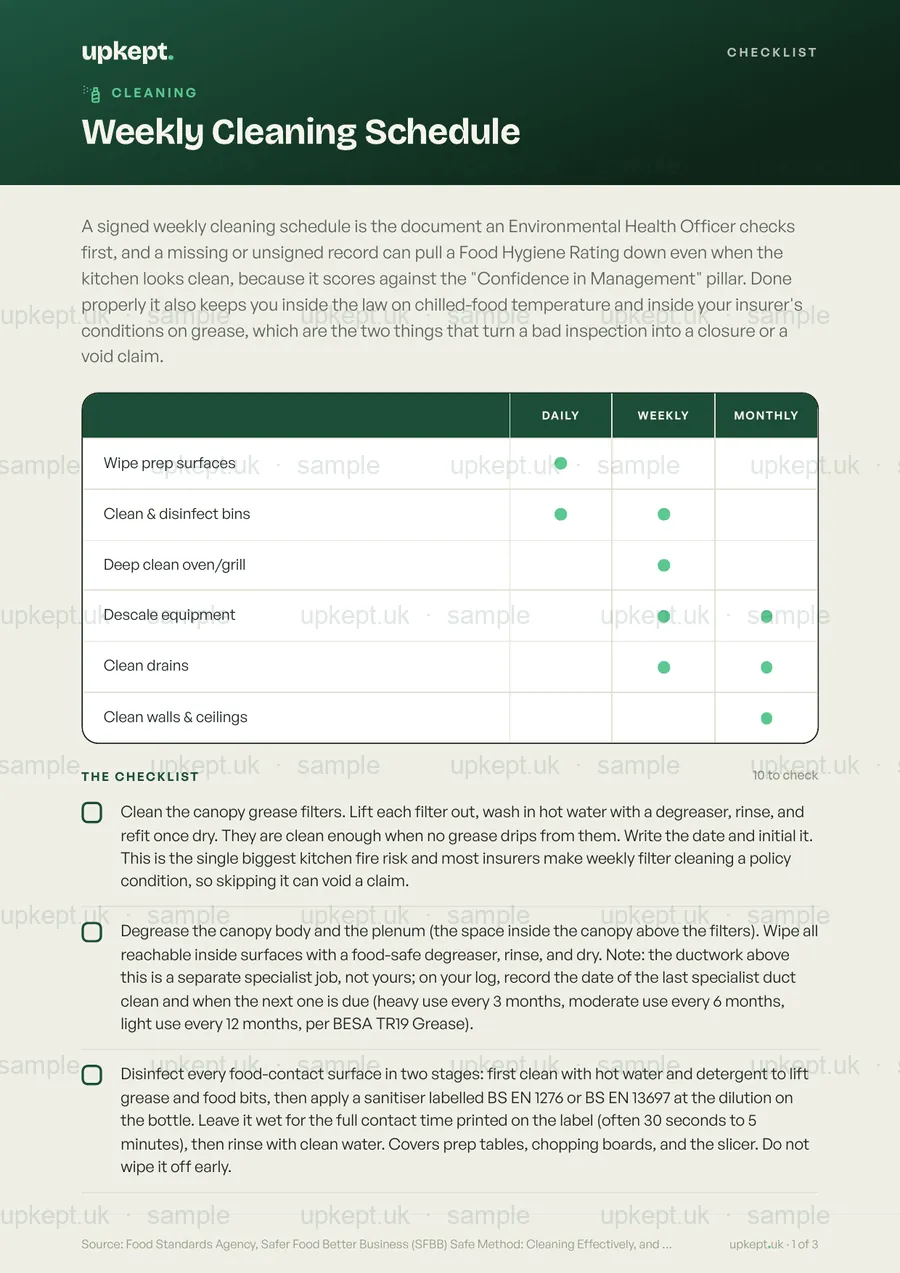
A signed weekly cleaning schedule is the document an Environmental Health Officer checks first, and a missing or unsigned record can pull a Food Hygiene Rating down even when the kitchen looks clean, because it scores against the "Confidence in Management" pillar. Done properly it also keeps you inside the law on chilled-food temperature and inside your insurer's conditions on grease, which are the two things that turn a bad inspection into a closure or a void claim.
A cleaning schedule template only works if it says what gets cleaned, how often, with what, and who signed it off. This one covers all four on a single printable page, laid out for real shifts rather than a laminated wish list.
10 checksPDF + phoneReviewed August 2026
Built on published UK guidance Show sources
Food Standards Agency, Safer Food Better Business (SFBB) Safe Method: Cleaning Effectively, and the SFBB Cleaning Schedule template (food.gov.uk); FSA requirement that disinfectants meet BS EN 1276 or BS EN 13697. Chilled-food 8C legal limit (aim 5C): Food Safety (Temperature Control) Regulations 1995, reg. 4. Grease and fire: London Fire Brigade Guidance Note GN 86 (Catering Kitchen Extract Systems), which recommends weekly canopy and filter cleaning; BESA TR19 Grease for specialist duct-cleaning frequencies (3/6/12 months) and the 200-micron mean grease threshold.
£14one-off, yours forever
Replaces a DIY doc, and you get every future update free when the guidance changes.
3 for 2 on documents and packs. Add 3 and your cheapest is free.
A clean one-page PDF, ready to print
Opens and ticks off on any phone
Clear, no jargon, easy to follow
Free updates whenever the guidance changes
Secure checkout30-day money-backInstant downloadNo subscriptionCard & Apple Pay
Best valueSave 42%
Or get all 56 templates
The Everything Bundle: every template today and every future one.£399 one-off, instead of £686 bought separately.
Made for places like this
What’s on it
10 things to check.
Everything that matters, nothing that does not. Here is the full list, exactly as it appears on the template.
1Clean the canopy grease filters. Lift each filter out, wash in hot water with a degreaser, rinse, and refit once dry. They are clean enough when no grease drips from them. Write the date and initial it. This is the single biggest kitchen fire risk and most insurers make weekly filter cleaning a policy condition, so skipping it can void a claim.
2Degrease the canopy body and the plenum (the space inside the canopy above the filters). Wipe all reachable inside surfaces with a food-safe degreaser, rinse, and dry. Note: the ductwork above this is a separate specialist job, not yours; on your log, record the date of the last specialist duct clean and when the next one is due (heavy use every 3 months, moderate use every 6 months, light use every 12 months, per BESA TR19 Grease).
3Disinfect every food-contact surface in two stages: first clean with hot water and detergent to lift grease and food bits, then apply a sanitiser labelled BS EN 1276 or BS EN 13697 at the dilution on the bottle. Leave it wet for the full contact time printed on the label (often 30 seconds to 5 minutes), then rinse with clean water. Covers prep tables, chopping boards, and the slicer. Do not wipe it off early.
4Empty and clean the inside of every fridge and cold room. Move food to another chilled unit first, then wipe shelves, walls, shelf brackets, and tray runners with a BS EN 1276 sanitiser, paying attention to corners where liquid pools and mould grows. Chilled food must by law stay at or below 8C (aim for 5C or below), so do not leave food out of refrigeration long enough to warm up. Log each unit cleaned.
5Check every fridge and freezer door seal. Run a finger along the full rubber gasket feeling for splits, black or green mould, or any part that no longer grips the frame. A failed seal lets warm air in and pushes food above the 8C legal limit. Write down what you found and, if a seal is cracked or mouldy, report it for replacement before the next service.
6Defrost any freezer with ice build-up thicker than about 5mm. Thick ice stops the door sealing and wastes power. Once defrosted, wipe the inside with a food-safe sanitiser. Log the unit, the date, and the ice thickness you saw before defrosting.
7Pull out each moveable cooking unit (fryers, range, combi oven, microwave) and clean the floor and wall behind and under it. Remove grease and food debris, and look for pest signs: droppings, gnaw marks, or greasy smears along the skirting. If you see any pest evidence, tell the manager the same day; this cannot wait for the next clean.
8Deep-clean the floor drains. Lift each drain cover, brush out debris and grease, flush with hot water, then pour in a drain-safe disinfectant and leave it for the contact time on the label. Blocked or dirty drains are a common pest entry point and a repeat EHO failure note. Date and initial it.
9Wipe down the hand-contact points the daily clean misses: door handles (including the cold-room handle), cupboard and drawer pulls, tap heads, bin lids, light switches, and till or timer keypads. Use a BS EN 1276 sanitiser, leave it for the contact time, then wipe off.
10Review and sign off the schedule for the week. Every completed task needs a date, the name of who did it, and initials. Any task not done needs a written reason next to it. An EHO treats a blank or unsigned line as proof the task was never done, so fill in every line honestly rather than leaving gaps.
Good to know
The most common mistake is wiping the sanitiser off too soon. A BS EN 1276 product only kills bacteria if it stays wet on the surface for its full contact time, often 30 seconds to 5 minutes, printed on the bottle; spray-and-immediately-wipe leaves the surface contaminated and looking clean. The FSA Safe Method "Cleaning Effectively" states this plainly, yet staff are rarely told it in training.
Source: Food Standards Agency, Safer Food Better Business (SFBB) Safe Method: Cleaning Effectively, and the SFBB Cleaning Schedule template (food.gov.uk); FSA requirement that disinfectants meet BS EN 1276 or BS EN 13697. Chilled-food 8C legal limit (aim 5C): Food Safety (Temperature Control) Regulations 1995, reg. 4. Grease and fire: London Fire Brigade Guidance Note GN 86 (Catering Kitchen Extract Systems), which recommends weekly canopy and filter cleaning; BESA TR19 Grease for specialist duct-cleaning frequencies (3/6/12 months) and the 200-micron mean grease threshold.
Good to know
Questions, answered
What should a cleaning schedule template include?
Each area or item, how often it is cleaned, the product and method, any safety notes, and a place to initial and date. Food-business guidance (FSA Safer Food, Better Business) expects cleaning to be planned and recorded, which is exactly what this schedule captures.
Does this work outside a kitchen?
Yes. The layout is the same whether you run a kitchen, a cafe floor, an office or a salon, and the free Daily Cleaning Rota pairs with it for the day-to-day jobs.
What is the Weekly Cleaning Schedule?
A signed weekly cleaning schedule is the document an Environmental Health Officer checks first, and a missing or unsigned record can pull a Food Hygiene Rating down even when the kitchen looks clean, because it scores against the "Confidence in Management" pillar. Done properly it also keeps you inside the law on chilled-food temperature and inside your insurer's conditions on grease, which are the two things that turn a bad inspection into a closure or a void claim.
Why does it matter?
The most common mistake is wiping the sanitiser off too soon. A BS EN 1276 product only kills bacteria if it stays wet on the surface for its full contact time, often 30 seconds to 5 minutes, printed on the bottle; spray-and-immediately-wipe leaves the surface contaminated and looking clean. The FSA Safe Method "Cleaning Effectively" states this plainly, yet staff are rarely told it in training.
How do I get it, and is it up to date?
The PDF downloads the moment you check out, prints sharp in black and white, and opens on any phone. It is reviewed for August 2026 and you get any future update free when the official guidance changes.
A signed cleaning record is the main evidence an Environmental Health Officer uses to decide whether your kitchen is clean every day, not just on inspection day. Done properly, this routine stops the four things that sink hygiene ratings and trigger enforcement: cross-contamination between raw and ready-to-eat food, allergen cross-contact, grease fires in the extract system, and pest infestations.
A signed, time-stamped hourly check gives you a paper trail that protects you if someone slips, complains, or is injured, and it forces a physical walk-through that catches the small failures (empty soap, no toilet roll, a broken lock, a wet floor) before they turn into complaints, bad reviews, or a downmark from the Environmental Health Officer. The log is usually the first thing an EHO asks to see.
A neglected waste area is the most common cause of pest infestation, the most common spot for a deliberate fire to start and spread into the building, and the source of unlimited fines under the duty of care in EPA 1990 s.34. This check keeps the environmental health officer, your insurer, and the fire risk assessment satisfied, and proves the area was inspected if anyone asks.