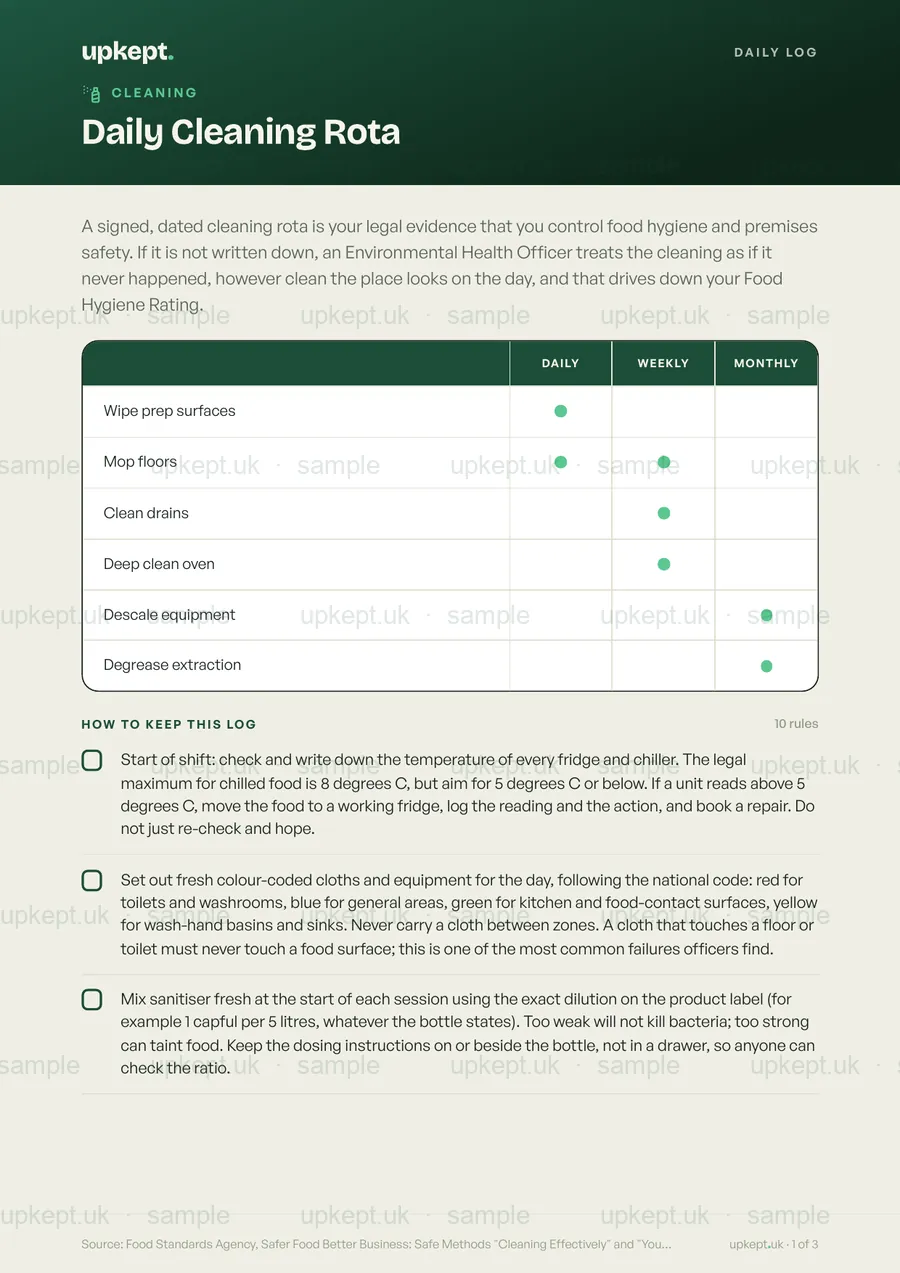
A signed, dated cleaning rota is your legal evidence that you control food hygiene and premises safety. If it is not written down, an Environmental Health Officer treats the cleaning as if it never happened, however clean the place looks on the day, and that drives down your Food Hygiene Rating.
This free daily cleaning rota template gives every cleaning job a named owner, a fixed slot and a place to sign, so the clean actually happens the same way every day. Print it or run it off a phone.
10 checksPDF + phoneReviewed August 2026
Built on published UK guidance Show sources
Food Standards Agency, Safer Food Better Business: Safe Methods "Cleaning Effectively" and "Your Cleaning Schedule", and "Chilled Storage and Display". Food Safety and Hygiene (England) Regulations 2013 (SI 2013/2996), Schedule 4 (8 degrees C chill holding requirement). Regulation (EC) No 852/2004, Annex II, Chapter I (premises) and Chapter V (equipment), on chemical storage and equipment hygiene. BS EN 1276 and BS EN 13697 (bactericidal efficacy standards for food-area disinfectants). National colour-coding scheme (BICSc / former NPSA): red, blue, green, yellow. FSA "International review of the literature and guidance on food allergen cleaning" (dry-wiping leaves residue; wash, rinse, sanitise removes it). The 25 percent grease-trap rule is the recognised FOG maintenance threshold; Water Industry Act 1991 s.111 prohibits discharging FOG to sewers.
Freeno card needed
Replaces a DIY doc, and you get every future update free when the guidance changes.
3 for 2 on documents and packs. Add 3 and your cheapest is free.
A clean one-page PDF, ready to print
Opens and ticks off on any phone
Clear, no jargon, easy to follow
Free updates whenever the guidance changes
Secure checkout30-day money-backInstant downloadNo subscriptionCard & Apple Pay
Made for places like this
What’s on it
10 things to check.
Everything that matters, nothing that does not. Here is the full list, exactly as it appears on the template.
1Start of shift: check and write down the temperature of every fridge and chiller. The legal maximum for chilled food is 8 degrees C, but aim for 5 degrees C or below. If a unit reads above 5 degrees C, move the food to a working fridge, log the reading and the action, and book a repair. Do not just re-check and hope.
2Set out fresh colour-coded cloths and equipment for the day, following the national code: red for toilets and washrooms, blue for general areas, green for kitchen and food-contact surfaces, yellow for wash-hand basins and sinks. Never carry a cloth between zones. A cloth that touches a floor or toilet must never touch a food surface; this is one of the most common failures officers find.
3Mix sanitiser fresh at the start of each session using the exact dilution on the product label (for example 1 capful per 5 litres, whatever the bottle states). Too weak will not kill bacteria; too strong can taint food. Keep the dosing instructions on or beside the bottle, not in a drawer, so anyone can check the ratio.
4Two-stage clean every food-contact surface before and after each service. Stage one: remove visible dirt and grease with detergent and a cloth. Stage two: spray on a disinfectant marked BS EN 1276 or BS EN 13697, leave it for the contact time on the label (often 30 seconds to 5 minutes), then wipe or rinse as the label says. Disinfectant does not work on a dirty or greasy surface, and spraying and instantly wiping does almost nothing.
5Clean and sanitise hand-contact food equipment after every use and again at the end of service: chopping boards, knife handles, slicer guards, can-opener blades, tongs, and prep machine parts. Use the two-stage method above so the disinfectant lands on a clean surface.
6When a surface, board, or tool has touched an allergen and you need it for a different food, do not dry-wipe it. Scrape off debris, wash with detergent and hot water, rinse, then sanitise with a clean cloth. Dry-wiping leaves allergen residue behind and can cause an allergic reaction.
7After every service, wipe down high-touch non-food surfaces that the rota usually skips: door handles (both sides), light switches, tap handles, fridge and oven door handles, equipment control panels, and any touchscreens. These spread bacteria by hand even though they are not part of food prep.
8End of service: clear and flush all floor drains and gullies with hot water, lift and scrub the drain covers, and clear out food debris. Blocked or smelly drains attract pests and are a regular reason officers mark down premises condition. If you have a grease trap, check the grease and solids level weekly and book emptying before it reaches 25 percent full.
9End of session: return all cleaning chemicals to their locked or clearly separated store, away from food. Check every container is labelled with its contents and dilution ratio. Unlabelled or decanted chemicals are a food safety breach under Regulation (EC) 852/2004 and risk poisoning or contamination.
10Sign and date each task on the rota as you finish it, on the day, not from memory later. Write down any problem you found (equipment fault, high temperature, pest sign, spill) and what you did about it. An unsigned or half-filled rota counts as no system at all, and officers spot backdating from the ink and handwriting.
Good to know
Disinfectant only kills bacteria if the surface is visibly clean first and the product is left on for its full contact time. Spraying and wiping straight away gives almost no bactericidal effect, even with a BS EN 1276 product, because the label contact time (often 30 seconds or more) has not passed. This is why a two-stage clean (detergent first, then disinfectant left to dwell) is the rule, not a nicety.
Source: Food Standards Agency, Safer Food Better Business: Safe Methods "Cleaning Effectively" and "Your Cleaning Schedule", and "Chilled Storage and Display". Food Safety and Hygiene (England) Regulations 2013 (SI 2013/2996), Schedule 4 (8 degrees C chill holding requirement). Regulation (EC) No 852/2004, Annex II, Chapter I (premises) and Chapter V (equipment), on chemical storage and equipment hygiene. BS EN 1276 and BS EN 13697 (bactericidal efficacy standards for food-area disinfectants). National colour-coding scheme (BICSc / former NPSA): red, blue, green, yellow. FSA "International review of the literature and guidance on food allergen cleaning" (dry-wiping leaves residue; wash, rinse, sanitise removes it). The 25 percent grease-trap rule is the recognised FOG maintenance threshold; Water Industry Act 1991 s.111 prohibits discharging FOG to sewers.
Good to know
Questions, answered
What is the difference between a cleaning rota and a cleaning schedule?
A rota says who does which job today, with initials when it is done. A schedule plans jobs across the week or month. This free template is the daily rota; the Weekly Cleaning Schedule covers the planning side, and they work together.
Is this cleaning rota template free?
Yes, the full one-page rota is a free download. The sector packs add the matching weekly, monthly and deep-clean checklists for your kind of place.
What is the Daily Cleaning Rota?
A signed, dated cleaning rota is your legal evidence that you control food hygiene and premises safety. If it is not written down, an Environmental Health Officer treats the cleaning as if it never happened, however clean the place looks on the day, and that drives down your Food Hygiene Rating.
Why does it matter?
Disinfectant only kills bacteria if the surface is visibly clean first and the product is left on for its full contact time. Spraying and wiping straight away gives almost no bactericidal effect, even with a BS EN 1276 product, because the label contact time (often 30 seconds or more) has not passed. This is why a two-stage clean (detergent first, then disinfectant left to dwell) is the rule, not a nicety.
How do I get it, and is it up to date?
The PDF downloads the moment you check out, prints sharp in black and white, and opens on any phone. It is reviewed for August 2026 and you get any future update free when the official guidance changes.
A signed cleaning record is the main evidence an Environmental Health Officer uses to decide whether your kitchen is clean every day, not just on inspection day. Done properly, this routine stops the four things that sink hygiene ratings and trigger enforcement: cross-contamination between raw and ready-to-eat food, allergen cross-contact, grease fires in the extract system, and pest infestations.
A signed, time-stamped hourly check gives you a paper trail that protects you if someone slips, complains, or is injured, and it forces a physical walk-through that catches the small failures (empty soap, no toilet roll, a broken lock, a wet floor) before they turn into complaints, bad reviews, or a downmark from the Environmental Health Officer. The log is usually the first thing an EHO asks to see.
A neglected waste area is the most common cause of pest infestation, the most common spot for a deliberate fire to start and spread into the building, and the source of unlimited fines under the duty of care in EPA 1990 s.34. This check keeps the environmental health officer, your insurer, and the fire risk assessment satisfied, and proves the area was inspected if anyone asks.