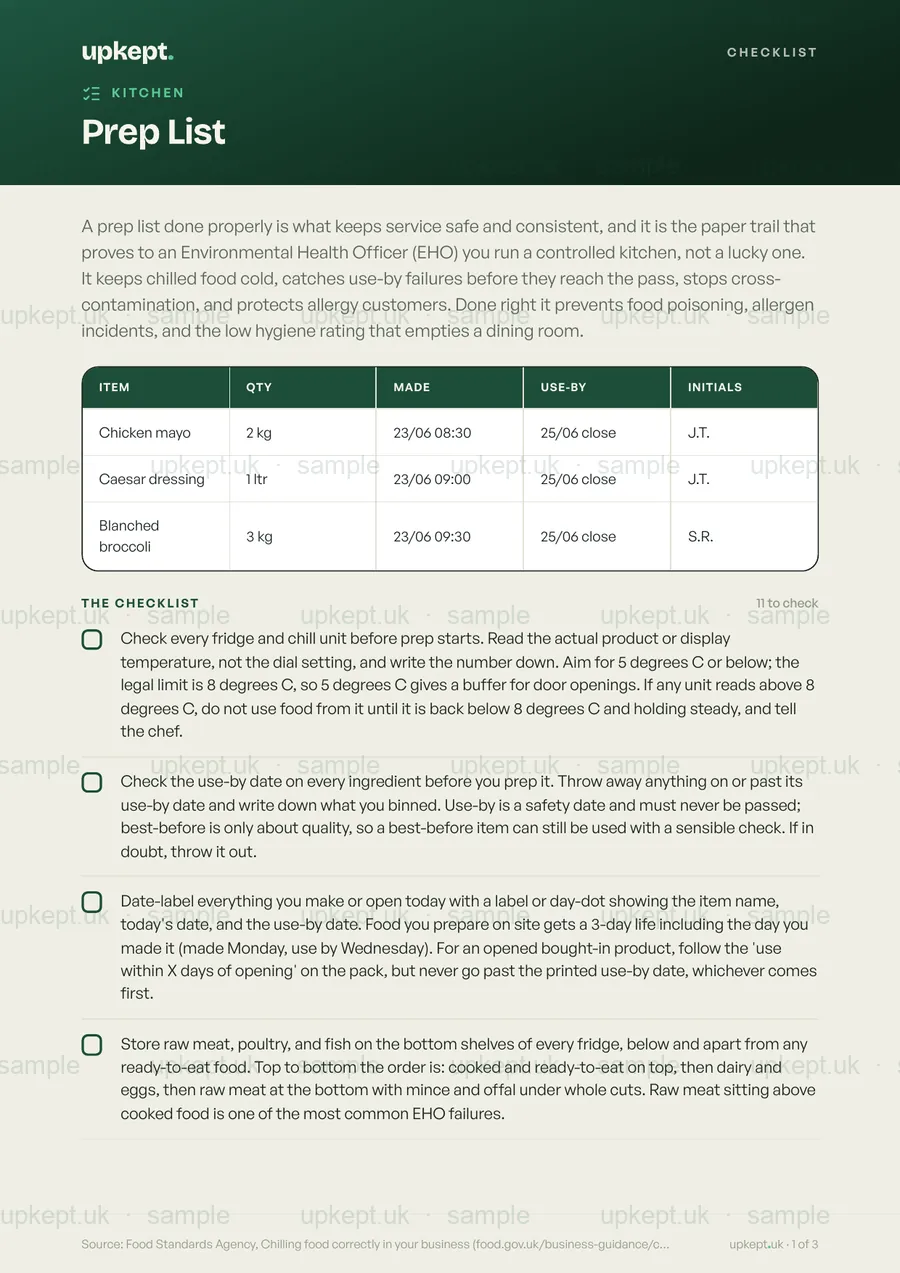
A prep list done properly is what keeps service safe and consistent, and it is the paper trail that proves to an Environmental Health Officer (EHO) you run a controlled kitchen, not a lucky one. It keeps chilled food cold, catches use-by failures before they reach the pass, stops cross-contamination, and protects allergy customers. Done right it prevents food poisoning, allergen incidents, and the low hygiene rating that empties a dining room.
11 checksPDF + phoneReviewed August 2026
Built on published UK guidance Show sources
Food Standards Agency, Chilling food correctly in your business (food.gov.uk/business-guidance/chilling-food-correctly-in-your-business), including the 4-hour cold display rule and cooling to 8 degrees C within 90 minutes to 2 hours; FSA Safer Food, Better Business for Caterers, Safe Methods: Chilled Storage and Display, Hot Holding (63 degrees C, 2-hour rule, reheat once to 75 degrees C / 82 degrees C in Scotland), and Cooking (75 degrees C core, or 70 degrees C for 2 minutes); Food Information (Amendment) (England) Regulations 2019 (Natasha's Law), in force 1 October 2021, requiring PPDS labels to carry the food name and full ingredients list with allergens emphasised in bold, italic, or coloured type; Food Safety and Hygiene (England) Regulations 2013, Schedule 4 (the 4-hour display exemption) and temperature control requirements.
£14one-off, yours forever
Replaces a DIY doc, and you get every future update free when the guidance changes.
3 for 2 on documents and packs. Add 3 and your cheapest is free.
A clean one-page PDF, ready to print
Opens and ticks off on any phone
Clear, no jargon, easy to follow
Free updates whenever the guidance changes
Secure checkout30-day money-backInstant downloadNo subscriptionCard & Apple Pay
Best valueSave 42%
Or get all 56 templates
The Everything Bundle: every template today and every future one.£399 one-off, instead of £686 bought separately.
Made for places like this
What’s on it
11 things to check.
Everything that matters, nothing that does not. Here is the full list, exactly as it appears on the template.
1Check every fridge and chill unit before prep starts. Read the actual product or display temperature, not the dial setting, and write the number down. Aim for 5 degrees C or below; the legal limit is 8 degrees C, so 5 degrees C gives a buffer for door openings. If any unit reads above 8 degrees C, do not use food from it until it is back below 8 degrees C and holding steady, and tell the chef.
2Check the use-by date on every ingredient before you prep it. Throw away anything on or past its use-by date and write down what you binned. Use-by is a safety date and must never be passed; best-before is only about quality, so a best-before item can still be used with a sensible check. If in doubt, throw it out.
3Date-label everything you make or open today with a label or day-dot showing the item name, today's date, and the use-by date. Food you prepare on site gets a 3-day life including the day you made it (made Monday, use by Wednesday). For an opened bought-in product, follow the 'use within X days of opening' on the pack, but never go past the printed use-by date, whichever comes first.
4Store raw meat, poultry, and fish on the bottom shelves of every fridge, below and apart from any ready-to-eat food. Top to bottom the order is: cooked and ready-to-eat on top, then dairy and eggs, then raw meat at the bottom with mince and offal under whole cuts. Raw meat sitting above cooked food is one of the most common EHO failures.
5Defrost frozen meat, poultry, and fish in the fridge, never on the counter or in warm water. Once fully defrosted, use within 24 hours. Do not refreeze anything you have defrosted unless you have cooked it through first.
6Clean your probe thermometer before and between uses: wipe off food, clean it with an alcohol sanitiser wipe, and let it air dry or dry it with a clean disposable towel. Never probe raw food and then ready-to-eat food without cleaning it in between. When you cook, probe the thickest part: the core must reach 75 degrees C (or 70 degrees C held for 2 minutes). Write down the reading, the food, and your initials.
7Cool cooked food fast before it goes in the fridge: get it down to 8 degrees C or below within 90 minutes (2 hours at the absolute most). Use shallow trays, an ice bath, or a blast chiller, and divide big batches into smaller portions. Never put a large deep container of hot food straight into the fridge; it warms everything around it and stays in the danger zone for hours.
8Check hot-held food is 63 degrees C or above at least every 2 hours and write the reading down. If it has dropped below 63 degrees C for under 2 hours, reheat it once until steaming hot, to at least 75 degrees C (82 degrees C in Scotland), then return it to hot holding. If it has been below 63 degrees C for more than 2 hours, throw it away and log why. Only reheat any item once.
9Time-stamp cold food the moment it leaves the fridge for display or prep. It can be out for one period of up to 4 hours, then it must be used or thrown away; it cannot go back in the fridge after 4 hours. If it has been out under 4 hours and is not finished, it can go back in the fridge once and must be used in the same service.
10Confirm allergen information is right before service. If a recipe or a supplier has changed since your last check, update the allergen information for that dish before you serve it. Anything you pack on site before it is ordered (prepacked for direct sale, PPDS) must carry a label with the food name and a full ingredients list, with the allergens emphasised in the list in bold, italic, or a different colour. This is the law under Natasha's Law (in force 1 October 2021).
11Sign off the opening checks with your name and the time in the SFBB diary or your equivalent record. There must be an entry for every day you trade. EHOs read a blank day as a day no checks were done, not a day nothing went wrong.
Good to know
The legal cold-storage limit in England, Wales, and Northern Ireland is 8 degrees C, but kitchens that set fridges to exactly 8 degrees C routinely fail inspection, because one door opening or a tray of warm food pushes the reading over the limit. FSA guidance is to run at 5 degrees C in practice for a safe buffer. Most temperature failures are units sitting at 7 to 9 degrees C that the operator believed were compliant because the dial said 8.
Source: Food Standards Agency, Chilling food correctly in your business (food.gov.uk/business-guidance/chilling-food-correctly-in-your-business), including the 4-hour cold display rule and cooling to 8 degrees C within 90 minutes to 2 hours; FSA Safer Food, Better Business for Caterers, Safe Methods: Chilled Storage and Display, Hot Holding (63 degrees C, 2-hour rule, reheat once to 75 degrees C / 82 degrees C in Scotland), and Cooking (75 degrees C core, or 70 degrees C for 2 minutes); Food Information (Amendment) (England) Regulations 2019 (Natasha's Law), in force 1 October 2021, requiring PPDS labels to carry the food name and full ingredients list with allergens emphasised in bold, italic, or coloured type; Food Safety and Hygiene (England) Regulations 2013, Schedule 4 (the 4-hour display exemption) and temperature control requirements.
Good to know
Questions, answered
What is the Prep List?
A prep list done properly is what keeps service safe and consistent, and it is the paper trail that proves to an Environmental Health Officer (EHO) you run a controlled kitchen, not a lucky one. It keeps chilled food cold, catches use-by failures before they reach the pass, stops cross-contamination, and protects allergy customers. Done right it prevents food poisoning, allergen incidents, and the low hygiene rating that empties a dining room.
Why does it matter?
The legal cold-storage limit in England, Wales, and Northern Ireland is 8 degrees C, but kitchens that set fridges to exactly 8 degrees C routinely fail inspection, because one door opening or a tray of warm food pushes the reading over the limit. FSA guidance is to run at 5 degrees C in practice for a safe buffer. Most temperature failures are units sitting at 7 to 9 degrees C that the operator believed were compliant because the dial said 8.
How do I get it, and is it up to date?
The PDF downloads the moment you check out, prints sharp in black and white, and opens on any phone. It is reviewed for August 2026 and you get any future update free when the official guidance changes.
Your temperature log is the main evidence that your cold storage is actually working. A missing entry, or an out-of-range reading nobody acted on, is what turns a single fridge fault into a food poisoning case and a failed hygiene inspection. This list makes every entry a real number, taken at the right time, with the action recorded when something goes wrong.
A wrong, out-of-date, or missing allergen line can put a customer into anaphylaxis and kill them. It also breaks the Food Information Regulations 2014, where giving false or misleading allergen information is a criminal offence carrying an unlimited fine, not just a hygiene black mark. A correct matrix is what lets any team member answer "what's in this?" the same way every time.
A food safety daily diary is the written proof that your food safety system is actually being run, not just sitting in a folder. On inspection an Environmental Health Officer treats a blank or gap-filled diary as evidence the system is failing, while a complete one with real numbers is your legal defence if someone falls ill. Filled in properly it also catches a warm fridge or an undercooked batch before it reaches a customer.