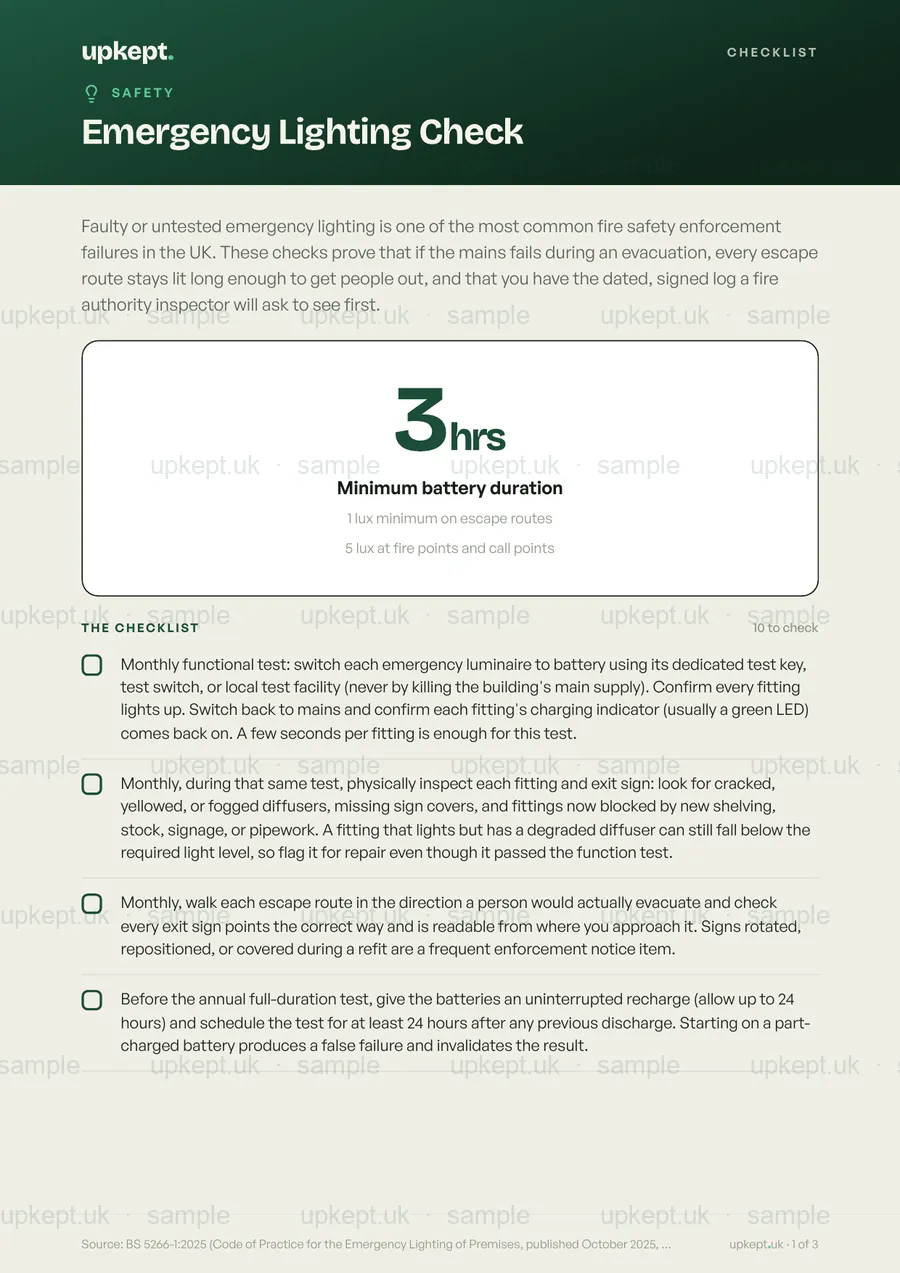
Faulty or untested emergency lighting is one of the most common fire safety enforcement failures in the UK. These checks prove that if the mains fails during an evacuation, every escape route stays lit long enough to get people out, and that you have the dated, signed log a fire authority inspector will ask to see first.
10 checksPDF + phoneReviewed August 2026
Built on published UK guidance Show sources
BS 5266-1:2025 (Code of Practice for the Emergency Lighting of Premises, published October 2025, superseding the 2016 edition; introduces the mandatory five-year photometric performance verification recorded in the log book). BS EN 1838:2024 (Lighting Applications: Emergency Lighting; escape route 1 lux across full route width, open area 0.5 lux excluding a 0.5 m border, 5 lux at safety equipment and call points). BS EN 50172:2024 (Emergency Escape Lighting Systems; monthly functional test, annual full rated-duration test, log book requirements). Regulatory Reform (Fire Safety) Order 2005, Article 14 (duty to keep emergency routes and exits, including their lighting, available and maintained).
£14one-off, yours forever
Replaces a DIY doc, and you get every future update free when the guidance changes.
3 for 2 on documents and packs. Add 3 and your cheapest is free.
A clean one-page PDF, ready to print
Opens and ticks off on any phone
Clear, no jargon, easy to follow
Free updates whenever the guidance changes
Secure checkout30-day money-backInstant downloadNo subscriptionCard & Apple Pay
Best valueSave 42%
Or get all 56 templates
The Everything Bundle: every template today and every future one.£399 one-off, instead of £686 bought separately.
Made for places like this
What’s on it
10 things to check.
Everything that matters, nothing that does not. Here is the full list, exactly as it appears on the template.
1Monthly functional test: switch each emergency luminaire to battery using its dedicated test key, test switch, or local test facility (never by killing the building's main supply). Confirm every fitting lights up. Switch back to mains and confirm each fitting's charging indicator (usually a green LED) comes back on. A few seconds per fitting is enough for this test.
2Monthly, during that same test, physically inspect each fitting and exit sign: look for cracked, yellowed, or fogged diffusers, missing sign covers, and fittings now blocked by new shelving, stock, signage, or pipework. A fitting that lights but has a degraded diffuser can still fall below the required light level, so flag it for repair even though it passed the function test.
3Monthly, walk each escape route in the direction a person would actually evacuate and check every exit sign points the correct way and is readable from where you approach it. Signs rotated, repositioned, or covered during a refit are a frequent enforcement notice item.
4Before the annual full-duration test, give the batteries an uninterrupted recharge (allow up to 24 hours) and schedule the test for at least 24 hours after any previous discharge. Starting on a part-charged battery produces a false failure and invalidates the result.
5Annual full-duration test: run every luminaire on battery for its full rated duration with the mains off. Use 3 hours for premises with a sleeping risk, places of assembly, or any building not evacuated and left empty immediately (the most common case); 1 hour is only acceptable where the building is evacuated at once and not reoccupied until the batteries have recharged. Do this when the building is unoccupied or low-risk, because emergency cover is reduced during the test and the recharge after it.
6After the annual test, allow the full recharge (up to 24 hours) and confirm every fitting has returned to its charging state before you sign off. Any fitting that went dark before its rated time must be repaired and retested before the log is signed.
7Every 12 months, check coverage against the current floor plan. Escape routes need at least 1 lux at floor level across the full width of the route (not just the centre line; BS EN 1838:2024), open anti-panic areas need at least 0.5 lux (excluding a 0.5 m border), and fire alarm call points, manual call points, firefighting equipment, and first aid points need at least 5 lux. If the layout has changed since install, look for routes that now have gaps.
8After any building works, refurbishment, or layout change, treat the system as potentially non-compliant and re-check it straight away rather than waiting for the next annual test. New partitions, lowered ceilings, or relocated fire doors can block or re-angle fittings so a previously lit route now falls below 1 lux.
9Five-year photometric verification (new mandatory requirement under BS 5266-1:2025, in force from October 2025): book a competent engineer with a calibrated lux meter to take actual floor-level readings along every escape route under simulated mains failure, and confirm measured levels still meet the original design. This cannot be done by in-house staff with a phone app. Record the results in the log book. If your building has not had one since October 2025, schedule it.
10Log every test in the emergency lighting log book with the date, the name of the person who did it, the result per fitting or zone, any faults found, and the remedial action taken. Keep the log on site and available for inspection. A fully working system with no log is treated as non-compliant, so an unlogged test is effectively an untested one.
Good to know
The monthly test only has to prove each fitting switches on, so a few seconds per luminaire is enough; the annual test must run for the full rated duration with the mains off (3 hours for most premises, 1 hour only where the building is evacuated immediately and not reoccupied until recharged). Running a quick flick-test and recording it as the annual duration test is non-compliant and is spotted immediately by an inspector reading the log.
Source: BS 5266-1:2025 (Code of Practice for the Emergency Lighting of Premises, published October 2025, superseding the 2016 edition; introduces the mandatory five-year photometric performance verification recorded in the log book). BS EN 1838:2024 (Lighting Applications: Emergency Lighting; escape route 1 lux across full route width, open area 0.5 lux excluding a 0.5 m border, 5 lux at safety equipment and call points). BS EN 50172:2024 (Emergency Escape Lighting Systems; monthly functional test, annual full rated-duration test, log book requirements). Regulatory Reform (Fire Safety) Order 2005, Article 14 (duty to keep emergency routes and exits, including their lighting, available and maintained).
Good to know
Questions, answered
What is the Emergency Lighting Check?
Faulty or untested emergency lighting is one of the most common fire safety enforcement failures in the UK. These checks prove that if the mains fails during an evacuation, every escape route stays lit long enough to get people out, and that you have the dated, signed log a fire authority inspector will ask to see first.
Why does it matter?
The monthly test only has to prove each fitting switches on, so a few seconds per luminaire is enough; the annual test must run for the full rated duration with the mains off (3 hours for most premises, 1 hour only where the building is evacuated immediately and not reoccupied until recharged). Running a quick flick-test and recording it as the annual duration test is non-compliant and is spotted immediately by an inspector reading the log.
How do I get it, and is it up to date?
The PDF downloads the moment you check out, prints sharp in black and white, and opens on any phone. It is reviewed for August 2026 and you get any future update free when the official guidance changes.
A discharged or depressurised extinguisher found during a real fire is no better than having no extinguisher at all. The monthly visual check catches the common pre-failure states (lost pressure, broken tamper seal, blocked access, overdue service) before they matter, and it gives the responsible person the maintenance records the Regulatory Reform (Fire Safety) Order 2005 requires.
A fire door only works if it closes fully, latches, and seals the gaps; one door that fails to do that lets smoke and fire spread through a building in minutes and removes people's time to escape. These checks catch the specific, common failures (props, blown gaps, missing closers, painted-up seals) that turn a survivable fire into a fatal one.
An under-stocked or expired first aid kit means the person treating an injury reaches for a dressing and finds an empty slot, a perished wrapper, or latex gloves that trigger an allergic reaction. A regular documented check fixes that in advance and gives an HSE or Ofsted inspector evidence that your first aid provision is genuinely maintained, not just present.