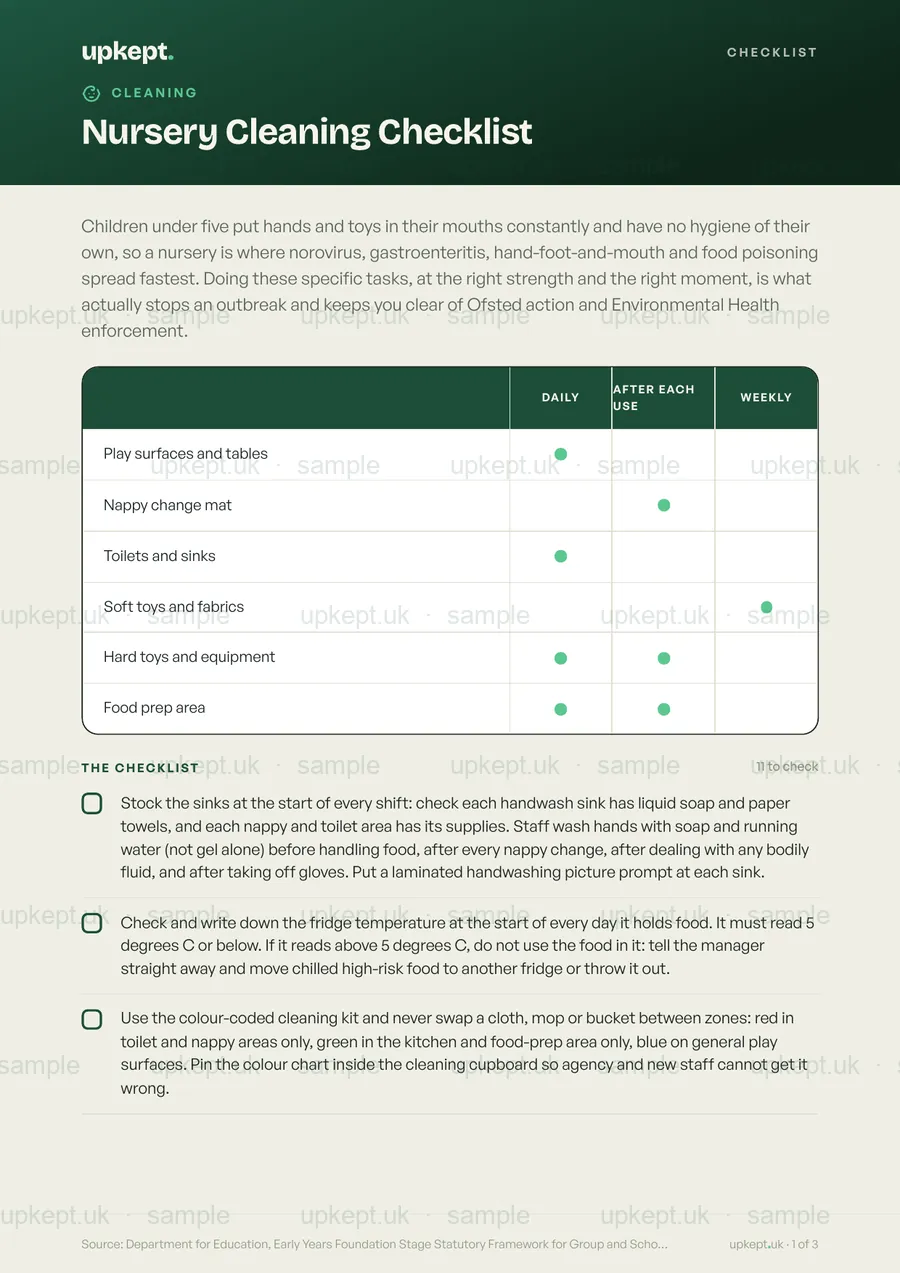
Children under five put hands and toys in their mouths constantly and have no hygiene of their own, so a nursery is where norovirus, gastroenteritis, hand-foot-and-mouth and food poisoning spread fastest. Doing these specific tasks, at the right strength and the right moment, is what actually stops an outbreak and keeps you clear of Ofsted action and Environmental Health enforcement.
11 checksPDF + phoneReviewed August 2026
Built on published UK guidance Show sources
Department for Education, Early Years Foundation Stage Statutory Framework for Group and School-Based Providers (effective 1 September 2025), Safeguarding and Welfare Requirements (food poisoning affecting two or more children notified to Ofsted as soon as possible and within 14 days; hygienic changing and food-prep facilities). UKHSA, Health Protection in Children and Young People's Settings, Including Education, plus UKHSA/PHE infection-control guidance on blood and body-fluid spillages (1,000 ppm available chlorine for routine surfaces; 10,000 ppm for blood spills, mixed with cold water; no chlorine directly onto urine or vomit). Food Standards Agency 'Cooking safely in your business' (70 degrees C for 2 minutes, equivalent to 75 degrees C for 30 seconds) and 'Chilling food correctly' (chilled food at 5 degrees C or below as the practical target; 8 degrees C legal maximum); Food Standards Scotland (reheated food 82 degrees C). HSE COSHH Regulations 2002 (as amended) for chemical storage. BICSc / NHS national colour-coding scheme for cleaning equipment (red sanitary, green kitchen, blue general).
£14one-off, yours forever
Replaces a DIY doc, and you get every future update free when the guidance changes.
3 for 2 on documents and packs. Add 3 and your cheapest is free.
A clean one-page PDF, ready to print
Opens and ticks off on any phone
Clear, no jargon, easy to follow
Free updates whenever the guidance changes
Secure checkout30-day money-backInstant downloadNo subscriptionCard & Apple Pay
Best valueSave 42%
Or get all 56 templates
The Everything Bundle: every template today and every future one.£399 one-off, instead of £686 bought separately.
Made for places like this
What’s on it
11 things to check.
Everything that matters, nothing that does not. Here is the full list, exactly as it appears on the template.
1Stock the sinks at the start of every shift: check each handwash sink has liquid soap and paper towels, and each nappy and toilet area has its supplies. Staff wash hands with soap and running water (not gel alone) before handling food, after every nappy change, after dealing with any bodily fluid, and after taking off gloves. Put a laminated handwashing picture prompt at each sink.
2Check and write down the fridge temperature at the start of every day it holds food. It must read 5 degrees C or below. If it reads above 5 degrees C, do not use the food in it: tell the manager straight away and move chilled high-risk food to another fridge or throw it out.
3Use the colour-coded cleaning kit and never swap a cloth, mop or bucket between zones: red in toilet and nappy areas only, green in the kitchen and food-prep area only, blue on general play surfaces. Pin the colour chart inside the cleaning cupboard so agency and new staff cannot get it wrong.
4Clean and disinfect the nappy-change mat after every single change: wipe with detergent and water, then spray with a disinfectant rated at least 1,000 ppm available chlorine and let it air dry. Never start the next change on a mat that is still wet or has not been disinfected. Check the mat surface has no cracks or splits (broken vinyl cannot be properly disinfected and must be replaced).
5Clean and disinfect kitchen and food-prep surfaces with detergent and hot water, then a food-safe sanitiser, before and after every meal or snack. Use separate colour-coded chopping boards (green for fruit and veg, red for raw meat if used on site) and store them apart so they cannot touch.
6Before serving any hot meal, push a clean, sanitised probe into the thickest part. It must reach 75 degrees C (in Scotland, reheated food must reach 82 degrees C). Write down the dish, the reading, the time and your name. If it does not reach the temperature, do not serve it: keep heating and probe again.
7Pull any toy a baby or toddler has mouthed straight into a labelled 'to clean' tub so it is not handed to another child. Wash it in hot soapy water, rinse, disinfect with a product safe for children's mouths, and let it dry fully before it goes back out. Deep clean older children's resources that are not usually mouthed at least once a week.
8Refresh the water tray with clean water at the start of each session; never top up standing water. At the end of the day empty it completely, wash with detergent, rinse, and stand it open or upside down to dry overnight. Do the same for any other standing-water play (sand-and-water, paddling).
9Deal with a blood, vomit or faeces spill straight away: put on disposable gloves and apron, scoop the solid part into a clinical waste bag with paper towels, then disinfect. Blood or blood-stained spills need a hypochlorite solution at 10,000 ppm available chlorine (roughly 1 part household bleach to 10 parts COLD water), left for the time on the product label (about 3 minutes) before wiping. Never pour bleach onto urine or vomit before you have mopped up the bulk first; bleach on these fluids releases toxic chlorine gas.
10Keep every chemical (bleach, disinfectant, sanitiser) in a locked cupboard at all times, out of children's reach and away from food and medicines. Check the lock works at the start of each day. Every product must keep its original label and have its COSHH safety data sheet to hand.
11If two or more children in your care get food-poisoning symptoms (sickness, diarrhoea) within the same outbreak, tell the manager, who must notify Ofsted as soon as possible and within 14 days, and tell the local Environmental Health team. Write down who was affected, what they ate and when, and keep any leftover food where you can for testing.
Good to know
The single number most settings get wrong is the disinfectant strength for a blood or blood-stained spill: it must be 10,000 ppm available chlorine (about 1 part household bleach to 10 parts cold water), ten times stronger than the 1,000 ppm used for routine surfaces and nappy mats. The weaker solution leaves live virus on the surface, and the two are not interchangeable. Always mix with cold water, and never put any chlorine product onto urine or vomit before mopping up the bulk, because it gives off toxic chlorine gas.
Source: Department for Education, Early Years Foundation Stage Statutory Framework for Group and School-Based Providers (effective 1 September 2025), Safeguarding and Welfare Requirements (food poisoning affecting two or more children notified to Ofsted as soon as possible and within 14 days; hygienic changing and food-prep facilities). UKHSA, Health Protection in Children and Young People's Settings, Including Education, plus UKHSA/PHE infection-control guidance on blood and body-fluid spillages (1,000 ppm available chlorine for routine surfaces; 10,000 ppm for blood spills, mixed with cold water; no chlorine directly onto urine or vomit). Food Standards Agency 'Cooking safely in your business' (70 degrees C for 2 minutes, equivalent to 75 degrees C for 30 seconds) and 'Chilling food correctly' (chilled food at 5 degrees C or below as the practical target; 8 degrees C legal maximum); Food Standards Scotland (reheated food 82 degrees C). HSE COSHH Regulations 2002 (as amended) for chemical storage. BICSc / NHS national colour-coding scheme for cleaning equipment (red sanitary, green kitchen, blue general).
Good to know
Questions, answered
What is the Nursery Cleaning Checklist?
Children under five put hands and toys in their mouths constantly and have no hygiene of their own, so a nursery is where norovirus, gastroenteritis, hand-foot-and-mouth and food poisoning spread fastest. Doing these specific tasks, at the right strength and the right moment, is what actually stops an outbreak and keeps you clear of Ofsted action and Environmental Health enforcement.
Why does it matter?
The single number most settings get wrong is the disinfectant strength for a blood or blood-stained spill: it must be 10,000 ppm available chlorine (about 1 part household bleach to 10 parts cold water), ten times stronger than the 1,000 ppm used for routine surfaces and nappy mats. The weaker solution leaves live virus on the surface, and the two are not interchangeable. Always mix with cold water, and never put any chlorine product onto urine or vomit before mopping up the bulk, because it gives off toxic chlorine gas.
How do I get it, and is it up to date?
The PDF downloads the moment you check out, prints sharp in black and white, and opens on any phone. It is reviewed for August 2026 and you get any future update free when the official guidance changes.
A signed cleaning record is the main evidence an Environmental Health Officer uses to decide whether your kitchen is clean every day, not just on inspection day. Done properly, this routine stops the four things that sink hygiene ratings and trigger enforcement: cross-contamination between raw and ready-to-eat food, allergen cross-contact, grease fires in the extract system, and pest infestations.
A signed, time-stamped hourly check gives you a paper trail that protects you if someone slips, complains, or is injured, and it forces a physical walk-through that catches the small failures (empty soap, no toilet roll, a broken lock, a wet floor) before they turn into complaints, bad reviews, or a downmark from the Environmental Health Officer. The log is usually the first thing an EHO asks to see.
A neglected waste area is the most common cause of pest infestation, the most common spot for a deliberate fire to start and spread into the building, and the source of unlimited fines under the duty of care in EPA 1990 s.34. This check keeps the environmental health officer, your insurer, and the fire risk assessment satisfied, and proves the area was inspected if anyone asks.