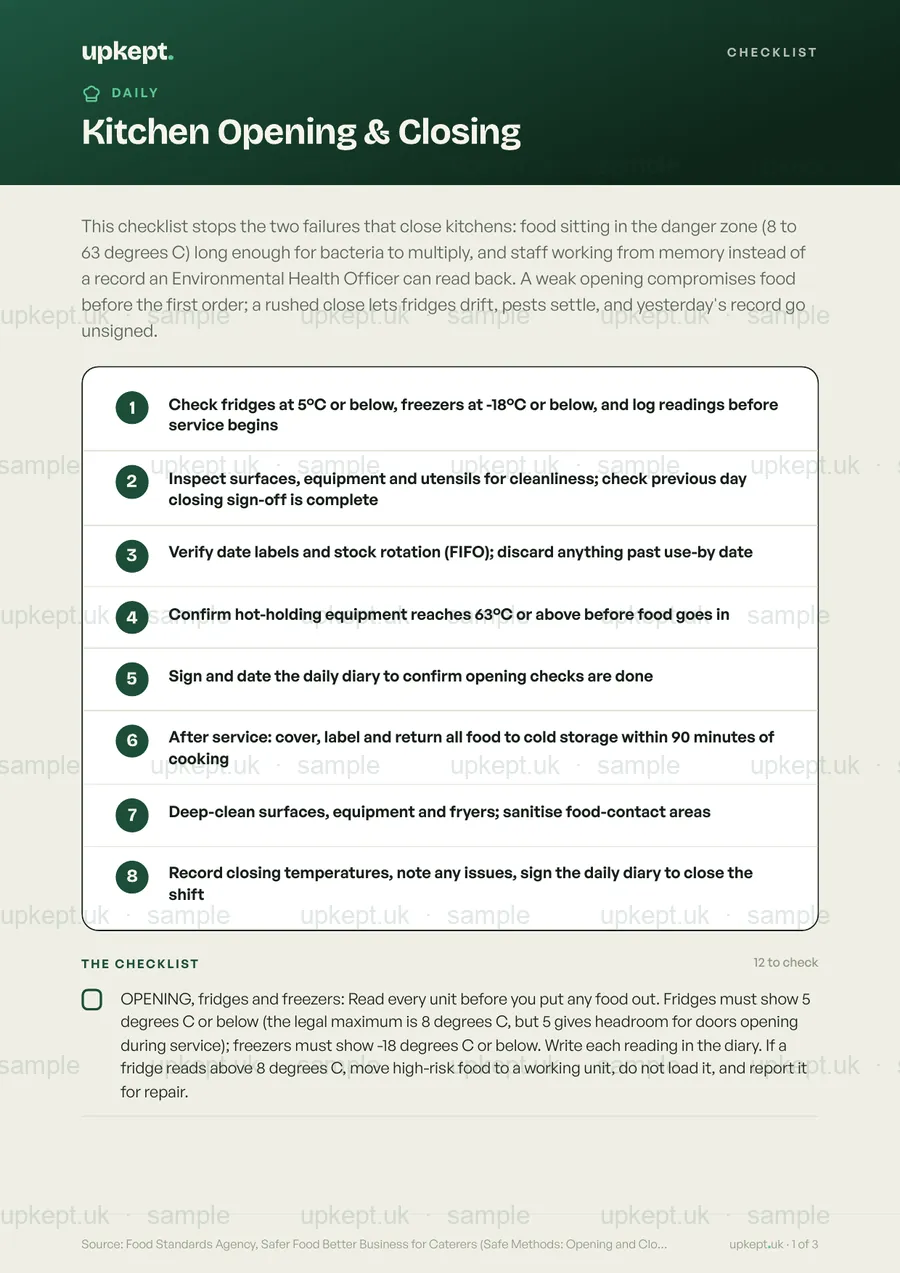
This checklist stops the two failures that close kitchens: food sitting in the danger zone (8 to 63 degrees C) long enough for bacteria to multiply, and staff working from memory instead of a record an Environmental Health Officer can read back. A weak opening compromises food before the first order; a rushed close lets fridges drift, pests settle, and yesterday's record go unsigned.
12 checksPDF + phoneReviewed August 2026
Built on published UK guidance Show sources
Food Standards Agency, Safer Food Better Business for Caterers (Safe Methods: Opening and Closing Checks; Chilling, Hot Holding, Cooling Down; Prove It probe-check); FSA Chilling Food Correctly guidance (8 degrees C legal maximum in England, Wales and Northern Ireland, 5 degrees C recommended; cool cooked food quickly); Food Safety and Hygiene (England) Regulations 2013, Schedule 4 (temperature control); Food Safety (Temperature Control) Regulations 1995; FSA Food Handlers: Fitness to Work guidance (48-hour exclusion from when symptoms stop); Food Information Regulations 2014 and Natasha's Law (Food Information (Amendment) (England) Regulations 2019) (14 regulated allergens, written allergen information).
£14one-off, yours forever
Replaces a DIY doc, and you get every future update free when the guidance changes.
3 for 2 on documents and packs. Add 3 and your cheapest is free.
A clean one-page PDF, ready to print
Opens and ticks off on any phone
Clear, no jargon, easy to follow
Free updates whenever the guidance changes
Secure checkout30-day money-backInstant downloadNo subscriptionCard & Apple Pay
Best valueSave 42%
Or get all 56 templates
The Everything Bundle: every template today and every future one.£399 one-off, instead of £686 bought separately.
Made for places like this
What’s on it
12 things to check.
Everything that matters, nothing that does not. Here is the full list, exactly as it appears on the template.
1OPENING, fridges and freezers: Read every unit before you put any food out. Fridges must show 5 degrees C or below (the legal maximum is 8 degrees C, but 5 gives headroom for doors opening during service); freezers must show -18 degrees C or below. Write each reading in the diary. If a fridge reads above 8 degrees C, move high-risk food to a working unit, do not load it, and report it for repair.
2OPENING, probe thermometer: Switch it on, check the battery symbol, and wipe the probe with a sanitiser wipe. If it has not been calibration-checked this week, stand the probe in a glass of crushed ice and water for 30 seconds: it must read between -1 and +1 degrees C. Outside that range, take it out of use and use the backup. Do not run service without a probe you have checked this way in the last 7 days.
3OPENING, pest check: Walk the kitchen and dry store before touching food. Look for droppings (small dark pellets along wall edges and under shelving), gnaw marks or chewed packaging, and dark grease smears low on walls. If you find any sign, do not open for food; phone the pest contractor and write down what you found and what you did.
4OPENING, fridge stock and dates: Check every chilled item is covered, labelled, and within its use-by date. Bin anything past use-by. Ready-to-eat high-risk food (cooked meats, dairy, prepared salads, sauces) gets a use-by no more than the made or opened date plus 2 days unless your HACCP says otherwise. Never taste food to decide if it is safe.
5OPENING, allergens: Check your written allergen matrix matches today's menu for all 14 regulated allergens (celery, cereals containing gluten, crustaceans, eggs, fish, lupin, milk, molluscs, mustard, peanuts, sesame, soya, sulphur dioxide or sulphites, tree nuts). If a dish or an ingredient changed, update the matrix now, before service. The written information must be on-site and shown to any customer who asks.
6OPENING, staff fitness: Anyone who has had vomiting or diarrhoea must stay away from open food until 48 hours after their last symptom stopped on its own. Send them home or off food duties, no exceptions for how busy it is, and note in the diary that you checked.
7OPENING, handwash and supplies: At every handwash basin confirm hot water runs and there is soap. At every prep station confirm in-date sanitiser spray, blue roll, and colour-coded cloths kept separate for surfaces and floors. If a basin has no soap or no hot water, do not start prep there until it is fixed.
8CLOSING, cool before you store: Cool hot food fast and aim to get it from cooking heat down to 8 degrees C or below within 90 minutes. Spread it into shallow trays no deeper than 5 cm, use a blast chiller if you have one, or stand containers in an ice bath and stir every 10 to 15 minutes. Probe the centre before it goes in the fridge. Any food that sat below 63 degrees C for more than 2 hours goes in the bin, not the fridge.
9CLOSING, cover, label and store: Cover every container going into the fridge and label it with what it is, the date made or opened, and the use-by (cooked high-risk food is made-date plus 2 days, so chicken cooked Monday is use-by Wednesday). Store raw meat and poultry on the bottom shelf, below all ready-to-eat food. Never put uncovered raw meat above anything ready to eat.
10CLOSING, clean food-contact surfaces: For boards, surfaces, and anything that touched raw meat, work in order: scrape off debris, wash with hot detergent water, rinse, then apply sanitiser and leave it the contact time on the label (usually 30 to 60 seconds) without wiping it off early. Keep boards colour-separated (red raw meat, blue raw fish, green salad and fruit, brown vegetables, yellow cooked meat, white dairy and bakery); this is your proof you control cross-contamination.
11CLOSING, waste and pests: Take all food-waste bins out to the external bin store; do not leave them in the kitchen overnight. Check drains run clear and covers sit flat. Block any floor-level gap wider than 6 mm (about a pencil width, enough for a mouse) before you lock up.
12CLOSING, shut down and record: Switch off equipment and extraction once cleaning is done, turn off the gas at the isolation valve, and check every fridge and freezer door is fully shut with no gap (a door left ajar can push the unit above 8 degrees C within a few hours and spoil everything inside). Write the final fridge and freezer readings in the diary, sign and date it, and file it. Keep completed diary pages for at least 3 months for the EHO.
Good to know
Hot food can legally drop below 63 degrees C for one single period of up to 2 hours (for example, on display), and only once per batch. After that 2 hours it must either be reheated until steaming hot and returned to hot holding above 63 degrees C, or chilled and used within 2 days. It cannot go back under the heat lamp a second time. Most operators do not know the single-period rule and reheat the same batch repeatedly, which is an enforcement breach under the Food Safety and Hygiene (England) Regulations 2013.
Source: Food Standards Agency, Safer Food Better Business for Caterers (Safe Methods: Opening and Closing Checks; Chilling, Hot Holding, Cooling Down; Prove It probe-check); FSA Chilling Food Correctly guidance (8 degrees C legal maximum in England, Wales and Northern Ireland, 5 degrees C recommended; cool cooked food quickly); Food Safety and Hygiene (England) Regulations 2013, Schedule 4 (temperature control); Food Safety (Temperature Control) Regulations 1995; FSA Food Handlers: Fitness to Work guidance (48-hour exclusion from when symptoms stop); Food Information Regulations 2014 and Natasha's Law (Food Information (Amendment) (England) Regulations 2019) (14 regulated allergens, written allergen information).
Good to know
Questions, answered
What is the Kitchen Opening & Closing?
This checklist stops the two failures that close kitchens: food sitting in the danger zone (8 to 63 degrees C) long enough for bacteria to multiply, and staff working from memory instead of a record an Environmental Health Officer can read back. A weak opening compromises food before the first order; a rushed close lets fridges drift, pests settle, and yesterday's record go unsigned.
Why does it matter?
Hot food can legally drop below 63 degrees C for one single period of up to 2 hours (for example, on display), and only once per batch. After that 2 hours it must either be reheated until steaming hot and returned to hot holding above 63 degrees C, or chilled and used within 2 days. It cannot go back under the heat lamp a second time. Most operators do not know the single-period rule and reheat the same batch repeatedly, which is an enforcement breach under the Food Safety and Hygiene (England) Regulations 2013.
How do I get it, and is it up to date?
The PDF downloads the moment you check out, prints sharp in black and white, and opens on any phone. It is reviewed for August 2026 and you get any future update free when the official guidance changes.
A proper opening check, done before the first customer or the first food is touched, is your strongest defence against a poor Food Hygiene Rating, a customer falling ill, or an enforcement notice. The Environmental Health Officer scores how well you manage safety every day, not just on inspection day, so a signed daily record that proves you check temperatures, allergens and sickness exclusion is what protects the rating and the business.
A closing checklist stops the overnight failures that trigger enforcement notices, voided insurance claims, and food poisoning: fridges drifting above 8C unnoticed, hot food cooled too slowly, gas left on, fire exits blocked, and cash left out. These are the specific things an EHO inspector or an insurer's loss adjuster looks for, and the closing record is the proof you did them.
A correct cash-up catches theft, miscounts and till faults at the end of each shift, before they compound and become impossible to trace back to a person or a day. Done the same way every day it gives you the contemporaneous till records HMRC expects, and builds a variance history that tells a one-off mistake apart from a steady leak.