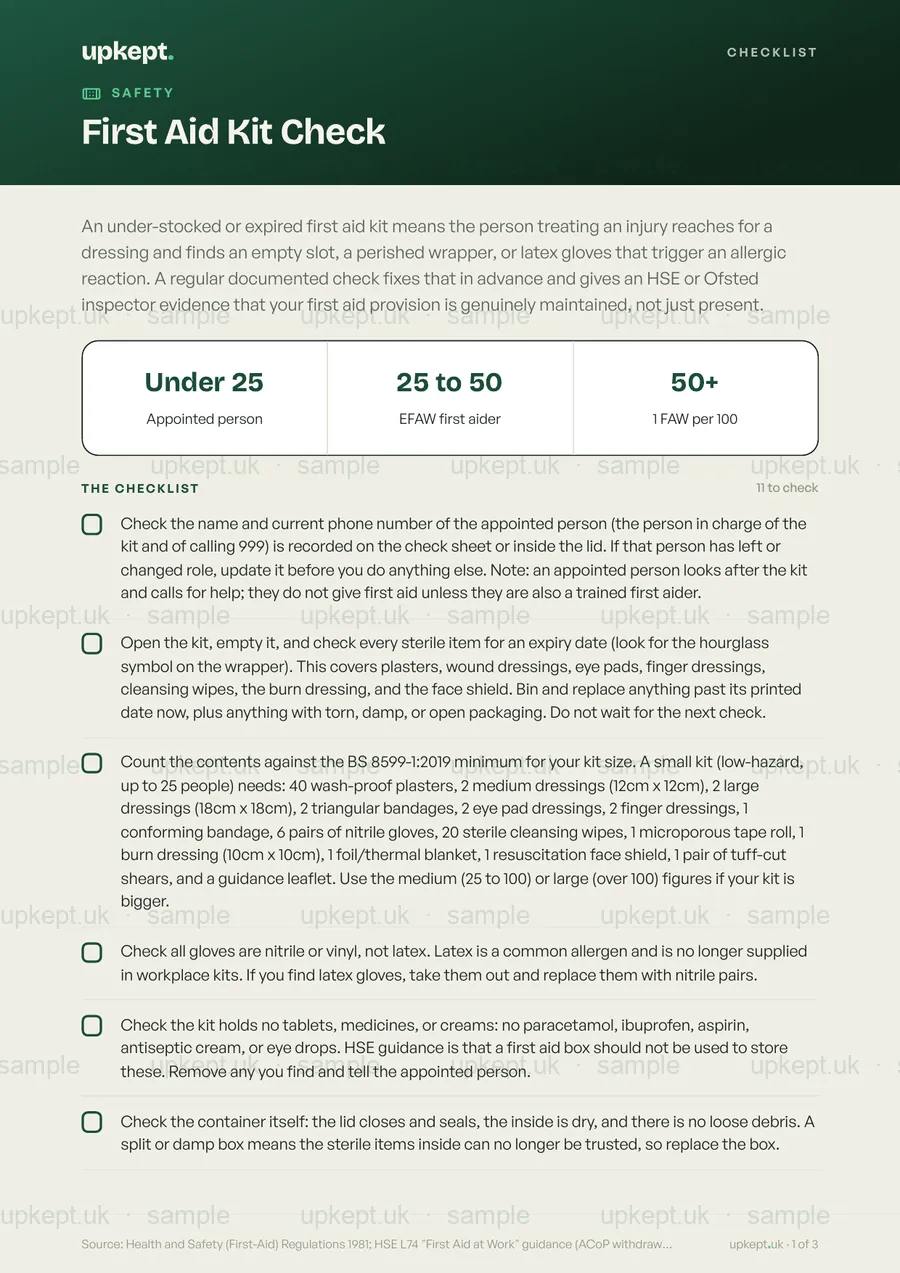
An under-stocked or expired first aid kit means the person treating an injury reaches for a dressing and finds an empty slot, a perished wrapper, or latex gloves that trigger an allergic reaction. A regular documented check fixes that in advance and gives an HSE or Ofsted inspector evidence that your first aid provision is genuinely maintained, not just present.
A first aid kit checklist stops the quiet failures: the used-up plasters nobody replaced, the expired dressings, the kit that wandered off its wall. This one follows BS 8599-1 workplace kit contents, with restock prompts and a sign-off line.
11 checksPDF + phoneReviewed August 2026
Built on published UK guidance Show sources
Health and Safety (First-Aid) Regulations 1981; HSE L74 "First Aid at Work" guidance (ACoP withdrawn 2013, guidance current); HSE INDG214 "First aid at work: your questions answered" (appointed person role; recommendation not to keep tablets/medicines in the box); BS 8599-1:2019 "Workplace first aid kits", Table 1 (contents and quantities by kit size); Health and Safety (Safety Signs and Signals) Regulations 1996 and BS EN ISO 7010 symbol E003 (first aid sign); EYFS Statutory Framework (from 1 September 2025), paediatric first aid requirements; Food Standards Agency / food hygiene guidance on blue plasters in food-handling areas.
£14one-off, yours forever
Replaces a DIY doc, and you get every future update free when the guidance changes.
3 for 2 on documents and packs. Add 3 and your cheapest is free.
A clean one-page PDF, ready to print
Opens and ticks off on any phone
Clear, no jargon, easy to follow
Free updates whenever the guidance changes
Secure checkout30-day money-backInstant downloadNo subscriptionCard & Apple Pay
Best valueSave 42%
Or get all 56 templates
The Everything Bundle: every template today and every future one.£399 one-off, instead of £686 bought separately.
Made for places like this
What’s on it
11 things to check.
Everything that matters, nothing that does not. Here is the full list, exactly as it appears on the template.
1Check the name and current phone number of the appointed person (the person in charge of the kit and of calling 999) is recorded on the check sheet or inside the lid. If that person has left or changed role, update it before you do anything else. Note: an appointed person looks after the kit and calls for help; they do not give first aid unless they are also a trained first aider.
2Open the kit, empty it, and check every sterile item for an expiry date (look for the hourglass symbol on the wrapper). This covers plasters, wound dressings, eye pads, finger dressings, cleansing wipes, the burn dressing, and the face shield. Bin and replace anything past its printed date now, plus anything with torn, damp, or open packaging. Do not wait for the next check.
3Count the contents against the BS 8599-1:2019 minimum for your kit size. A small kit (low-hazard, up to 25 people) needs: 40 wash-proof plasters, 2 medium dressings (12cm x 12cm), 2 large dressings (18cm x 18cm), 2 triangular bandages, 2 eye pad dressings, 2 finger dressings, 1 conforming bandage, 6 pairs of nitrile gloves, 20 sterile cleansing wipes, 1 microporous tape roll, 1 burn dressing (10cm x 10cm), 1 foil/thermal blanket, 1 resuscitation face shield, 1 pair of tuff-cut shears, and a guidance leaflet. Use the medium (25 to 100) or large (over 100) figures if your kit is bigger.
4Check all gloves are nitrile or vinyl, not latex. Latex is a common allergen and is no longer supplied in workplace kits. If you find latex gloves, take them out and replace them with nitrile pairs.
5Check the kit holds no tablets, medicines, or creams: no paracetamol, ibuprofen, aspirin, antiseptic cream, or eye drops. HSE guidance is that a first aid box should not be used to store these. Remove any you find and tell the appointed person.
6Check the container itself: the lid closes and seals, the inside is dry, and there is no loose debris. A split or damp box means the sterile items inside can no longer be trusted, so replace the box.
7Check the kit is reachable and signed. It must not be locked away, stored above shoulder height, or hidden behind a closed door, and it needs a first aid sign (white cross on green, BS EN ISO 7010 symbol E003) visible as you approach. In care homes and nurseries, confirm a separate portable kit is ready for any outing off the premises.
8Food-prep areas only (care home kitchen, nursery lunch prep): check the kitchen has its own supply of blue plasters. Blue is used because it is not a natural food colour, so a lost plaster is easy to spot; standard skin-tone plasters must not be used where food is handled. Metal-detectable blue plasters are recommended on top of this where the site uses detection equipment.
9Nursery and EYFS settings only: confirm at least one person with a current 12-hour Paediatric First Aid (PFA) certificate is on the premises whenever children are present, and that a PFA-qualified person is in the room whenever children are eating. Certificates last three years. Since 1 September 2025, students, trainees, and apprentices must hold a valid PFA certificate to be counted in staff-to-child ratios. Record each holder's name and certificate expiry date on the check sheet.
10Restock every used or expired item before you sign the check off, not after. Never mark a check complete while replacement stock is still on order. Failing to restock after an incident is the most commonly missed step and the most likely to leave the next casualty unattended.
11Write up the check: date, your name, every item confirmed or replaced, and the next check date. HSE expects you to be able to show first aid arrangements are actively maintained, and an inspector treats a check with no written record as no check at all. Check monthly as standard; check after every incident, and at least every four weeks, in busy or higher-risk settings.
Good to know
There is no legally fixed list of what a first aid box must contain. The Health and Safety (First-Aid) Regulations 1981 only require provision that is "adequate and appropriate" for your own needs assessment. BS 8599-1:2019 is a British Standard, not a law, but it is the benchmark an inspector or court will measure your kit against, so treat it as the floor while sizing the actual contents to your workplace risks.
Source: Health and Safety (First-Aid) Regulations 1981; HSE L74 "First Aid at Work" guidance (ACoP withdrawn 2013, guidance current); HSE INDG214 "First aid at work: your questions answered" (appointed person role; recommendation not to keep tablets/medicines in the box); BS 8599-1:2019 "Workplace first aid kits", Table 1 (contents and quantities by kit size); Health and Safety (Safety Signs and Signals) Regulations 1996 and BS EN ISO 7010 symbol E003 (first aid sign); EYFS Statutory Framework (from 1 September 2025), paediatric first aid requirements; Food Standards Agency / food hygiene guidance on blue plasters in food-handling areas.
Good to know
Questions, answered
What should be in a workplace first aid kit?
BS 8599-1 sets the benchmark contents for UK workplace kits by size: plasters, sterile dressings, bandages, gloves and more, in quantities matched to the kit size. This checklist follows that standard so you restock against something official rather than guesswork.
How often should a first aid kit be checked?
HSE guidance is to check kits regularly and restock after use. A monthly check with a dated signature is the routine most workplaces settle on, and it is how this checklist is laid out.
What is the First Aid Kit Check?
An under-stocked or expired first aid kit means the person treating an injury reaches for a dressing and finds an empty slot, a perished wrapper, or latex gloves that trigger an allergic reaction. A regular documented check fixes that in advance and gives an HSE or Ofsted inspector evidence that your first aid provision is genuinely maintained, not just present.
Why does it matter?
There is no legally fixed list of what a first aid box must contain. The Health and Safety (First-Aid) Regulations 1981 only require provision that is "adequate and appropriate" for your own needs assessment. BS 8599-1:2019 is a British Standard, not a law, but it is the benchmark an inspector or court will measure your kit against, so treat it as the floor while sizing the actual contents to your workplace risks.
How do I get it, and is it up to date?
The PDF downloads the moment you check out, prints sharp in black and white, and opens on any phone. It is reviewed for August 2026 and you get any future update free when the official guidance changes.
A discharged or depressurised extinguisher found during a real fire is no better than having no extinguisher at all. The monthly visual check catches the common pre-failure states (lost pressure, broken tamper seal, blocked access, overdue service) before they matter, and it gives the responsible person the maintenance records the Regulatory Reform (Fire Safety) Order 2005 requires.
A fire door only works if it closes fully, latches, and seals the gaps; one door that fails to do that lets smoke and fire spread through a building in minutes and removes people's time to escape. These checks catch the specific, common failures (props, blown gaps, missing closers, painted-up seals) that turn a survivable fire into a fatal one.
Faulty or untested emergency lighting is one of the most common fire safety enforcement failures in the UK. These checks prove that if the mains fails during an evacuation, every escape route stays lit long enough to get people out, and that you have the dated, signed log a fire authority inspector will ask to see first.