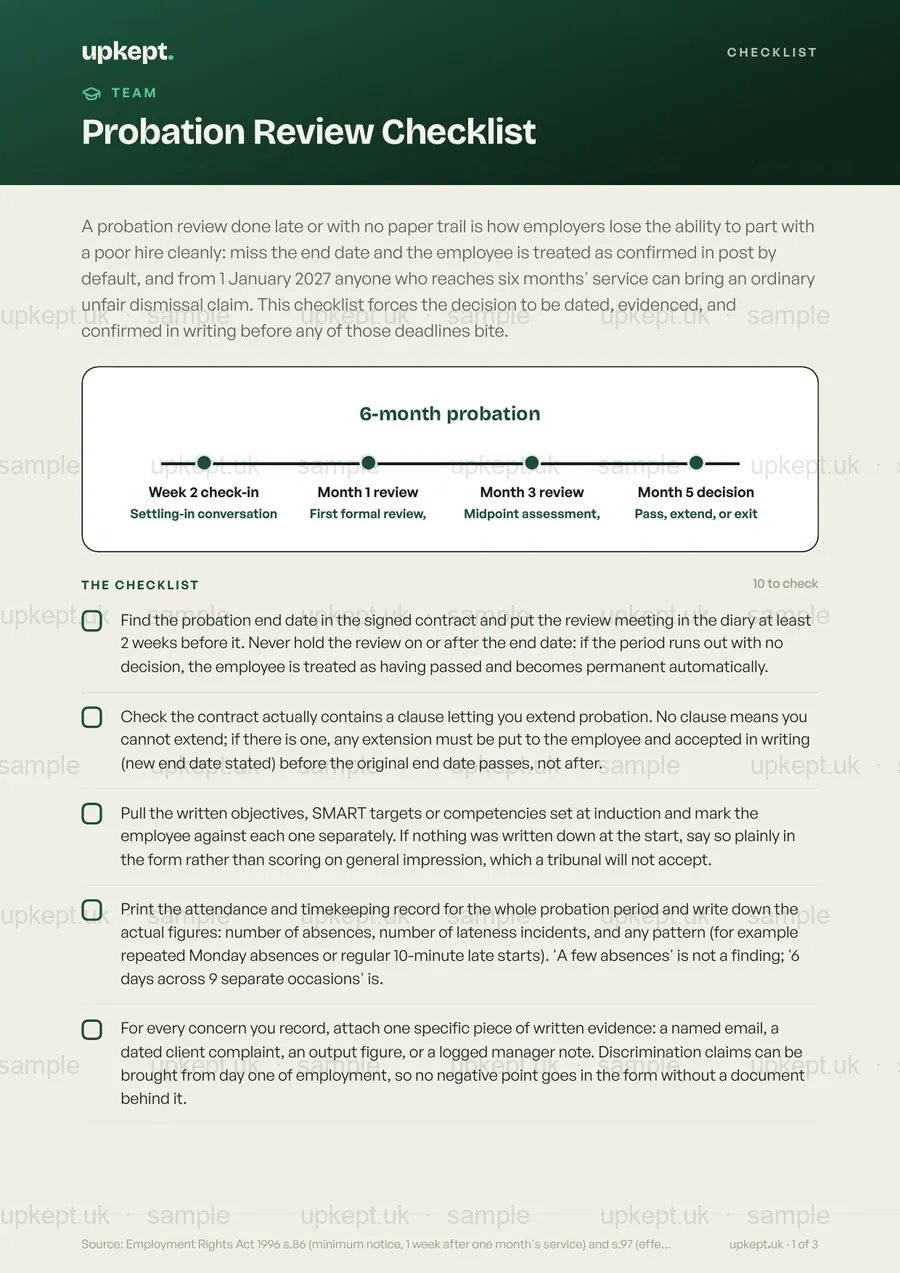
A probation review done late or with no paper trail is how employers lose the ability to part with a poor hire cleanly: miss the end date and the employee is treated as confirmed in post by default, and from 1 January 2027 anyone who reaches six months' service can bring an ordinary unfair dismissal claim. This checklist forces the decision to be dated, evidenced, and confirmed in writing before any of those deadlines bite.
10 checksPDF + phoneReviewed August 2026
Built on published UK guidance Show sources
Employment Rights Act 1996 s.86 (minimum notice, 1 week after one month's service) and s.97 (effective date of termination extended by statutory notice when counting qualifying service); Employment Relations Act 1999 s.10 (right to be accompanied at a hearing that may result in a formal warning or other disciplinary action); Employment Rights Act 2025 (unfair dismissal qualifying period reduced from 2 years to 6 months, in force 1 January 2027, confirmed by Acas "Employment Rights Act 2025" guidance); Equality Act 2010 and EHRC time-limits guidance (discrimination claims, no qualifying period, 3 months less one day, Acas early conciliation required); Acas Code of Practice on Disciplinary and Grievance Procedures (2015); Acas guidance "Dismissal during a probation period" (acas.org.uk).
£14one-off, yours forever
Replaces a DIY doc, and you get every future update free when the guidance changes.
3 for 2 on documents and packs. Add 3 and your cheapest is free.
A clean one-page PDF, ready to print
Opens and ticks off on any phone
Clear, no jargon, easy to follow
Free updates whenever the guidance changes
Secure checkout30-day money-backInstant downloadNo subscriptionCard & Apple Pay
Best valueSave 42%
Or get all 56 templates
The Everything Bundle: every template today and every future one.£399 one-off, instead of £686 bought separately.
Made for places like this
What’s on it
10 things to check.
Everything that matters, nothing that does not. Here is the full list, exactly as it appears on the template.
1Find the probation end date in the signed contract and put the review meeting in the diary at least 2 weeks before it. Never hold the review on or after the end date: if the period runs out with no decision, the employee is treated as having passed and becomes permanent automatically.
2Check the contract actually contains a clause letting you extend probation. No clause means you cannot extend; if there is one, any extension must be put to the employee and accepted in writing (new end date stated) before the original end date passes, not after.
3Pull the written objectives, SMART targets or competencies set at induction and mark the employee against each one separately. If nothing was written down at the start, say so plainly in the form rather than scoring on general impression, which a tribunal will not accept.
4Print the attendance and timekeeping record for the whole probation period and write down the actual figures: number of absences, number of lateness incidents, and any pattern (for example repeated Monday absences or regular 10-minute late starts). 'A few absences' is not a finding; '6 days across 9 separate occasions' is.
5For every concern you record, attach one specific piece of written evidence: a named email, a dated client complaint, an output figure, or a logged manager note. Discrimination claims can be brought from day one of employment, so no negative point goes in the form without a document behind it.
6Decide before the meeting whether the likely outcome is a formal warning or dismissal. If it is, you must offer the statutory right to be accompanied (section 10 Employment Relations Act 1999) in writing beforehand, and the companion can only be a trade union rep or a work colleague. A genuinely informal progress chat does not trigger this right.
7Give the employee the outcome in writing within 5 working days of the meeting, stating clearly: passed, extended (with the new end date), or failed. A verbal conversation is not enough; if you say nothing, the law treats the employee as having passed.
8If you are dismissing, give the longer of the contractual notice and the statutory minimum. After one month's service the statutory floor is 1 week (section 86 Employment Rights Act 1996). State the exact notice and the last working day in the dismissal letter.
9Make and confirm any dismissal decision before the employee reaches roughly 5 months' service, not 5 months 3 weeks. From 1 January 2027 the unfair dismissal qualifying period drops from 2 years to 6 months, and any statutory notice you owe is added on top when service is counted, so a late dismissal can push the employee over 6 months and hand them full unfair dismissal rights.
10Keep the signed review form, the outcome letter and all supporting evidence on the HR file for at least 6 years. Discrimination claims have a short window (3 months less one day from the act, and Acas early conciliation must be started inside that window), but the underlying records can be called for years later in tribunal or civil proceedings.
Good to know
If probation expires and you have neither extended it in writing nor confirmed the outcome, the employee is treated as having passed and becomes permanent from that date. From 1 January 2027 the danger sharpens: the unfair dismissal qualifying period falls to 6 months, and because any statutory notice you owe is added to the leaving date when service is counted, a dismissal decided at 5 months 3 weeks can still tip the employee past 6 months and give them full unfair dismissal rights. Decide by around 5 months, not at the wire.
Source: Employment Rights Act 1996 s.86 (minimum notice, 1 week after one month's service) and s.97 (effective date of termination extended by statutory notice when counting qualifying service); Employment Relations Act 1999 s.10 (right to be accompanied at a hearing that may result in a formal warning or other disciplinary action); Employment Rights Act 2025 (unfair dismissal qualifying period reduced from 2 years to 6 months, in force 1 January 2027, confirmed by Acas "Employment Rights Act 2025" guidance); Equality Act 2010 and EHRC time-limits guidance (discrimination claims, no qualifying period, 3 months less one day, Acas early conciliation required); Acas Code of Practice on Disciplinary and Grievance Procedures (2015); Acas guidance "Dismissal during a probation period" (acas.org.uk).
Good to know
Questions, answered
What is the Probation Review Checklist?
A probation review done late or with no paper trail is how employers lose the ability to part with a poor hire cleanly: miss the end date and the employee is treated as confirmed in post by default, and from 1 January 2027 anyone who reaches six months' service can bring an ordinary unfair dismissal claim. This checklist forces the decision to be dated, evidenced, and confirmed in writing before any of those deadlines bite.
Why does it matter?
If probation expires and you have neither extended it in writing nor confirmed the outcome, the employee is treated as having passed and becomes permanent from that date. From 1 January 2027 the danger sharpens: the unfair dismissal qualifying period falls to 6 months, and because any statutory notice you owe is added to the leaving date when service is counted, a dismissal decided at 5 months 3 weeks can still tip the employee past 6 months and give them full unfair dismissal rights. Decide by around 5 months, not at the wire.
How do I get it, and is it up to date?
The PDF downloads the moment you check out, prints sharp in black and white, and opens on any phone. It is reviewed for August 2026 and you get any future update free when the official guidance changes.
A weak handover is the most common root cause of medication errors, choking on the wrong diet texture, missed post-fall checks, and pressure damage that goes unwatched. A sheet that names the specific person, number, and action passes information the next shift can act on immediately, and it is the record CQC reads back when something goes wrong.
Onboarding done right keeps the business clear of an illegal-working civil penalty (up to £60,000 per worker), of tribunal claims for a missing written statement or unlawful pay deductions, and of the early attrition that hits when someone leaves inside 90 days because day one was a mess. This is the order an onboarder actually works through, from legal must-dos to the things that make a new starter productive.
A new starter induction that is actually done, not just signed off, prevents two kinds of expensive failure: legal exposure (a £45,000 to £60,000 illegal-working penalty, an unfair dismissal or discrimination claim, an ICO breach, an HMRC tax-records penalty) and operational failure (someone who cannot evacuate the building, cannot log in for three days, or hits month five of probation with no documented reviews). Each item below names the document, the number or deadline, and the action, so it can be ticked off and evidenced.