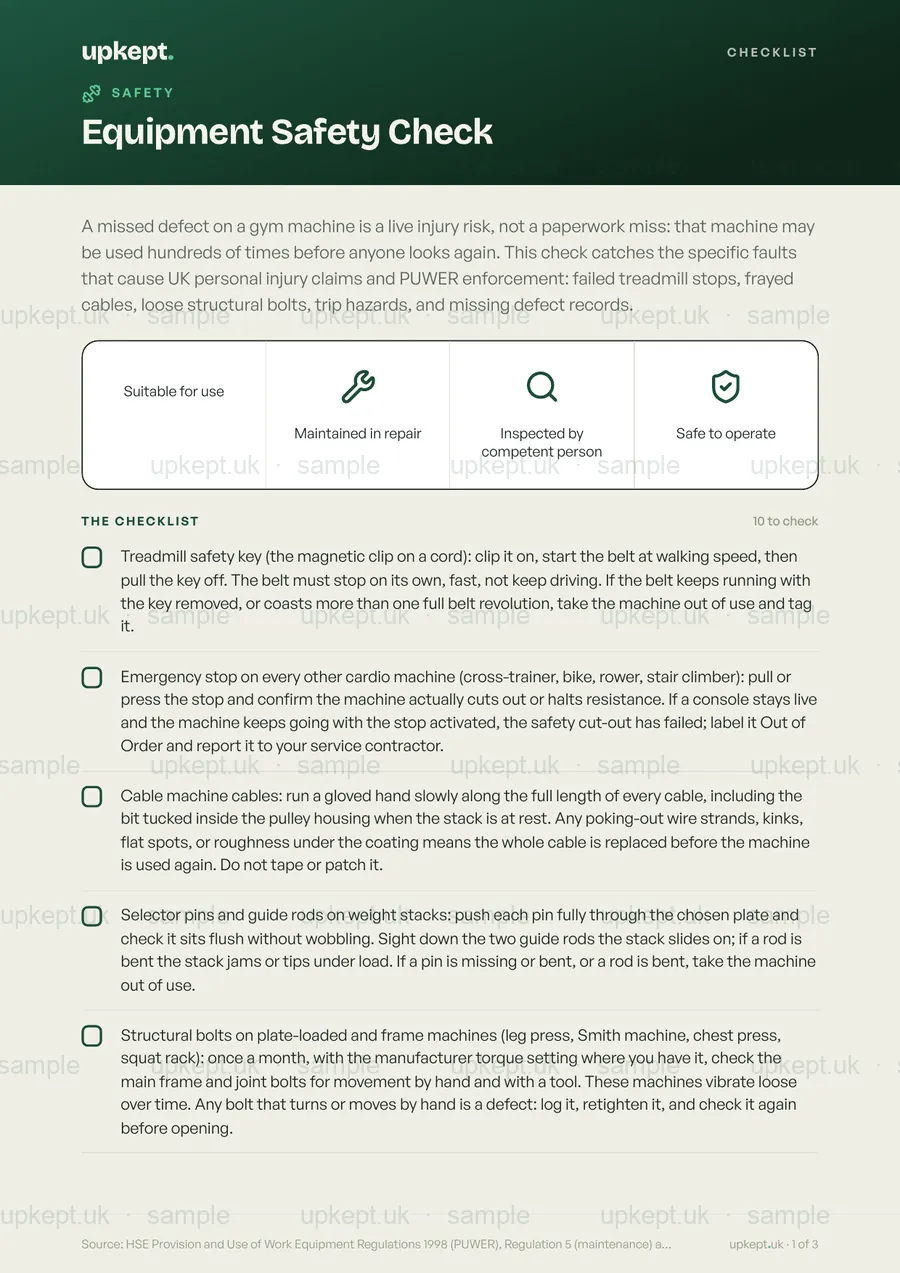
A missed defect on a gym machine is a live injury risk, not a paperwork miss: that machine may be used hundreds of times before anyone looks again. This check catches the specific faults that cause UK personal injury claims and PUWER enforcement: failed treadmill stops, frayed cables, loose structural bolts, trip hazards, and missing defect records.
10 checksPDF + phoneReviewed August 2026
Built on published UK guidance Show sources
HSE Provision and Use of Work Equipment Regulations 1998 (PUWER), Regulation 5 (maintenance) and Regulation 6 (inspection, competent person, records kept until at least the next inspection); HSE work-equipment inspection guidance (hse.gov.uk, confirming risk-based frequency and that the competent person need not be independent); HSE leaflet INDG291 "Providing and using work equipment safely"; BS EN ISO 20957-1 (general safety requirements for stationary training equipment, stability and structural integrity) and the BS ISO 20957 part-specific standards for treadmills and strength equipment; General Product Safety Regulations 2005 (UK benchmark for safe fitness products).
£14one-off, yours forever
Replaces a DIY doc, and you get every future update free when the guidance changes.
3 for 2 on documents and packs. Add 3 and your cheapest is free.
A clean one-page PDF, ready to print
Opens and ticks off on any phone
Clear, no jargon, easy to follow
Free updates whenever the guidance changes
Secure checkout30-day money-backInstant downloadNo subscriptionCard & Apple Pay
Best valueSave 42%
Or get all 56 templates
The Everything Bundle: every template today and every future one.£399 one-off, instead of £686 bought separately.
Made for places like this
What’s on it
10 things to check.
Everything that matters, nothing that does not. Here is the full list, exactly as it appears on the template.
1Treadmill safety key (the magnetic clip on a cord): clip it on, start the belt at walking speed, then pull the key off. The belt must stop on its own, fast, not keep driving. If the belt keeps running with the key removed, or coasts more than one full belt revolution, take the machine out of use and tag it.
2Emergency stop on every other cardio machine (cross-trainer, bike, rower, stair climber): pull or press the stop and confirm the machine actually cuts out or halts resistance. If a console stays live and the machine keeps going with the stop activated, the safety cut-out has failed; label it Out of Order and report it to your service contractor.
3Cable machine cables: run a gloved hand slowly along the full length of every cable, including the bit tucked inside the pulley housing when the stack is at rest. Any poking-out wire strands, kinks, flat spots, or roughness under the coating means the whole cable is replaced before the machine is used again. Do not tape or patch it.
4Selector pins and guide rods on weight stacks: push each pin fully through the chosen plate and check it sits flush without wobbling. Sight down the two guide rods the stack slides on; if a rod is bent the stack jams or tips under load. If a pin is missing or bent, or a rod is bent, take the machine out of use.
5Structural bolts on plate-loaded and frame machines (leg press, Smith machine, chest press, squat rack): once a month, with the manufacturer torque setting where you have it, check the main frame and joint bolts for movement by hand and with a tool. These machines vibrate loose over time. Any bolt that turns or moves by hand is a defect: log it, retighten it, and check it again before opening.
6Bench and pad upholstery: press hard on every pad and seat. Foam that does not spring back within about 2 seconds has collapsed and no longer supports load, so replace it. Any cut, split, or hole bigger than about 10mm in the vinyl traps bacteria and is a claim waiting to happen: tag it out and book the repair that day.
7Treadmill belt tracking: stand behind the machine, run the belt empty at a slow speed, and watch it. The belt should run roughly central and not drift hard to one edge or rub the side. A belt that pulls firmly to one side, or where you can see the deck or rear roller worn, needs adjusting or a service engineer before anyone uses it.
8Floor and matting in the fall zone (at least 1 metre clear on every side a user steps off): walk each machine's surround. Rubber or anti-fatigue matting must lie flat with no curled edges, splits, or gaps between tiles wider than about 5mm. Tug any mat that shifts when pulled; a mat that slides is a trip the second someone dismounts. Flatten, refix, or replace it.
9Defect log: every fault you find goes in the site defect register before the gym opens, with the machine name, the exact fault, the date, your name, and what you did (fixed, tagged out, or contractor called). PUWER Regulation 6 requires you to keep this record and produce it on request; keep each entry at least until the next inspection of that machine. Telling a manager with nothing written down does not count.
10Out-of-service tagging: confirm every machine you have failed today carries a clear Out of Order tag and is unplugged or pulled away from the floor so a member cannot just step on and use it. A logged defect with the machine still live and reachable is the exact setup that produces an injury claim.
Good to know
Daily check logs do not, on their own, satisfy PUWER. Regulation 6 also requires inspection at suitable intervals by a competent person, someone with enough knowledge to know what to look for and what to do about a fault. Two myths to drop: PUWER sets no fixed annual date (frequency comes from your risk assessment and the maker's service schedule, not a calendar rule), and the competent person does not have to be an outside third party (experienced in-house staff can qualify). The legal floor for keeping the record is until the next inspection, though keeping it for the life of the machine is sensible.
Source: HSE Provision and Use of Work Equipment Regulations 1998 (PUWER), Regulation 5 (maintenance) and Regulation 6 (inspection, competent person, records kept until at least the next inspection); HSE work-equipment inspection guidance (hse.gov.uk, confirming risk-based frequency and that the competent person need not be independent); HSE leaflet INDG291 "Providing and using work equipment safely"; BS EN ISO 20957-1 (general safety requirements for stationary training equipment, stability and structural integrity) and the BS ISO 20957 part-specific standards for treadmills and strength equipment; General Product Safety Regulations 2005 (UK benchmark for safe fitness products).
Good to know
Questions, answered
What is the Equipment Safety Check?
A missed defect on a gym machine is a live injury risk, not a paperwork miss: that machine may be used hundreds of times before anyone looks again. This check catches the specific faults that cause UK personal injury claims and PUWER enforcement: failed treadmill stops, frayed cables, loose structural bolts, trip hazards, and missing defect records.
Why does it matter?
Daily check logs do not, on their own, satisfy PUWER. Regulation 6 also requires inspection at suitable intervals by a competent person, someone with enough knowledge to know what to look for and what to do about a fault. Two myths to drop: PUWER sets no fixed annual date (frequency comes from your risk assessment and the maker's service schedule, not a calendar rule), and the competent person does not have to be an outside third party (experienced in-house staff can qualify). The legal floor for keeping the record is until the next inspection, though keeping it for the life of the machine is sensible.
How do I get it, and is it up to date?
The PDF downloads the moment you check out, prints sharp in black and white, and opens on any phone. It is reviewed for August 2026 and you get any future update free when the official guidance changes.
A discharged or depressurised extinguisher found during a real fire is no better than having no extinguisher at all. The monthly visual check catches the common pre-failure states (lost pressure, broken tamper seal, blocked access, overdue service) before they matter, and it gives the responsible person the maintenance records the Regulatory Reform (Fire Safety) Order 2005 requires.
A fire door only works if it closes fully, latches, and seals the gaps; one door that fails to do that lets smoke and fire spread through a building in minutes and removes people's time to escape. These checks catch the specific, common failures (props, blown gaps, missing closers, painted-up seals) that turn a survivable fire into a fatal one.
An under-stocked or expired first aid kit means the person treating an injury reaches for a dressing and finds an empty slot, a perished wrapper, or latex gloves that trigger an allergic reaction. A regular documented check fixes that in advance and gives an HSE or Ofsted inspector evidence that your first aid provision is genuinely maintained, not just present.