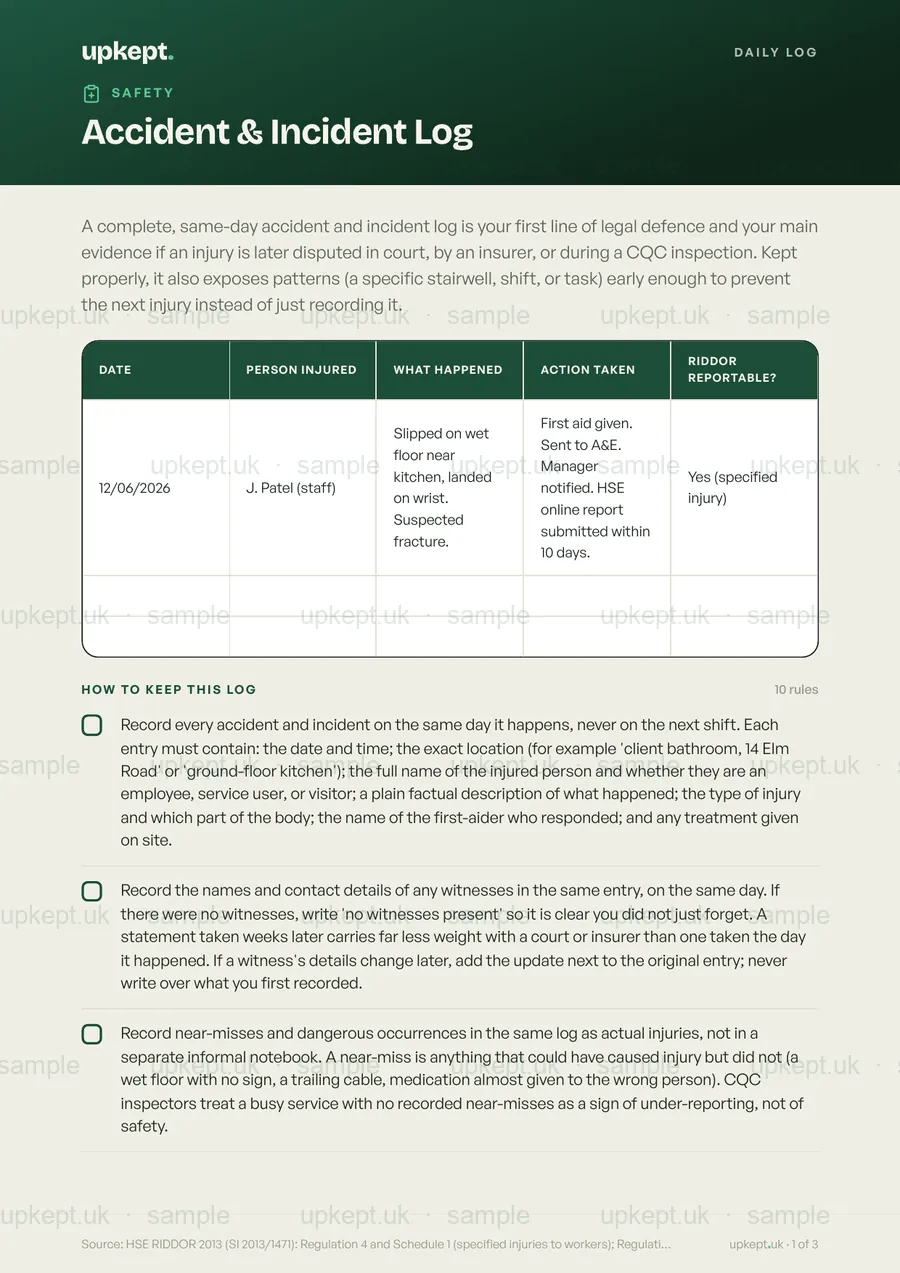
A complete, same-day accident and incident log is your first line of legal defence and your main evidence if an injury is later disputed in court, by an insurer, or during a CQC inspection. Kept properly, it also exposes patterns (a specific stairwell, shift, or task) early enough to prevent the next injury instead of just recording it.
10 checksPDF + phoneReviewed August 2026
Built on published UK guidance Show sources
HSE RIDDOR 2013 (SI 2013/1471): Regulation 4 and Schedule 1 (specified injuries to workers); Regulation 4(2) (over-7-day incapacitation, 15-day online reporting window); Regulation 12 (records, minimum 3 years). HSE guidance 'Specified injuries to workers' (hse.gov.uk/riddor/specified-injuries.htm) and 'What records do I need to keep?' (hse.gov.uk/riddor/what-must-i-keep.htm). UK GDPR / Data Protection Act 2018, Articles 5 and 25 (data minimisation, access limitation). CQC (Registration) Regulations 2009, Regulation 18 (notification of other incidents, 'without delay'). COSHH Regulations 2002, Regulation 11 (health surveillance records kept 40 years from last entry). Limitation Act 1980, sections 11 and 28 (3-year personal-injury limit; for a child it runs from the 18th birthday).
£14one-off, yours forever
Replaces a DIY doc, and you get every future update free when the guidance changes.
3 for 2 on documents and packs. Add 3 and your cheapest is free.
A clean one-page PDF, ready to print
Opens and ticks off on any phone
Clear, no jargon, easy to follow
Free updates whenever the guidance changes
Secure checkout30-day money-backInstant downloadNo subscriptionCard & Apple Pay
Best valueSave 42%
Or get all 56 templates
The Everything Bundle: every template today and every future one.£399 one-off, instead of £686 bought separately.
Made for places like this
What’s on it
10 things to check.
Everything that matters, nothing that does not. Here is the full list, exactly as it appears on the template.
1Record every accident and incident on the same day it happens, never on the next shift. Each entry must contain: the date and time; the exact location (for example 'client bathroom, 14 Elm Road' or 'ground-floor kitchen'); the full name of the injured person and whether they are an employee, service user, or visitor; a plain factual description of what happened; the type of injury and which part of the body; the name of the first-aider who responded; and any treatment given on site.
2Record the names and contact details of any witnesses in the same entry, on the same day. If there were no witnesses, write 'no witnesses present' so it is clear you did not just forget. A statement taken weeks later carries far less weight with a court or insurer than one taken the day it happened. If a witness's details change later, add the update next to the original entry; never write over what you first recorded.
3Record near-misses and dangerous occurrences in the same log as actual injuries, not in a separate informal notebook. A near-miss is anything that could have caused injury but did not (a wet floor with no sign, a trailing cable, medication almost given to the wrong person). CQC inspectors treat a busy service with no recorded near-misses as a sign of under-reporting, not of safety.
4As soon as an injury happens, check it against the RIDDOR specified-injury list; do not wait until the end of the week. Specified injuries that must be reported to the HSE without delay (and confirmed online at hse.gov.uk within 10 days) are: any bone fracture except fingers, thumbs, and toes; any amputation; any injury likely to cause permanent loss of or reduction in sight; a crush injury to the brain or to internal organs in the chest or abdomen; a burn covering more than 10% of the body or damaging the eyes, airways, or other vital organs; any scalping needing hospital treatment; and any loss of consciousness caused by a head injury or asphyxia.
5Count the days off work for any injury that stops someone doing their normal duties. If a worker (including a domiciliary care worker) cannot do their normal job for more than 3 consecutive days after the day of the accident (do not count the accident day; do count weekends and rest days), record it in the log. If the same absence passes 7 consecutive days, report it to the HSE online within 15 days of the accident date. The 15-day clock starts on the accident date, not on day 8, and missing it is a criminal offence.
6For care delivered in a client's home, log the incident under the same system as an office-based one, with the client's address as the location. The 'responsible person' who must make any RIDDOR report is your registered manager, not the householder. Violence or aggression from a client that injures a care worker is RIDDOR-reportable if the injury meets the specified-injury list or the over-7-day absence threshold.
7If your service is CQC-registered, check every serious incident against the Regulation 18 notification list and notify CQC without delay (treat this as same day, within 24 hours). Notifiable incidents include: any injury to a service user causing harm that is not likely to be temporary (loss of a sense, of movement, of mental function, or shortened life expectancy); any abuse or alleged abuse; any incident reported to or investigated by the police; and any event that stops you running the service safely (for example losing all staff on a shift, or a utility or fire-alarm failure lasting over 24 hours). Write the CQC notification reference number into the incident record.
8File each completed entry away from the open log, in a locked cabinet or an access-controlled digital folder. Under UK GDPR and the Data Protection Act 2018 you must not leave one person's injury and personal details on view to anyone who opens a shared book; use an accident book with perforated pages so each entry can be removed and filed. Limit access to people who genuinely need it.
9Review the whole log at least once a month and write down what you found. Count incidents by type, by location, and by time of day, and confirm that any corrective action agreed after a previous incident was actually done. Save the review as a dated note (paper or digital) filed with the log. CQC inspectors ask to see this; a log with no review notes is treated as a governance gap.
10Keep completed accident records for at least 3 years from the date of the entry, as required by RIDDOR 2013. Keep records longer where a later claim is realistic: an injured adult normally has 3 years from the injury to bring a personal-injury claim, and for someone injured as a child that 3 years does not start until their 18th birthday, so keep their record until at least their 21st. For any exposure to a hazardous substance under COSHH, keep the health record for 40 years because occupational diseases can take decades to appear. Label and date the archive so nothing is destroyed early.
Good to know
A broken finger is not automatically RIDDOR-reportable. Fractures to fingers, thumbs, and toes are the only fractures excluded from the specified-injury list, so a worker can break a finger and you report nothing, unless it keeps them off their normal duties for more than 7 consecutive days. At that point you have 15 days to report it, counted from the date of the accident, not from day 8. Starting the clock on day 8 is the single most common RIDDOR timing mistake.
Source: HSE RIDDOR 2013 (SI 2013/1471): Regulation 4 and Schedule 1 (specified injuries to workers); Regulation 4(2) (over-7-day incapacitation, 15-day online reporting window); Regulation 12 (records, minimum 3 years). HSE guidance 'Specified injuries to workers' (hse.gov.uk/riddor/specified-injuries.htm) and 'What records do I need to keep?' (hse.gov.uk/riddor/what-must-i-keep.htm). UK GDPR / Data Protection Act 2018, Articles 5 and 25 (data minimisation, access limitation). CQC (Registration) Regulations 2009, Regulation 18 (notification of other incidents, 'without delay'). COSHH Regulations 2002, Regulation 11 (health surveillance records kept 40 years from last entry). Limitation Act 1980, sections 11 and 28 (3-year personal-injury limit; for a child it runs from the 18th birthday).
Good to know
Questions, answered
What is the Accident & Incident Log?
A complete, same-day accident and incident log is your first line of legal defence and your main evidence if an injury is later disputed in court, by an insurer, or during a CQC inspection. Kept properly, it also exposes patterns (a specific stairwell, shift, or task) early enough to prevent the next injury instead of just recording it.
Why does it matter?
A broken finger is not automatically RIDDOR-reportable. Fractures to fingers, thumbs, and toes are the only fractures excluded from the specified-injury list, so a worker can break a finger and you report nothing, unless it keeps them off their normal duties for more than 7 consecutive days. At that point you have 15 days to report it, counted from the date of the accident, not from day 8. Starting the clock on day 8 is the single most common RIDDOR timing mistake.
How do I get it, and is it up to date?
The PDF downloads the moment you check out, prints sharp in black and white, and opens on any phone. It is reviewed for August 2026 and you get any future update free when the official guidance changes.
A discharged or depressurised extinguisher found during a real fire is no better than having no extinguisher at all. The monthly visual check catches the common pre-failure states (lost pressure, broken tamper seal, blocked access, overdue service) before they matter, and it gives the responsible person the maintenance records the Regulatory Reform (Fire Safety) Order 2005 requires.
A fire door only works if it closes fully, latches, and seals the gaps; one door that fails to do that lets smoke and fire spread through a building in minutes and removes people's time to escape. These checks catch the specific, common failures (props, blown gaps, missing closers, painted-up seals) that turn a survivable fire into a fatal one.
An under-stocked or expired first aid kit means the person treating an injury reaches for a dressing and finds an empty slot, a perished wrapper, or latex gloves that trigger an allergic reaction. A regular documented check fixes that in advance and gives an HSE or Ofsted inspector evidence that your first aid provision is genuinely maintained, not just present.