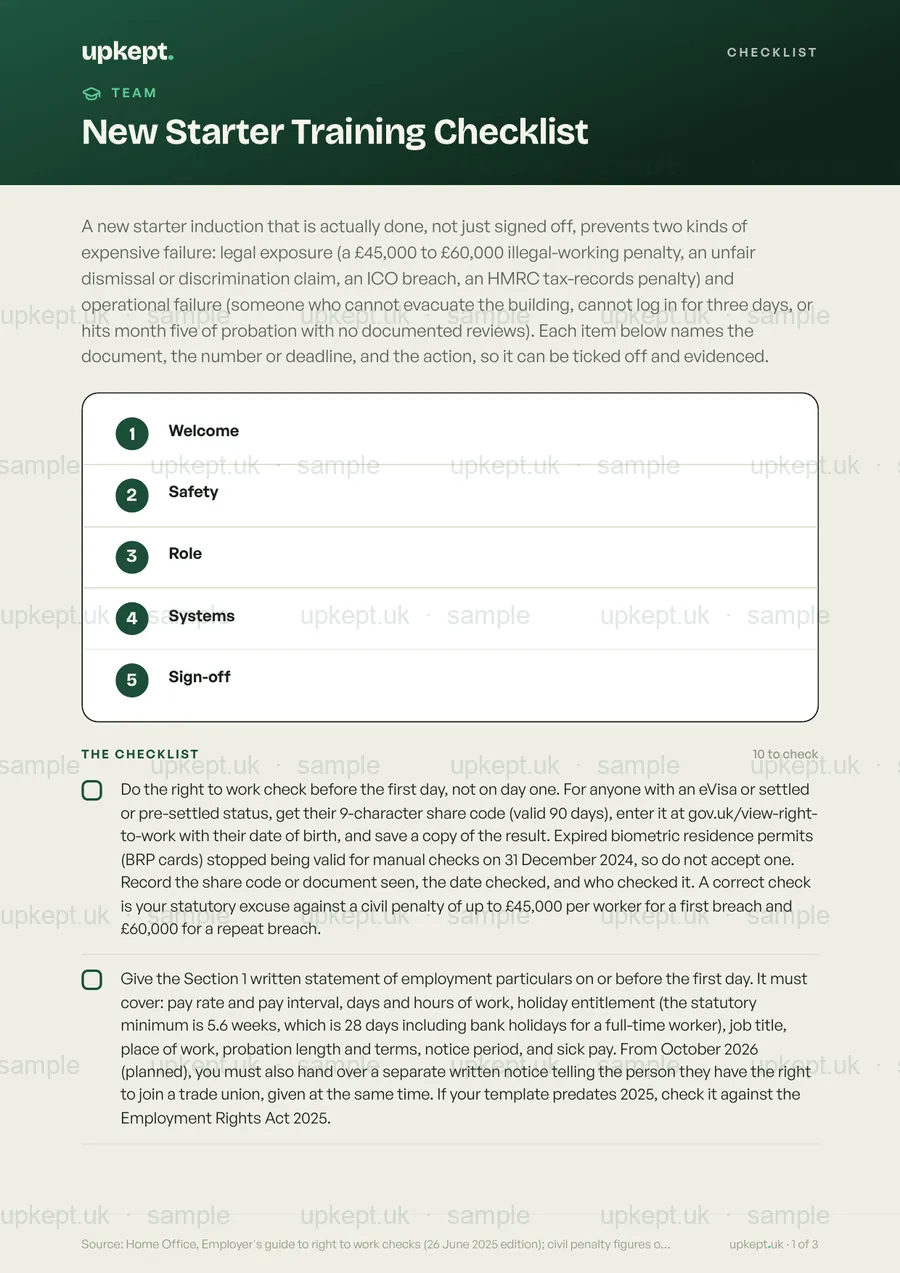
A new starter induction that is actually done, not just signed off, prevents two kinds of expensive failure: legal exposure (a £45,000 to £60,000 illegal-working penalty, an unfair dismissal or discrimination claim, an ICO breach, an HMRC tax-records penalty) and operational failure (someone who cannot evacuate the building, cannot log in for three days, or hits month five of probation with no documented reviews). Each item below names the document, the number or deadline, and the action, so it can be ticked off and evidenced.
10 checksPDF + phoneReviewed August 2026
Built on published UK guidance Show sources
Home Office, Employer's guide to right to work checks (26 June 2025 edition); civil penalty figures of £45,000 first breach and £60,000 repeat breach in force from 13 February 2024. Employment Rights Act 1996, s.1 (written particulars, day one since 6 April 2020). Employment Rights Act 2025: trade union right-to-join statement (regulations planned October 2026); unfair dismissal qualifying period reduced from two years to six months, in force 1 January 2027; Statutory Sick Pay reform (no waiting days, no lower earnings limit) in force 6 April 2026. HMRC Starter Checklist and PAYE record-keeping guidance, 2026/27 (records kept three years, penalty up to £3,000). Regulatory Reform (Fire Safety) Order 2005 (SI 2005/1541). Health and Safety (Display Screen Equipment) Regulations 1992 (SI 1992/2792). UK GDPR and Data Protection Act 2018; ICO breach reporting within 72 hours. Working Time Regulations 1998 (5.6 weeks statutory holiday). GOV.UK and Acas guidance on self-certification and fit notes (fit note required after more than 7 calendar days).
£14one-off, yours forever
Replaces a DIY doc, and you get every future update free when the guidance changes.
3 for 2 on documents and packs. Add 3 and your cheapest is free.
A clean one-page PDF, ready to print
Opens and ticks off on any phone
Clear, no jargon, easy to follow
Free updates whenever the guidance changes
Secure checkout30-day money-backInstant downloadNo subscriptionCard & Apple Pay
Best valueSave 42%
Or get all 56 templates
The Everything Bundle: every template today and every future one.£399 one-off, instead of £686 bought separately.
Made for places like this
What’s on it
10 things to check.
Everything that matters, nothing that does not. Here is the full list, exactly as it appears on the template.
1Do the right to work check before the first day, not on day one. For anyone with an eVisa or settled or pre-settled status, get their 9-character share code (valid 90 days), enter it at gov.uk/view-right-to-work with their date of birth, and save a copy of the result. Expired biometric residence permits (BRP cards) stopped being valid for manual checks on 31 December 2024, so do not accept one. Record the share code or document seen, the date checked, and who checked it. A correct check is your statutory excuse against a civil penalty of up to £45,000 per worker for a first breach and £60,000 for a repeat breach.
2Give the Section 1 written statement of employment particulars on or before the first day. It must cover: pay rate and pay interval, days and hours of work, holiday entitlement (the statutory minimum is 5.6 weeks, which is 28 days including bank holidays for a full-time worker), job title, place of work, probation length and terms, notice period, and sick pay. From October 2026 (planned), you must also hand over a separate written notice telling the person they have the right to join a trade union, given at the same time. If your template predates 2025, check it against the Employment Rights Act 2025.
3Get the HMRC starter checklist (the form people still call a P46) before the first payday from anyone who cannot give you a valid P45. Make sure they tick the correct statement (A, B, or C); the wrong tick is the most common cause of a wrong tax code. If no P45 and no completed starter checklist arrives in time, run them on emergency code 1257L W1 or M1. Keep the completed checklist for at least three years after the end of that tax year; HMRC can charge up to £3,000 for failing to keep PAYE records.
4Run the fire safety induction on day one, before they settle at a desk. Walk them from their workstation to the nearest fire exit, show them the assembly point outside, and tell them who to report to once they are out. This is required under the Regulatory Reform (Fire Safety) Order 2005. A signed sheet is not enough on its own: make them physically walk the route so they can describe it.
5Complete an individual DSE (display screen equipment) workstation assessment for anyone who uses a screen for an hour or more at a time as a normal part of their job. This is required under the Health and Safety (Display Screen Equipment) Regulations 1992, and it applies whatever the size of the employer. Do one assessment per person, not a generic office-wide one. Check: feet flat on the floor with thighs roughly level, screen about 50 to 70 cm away, top of the screen at or just below eye level, keyboard and mouse reachable without stretching. Record the assessment and any changes made.
6Run UK GDPR and data protection awareness before you give the person access to any personal data or any system holding it. The ICO expects you to show that staff were trained before they start processing personal data (UK GDPR and the Data Protection Act 2018). Cover: what counts as personal data, what they must never send to external or personal email, and how to report a suspected breach internally straight away (the organisation must notify the ICO within 72 hours of becoming aware of a notifiable breach). Record that they completed it and the date.
7Set up their IT before or on day one: a working email account, login credentials, and a written list of the systems they will use. Waiting days for access is one of the most common first-week complaints and pure lost productivity. Confirm the password and security policy has been explained, and for any system holding financial or other sensitive records, record when access was granted and at what permission level.
8Put the probation review dates in the calendar on day one. Book a four-week check-in and a formal review no later than month five of a six-month probation. The unfair dismissal qualifying period drops from two years to six months on 1 January 2027 under the Employment Rights Act 2025, so a six-month probation will leave almost no margin: without documented mid-point feedback, measurable targets, and a recorded end-of-probation decision before month five, you carry real risk. Note that discrimination protection applies from day one regardless of length of service.
9Explain the absence reporting rule on day one in plain terms: who to phone (a call, not a text), by what time (often before the shift or by a set time such as 9am), and that they can self-certify up to 7 calendar days off sick before a GP fit note is needed (a fit note is required once absence runs to more than 7 calendar days in a row, weekends included). Since 6 April 2026, Statutory Sick Pay is paid from the first qualifying day of sickness with no three waiting days and no lower earnings limit, so they are entitled from day one.
10Name at least one go-to person besides their line manager, a buddy, an HR contact, or a team lead, and tell them exactly what that person helps with. Put the name, role, and contact detail in writing. A named non-manager contact gives a new starter somewhere to ask the questions they would not raise with their boss, and it is the single cheapest thing you can do to reduce first-month attrition.
Good to know
The Section 1 written statement has been a day one document since 6 April 2020, but a second day one document is coming: under the Employment Rights Act 2025, employers will have to hand every new starter a separate written notice of their right to join a trade union, given at the same time as the Section 1 statement. The government plans to bring this in from October 2026, so an induction pack that only contains the Section 1 statement will be incomplete once it starts. Build the slot in now rather than retrofitting it across every hire later.
Source: Home Office, Employer's guide to right to work checks (26 June 2025 edition); civil penalty figures of £45,000 first breach and £60,000 repeat breach in force from 13 February 2024. Employment Rights Act 1996, s.1 (written particulars, day one since 6 April 2020). Employment Rights Act 2025: trade union right-to-join statement (regulations planned October 2026); unfair dismissal qualifying period reduced from two years to six months, in force 1 January 2027; Statutory Sick Pay reform (no waiting days, no lower earnings limit) in force 6 April 2026. HMRC Starter Checklist and PAYE record-keeping guidance, 2026/27 (records kept three years, penalty up to £3,000). Regulatory Reform (Fire Safety) Order 2005 (SI 2005/1541). Health and Safety (Display Screen Equipment) Regulations 1992 (SI 1992/2792). UK GDPR and Data Protection Act 2018; ICO breach reporting within 72 hours. Working Time Regulations 1998 (5.6 weeks statutory holiday). GOV.UK and Acas guidance on self-certification and fit notes (fit note required after more than 7 calendar days).
Good to know
Questions, answered
What is the New Starter Training Checklist?
A new starter induction that is actually done, not just signed off, prevents two kinds of expensive failure: legal exposure (a £45,000 to £60,000 illegal-working penalty, an unfair dismissal or discrimination claim, an ICO breach, an HMRC tax-records penalty) and operational failure (someone who cannot evacuate the building, cannot log in for three days, or hits month five of probation with no documented reviews). Each item below names the document, the number or deadline, and the action, so it can be ticked off and evidenced.
Why does it matter?
The Section 1 written statement has been a day one document since 6 April 2020, but a second day one document is coming: under the Employment Rights Act 2025, employers will have to hand every new starter a separate written notice of their right to join a trade union, given at the same time as the Section 1 statement. The government plans to bring this in from October 2026, so an induction pack that only contains the Section 1 statement will be incomplete once it starts. Build the slot in now rather than retrofitting it across every hire later.
How do I get it, and is it up to date?
The PDF downloads the moment you check out, prints sharp in black and white, and opens on any phone. It is reviewed for August 2026 and you get any future update free when the official guidance changes.
A weak handover is the most common root cause of medication errors, choking on the wrong diet texture, missed post-fall checks, and pressure damage that goes unwatched. A sheet that names the specific person, number, and action passes information the next shift can act on immediately, and it is the record CQC reads back when something goes wrong.
Onboarding done right keeps the business clear of an illegal-working civil penalty (up to £60,000 per worker), of tribunal claims for a missing written statement or unlawful pay deductions, and of the early attrition that hits when someone leaves inside 90 days because day one was a mess. This is the order an onboarder actually works through, from legal must-dos to the things that make a new starter productive.
A good SOP template stops two failures: staff doing the same task differently because no one wrote the steps down precisely, and auditors raising nonconformances because the document is missing the control information (version, owner, approval, review date) that ISO 9001:2015 Clause 7.5 expects. Build the template once and every SOP your office produces will be usable by a new starter on their second shift and able to survive an audit.