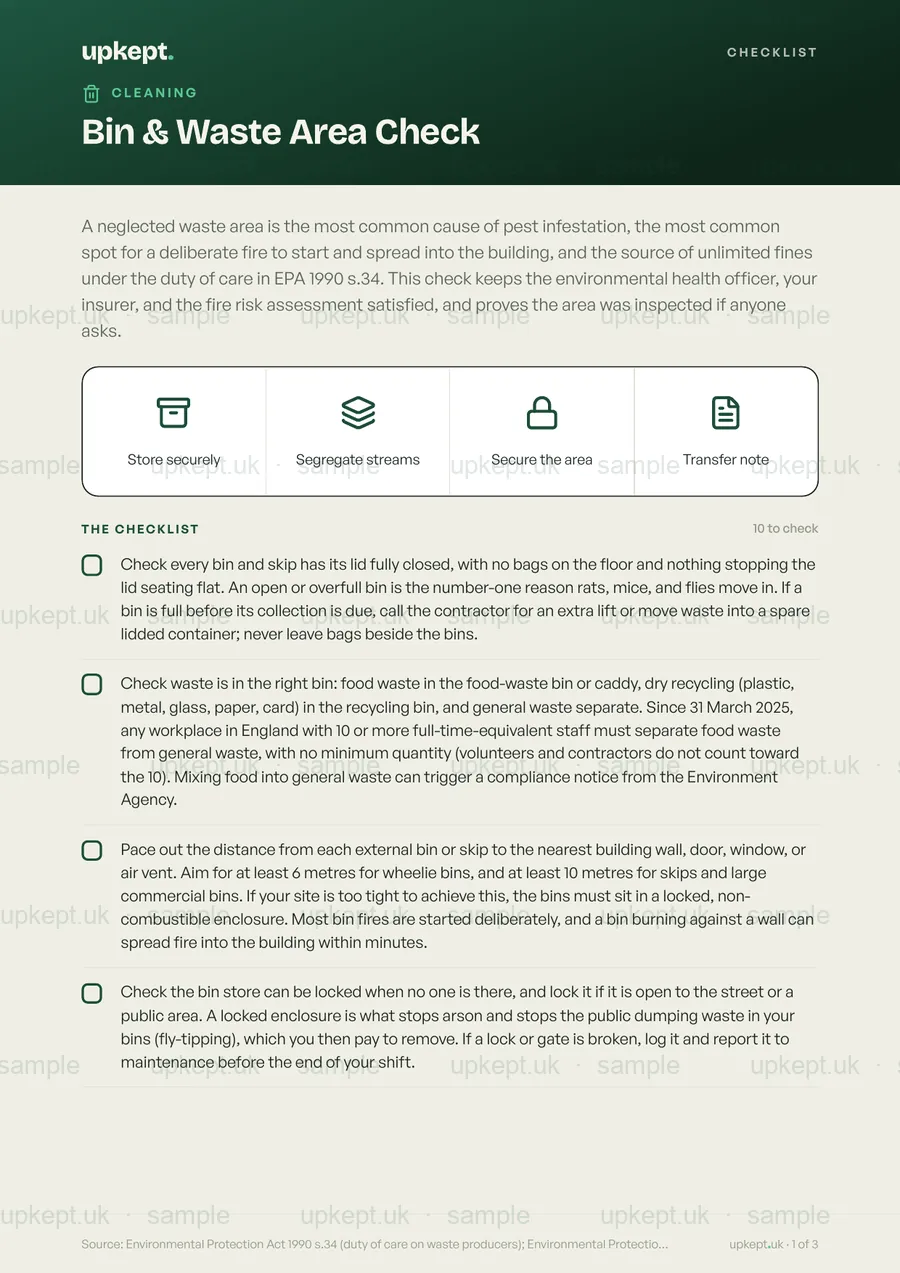
A neglected waste area is the most common cause of pest infestation, the most common spot for a deliberate fire to start and spread into the building, and the source of unlimited fines under the duty of care in EPA 1990 s.34. This check keeps the environmental health officer, your insurer, and the fire risk assessment satisfied, and proves the area was inspected if anyone asks.
10 checksPDF + phoneReviewed August 2026
Built on published UK guidance Show sources
Environmental Protection Act 1990 s.34 (duty of care on waste producers); Environmental Protection (Duty of Care) Regulations 1991 SI 1991/2839 reg.3 (two-year retention of waste transfer notes, production to an officer within 7 days of demand); Separation of Waste (England) Regulations 2025 and GOV.UK "Simpler Recycling: workplace recycling in England" (food-waste separation from 31 March 2025 for workplaces with 10 or more FTE, no minimum quantity); CFPA-Europe Guideline No.7:2022, referenced by BS 9991:2024 (minimum 6 m separation of waste containers from buildings and openings, with greater distances for skips and large commercial bins); GOV.UK / Environment Agency public register of waste carriers, brokers and dealers (environment.data.gov.uk/public-register)
£14one-off, yours forever
Replaces a DIY doc, and you get every future update free when the guidance changes.
3 for 2 on documents and packs. Add 3 and your cheapest is free.
A clean one-page PDF, ready to print
Opens and ticks off on any phone
Clear, no jargon, easy to follow
Free updates whenever the guidance changes
Secure checkout30-day money-backInstant downloadNo subscriptionCard & Apple Pay
Best valueSave 42%
Or get all 56 templates
The Everything Bundle: every template today and every future one.£399 one-off, instead of £686 bought separately.
Made for places like this
What’s on it
10 things to check.
Everything that matters, nothing that does not. Here is the full list, exactly as it appears on the template.
1Check every bin and skip has its lid fully closed, with no bags on the floor and nothing stopping the lid seating flat. An open or overfull bin is the number-one reason rats, mice, and flies move in. If a bin is full before its collection is due, call the contractor for an extra lift or move waste into a spare lidded container; never leave bags beside the bins.
2Check waste is in the right bin: food waste in the food-waste bin or caddy, dry recycling (plastic, metal, glass, paper, card) in the recycling bin, and general waste separate. Since 31 March 2025, any workplace in England with 10 or more full-time-equivalent staff must separate food waste from general waste, with no minimum quantity (volunteers and contractors do not count toward the 10). Mixing food into general waste can trigger a compliance notice from the Environment Agency.
3Pace out the distance from each external bin or skip to the nearest building wall, door, window, or air vent. Aim for at least 6 metres for wheelie bins, and at least 10 metres for skips and large commercial bins. If your site is too tight to achieve this, the bins must sit in a locked, non-combustible enclosure. Most bin fires are started deliberately, and a bin burning against a wall can spread fire into the building within minutes.
4Check the bin store can be locked when no one is there, and lock it if it is open to the street or a public area. A locked enclosure is what stops arson and stops the public dumping waste in your bins (fly-tipping), which you then pay to remove. If a lock or gate is broken, log it and report it to maintenance before the end of your shift.
5Look over the floor, walls, and drain channels for spillage, food debris, pooled liquid, or grease. Clean off any contamination before you finish the check. Dirty surfaces draw in pests, and on a food site this is part of your food-safety records, so write down what you found and what you did about it.
6Look for signs of rodents: fresh droppings (small dark grains 5 to 10 mm for mice, 10 to 20 mm for rats), gnaw marks on bins or doors, dark greasy smear marks along walls and bin bases, and fresh burrow holes in soft ground nearby. If you spot any of these, log it and call your pest-control contractor the same day; do not wait for the next scheduled visit.
7Check the most recent waste transfer note is on file. You must keep a copy of every waste transfer note for at least two years from the date of transfer, and be able to produce it to an enforcement officer within 7 days of being asked. Confirm the note shows the transfer date and the carrier's registration number.
8Confirm your waste contractor is currently registered, at least once a year and before using a new one. Search the Environment Agency public register at environment.data.gov.uk/public-register by company name or registration number and check the status is active. Carrier registrations expire every three years, so a carrier who was registered last year may not be now. If you cannot find them or their registration has lapsed, stop using them: you stay legally liable for the waste even after they take it away.
9Check each bin is clearly labelled with what goes in it (general, food, recycling) and that the area is lit well enough to read the labels and use it safely after dark. Unlabelled bins are the main cause of the wrong waste going in, which can get a whole load rejected and sent to landfill at your cost. If a label is missing or a light is out, log it and report it.
10Write down the date and time of this check, who did it, and anything you found or actioned. Keep the log for at least three months, or longer if your insurer, local authority, or contract asks for it. This record is your only proof of when the area was last checked and what state it was in if an environmental health officer, insurer, or fire assessor asks.
Good to know
Most operators assume their waste contractor is registered and never check, but under the duty of care in EPA 1990 s.34 the legal responsibility sits with you, the waste producer. If your carrier turns out to be unregistered and dumps or fly-tips your waste, you can face an unlimited fine even though you paid them in good faith. Carrier registrations must be renewed every three years, so one that was valid last year may have lapsed, and the Environment Agency public register takes under a minute to search.
Source: Environmental Protection Act 1990 s.34 (duty of care on waste producers); Environmental Protection (Duty of Care) Regulations 1991 SI 1991/2839 reg.3 (two-year retention of waste transfer notes, production to an officer within 7 days of demand); Separation of Waste (England) Regulations 2025 and GOV.UK "Simpler Recycling: workplace recycling in England" (food-waste separation from 31 March 2025 for workplaces with 10 or more FTE, no minimum quantity); CFPA-Europe Guideline No.7:2022, referenced by BS 9991:2024 (minimum 6 m separation of waste containers from buildings and openings, with greater distances for skips and large commercial bins); GOV.UK / Environment Agency public register of waste carriers, brokers and dealers (environment.data.gov.uk/public-register)
Good to know
Questions, answered
What is the Bin & Waste Area Check?
A neglected waste area is the most common cause of pest infestation, the most common spot for a deliberate fire to start and spread into the building, and the source of unlimited fines under the duty of care in EPA 1990 s.34. This check keeps the environmental health officer, your insurer, and the fire risk assessment satisfied, and proves the area was inspected if anyone asks.
Why does it matter?
Most operators assume their waste contractor is registered and never check, but under the duty of care in EPA 1990 s.34 the legal responsibility sits with you, the waste producer. If your carrier turns out to be unregistered and dumps or fly-tips your waste, you can face an unlimited fine even though you paid them in good faith. Carrier registrations must be renewed every three years, so one that was valid last year may have lapsed, and the Environment Agency public register takes under a minute to search.
How do I get it, and is it up to date?
The PDF downloads the moment you check out, prints sharp in black and white, and opens on any phone. It is reviewed for August 2026 and you get any future update free when the official guidance changes.
A signed cleaning record is the main evidence an Environmental Health Officer uses to decide whether your kitchen is clean every day, not just on inspection day. Done properly, this routine stops the four things that sink hygiene ratings and trigger enforcement: cross-contamination between raw and ready-to-eat food, allergen cross-contact, grease fires in the extract system, and pest infestations.
A signed, time-stamped hourly check gives you a paper trail that protects you if someone slips, complains, or is injured, and it forces a physical walk-through that catches the small failures (empty soap, no toilet roll, a broken lock, a wet floor) before they turn into complaints, bad reviews, or a downmark from the Environmental Health Officer. The log is usually the first thing an EHO asks to see.
A signed, dated cleaning rota is your legal evidence that you control food hygiene and premises safety. If it is not written down, an Environmental Health Officer treats the cleaning as if it never happened, however clean the place looks on the day, and that drives down your Food Hygiene Rating.