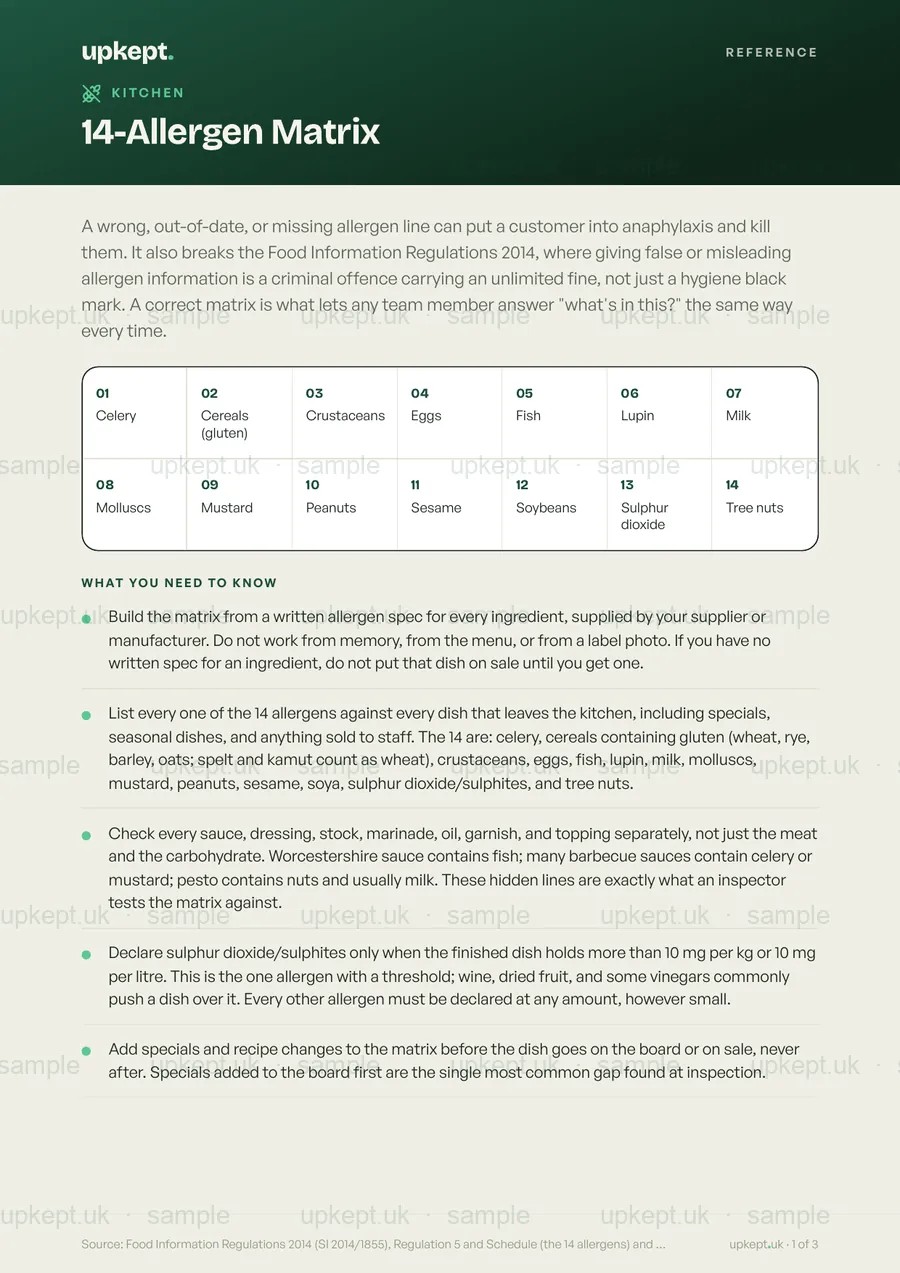
A wrong, out-of-date, or missing allergen line can put a customer into anaphylaxis and kill them. It also breaks the Food Information Regulations 2014, where giving false or misleading allergen information is a criminal offence carrying an unlimited fine, not just a hygiene black mark. A correct matrix is what lets any team member answer "what's in this?" the same way every time.
This free 14 allergen matrix maps every dish on your menu against the 14 allergens UK law requires you to declare, one grid the whole team can check before answering a customer.
11 checksPDF + phoneReviewed August 2026
Built on published UK guidance Show sources
Food Information Regulations 2014 (SI 2014/1855), Regulation 5 and Schedule (the 14 allergens) and Regulation 10 (allergen information for non-prepacked food), which implement retained Regulation (EU) No 1169/2011, Annex II; FSA Food Allergen Labelling and Information Requirements Technical Guidance, Part 2: Non-Prepacked Food, and the FSA Best Practice Guidance on Allergen Information for Non-Prepacked Foods including the distance-selling/pre-ordering section (food.gov.uk).
Freeno card needed
Replaces a DIY doc, and you get every future update free when the guidance changes.
3 for 2 on documents and packs. Add 3 and your cheapest is free.
A clean one-page PDF, ready to print
Opens and ticks off on any phone
Clear, no jargon, easy to follow
Free updates whenever the guidance changes
Secure checkout30-day money-backInstant downloadNo subscriptionCard & Apple Pay
Made for places like this
What’s on it
11 things to check.
Everything that matters, nothing that does not. Here is the full list, exactly as it appears on the template.
1Build the matrix from a written allergen spec for every ingredient, supplied by your supplier or manufacturer. Do not work from memory, from the menu, or from a label photo. If you have no written spec for an ingredient, do not put that dish on sale until you get one.
2List every one of the 14 allergens against every dish that leaves the kitchen, including specials, seasonal dishes, and anything sold to staff. The 14 are: celery, cereals containing gluten (wheat, rye, barley, oats; spelt and kamut count as wheat), crustaceans, eggs, fish, lupin, milk, molluscs, mustard, peanuts, sesame, soya, sulphur dioxide/sulphites, and tree nuts.
3Check every sauce, dressing, stock, marinade, oil, garnish, and topping separately, not just the meat and the carbohydrate. Worcestershire sauce contains fish; many barbecue sauces contain celery or mustard; pesto contains nuts and usually milk. These hidden lines are exactly what an inspector tests the matrix against.
4Declare sulphur dioxide/sulphites only when the finished dish holds more than 10 mg per kg or 10 mg per litre. This is the one allergen with a threshold; wine, dried fruit, and some vinegars commonly push a dish over it. Every other allergen must be declared at any amount, however small.
5Add specials and recipe changes to the matrix before the dish goes on the board or on sale, never after. Specials added to the board first are the single most common gap found at inspection.
6Update the matrix the same day a supplier, recipe, or ingredient changes, before the affected dish is sold again. One delivery of a substituted product (for example a standard mayo arriving in place of the nut-free one) breaks every dish that uses it. Make a swapped or substituted delivery a same-day matrix check.
7Keep one master matrix, dated, as the only version staff can reach. Remove or mark every older copy as void and store it separately. If an Environmental Health Officer finds two live versions on the premises, that is treated as a breach.
8Put the current matrix where staff can reach it during service, not in the office, and train everyone who takes orders or answers allergen questions to read it rather than answer from memory. Record the date each person was shown it; an inspector can ask for that evidence.
9Never use a blanket 'may contain allergens' notice across the menu. The FSA treats a general precautionary statement as likely to be misleading. Where you have a real cross-contamination risk you cannot remove, name the specific allergen against the specific dish instead.
10For online and phone orders, give full written allergen information for all 14 allergens before the order is paid for, and repeat it on the packaging or receipt at delivery. Both stages are a legal requirement under the Food Information Regulations 2014, not best practice.
11Re-check the whole matrix against current supplier specs at least every three months, even with no known changes, and record the review date. Manufacturers reformulate without telling you, so a January nut-free product can carry a nut warning by April; the scheduled review is how you catch it before a customer does.
Good to know
Sulphur dioxide and sulphites are the only one of the 14 allergens with a declaration threshold: you must declare them only when the finished dish, as served, holds more than 10 mg per kg or 10 mg per litre (measured as total SO2). Below that you do not. Every other allergen must be declared no matter how small the trace, so do not apply that 10 mg rule to anything else; many operators wrongly do, and either over-declare (creating noise staff stop trusting) or under-declare a genuine allergen.
Source: Food Information Regulations 2014 (SI 2014/1855), Regulation 5 and Schedule (the 14 allergens) and Regulation 10 (allergen information for non-prepacked food), which implement retained Regulation (EU) No 1169/2011, Annex II; FSA Food Allergen Labelling and Information Requirements Technical Guidance, Part 2: Non-Prepacked Food, and the FSA Best Practice Guidance on Allergen Information for Non-Prepacked Foods including the distance-selling/pre-ordering section (food.gov.uk).
Good to know
Questions, answered
What are the 14 allergens?
Celery, cereals containing gluten, crustaceans, eggs, fish, lupin, milk, molluscs, mustard, peanuts, sesame, soybeans, sulphur dioxide and sulphites, and tree nuts. Those are the fourteen that UK food information rules require you to declare when they are used as ingredients.
Is an allergen matrix a legal requirement?
The matrix itself is not named in law, but you must be able to give accurate allergen information for everything you serve. A completed matrix is the simplest way to hold that information somewhere the whole team can use, and the FSA provides the allergen list this template is built on.
What is the 14-Allergen Matrix?
A wrong, out-of-date, or missing allergen line can put a customer into anaphylaxis and kill them. It also breaks the Food Information Regulations 2014, where giving false or misleading allergen information is a criminal offence carrying an unlimited fine, not just a hygiene black mark. A correct matrix is what lets any team member answer "what's in this?" the same way every time.
Why does it matter?
Sulphur dioxide and sulphites are the only one of the 14 allergens with a declaration threshold: you must declare them only when the finished dish, as served, holds more than 10 mg per kg or 10 mg per litre (measured as total SO2). Below that you do not. Every other allergen must be declared no matter how small the trace, so do not apply that 10 mg rule to anything else; many operators wrongly do, and either over-declare (creating noise staff stop trusting) or under-declare a genuine allergen.
How do I get it, and is it up to date?
The PDF downloads the moment you check out, prints sharp in black and white, and opens on any phone. It is reviewed for August 2026 and you get any future update free when the official guidance changes.
Your temperature log is the main evidence that your cold storage is actually working. A missing entry, or an out-of-range reading nobody acted on, is what turns a single fridge fault into a food poisoning case and a failed hygiene inspection. This list makes every entry a real number, taken at the right time, with the action recorded when something goes wrong.
A food safety daily diary is the written proof that your food safety system is actually being run, not just sitting in a folder. On inspection an Environmental Health Officer treats a blank or gap-filled diary as evidence the system is failing, while a complete one with real numbers is your legal defence if someone falls ill. Filled in properly it also catches a warm fridge or an undercooked batch before it reaches a customer.
Cooking and reheating temperature records are the main evidence an Environmental Health Officer (EHO) uses to judge whether your food safety system actually works on the floor, not just on paper. Ticks, the word 'OK', or numbers all written up at the end of the shift are treated as no record at all, and that alone can drop your hygiene rating and trigger a return visit. Done properly, this log catches food that never reached a safe core temperature and flags failing equipment before it causes a food poisoning incident.