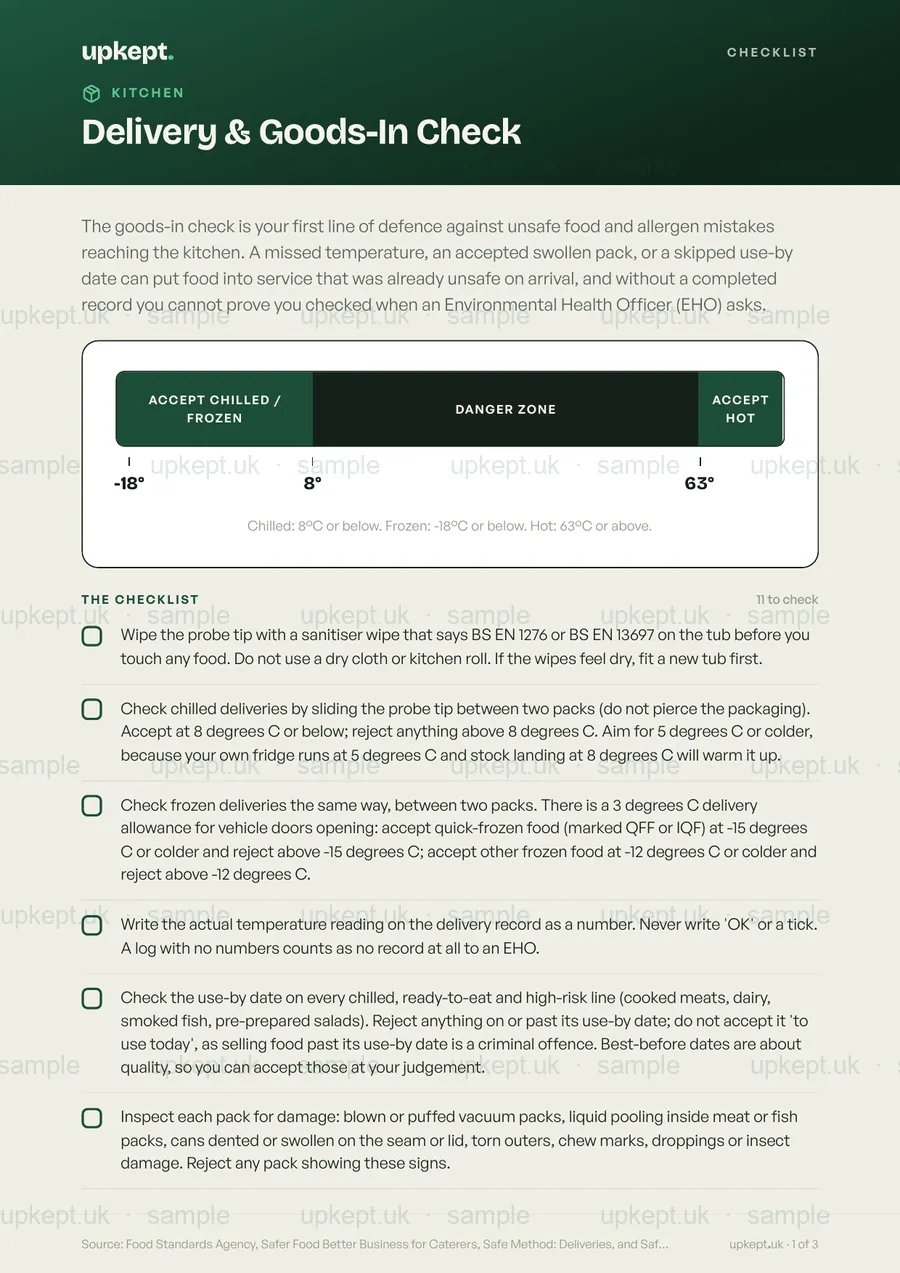
The goods-in check is your first line of defence against unsafe food and allergen mistakes reaching the kitchen. A missed temperature, an accepted swollen pack, or a skipped use-by date can put food into service that was already unsafe on arrival, and without a completed record you cannot prove you checked when an Environmental Health Officer (EHO) asks.
11 checksPDF + phoneReviewed August 2026
Built on published UK guidance Show sources
Food Standards Agency, Safer Food Better Business for Caterers, Safe Method: Deliveries, and Safe Method: Prove It (between-pack probe technique, iced-water check reads -1 to +1 degrees C, FSA probe accuracy +/-0.5 degrees C); Food Safety and Hygiene (England) Regulations 2013 (8 degrees C chilled maximum; equivalent 2006 regulations in Wales and Northern Ireland); Quick-frozen Foodstuffs (England) Regulations 2007 (-18 degrees C quick-frozen with a 3 degrees C transport tolerance; -15 degrees C other frozen); Food Safety Act 1990 (offence to sell food past its use-by date). Sources: food.gov.uk; highspeedtraining.co.uk frozen food delivery checklist; legislation.gov.uk.
£14one-off, yours forever
Replaces a DIY doc, and you get every future update free when the guidance changes.
3 for 2 on documents and packs. Add 3 and your cheapest is free.
A clean one-page PDF, ready to print
Opens and ticks off on any phone
Clear, no jargon, easy to follow
Free updates whenever the guidance changes
Secure checkout30-day money-backInstant downloadNo subscriptionCard & Apple Pay
Best valueSave 42%
Or get all 56 templates
The Everything Bundle: every template today and every future one.£399 one-off, instead of £686 bought separately.
Made for places like this
What’s on it
11 things to check.
Everything that matters, nothing that does not. Here is the full list, exactly as it appears on the template.
1Wipe the probe tip with a sanitiser wipe that says BS EN 1276 or BS EN 13697 on the tub before you touch any food. Do not use a dry cloth or kitchen roll. If the wipes feel dry, fit a new tub first.
2Check chilled deliveries by sliding the probe tip between two packs (do not pierce the packaging). Accept at 8 degrees C or below; reject anything above 8 degrees C. Aim for 5 degrees C or colder, because your own fridge runs at 5 degrees C and stock landing at 8 degrees C will warm it up.
3Check frozen deliveries the same way, between two packs. There is a 3 degrees C delivery allowance for vehicle doors opening: accept quick-frozen food (marked QFF or IQF) at -15 degrees C or colder and reject above -15 degrees C; accept other frozen food at -12 degrees C or colder and reject above -12 degrees C.
4Write the actual temperature reading on the delivery record as a number. Never write 'OK' or a tick. A log with no numbers counts as no record at all to an EHO.
5Check the use-by date on every chilled, ready-to-eat and high-risk line (cooked meats, dairy, smoked fish, pre-prepared salads). Reject anything on or past its use-by date; do not accept it 'to use today', as selling food past its use-by date is a criminal offence. Best-before dates are about quality, so you can accept those at your judgement.
6Inspect each pack for damage: blown or puffed vacuum packs, liquid pooling inside meat or fish packs, cans dented or swollen on the seam or lid, torn outers, chew marks, droppings or insect damage. Reject any pack showing these signs.
7Put every rejected item to one side straight away, in a marked spot away from the delivery, so it cannot get put into storage by mistake. Tell the driver and note the reason on the record.
8Check the allergen spec or label on every product matches what you ordered before it goes into storage. If a product has been reformulated or swapped for a different own-label line, hold it to one side until you have updated your allergen information. This is the most common way an unexpected allergen reaches a dish.
9Put the delivery away using First In First Out: new stock goes behind existing stock with the shortest date at the front. If there is no room, take the old stock out, put the new stock in, then return the old stock to the front; never stack new in front of old.
10Record the supplier name, the date, what was delivered, the temperatures, and what you accepted or rejected, then sign it. Keep these records (invoices and the diary) for at least 2 years so you can trace any product back to its supplier.
11Once a week, stand the probe in a glass of iced water (ice and water mixed, tip not touching the glass) and check it reads between -1 and +1 degrees C. If it reads outside that, take it out of use and recalibrate or replace it. A probe reading 2 degrees C low will pass a delivery that is actually too warm.
Good to know
There is a 3 degrees C allowance on frozen deliveries (not on chilled), because the vehicle door is opened repeatedly on the round. So quick-frozen food storing at -18 degrees C can legally be accepted down to -15 degrees C, and other frozen food storing at -15 degrees C down to -12 degrees C. Rejecting solid frozen stock at -16 degrees C is rejecting good food; the actual reject points are above -15 degrees C (quick-frozen) and above -12 degrees C (other frozen).
Source: Food Standards Agency, Safer Food Better Business for Caterers, Safe Method: Deliveries, and Safe Method: Prove It (between-pack probe technique, iced-water check reads -1 to +1 degrees C, FSA probe accuracy +/-0.5 degrees C); Food Safety and Hygiene (England) Regulations 2013 (8 degrees C chilled maximum; equivalent 2006 regulations in Wales and Northern Ireland); Quick-frozen Foodstuffs (England) Regulations 2007 (-18 degrees C quick-frozen with a 3 degrees C transport tolerance; -15 degrees C other frozen); Food Safety Act 1990 (offence to sell food past its use-by date). Sources: food.gov.uk; highspeedtraining.co.uk frozen food delivery checklist; legislation.gov.uk.
Good to know
Questions, answered
What is the Delivery & Goods-In Check?
The goods-in check is your first line of defence against unsafe food and allergen mistakes reaching the kitchen. A missed temperature, an accepted swollen pack, or a skipped use-by date can put food into service that was already unsafe on arrival, and without a completed record you cannot prove you checked when an Environmental Health Officer (EHO) asks.
Why does it matter?
There is a 3 degrees C allowance on frozen deliveries (not on chilled), because the vehicle door is opened repeatedly on the round. So quick-frozen food storing at -18 degrees C can legally be accepted down to -15 degrees C, and other frozen food storing at -15 degrees C down to -12 degrees C. Rejecting solid frozen stock at -16 degrees C is rejecting good food; the actual reject points are above -15 degrees C (quick-frozen) and above -12 degrees C (other frozen).
How do I get it, and is it up to date?
The PDF downloads the moment you check out, prints sharp in black and white, and opens on any phone. It is reviewed for August 2026 and you get any future update free when the official guidance changes.
Your temperature log is the main evidence that your cold storage is actually working. A missing entry, or an out-of-range reading nobody acted on, is what turns a single fridge fault into a food poisoning case and a failed hygiene inspection. This list makes every entry a real number, taken at the right time, with the action recorded when something goes wrong.
A wrong, out-of-date, or missing allergen line can put a customer into anaphylaxis and kill them. It also breaks the Food Information Regulations 2014, where giving false or misleading allergen information is a criminal offence carrying an unlimited fine, not just a hygiene black mark. A correct matrix is what lets any team member answer "what's in this?" the same way every time.
A food safety daily diary is the written proof that your food safety system is actually being run, not just sitting in a folder. On inspection an Environmental Health Officer treats a blank or gap-filled diary as evidence the system is failing, while a complete one with real numbers is your legal defence if someone falls ill. Filled in properly it also catches a warm fridge or an undercooked batch before it reaches a customer.