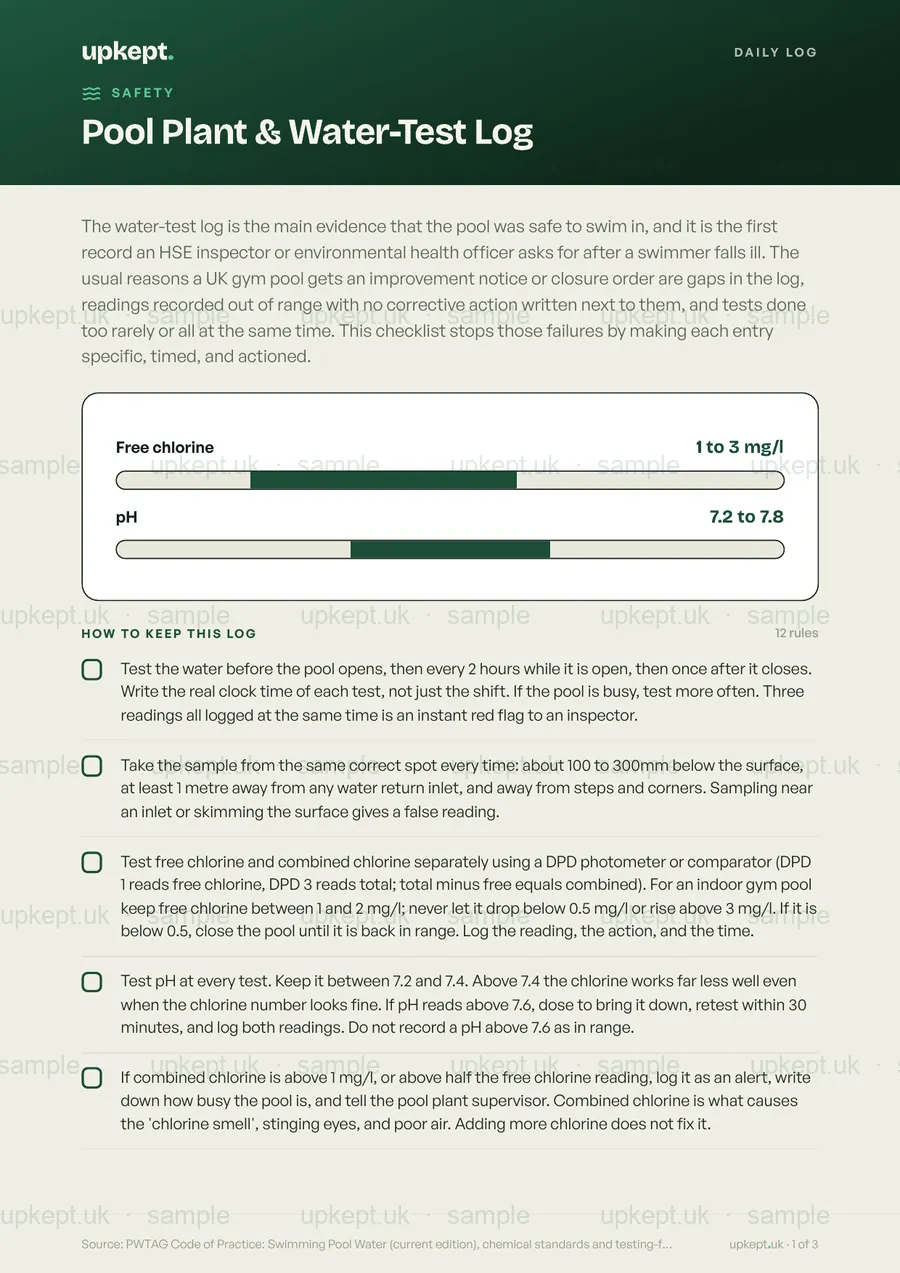
The water-test log is the main evidence that the pool was safe to swim in, and it is the first record an HSE inspector or environmental health officer asks for after a swimmer falls ill. The usual reasons a UK gym pool gets an improvement notice or closure order are gaps in the log, readings recorded out of range with no corrective action written next to them, and tests done too rarely or all at the same time. This checklist stops those failures by making each entry specific, timed, and actioned.
12 checksPDF + phoneReviewed August 2026
Built on published UK guidance Show sources
PWTAG Code of Practice: Swimming Pool Water (current edition), chemical standards and testing-frequency tables; PWTAG Technical Note 53 (Microbiological Testing) and the PWTAG Microbiological Sampling note (Sept 2014) for the lab pass/fail criteria; PWTAG Technical Note 61 (Combined Chlorine); HSE HSG179 Health and Safety in Swimming Pools (4th edition), which defers water-treatment detail to PWTAG; Health and Safety at Work etc. Act 1974, Section 33 (offences, including falsified records).
£14one-off, yours forever
Replaces a DIY doc, and you get every future update free when the guidance changes.
3 for 2 on documents and packs. Add 3 and your cheapest is free.
A clean one-page PDF, ready to print
Opens and ticks off on any phone
Clear, no jargon, easy to follow
Free updates whenever the guidance changes
Secure checkout30-day money-backInstant downloadNo subscriptionCard & Apple Pay
Best valueSave 42%
Or get all 56 templates
The Everything Bundle: every template today and every future one.£399 one-off, instead of £686 bought separately.
Made for places like this
What’s on it
12 things to check.
Everything that matters, nothing that does not. Here is the full list, exactly as it appears on the template.
1Test the water before the pool opens, then every 2 hours while it is open, then once after it closes. Write the real clock time of each test, not just the shift. If the pool is busy, test more often. Three readings all logged at the same time is an instant red flag to an inspector.
2Take the sample from the same correct spot every time: about 100 to 300mm below the surface, at least 1 metre away from any water return inlet, and away from steps and corners. Sampling near an inlet or skimming the surface gives a false reading.
3Test free chlorine and combined chlorine separately using a DPD photometer or comparator (DPD 1 reads free chlorine, DPD 3 reads total; total minus free equals combined). For an indoor gym pool keep free chlorine between 1 and 2 mg/l; never let it drop below 0.5 mg/l or rise above 3 mg/l. If it is below 0.5, close the pool until it is back in range. Log the reading, the action, and the time.
4Test pH at every test. Keep it between 7.2 and 7.4. Above 7.4 the chlorine works far less well even when the chlorine number looks fine. If pH reads above 7.6, dose to bring it down, retest within 30 minutes, and log both readings. Do not record a pH above 7.6 as in range.
5If combined chlorine is above 1 mg/l, or above half the free chlorine reading, log it as an alert, write down how busy the pool is, and tell the pool plant supervisor. Combined chlorine is what causes the 'chlorine smell', stinging eyes, and poor air. Adding more chlorine does not fix it.
6Test total alkalinity at least once a week. Keep it between 80 and 200 mg/l. Outside this range pH will not hold steady and every other chemical becomes harder to control. If you add a correction dose, write down how much and retest the next day.
7Test water temperature at every test session. A gym pool is usually run at 27.5 to 29 degrees C, but check your pool's own Pool Safety Operating Procedure for its set figure. Above 30 degrees C the chlorine burns off faster and infection risk climbs, especially when the pool is busy. Log the reading.
8Test total dissolved solids (TDS) at least once a month. It must not be more than 1,000 mg/l above the mains tap water it is filled from, and never above 1,500 mg/l. A rising number means the pool needs diluting with fresh water. Log the reading, the mains baseline, and any fresh water added.
9At the start of each month, and whenever you open a new pack, write down the DPD tablet or reagent batch number and expiry date. Out-of-date DPD reagent bleaches out at high chlorine and reads zero or near-zero, making over-chlorinated water look safe. Bin any pack past its expiry date.
10Write every corrective action next to the reading that triggered it: what you dosed, how much, at what time, who did it, and the retest result. An out-of-range reading with no action written beside it is treated by inspectors exactly like having no log at all.
11Send a sample for the monthly microbiology lab test and file the certificate in the pool technical file next to the daily logs. A pass is: aerobic colony count under 100 cfu/ml at 37 degrees C, no coliforms in 100ml, no E. coli in 100ml, and no Pseudomonas aeruginosa in 100ml. Any failure triggers an immediate investigation and re-sample.
12Never backdate, copy forward, or fill in entries in advance. Each line is written at the time of the test by the person who did it, signed with their name or initials. The log is a legal record; faking it is an offence under the Health and Safety at Work etc. Act 1974.
Good to know
The 'pool smell' is not too much chlorine; it is the opposite. That smell is combined chlorine (chloramines), which builds up when the free chlorine is being used up faster than it is being added, usually on a busy day. The fix is not to cut the chlorine but to shock dose (superchlorinate) and dilute with fresh water. PWTAG Technical Note 61 sets this out.
Source: PWTAG Code of Practice: Swimming Pool Water (current edition), chemical standards and testing-frequency tables; PWTAG Technical Note 53 (Microbiological Testing) and the PWTAG Microbiological Sampling note (Sept 2014) for the lab pass/fail criteria; PWTAG Technical Note 61 (Combined Chlorine); HSE HSG179 Health and Safety in Swimming Pools (4th edition), which defers water-treatment detail to PWTAG; Health and Safety at Work etc. Act 1974, Section 33 (offences, including falsified records).
Good to know
Questions, answered
What is the Pool Plant & Water-Test Log?
The water-test log is the main evidence that the pool was safe to swim in, and it is the first record an HSE inspector or environmental health officer asks for after a swimmer falls ill. The usual reasons a UK gym pool gets an improvement notice or closure order are gaps in the log, readings recorded out of range with no corrective action written next to them, and tests done too rarely or all at the same time. This checklist stops those failures by making each entry specific, timed, and actioned.
Why does it matter?
The 'pool smell' is not too much chlorine; it is the opposite. That smell is combined chlorine (chloramines), which builds up when the free chlorine is being used up faster than it is being added, usually on a busy day. The fix is not to cut the chlorine but to shock dose (superchlorinate) and dilute with fresh water. PWTAG Technical Note 61 sets this out.
How do I get it, and is it up to date?
The PDF downloads the moment you check out, prints sharp in black and white, and opens on any phone. It is reviewed for August 2026 and you get any future update free when the official guidance changes.
A discharged or depressurised extinguisher found during a real fire is no better than having no extinguisher at all. The monthly visual check catches the common pre-failure states (lost pressure, broken tamper seal, blocked access, overdue service) before they matter, and it gives the responsible person the maintenance records the Regulatory Reform (Fire Safety) Order 2005 requires.
A fire door only works if it closes fully, latches, and seals the gaps; one door that fails to do that lets smoke and fire spread through a building in minutes and removes people's time to escape. These checks catch the specific, common failures (props, blown gaps, missing closers, painted-up seals) that turn a survivable fire into a fatal one.
An under-stocked or expired first aid kit means the person treating an injury reaches for a dressing and finds an empty slot, a perished wrapper, or latex gloves that trigger an allergic reaction. A regular documented check fixes that in advance and gives an HSE or Ofsted inspector evidence that your first aid provision is genuinely maintained, not just present.