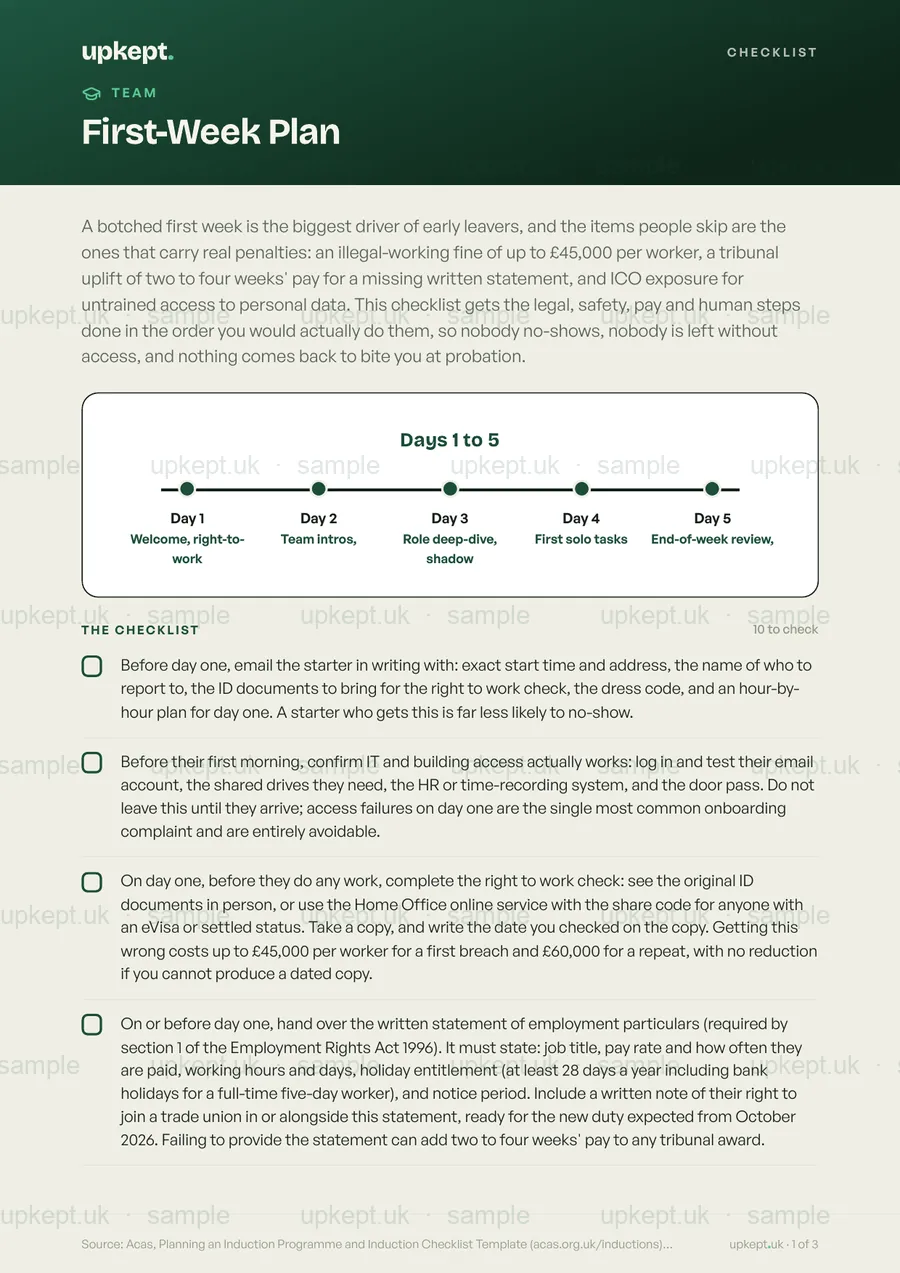
A botched first week is the biggest driver of early leavers, and the items people skip are the ones that carry real penalties: an illegal-working fine of up to £45,000 per worker, a tribunal uplift of two to four weeks' pay for a missing written statement, and ICO exposure for untrained access to personal data. This checklist gets the legal, safety, pay and human steps done in the order you would actually do them, so nobody no-shows, nobody is left without access, and nothing comes back to bite you at probation.
10 checksPDF + phoneReviewed August 2026
Built on published UK guidance Show sources
Acas, Planning an Induction Programme and Induction Checklist Template (acas.org.uk/inductions); Employment Rights Act 1996 s.1 (written statement, day-one requirement); Health and Safety (Display Screen Equipment) Regulations 1992 (as amended 2002), HSE guidance on the one-hour-or-more user threshold; Regulatory Reform (Fire Safety) Order 2005; Immigration, Asylum and Nationality Act 2006 and the Home Office Code of Practice on Preventing Illegal Working, civil penalty rates effective 13 February 2024 (£45,000 first breach / £60,000 repeat, per worker); GOV.UK Holiday Entitlement (5.6 weeks / 28 days for a full-time five-day worker); ICO Accountability Framework, training and awareness; Employment Rights Act 2025 (Royal Assent 18 December 2025): unfair dismissal qualifying period reduced to six months from 1 January 2027, and the duty to notify staff of the right to join a trade union (delivered with the s.1 statement), Government intends to commence October 2026.
£14one-off, yours forever
Replaces a DIY doc, and you get every future update free when the guidance changes.
3 for 2 on documents and packs. Add 3 and your cheapest is free.
A clean one-page PDF, ready to print
Opens and ticks off on any phone
Clear, no jargon, easy to follow
Free updates whenever the guidance changes
Secure checkout30-day money-backInstant downloadNo subscriptionCard & Apple Pay
Best valueSave 42%
Or get all 56 templates
The Everything Bundle: every template today and every future one.£399 one-off, instead of £686 bought separately.
Made for places like this
What’s on it
10 things to check.
Everything that matters, nothing that does not. Here is the full list, exactly as it appears on the template.
1Before day one, email the starter in writing with: exact start time and address, the name of who to report to, the ID documents to bring for the right to work check, the dress code, and an hour-by-hour plan for day one. A starter who gets this is far less likely to no-show.
2Before their first morning, confirm IT and building access actually works: log in and test their email account, the shared drives they need, the HR or time-recording system, and the door pass. Do not leave this until they arrive; access failures on day one are the single most common onboarding complaint and are entirely avoidable.
3On day one, before they do any work, complete the right to work check: see the original ID documents in person, or use the Home Office online service with the share code for anyone with an eVisa or settled status. Take a copy, and write the date you checked on the copy. Getting this wrong costs up to £45,000 per worker for a first breach and £60,000 for a repeat, with no reduction if you cannot produce a dated copy.
4On or before day one, hand over the written statement of employment particulars (required by section 1 of the Employment Rights Act 1996). It must state: job title, pay rate and how often they are paid, working hours and days, holiday entitlement (at least 28 days a year including bank holidays for a full-time five-day worker), and notice period. Include a written note of their right to join a trade union in or alongside this statement, ready for the new duty expected from October 2026. Failing to provide the statement can add two to four weeks' pay to any tribunal award.
5On day one, before they are left alone in the building, walk them through fire safety: point out the two nearest fire exits, take them to the assembly point, and explain how the roll-call register works. Get them to sign a dated record. This is required under the Regulatory Reform (Fire Safety) Order 2005 and is the item most often found missing when a fire officer or insurer inspects.
6On day one, add them to payroll and submit their details to HMRC through Real Time Information before their first payday. Get their National Insurance number, bank details, and a completed starter checklist (statement A, B or C) if they have no P45, all in writing. A missing NI number or the wrong starter statement is the most common week-one payroll error and takes months to fix.
7Within the first week, run a DSE (display screen equipment) workstation assessment for this specific person at their desk, not a generic office one. It is required for anyone using a screen for an hour or more at a time most days, under the Health and Safety (Display Screen Equipment) Regulations 1992. If they will work from home too, give them a separate home-working assessment to complete.
8Before they are given access to any personal data, and at the latest within their first month, have them complete data protection induction training and record the date they finished. Cover three things: what counts as personal data, how your organisation handles it, and exactly who to tell if they spot a possible breach. The ICO expects a record of completion, and missing training counts against you in any investigation.
9On day one, set the probation review date, put it in writing, and tell the starter when it is. From 1 January 2027 employees can claim unfair dismissal after six months rather than two years, so anyone hired from mid-2026 will have full rights at six months; an undocumented or skipped probation review leaves you exposed much earlier than before.
10Book the line manager's end-of-week check-in for day four or five now, as a real diary slot, not a vague 'catch up soon'. Use it to confirm four things: the job matches what was described, the workload is manageable, every access and equipment gap is closed, and they know who to ask when stuck. Note the answers in a couple of lines. Acas guidance is most explicit about this step, and it is the one most often skipped.
Good to know
Most managers think the right to work check can wait until the end of the first week and that photocopying a passport covers it. Both are wrong: the check must be done before the person starts any work, you must see the original documents in person or use the Home Office online service with a share code (a photocopy alone is not a valid check), and you must record the date of the check on the copy. Since 13 February 2024 the fine for getting it wrong is up to £45,000 per worker for a first breach and £60,000 for a repeat, with no allowance for an honest mistake if you cannot produce a dated copy.
Source: Acas, Planning an Induction Programme and Induction Checklist Template (acas.org.uk/inductions); Employment Rights Act 1996 s.1 (written statement, day-one requirement); Health and Safety (Display Screen Equipment) Regulations 1992 (as amended 2002), HSE guidance on the one-hour-or-more user threshold; Regulatory Reform (Fire Safety) Order 2005; Immigration, Asylum and Nationality Act 2006 and the Home Office Code of Practice on Preventing Illegal Working, civil penalty rates effective 13 February 2024 (£45,000 first breach / £60,000 repeat, per worker); GOV.UK Holiday Entitlement (5.6 weeks / 28 days for a full-time five-day worker); ICO Accountability Framework, training and awareness; Employment Rights Act 2025 (Royal Assent 18 December 2025): unfair dismissal qualifying period reduced to six months from 1 January 2027, and the duty to notify staff of the right to join a trade union (delivered with the s.1 statement), Government intends to commence October 2026.
Good to know
Questions, answered
What is the First-Week Plan?
A botched first week is the biggest driver of early leavers, and the items people skip are the ones that carry real penalties: an illegal-working fine of up to £45,000 per worker, a tribunal uplift of two to four weeks' pay for a missing written statement, and ICO exposure for untrained access to personal data. This checklist gets the legal, safety, pay and human steps done in the order you would actually do them, so nobody no-shows, nobody is left without access, and nothing comes back to bite you at probation.
Why does it matter?
Most managers think the right to work check can wait until the end of the first week and that photocopying a passport covers it. Both are wrong: the check must be done before the person starts any work, you must see the original documents in person or use the Home Office online service with a share code (a photocopy alone is not a valid check), and you must record the date of the check on the copy. Since 13 February 2024 the fine for getting it wrong is up to £45,000 per worker for a first breach and £60,000 for a repeat, with no allowance for an honest mistake if you cannot produce a dated copy.
How do I get it, and is it up to date?
The PDF downloads the moment you check out, prints sharp in black and white, and opens on any phone. It is reviewed for August 2026 and you get any future update free when the official guidance changes.
A weak handover is the most common root cause of medication errors, choking on the wrong diet texture, missed post-fall checks, and pressure damage that goes unwatched. A sheet that names the specific person, number, and action passes information the next shift can act on immediately, and it is the record CQC reads back when something goes wrong.
Onboarding done right keeps the business clear of an illegal-working civil penalty (up to £60,000 per worker), of tribunal claims for a missing written statement or unlawful pay deductions, and of the early attrition that hits when someone leaves inside 90 days because day one was a mess. This is the order an onboarder actually works through, from legal must-dos to the things that make a new starter productive.
A new starter induction that is actually done, not just signed off, prevents two kinds of expensive failure: legal exposure (a £45,000 to £60,000 illegal-working penalty, an unfair dismissal or discrimination claim, an ICO breach, an HMRC tax-records penalty) and operational failure (someone who cannot evacuate the building, cannot log in for three days, or hits month five of probation with no documented reviews). Each item below names the document, the number or deadline, and the action, so it can be ticked off and evidenced.