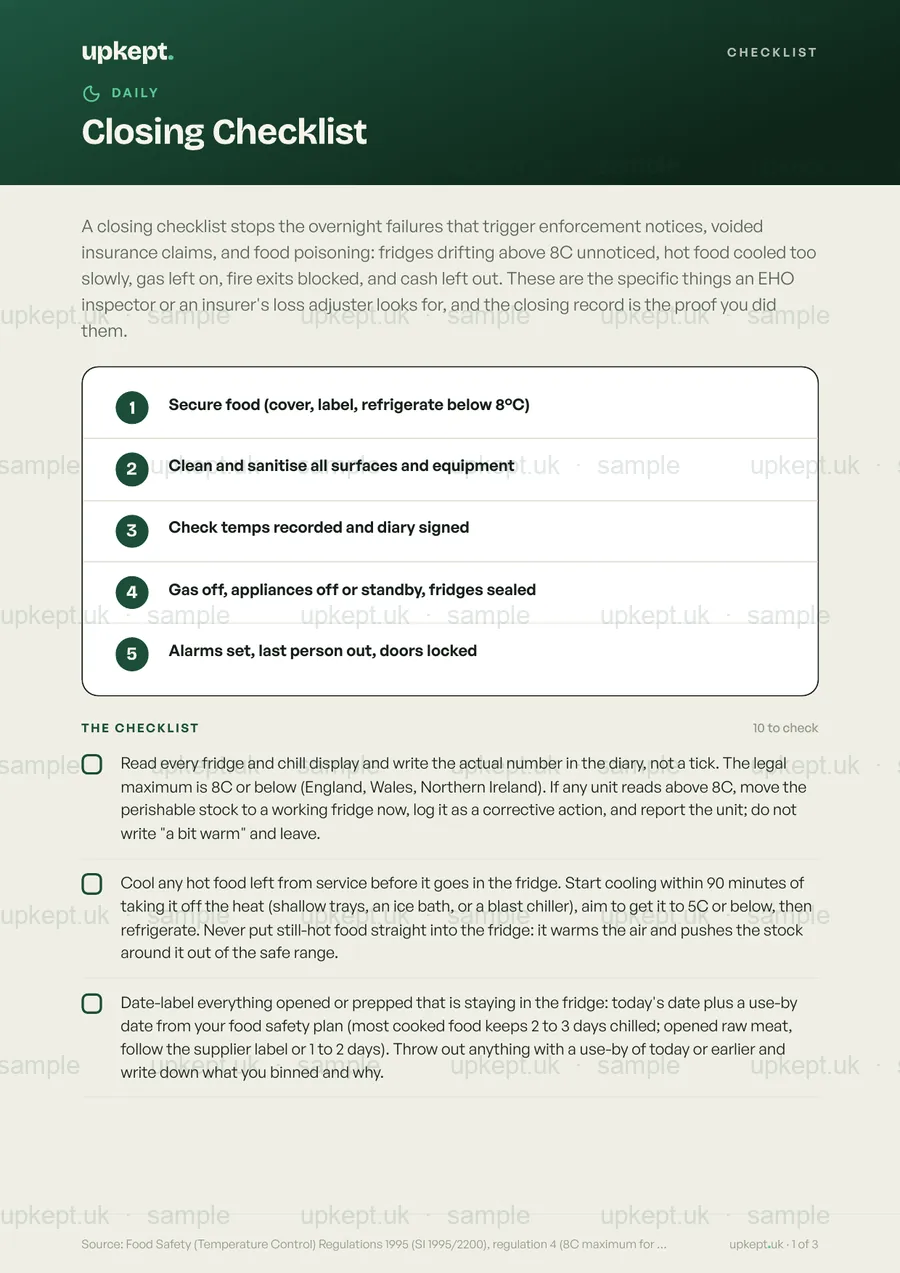
A closing checklist stops the overnight failures that trigger enforcement notices, voided insurance claims, and food poisoning: fridges drifting above 8C unnoticed, hot food cooled too slowly, gas left on, fire exits blocked, and cash left out. These are the specific things an EHO inspector or an insurer's loss adjuster looks for, and the closing record is the proof you did them.
10 checksPDF + phoneReviewed August 2026
Built on published UK guidance Show sources
Food Safety (Temperature Control) Regulations 1995 (SI 1995/2200), regulation 4 (8C maximum for cold food capable of supporting bacterial growth, England and Wales; mirrored in Northern Ireland); FSA Safer Food Better Business for Caterers, Chilling safe methods and Daily Diary (cool hot food, start cooling within 90 minutes, aim for 5C or below; manager signs the diary to confirm closing checks); FSA guidance on storing chilled food (5C or below recommended fridge operating temperature; danger zone 8C to 63C); Regulatory Reform (Fire Safety) Order 2005, article 14 (escape routes and exits kept clear, exits not locked against immediate opening); National Gas Emergency Service 0800 111 999.
£14one-off, yours forever
Replaces a DIY doc, and you get every future update free when the guidance changes.
3 for 2 on documents and packs. Add 3 and your cheapest is free.
A clean one-page PDF, ready to print
Opens and ticks off on any phone
Clear, no jargon, easy to follow
Free updates whenever the guidance changes
Secure checkout30-day money-backInstant downloadNo subscriptionCard & Apple Pay
Best valueSave 42%
Or get all 56 templates
The Everything Bundle: every template today and every future one.£399 one-off, instead of £686 bought separately.
Made for places like this
What’s on it
10 things to check.
Everything that matters, nothing that does not. Here is the full list, exactly as it appears on the template.
1Read every fridge and chill display and write the actual number in the diary, not a tick. The legal maximum is 8C or below (England, Wales, Northern Ireland). If any unit reads above 8C, move the perishable stock to a working fridge now, log it as a corrective action, and report the unit; do not write "a bit warm" and leave.
2Cool any hot food left from service before it goes in the fridge. Start cooling within 90 minutes of taking it off the heat (shallow trays, an ice bath, or a blast chiller), aim to get it to 5C or below, then refrigerate. Never put still-hot food straight into the fridge: it warms the air and pushes the stock around it out of the safe range.
3Date-label everything opened or prepped that is staying in the fridge: today's date plus a use-by date from your food safety plan (most cooked food keeps 2 to 3 days chilled; opened raw meat, follow the supplier label or 1 to 2 days). Throw out anything with a use-by of today or earlier and write down what you binned and why.
4Update the allergen information for any special or substituted dish served today. If a recipe changed, an ingredient was swapped, or a dish ran out and was replaced, correct the allergen matrix now or leave a written note for the opening manager, so the next shift never reads out information that no longer matches the food.
5Turn off every gas appliance at its isolation valve, not just the control knob, and check each burner, grill, and pilot is fully out. Then close the main kitchen gas shut-off valve. If you smell gas at any point, do not touch any electrical switch: open doors and windows, get everyone out, and call the National Gas Emergency line on 0800 111 999.
6Walk every fire exit. Each one must be clear of deliveries and clutter, openable from the inside without a key, and able to close and latch on its own. Remove any wedge holding a fire door open. Check the lit exit signs are on. Blocked or propped fire exits are an offence under the Regulatory Reform (Fire Safety) Order 2005.
7Count the till and reconcile it against the day's sales before you take any cash out: record opening float, total takings, and closing float in the cash log. Put excess cash in the safe and lock it. Have two people present for this where staffing allows.
8Do one sweep of the whole premises before locking up: store rooms, toilets, and back-of-house, to confirm no customer, driver, or visitor is shut inside. Switch off non-essential equipment and lights, and check every external door and window is shut and locked.
9Set the intruder alarm and confirm it has armed before you leave. Write the name of the last person out and the lock-up time in the closing log. This is the record your insurer and the police will ask for if there is an overnight break-in.
10Sign and date the SFBB closing record (or your equivalent). The manager on site signs to confirm the closing checks above were actually done. EHOs ask to see completed diary pages at every visit, and a blank or unsigned page is treated as a check that never happened.
Good to know
8C is the law, but it is not the target. The legal cold-storage maximum in England, Wales, and Northern Ireland is 8C or below, yet the FSA's recommended operating temperature is 5C or below, and that is what inspectors expect to see in practice. A fridge reading 7C is legal but will draw a comment and be flagged as a trend if it keeps happening. Set your kit to run at around 1 to 4C so normal door openings and warm-day spikes never push you past 8C.
Source: Food Safety (Temperature Control) Regulations 1995 (SI 1995/2200), regulation 4 (8C maximum for cold food capable of supporting bacterial growth, England and Wales; mirrored in Northern Ireland); FSA Safer Food Better Business for Caterers, Chilling safe methods and Daily Diary (cool hot food, start cooling within 90 minutes, aim for 5C or below; manager signs the diary to confirm closing checks); FSA guidance on storing chilled food (5C or below recommended fridge operating temperature; danger zone 8C to 63C); Regulatory Reform (Fire Safety) Order 2005, article 14 (escape routes and exits kept clear, exits not locked against immediate opening); National Gas Emergency Service 0800 111 999.
Good to know
Questions, answered
What is the Closing Checklist?
A closing checklist stops the overnight failures that trigger enforcement notices, voided insurance claims, and food poisoning: fridges drifting above 8C unnoticed, hot food cooled too slowly, gas left on, fire exits blocked, and cash left out. These are the specific things an EHO inspector or an insurer's loss adjuster looks for, and the closing record is the proof you did them.
Why does it matter?
8C is the law, but it is not the target. The legal cold-storage maximum in England, Wales, and Northern Ireland is 8C or below, yet the FSA's recommended operating temperature is 5C or below, and that is what inspectors expect to see in practice. A fridge reading 7C is legal but will draw a comment and be flagged as a trend if it keeps happening. Set your kit to run at around 1 to 4C so normal door openings and warm-day spikes never push you past 8C.
How do I get it, and is it up to date?
The PDF downloads the moment you check out, prints sharp in black and white, and opens on any phone. It is reviewed for August 2026 and you get any future update free when the official guidance changes.
This checklist stops the two failures that close kitchens: food sitting in the danger zone (8 to 63 degrees C) long enough for bacteria to multiply, and staff working from memory instead of a record an Environmental Health Officer can read back. A weak opening compromises food before the first order; a rushed close lets fridges drift, pests settle, and yesterday's record go unsigned.
A proper opening check, done before the first customer or the first food is touched, is your strongest defence against a poor Food Hygiene Rating, a customer falling ill, or an enforcement notice. The Environmental Health Officer scores how well you manage safety every day, not just on inspection day, so a signed daily record that proves you check temperatures, allergens and sickness exclusion is what protects the rating and the business.
A correct cash-up catches theft, miscounts and till faults at the end of each shift, before they compound and become impossible to trace back to a person or a day. Done the same way every day it gives you the contemporaneous till records HMRC expects, and builds a variance history that tells a one-off mistake apart from a steady leak.