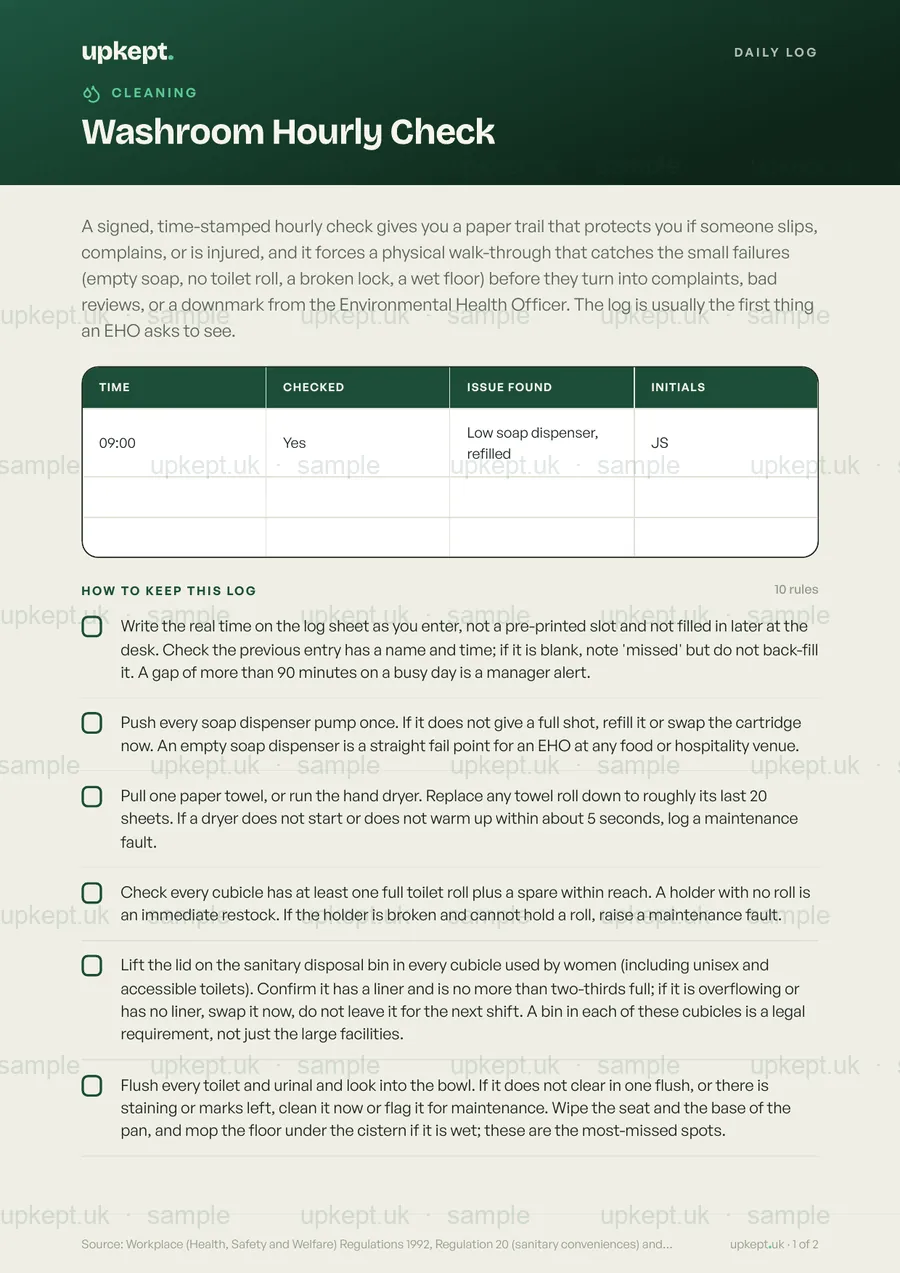
A signed, time-stamped hourly check gives you a paper trail that protects you if someone slips, complains, or is injured, and it forces a physical walk-through that catches the small failures (empty soap, no toilet roll, a broken lock, a wet floor) before they turn into complaints, bad reviews, or a downmark from the Environmental Health Officer. The log is usually the first thing an EHO asks to see.
10 checksPDF + phoneReviewed August 2026
Built on published UK guidance Show sources
Workplace (Health, Safety and Welfare) Regulations 1992, Regulation 20 (sanitary conveniences) and Regulation 21 (washing facilities), with HSE ACOP and guidance L24 'Workplace health, safety and welfare'; Environmental Protection Act 1990, Section 34 (duty of care for controlled/offensive waste); HSE ACOP L8 'Legionnaires' disease: the control of legionella bacteria in water systems' (hot water reaching 50 degrees C at the outlet within one minute); HSE information sheet HSIS6 'Safe hot water and surface temperatures' (44 degrees C maximum outlet temperature for vulnerable users via a thermostatic mixing valve); Health and Safety at Work etc. Act 1974 (general slip/trip duty).
Freeno card needed
Replaces a DIY doc, and you get every future update free when the guidance changes.
3 for 2 on documents and packs. Add 3 and your cheapest is free.
A clean one-page PDF, ready to print
Opens and ticks off on any phone
Clear, no jargon, easy to follow
Free updates whenever the guidance changes
Secure checkout30-day money-backInstant downloadNo subscriptionCard & Apple Pay
Made for places like this
What’s on it
10 things to check.
Everything that matters, nothing that does not. Here is the full list, exactly as it appears on the template.
1Write the real time on the log sheet as you enter, not a pre-printed slot and not filled in later at the desk. Check the previous entry has a name and time; if it is blank, note 'missed' but do not back-fill it. A gap of more than 90 minutes on a busy day is a manager alert.
2Push every soap dispenser pump once. If it does not give a full shot, refill it or swap the cartridge now. An empty soap dispenser is a straight fail point for an EHO at any food or hospitality venue.
3Pull one paper towel, or run the hand dryer. Replace any towel roll down to roughly its last 20 sheets. If a dryer does not start or does not warm up within about 5 seconds, log a maintenance fault.
4Check every cubicle has at least one full toilet roll plus a spare within reach. A holder with no roll is an immediate restock. If the holder is broken and cannot hold a roll, raise a maintenance fault.
5Lift the lid on the sanitary disposal bin in every cubicle used by women (including unisex and accessible toilets). Confirm it has a liner and is no more than two-thirds full; if it is overflowing or has no liner, swap it now, do not leave it for the next shift. A bin in each of these cubicles is a legal requirement, not just the large facilities.
6Flush every toilet and urinal and look into the bowl. If it does not clear in one flush, or there is staining or marks left, clean it now or flag it for maintenance. Wipe the seat and the base of the pan, and mop the floor under the cistern if it is wet; these are the most-missed spots.
7Test the lock on every cubicle door. If a bolt or latch does not engage, put an out-of-order sign on that door and raise a maintenance fault. Do not leave a cubicle that will not lock open for use.
8Look across the whole floor, including behind the door and under the basins. Mop any standing water before you leave; it is a slip hazard you are now on record as having seen. If a drain smells of sewage, contact the housekeeping supervisor within the hour.
9Run each basin hot tap for about 15 seconds. It should run hot, not just warm; if it stays cold, log it and tell maintenance, as cold-only basins undermine hand hygiene and can signal a hot-water-system fault. (At care homes and similar settings, basin, bath and shower outlets used by vulnerable people are deliberately capped at 44 degrees C by a mixing valve to prevent scalding, so warm rather than hot is correct there.)
10Restock from the under-sink or store cupboard before you leave the area: if soap cartridges, towel rolls, or bin liners are down to the last one, reorder now rather than at the end of the shift, so the next check is not caught short.
Good to know
A sanitary disposal bin is legally required in every individual cubicle used by women, including single unisex and accessible toilets, not just large multi-cubicle ladies' rooms. A shared bin outside the cubicle or in the lobby does not satisfy the duty. Sanitary waste is also classed as offensive waste, so it must be removed by a registered waste carrier with waste transfer notes kept as proof; putting it in the general bin can breach the Environmental Protection Act 1990 duty of care.
Source: Workplace (Health, Safety and Welfare) Regulations 1992, Regulation 20 (sanitary conveniences) and Regulation 21 (washing facilities), with HSE ACOP and guidance L24 'Workplace health, safety and welfare'; Environmental Protection Act 1990, Section 34 (duty of care for controlled/offensive waste); HSE ACOP L8 'Legionnaires' disease: the control of legionella bacteria in water systems' (hot water reaching 50 degrees C at the outlet within one minute); HSE information sheet HSIS6 'Safe hot water and surface temperatures' (44 degrees C maximum outlet temperature for vulnerable users via a thermostatic mixing valve); Health and Safety at Work etc. Act 1974 (general slip/trip duty).
Good to know
Questions, answered
What is the Washroom Hourly Check?
A signed, time-stamped hourly check gives you a paper trail that protects you if someone slips, complains, or is injured, and it forces a physical walk-through that catches the small failures (empty soap, no toilet roll, a broken lock, a wet floor) before they turn into complaints, bad reviews, or a downmark from the Environmental Health Officer. The log is usually the first thing an EHO asks to see.
Why does it matter?
A sanitary disposal bin is legally required in every individual cubicle used by women, including single unisex and accessible toilets, not just large multi-cubicle ladies' rooms. A shared bin outside the cubicle or in the lobby does not satisfy the duty. Sanitary waste is also classed as offensive waste, so it must be removed by a registered waste carrier with waste transfer notes kept as proof; putting it in the general bin can breach the Environmental Protection Act 1990 duty of care.
How do I get it, and is it up to date?
The PDF downloads the moment you check out, prints sharp in black and white, and opens on any phone. It is reviewed for August 2026 and you get any future update free when the official guidance changes.
A signed cleaning record is the main evidence an Environmental Health Officer uses to decide whether your kitchen is clean every day, not just on inspection day. Done properly, this routine stops the four things that sink hygiene ratings and trigger enforcement: cross-contamination between raw and ready-to-eat food, allergen cross-contact, grease fires in the extract system, and pest infestations.
A neglected waste area is the most common cause of pest infestation, the most common spot for a deliberate fire to start and spread into the building, and the source of unlimited fines under the duty of care in EPA 1990 s.34. This check keeps the environmental health officer, your insurer, and the fire risk assessment satisfied, and proves the area was inspected if anyone asks.
A signed, dated cleaning rota is your legal evidence that you control food hygiene and premises safety. If it is not written down, an Environmental Health Officer treats the cleaning as if it never happened, however clean the place looks on the day, and that drives down your Food Hygiene Rating.