upkept.
upkept.
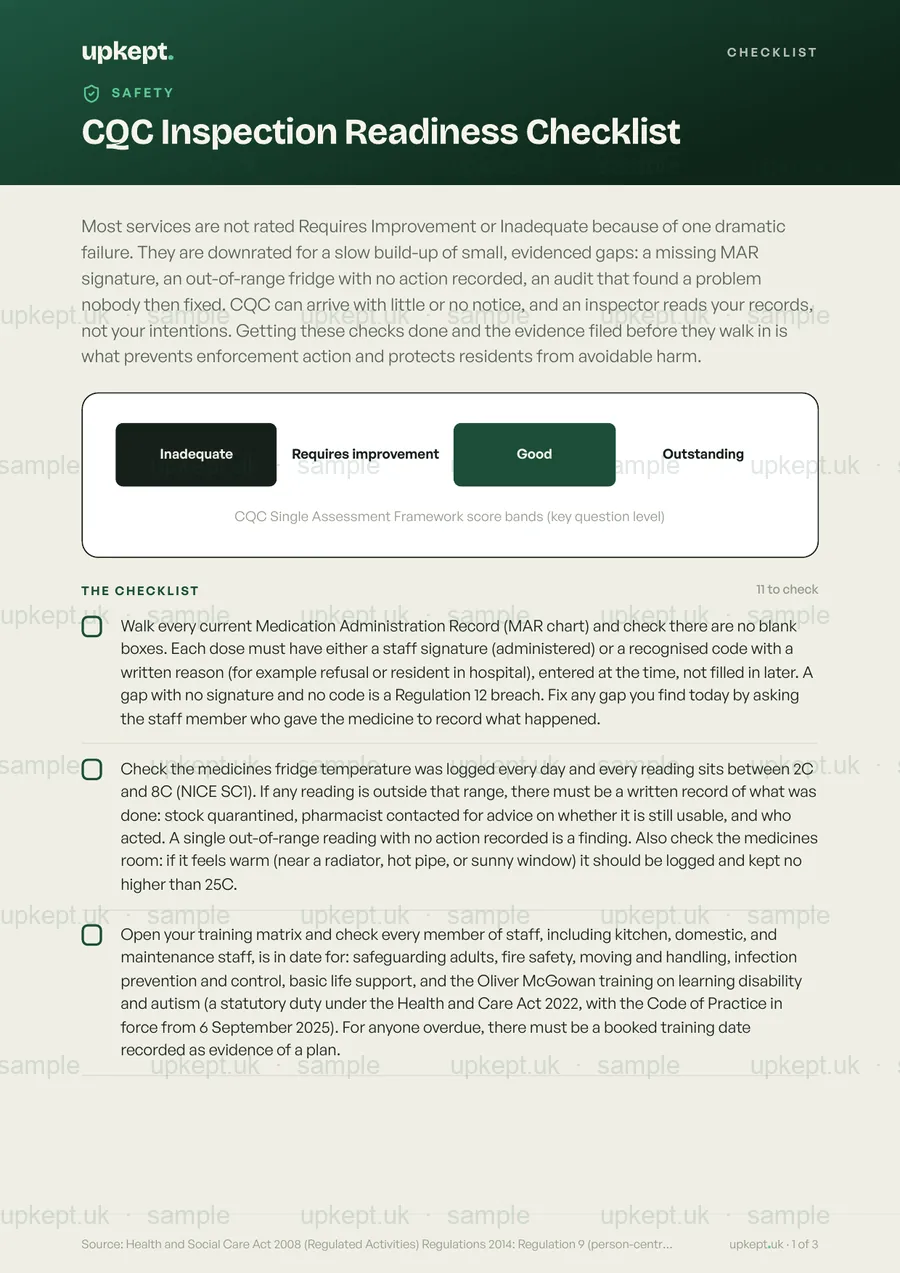
Sample page of the CQC Inspection Readiness Checklist

A sample page of the actual document

Safety

CQC Inspection Readiness Checklist

Most services are not rated Requires Improvement or Inadequate because of one dramatic failure. They are downrated for a slow build-up of small, evidenced gaps: a missing MAR signature, an out-of-range fridge with no action recorded, an audit that found a problem nobody then fixed. CQC can arrive with little or no notice, and an inspector reads your records, not your intentions. Getting these checks done and the evidence filed before they walk in is what prevents enforcement action and protects residents from avoidable harm.

11 checksPDF + phoneReviewed August 2026
Built on published UK guidance Show sources

Health and Social Care Act 2008 (Regulated Activities) Regulations 2014: Regulation 9 (person-centred care), Regulation 12 (safe care and treatment), Regulation 13 (safeguarding), Regulation 16 (complaints, including the 28-day duty to supply CQC a complaints summary on request), Regulation 17 (good governance), Regulation 18 (staffing), Regulation 19 and Schedule 3 (fit and proper persons employed). CQC (Registration) Regulations 2009, Regulation 18 (statutory notifications of abuse, police involvement, serious injury and DoLS authorisation requests). NICE Guideline SC1 Managing medicines in care homes (fridge 2-8C monitored daily; medicines room normally no higher than 25C). HSE ACOP L8 and HSG274 Part 2 (hot water 50C within one minute at the outlet, TMV-protected taps not exceeding 44C, cold water below 20C after two minutes). Health and Care Act 2022 s.181 and the Oliver McGowan Code of Practice (in force 6 September 2025). Mental Capacity Act 2005 Schedule A1 (DoLS) as modified by the June 2026 UK Supreme Court judgment redefining deprivation of liberty and overturning Cheshire West (2014); DHSC interim guidance 2026. CQC State of Care 2024-25 (DoLS application volumes and processing times). CQC assessment framework: the 2023 Single Assessment Framework is being replaced by sector-specific frameworks (draft published March 2026, finals expected late 2026), so confirm the current published framework before inspection.

£14one-off, yours forever

Replaces a DIY doc, and you get every future update free when the guidance changes.

Go to basket

30-day money-back guarantee.

3 for 2 on documents and packs. Add 3 and your cheapest is free.

  • A clean one-page PDF, ready to print
  • Opens and ticks off on any phone
  • Clear, no jargon, easy to follow
  • Free updates whenever the guidance changes
Secure checkout 30-day money-back Instant download No subscription Card & Apple Pay
Best valueSave 42%

Or get all 56 templates

The Everything Bundle: every template today and every future one.£399 one-off, instead of £686 bought separately.

A well-kept safety setting
Made for places like this

What’s on it

11 things to check.

Everything that matters, nothing that does not. Here is the full list, exactly as it appears on the template.

  • 1Walk every current Medication Administration Record (MAR chart) and check there are no blank boxes. Each dose must have either a staff signature (administered) or a recognised code with a written reason (for example refusal or resident in hospital), entered at the time, not filled in later. A gap with no signature and no code is a Regulation 12 breach. Fix any gap you find today by asking the staff member who gave the medicine to record what happened.
  • 2Check the medicines fridge temperature was logged every day and every reading sits between 2C and 8C (NICE SC1). If any reading is outside that range, there must be a written record of what was done: stock quarantined, pharmacist contacted for advice on whether it is still usable, and who acted. A single out-of-range reading with no action recorded is a finding. Also check the medicines room: if it feels warm (near a radiator, hot pipe, or sunny window) it should be logged and kept no higher than 25C.
  • 3Open your training matrix and check every member of staff, including kitchen, domestic, and maintenance staff, is in date for: safeguarding adults, fire safety, moving and handling, infection prevention and control, basic life support, and the Oliver McGowan training on learning disability and autism (a statutory duty under the Health and Care Act 2022, with the Code of Practice in force from 6 September 2025). For anyone overdue, there must be a booked training date recorded as evidence of a plan.
  • 4Pull five staff recruitment files at random and confirm each one contains: photo ID, an Enhanced DBS certificate (or a recorded DBS Adult First check if a supervised start was needed while the full DBS was pending), at least two references, and a note showing the references were checked before that person worked unsupervised. A missing Schedule 3 item is a direct Regulation 19 breach. Note any gap and chase the missing document.
  • 5Check every resident who is under continuous or close supervision and cannot leave when they want has a deprivation of liberty position recorded: either a DoLS authorisation applied for from the local authority, or a written reason why the manager has assessed that this resident is not deprived of their liberty. Following the June 2026 Supreme Court ruling there is no longer a single acid test, so each case needs an individual judgement recorded, not a blanket assumption. Keep a tracker showing resident name, date applied, status, and expiry. When in doubt, refer; an unauthorised deprivation of liberty is unlawful.
  • 6Spot-check five residents' care plans. Each must have been reviewed within the last month (or sooner if the resident's needs changed), be written specifically about that person rather than a generic template, and reflect their current risks, health, and preferences. A plan that reads identically to six months ago, for someone whose needs have moved on, is a Regulation 9 (person-centred care) failure. Flag any plan that is stale or generic for the nurse or senior to update.
  • 7Review the complaints log and confirm every complaint has a recorded outcome and that any action it identified was actually done. The hard legal deadline is Regulation 16: if CQC asks for a summary of complaints, you must provide it within 28 days. (A 3-working-day acknowledgement and a 25-working-day full response are recommended good-practice benchmarks, not law, but inspectors expect to see them met.) A complaint that was logged and never investigated is worse than no log at all.
  • 8Check the hot and cold water temperature records (taken at least monthly, more often in higher-risk areas). Hot water should reach 50C within one minute at the outlet; where a Thermostatic Mixing Valve (TMV) is fitted the tap itself should not exceed 44C to prevent scalding. Cold water should be below 20C after running for two minutes. Legionella multiplies between 20C and 45C. Confirm TMVs are serviced at least yearly, the Legionella risk assessment is in date, and the named responsible person is recorded (HSE ACOP L8 / HSG274).
  • 9Check your audit schedule (medication, care plans, accidents and incidents, infection control, environment) and confirm two things: the audits were done on time, AND every issue they found has a named person, a corrective action, and a completion date. An audit signed off with findings but no action plan is the most common Regulation 17 (good governance) failure on inspection: CQC treats a known risk left unaddressed as more serious than one never spotted. Write an action against any open finding before the inspector does.
  • 10Check the safeguarding log: every allegation or concern must have been referred to the local authority safeguarding team the same day (or next working day if out of hours), with the referral date, who made it, the council reference number, and the outcome recorded. Failing to refer is a Regulation 13 breach. Separately, check that any incident meeting a notifiable category (abuse or alleged abuse, police involvement, a serious injury, or a DoLS authorisation request) was notified to CQC without delay under Regulation 18 of the CQC Registration Regulations 2009; not every safeguarding referral is notifiable, but these are.
  • 11Compare your planned staffing levels against the actual rota for the last four weeks. The manager must be able to show staffing was set by residents' assessed dependency needs, not a fixed headcount. For any shift that ran below plan, there must be a record of why, who was in charge, and what was done to keep people safe. CQC publishes no minimum ratio; it weighs your planned levels against residents' needs and against any incidents that happened on short-staffed shifts.

Good to know

The biggest DoLS trap changed in June 2026. The Supreme Court overturned the long-standing Cheshire West "acid test" (continuous supervision and control, not free to leave), so there is no longer a single automatic trigger. Care homes must now make an individual, recorded judgement on each resident, looking at the type, degree, and effect of the restrictions and whether the person can validly consent. A resident who appears genuinely content and accepts the arrangement may now be capable of valid consent, which was not the position before. The DoLS process itself still runs (applications go to the local authority under the Mental Capacity Act), and where there is any doubt you should still refer; but blanket-applying for everyone, or assuming nobody needs one, are now both wrong. For scale: care homes and hospitals made 364,900 DoLS applications in 2024-25, which took an average of 126 days against a 21-day statutory limit, so backlogs are real and your own records must stand on their own.

Source: Health and Social Care Act 2008 (Regulated Activities) Regulations 2014: Regulation 9 (person-centred care), Regulation 12 (safe care and treatment), Regulation 13 (safeguarding), Regulation 16 (complaints, including the 28-day duty to supply CQC a complaints summary on request), Regulation 17 (good governance), Regulation 18 (staffing), Regulation 19 and Schedule 3 (fit and proper persons employed). CQC (Registration) Regulations 2009, Regulation 18 (statutory notifications of abuse, police involvement, serious injury and DoLS authorisation requests). NICE Guideline SC1 Managing medicines in care homes (fridge 2-8C monitored daily; medicines room normally no higher than 25C). HSE ACOP L8 and HSG274 Part 2 (hot water 50C within one minute at the outlet, TMV-protected taps not exceeding 44C, cold water below 20C after two minutes). Health and Care Act 2022 s.181 and the Oliver McGowan Code of Practice (in force 6 September 2025). Mental Capacity Act 2005 Schedule A1 (DoLS) as modified by the June 2026 UK Supreme Court judgment redefining deprivation of liberty and overturning Cheshire West (2014); DHSC interim guidance 2026. CQC State of Care 2024-25 (DoLS application volumes and processing times). CQC assessment framework: the 2023 Single Assessment Framework is being replaced by sector-specific frameworks (draft published March 2026, finals expected late 2026), so confirm the current published framework before inspection.

Good to know

Questions, answered

What is the CQC Inspection Readiness Checklist?

Most services are not rated Requires Improvement or Inadequate because of one dramatic failure. They are downrated for a slow build-up of small, evidenced gaps: a missing MAR signature, an out-of-range fridge with no action recorded, an audit that found a problem nobody then fixed. CQC can arrive with little or no notice, and an inspector reads your records, not your intentions. Getting these checks done and the evidence filed before they walk in is what prevents enforcement action and protects residents from avoidable harm.

Why does it matter?

The biggest DoLS trap changed in June 2026. The Supreme Court overturned the long-standing Cheshire West "acid test" (continuous supervision and control, not free to leave), so there is no longer a single automatic trigger. Care homes must now make an individual, recorded judgement on each resident, looking at the type, degree, and effect of the restrictions and whether the person can validly consent. A resident who appears genuinely content and accepts the arrangement may now be capable of valid consent, which was not the position before. The DoLS process itself still runs (applications go to the local authority under the Mental Capacity Act), and where there is any doubt you should still refer; but blanket-applying for everyone, or assuming nobody needs one, are now both wrong. For scale: care homes and hospitals made 364,900 DoLS applications in 2024-25, which took an average of 126 days against a 21-day statutory limit, so backlogs are real and your own records must stand on their own.

How do I get it, and is it up to date?

The PDF downloads the moment you check out, prints sharp in black and white, and opens on any phone. It is reviewed for August 2026 and you get any future update free when the official guidance changes.

More safety templates

Free

Fire Extinguisher Monthly Check

A discharged or depressurised extinguisher found during a real fire is no better than having no extinguisher at all. The monthly visual check catches the common pre-failure states (lost pressure, broken tamper seal, blocked access, overdue service) before they matter, and it gives the responsible person the maintenance records the Regulatory Reform (Fire Safety) Order 2005 requires.

FreeView
Safety

Fire Door Check

A fire door only works if it closes fully, latches, and seals the gaps; one door that fails to do that lets smoke and fire spread through a building in minutes and removes people's time to escape. These checks catch the specific, common failures (props, blown gaps, missing closers, painted-up seals) that turn a survivable fire into a fatal one.

£14View
Safety

First Aid Kit Check

An under-stocked or expired first aid kit means the person treating an injury reaches for a dressing and finds an empty slot, a perished wrapper, or latex gloves that trigger an allergic reaction. A regular documented check fixes that in advance and gives an HSE or Ofsted inspector evidence that your first aid provision is genuinely maintained, not just present.

£14View

CQC Inspection Readiness Checklist

£14