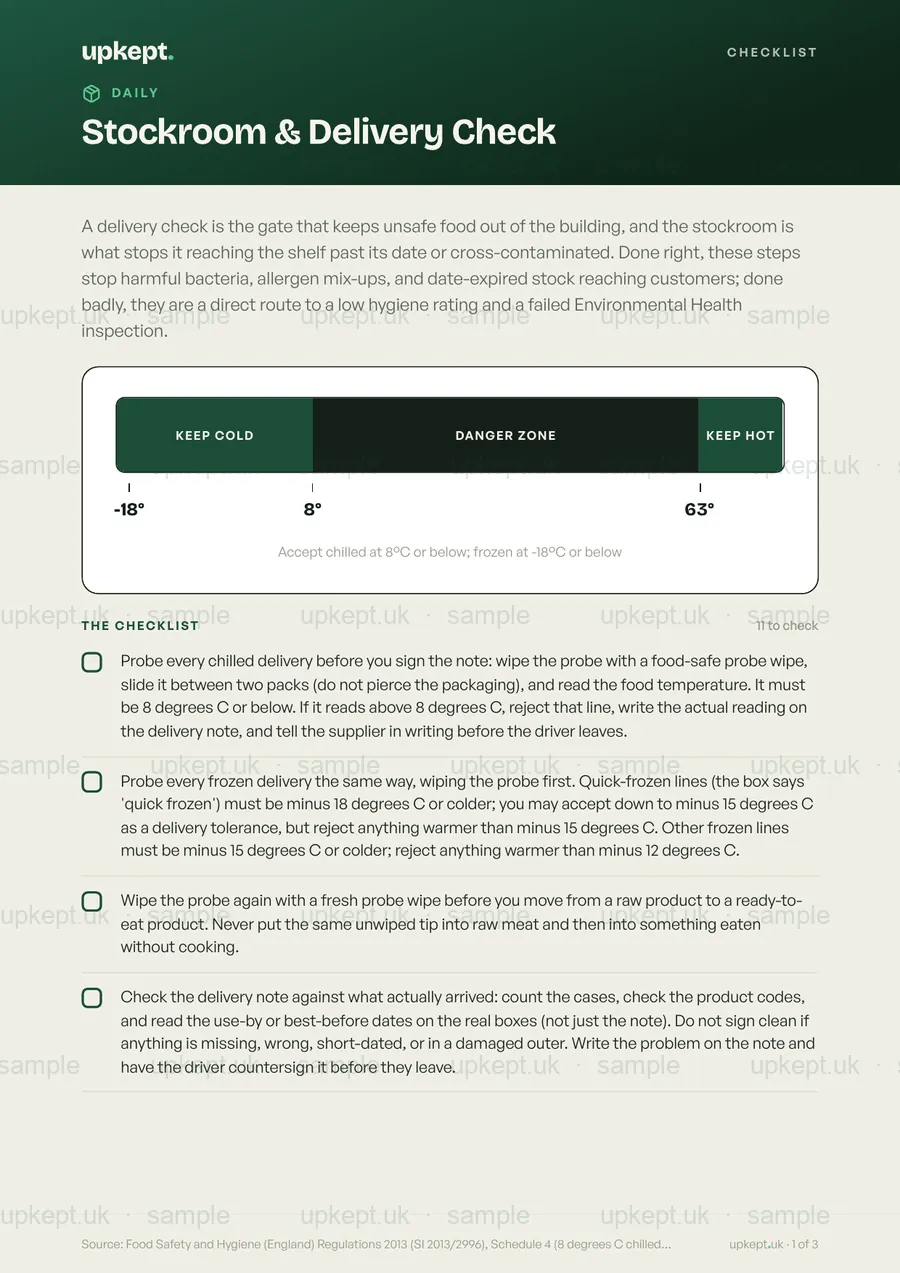
A delivery check is the gate that keeps unsafe food out of the building, and the stockroom is what stops it reaching the shelf past its date or cross-contaminated. Done right, these steps stop harmful bacteria, allergen mix-ups, and date-expired stock reaching customers; done badly, they are a direct route to a low hygiene rating and a failed Environmental Health inspection.
11 checksPDF + phoneReviewed August 2026
Built on published UK guidance Show sources
Food Safety and Hygiene (England) Regulations 2013 (SI 2013/2996), Schedule 4 (8 degrees C chilled limit on the food, 63 degrees C hot-hold limit); The Quick-frozen Foodstuffs (England) Regulations 2007 (SI 2007/191), Schedule (minus 18 degrees C storage, minus 15 degrees C transit tolerance for quick-frozen); FSA Safer Food, Better Business and Safe Method 'Prove It' (iced-water probe check reads minus 1 to plus 1 degrees C); FSA / Food Standards Scotland Guidance on Temperature Control Legislation in the UK.
£14one-off, yours forever
Replaces a DIY doc, and you get every future update free when the guidance changes.
3 for 2 on documents and packs. Add 3 and your cheapest is free.
A clean one-page PDF, ready to print
Opens and ticks off on any phone
Clear, no jargon, easy to follow
Free updates whenever the guidance changes
Secure checkout30-day money-backInstant downloadNo subscriptionCard & Apple Pay
Best valueSave 42%
Or get all 56 templates
The Everything Bundle: every template today and every future one.£399 one-off, instead of £686 bought separately.
Made for places like this
What’s on it
11 things to check.
Everything that matters, nothing that does not. Here is the full list, exactly as it appears on the template.
1Probe every chilled delivery before you sign the note: wipe the probe with a food-safe probe wipe, slide it between two packs (do not pierce the packaging), and read the food temperature. It must be 8 degrees C or below. If it reads above 8 degrees C, reject that line, write the actual reading on the delivery note, and tell the supplier in writing before the driver leaves.
2Probe every frozen delivery the same way, wiping the probe first. Quick-frozen lines (the box says 'quick frozen') must be minus 18 degrees C or colder; you may accept down to minus 15 degrees C as a delivery tolerance, but reject anything warmer than minus 15 degrees C. Other frozen lines must be minus 15 degrees C or colder; reject anything warmer than minus 12 degrees C.
3Wipe the probe again with a fresh probe wipe before you move from a raw product to a ready-to-eat product. Never put the same unwiped tip into raw meat and then into something eaten without cooking.
4Check the delivery note against what actually arrived: count the cases, check the product codes, and read the use-by or best-before dates on the real boxes (not just the note). Do not sign clean if anything is missing, wrong, short-dated, or in a damaged outer. Write the problem on the note and have the driver countersign it before they leave.
5Reject or quarantine any case that is damaged, has burst seals or leaks, has a blown or dented tin, shows ice crystals or a solid block of frozen liquid (a sign it thawed and was refrozen), or is already past its use-by date. Put a label on quarantined stock with the reason and the date, and keep it off the shelf.
6Put new stock away by date, oldest at the front, newest at the back (First Expired, First Out). After you fill the bay, walk it front to back and pull anything with a use-by date of today or earlier off sale straight away.
7Store raw meat, poultry, and fish below and away from cooked and ready-to-eat food in every chiller, or in a separate unit. Raw must always be on a lower shelf than ready-to-eat, covered, and never above unwrapped ready-to-eat food.
8Stand ambient stock in the dry store at least 15cm (6 inches) off the floor and clear of the wall, so you can sweep, see the floor, and spot pests. Break down and remove every empty cardboard box at the end of each delivery; rodents and cockroaches nest in cardboard.
9Look for pest signs on every delivery round and log what you find. Rat droppings are dark, 12 to 20mm long (about the size of an olive stone) and grouped in one spot; mouse droppings are 3 to 7mm (like a grain of rice) and scattered widely. Also check for gnaw marks, greasy smear marks along walls, and chewed packaging. Report any sighting to your manager and the pest contractor the same day.
10Calibrate the probe thermometer at least once a week using iced water: fill a cup with crushed ice, top with cold water, stir for 30 seconds, then put the probe in the middle without touching the sides. It must read between minus 1 and plus 1 degrees C. Record the reading and date. If it fails, label it 'do not use' and take it out of service until it is replaced or repaired.
11Fill in the delivery temperature log, calibration log, and any rejection record in full: the actual number (never just 'OK' or a tick), the date, the time, and your name. Keep these records for at least 12 months; an Environmental Health Officer can ask to see them at any time.
Good to know
The legal chilled limit is 8 degrees C, not the 5 degrees C most training tells staff to aim for. Schedule 4 of the Food Safety and Hygiene (England) Regulations 2013 sets the maximum at 8 degrees C, measured on the food itself, not the air. So a chilled delivery arriving at 7 degrees C is legally compliant and you cannot reject it on temperature alone, even though it is warmer than your fridge target. Knowing this matters when a supplier challenges a rejection.
Source: Food Safety and Hygiene (England) Regulations 2013 (SI 2013/2996), Schedule 4 (8 degrees C chilled limit on the food, 63 degrees C hot-hold limit); The Quick-frozen Foodstuffs (England) Regulations 2007 (SI 2007/191), Schedule (minus 18 degrees C storage, minus 15 degrees C transit tolerance for quick-frozen); FSA Safer Food, Better Business and Safe Method 'Prove It' (iced-water probe check reads minus 1 to plus 1 degrees C); FSA / Food Standards Scotland Guidance on Temperature Control Legislation in the UK.
Good to know
Questions, answered
What is the Stockroom & Delivery Check?
A delivery check is the gate that keeps unsafe food out of the building, and the stockroom is what stops it reaching the shelf past its date or cross-contaminated. Done right, these steps stop harmful bacteria, allergen mix-ups, and date-expired stock reaching customers; done badly, they are a direct route to a low hygiene rating and a failed Environmental Health inspection.
Why does it matter?
The legal chilled limit is 8 degrees C, not the 5 degrees C most training tells staff to aim for. Schedule 4 of the Food Safety and Hygiene (England) Regulations 2013 sets the maximum at 8 degrees C, measured on the food itself, not the air. So a chilled delivery arriving at 7 degrees C is legally compliant and you cannot reject it on temperature alone, even though it is warmer than your fridge target. Knowing this matters when a supplier challenges a rejection.
How do I get it, and is it up to date?
The PDF downloads the moment you check out, prints sharp in black and white, and opens on any phone. It is reviewed for August 2026 and you get any future update free when the official guidance changes.
This checklist stops the two failures that close kitchens: food sitting in the danger zone (8 to 63 degrees C) long enough for bacteria to multiply, and staff working from memory instead of a record an Environmental Health Officer can read back. A weak opening compromises food before the first order; a rushed close lets fridges drift, pests settle, and yesterday's record go unsigned.
A proper opening check, done before the first customer or the first food is touched, is your strongest defence against a poor Food Hygiene Rating, a customer falling ill, or an enforcement notice. The Environmental Health Officer scores how well you manage safety every day, not just on inspection day, so a signed daily record that proves you check temperatures, allergens and sickness exclusion is what protects the rating and the business.
A closing checklist stops the overnight failures that trigger enforcement notices, voided insurance claims, and food poisoning: fridges drifting above 8C unnoticed, hot food cooled too slowly, gas left on, fire exits blocked, and cash left out. These are the specific things an EHO inspector or an insurer's loss adjuster looks for, and the closing record is the proof you did them.