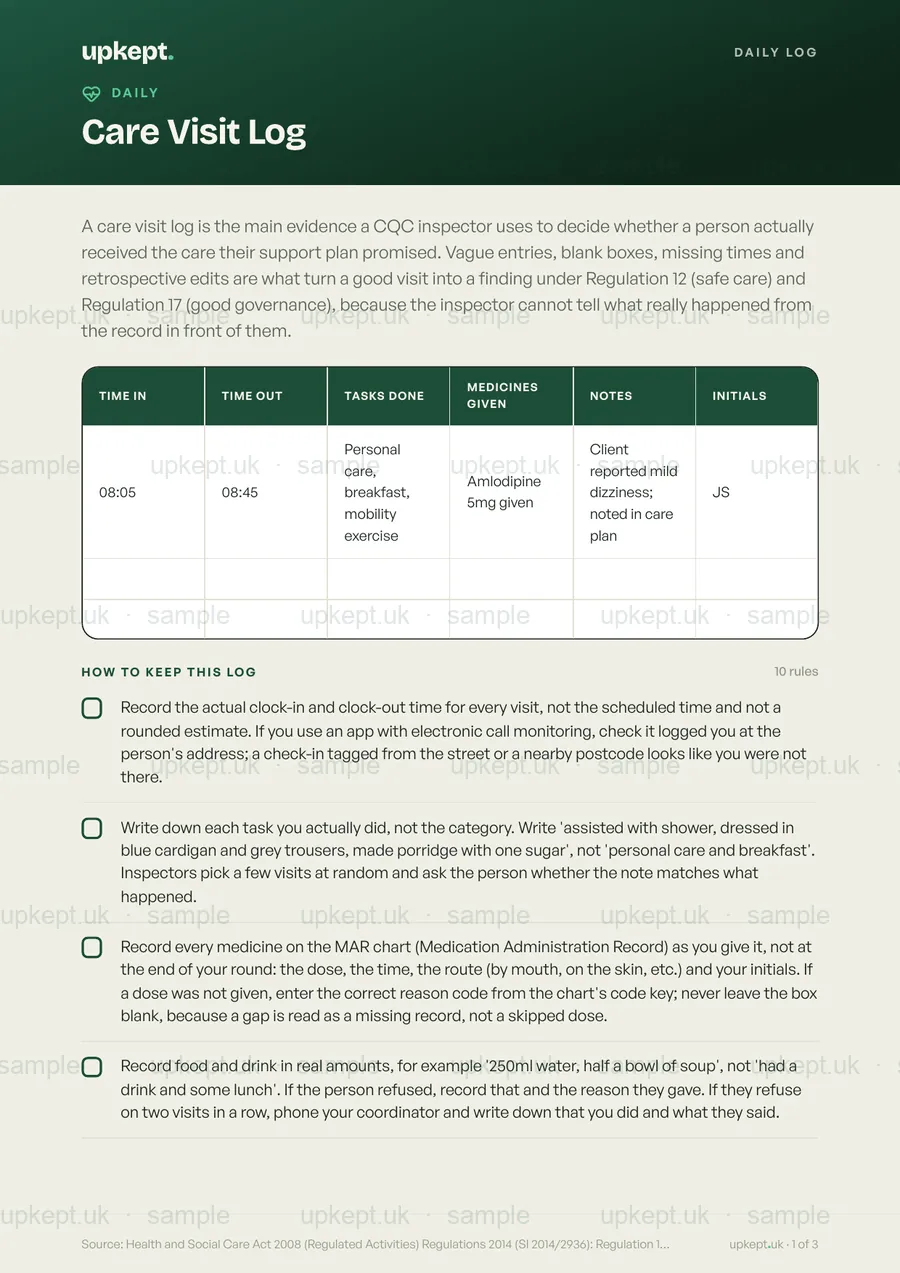
A care visit log is the main evidence a CQC inspector uses to decide whether a person actually received the care their support plan promised. Vague entries, blank boxes, missing times and retrospective edits are what turn a good visit into a finding under Regulation 12 (safe care) and Regulation 17 (good governance), because the inspector cannot tell what really happened from the record in front of them.
10 checksPDF + phoneReviewed August 2026
Built on published UK guidance Show sources
Health and Social Care Act 2008 (Regulated Activities) Regulations 2014 (SI 2014/2936): Regulation 12 (Safe care and treatment) and Regulation 17 (Good governance). CQC Single Assessment Framework (34 quality statements, six evidence categories including 'processes' and 'people's experience'; final version due summer 2026), 'Safe' and 'Well-led' key questions. NICE NG21 and Quality Standard QS123 Statement 4 (length of home care visits). Care Act 2014 statutory guidance (visits of 15 minutes or less not appropriate for intimate personal care). NICE Quality Standard QS89 Statement 4 (skin assessment for people shown to be at high risk by a pressure ulcer risk assessment). CQC Provider Information Return (adult social care), which asks domiciliary services for the number of visits under 15 minutes and scheduled missed visits in the preceding 28 days.
£14one-off, yours forever
Replaces a DIY doc, and you get every future update free when the guidance changes.
3 for 2 on documents and packs. Add 3 and your cheapest is free.
A clean one-page PDF, ready to print
Opens and ticks off on any phone
Clear, no jargon, easy to follow
Free updates whenever the guidance changes
Secure checkout30-day money-backInstant downloadNo subscriptionCard & Apple Pay
Best valueSave 42%
Or get all 56 templates
The Everything Bundle: every template today and every future one.£399 one-off, instead of £686 bought separately.
Made for places like this
What’s on it
10 things to check.
Everything that matters, nothing that does not. Here is the full list, exactly as it appears on the template.
1Record the actual clock-in and clock-out time for every visit, not the scheduled time and not a rounded estimate. If you use an app with electronic call monitoring, check it logged you at the person's address; a check-in tagged from the street or a nearby postcode looks like you were not there.
2Write down each task you actually did, not the category. Write 'assisted with shower, dressed in blue cardigan and grey trousers, made porridge with one sugar', not 'personal care and breakfast'. Inspectors pick a few visits at random and ask the person whether the note matches what happened.
3Record every medicine on the MAR chart (Medication Administration Record) as you give it, not at the end of your round: the dose, the time, the route (by mouth, on the skin, etc.) and your initials. If a dose was not given, enter the correct reason code from the chart's code key; never leave the box blank, because a gap is read as a missing record, not a skipped dose.
4Record food and drink in real amounts, for example '250ml water, half a bowl of soup', not 'had a drink and some lunch'. If the person refused, record that and the reason they gave. If they refuse on two visits in a row, phone your coordinator and write down that you did and what they said.
5For anyone at risk of pressure damage (most people who are bedbound or only partly mobile), check the skin at every visit and record the exact site and the colour of any redness or break. Use the body map if your system has one. Report any new mark, or any mark that has got worse, to the office the same day, before you finish your shift.
6Record mood and orientation in plain facts you observed, for example 'asked twice what year it was, did not recognise daughter', not 'seemed a bit confused'. A run of entries like this is often the first written sign of a urine infection or cognitive decline, so the words have to be specific enough to spot a pattern.
7If the visit ran shorter than scheduled, record the actual minutes and why. Visits of 15 minutes or less are not appropriate for personal care under the Care Act 2014 statutory guidance, and the CQC Provider Information Return asks how many visits in the last 28 days were under 15 minutes, so a short visit with no reason is a flag.
8If no one answers the door or you cannot complete the visit, follow your no-reply procedure and record it: the time you arrived, what you tried (knocked, rang, checked windows, phoned the office and the named contact), and the time you left. An unexplained gap with no entry can turn into a safeguarding incident; a full entry shows it was managed.
9Record any accident, near miss or safeguarding concern in the log at the time, even after you have phoned the office. Write what you saw, what was said and what you did. Do not write your opinion on whether it was deliberate. The log and the separate incident report must say the same thing.
10Sign or enter your full name or staff ID before you leave the property; an unsigned entry has no weight if the record is ever questioned. If your system needs a manager to countersign certain entries (for example a new pressure mark), flag it the same day so the countersignature is added while the detail is fresh.
Good to know
On the CQC Provider Information Return, domiciliary providers must report how many scheduled visits in the last 28 days were shorter than 15 minutes. The trap is that this counts the actual duration, not the planned one, so a visit booked for 30 minutes but completed in 12 is reportable. A provider whose system only records scheduled time, not real clock-in to clock-out, cannot produce this figure accurately and is creating a gap on every short visit without knowing it.
Source: Health and Social Care Act 2008 (Regulated Activities) Regulations 2014 (SI 2014/2936): Regulation 12 (Safe care and treatment) and Regulation 17 (Good governance). CQC Single Assessment Framework (34 quality statements, six evidence categories including 'processes' and 'people's experience'; final version due summer 2026), 'Safe' and 'Well-led' key questions. NICE NG21 and Quality Standard QS123 Statement 4 (length of home care visits). Care Act 2014 statutory guidance (visits of 15 minutes or less not appropriate for intimate personal care). NICE Quality Standard QS89 Statement 4 (skin assessment for people shown to be at high risk by a pressure ulcer risk assessment). CQC Provider Information Return (adult social care), which asks domiciliary services for the number of visits under 15 minutes and scheduled missed visits in the preceding 28 days.
Good to know
Questions, answered
What is the Care Visit Log?
A care visit log is the main evidence a CQC inspector uses to decide whether a person actually received the care their support plan promised. Vague entries, blank boxes, missing times and retrospective edits are what turn a good visit into a finding under Regulation 12 (safe care) and Regulation 17 (good governance), because the inspector cannot tell what really happened from the record in front of them.
Why does it matter?
On the CQC Provider Information Return, domiciliary providers must report how many scheduled visits in the last 28 days were shorter than 15 minutes. The trap is that this counts the actual duration, not the planned one, so a visit booked for 30 minutes but completed in 12 is reportable. A provider whose system only records scheduled time, not real clock-in to clock-out, cannot produce this figure accurately and is creating a gap on every short visit without knowing it.
How do I get it, and is it up to date?
The PDF downloads the moment you check out, prints sharp in black and white, and opens on any phone. It is reviewed for August 2026 and you get any future update free when the official guidance changes.
This checklist stops the two failures that close kitchens: food sitting in the danger zone (8 to 63 degrees C) long enough for bacteria to multiply, and staff working from memory instead of a record an Environmental Health Officer can read back. A weak opening compromises food before the first order; a rushed close lets fridges drift, pests settle, and yesterday's record go unsigned.
A proper opening check, done before the first customer or the first food is touched, is your strongest defence against a poor Food Hygiene Rating, a customer falling ill, or an enforcement notice. The Environmental Health Officer scores how well you manage safety every day, not just on inspection day, so a signed daily record that proves you check temperatures, allergens and sickness exclusion is what protects the rating and the business.
A closing checklist stops the overnight failures that trigger enforcement notices, voided insurance claims, and food poisoning: fridges drifting above 8C unnoticed, hot food cooled too slowly, gas left on, fire exits blocked, and cash left out. These are the specific things an EHO inspector or an insurer's loss adjuster looks for, and the closing record is the proof you did them.