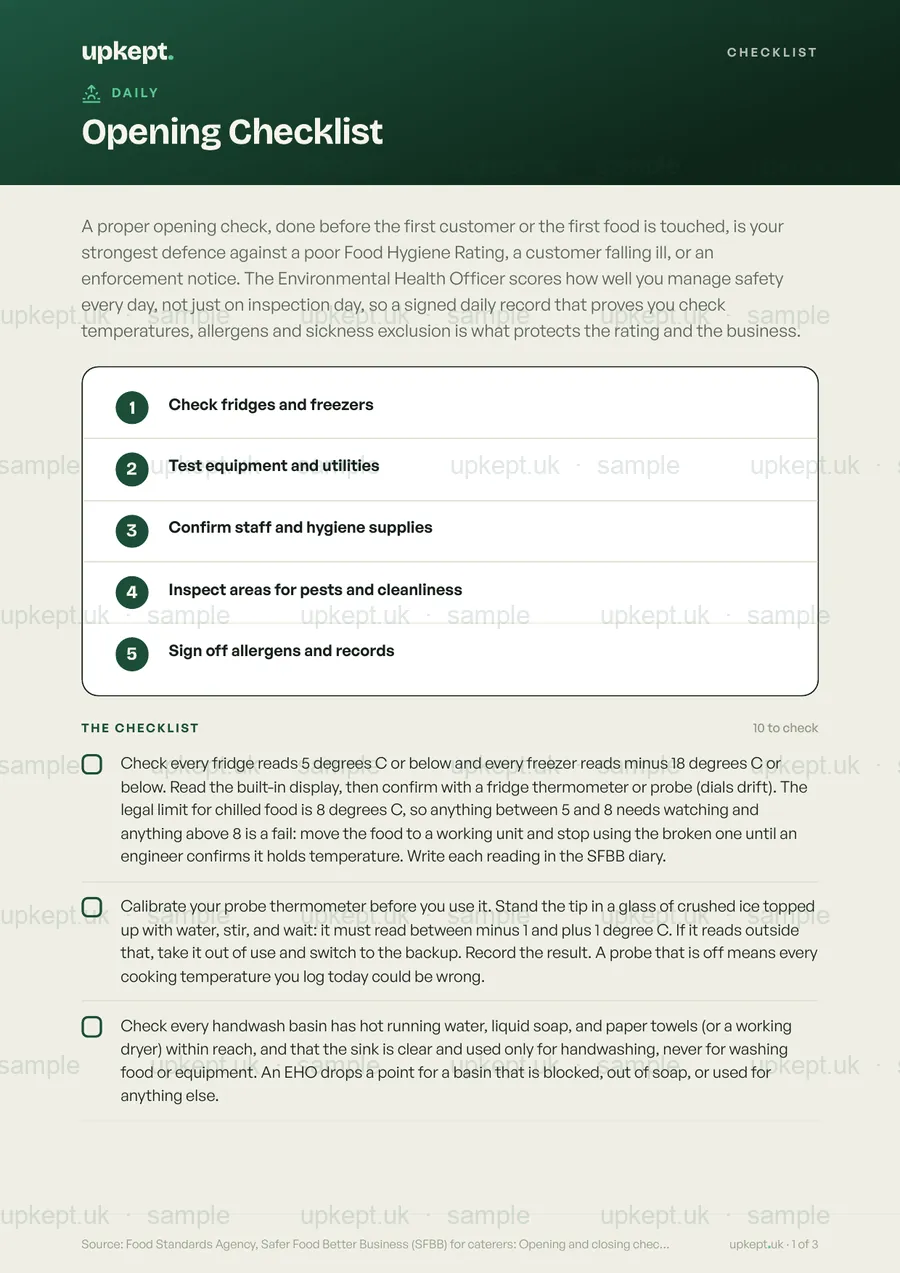
A proper opening check, done before the first customer or the first food is touched, is your strongest defence against a poor Food Hygiene Rating, a customer falling ill, or an enforcement notice. The Environmental Health Officer scores how well you manage safety every day, not just on inspection day, so a signed daily record that proves you check temperatures, allergens and sickness exclusion is what protects the rating and the business.
10 checksPDF + phoneReviewed August 2026
Built on published UK guidance Show sources
Food Standards Agency, Safer Food Better Business (SFBB) for caterers: Opening and closing checks, Temperature, Chilling, Personal hygiene/fitness to work, and Prove it (probe calibration) safe methods. FSA "Chilling food correctly" and "Fitness to work" business guidance (48-hour exclusion after symptoms stop). Food Safety and Hygiene (England) Regulations 2013 and Regulation (EC) 852/2004 (8 degrees C chilled limit; temperature control). Food Information Regulations 2014 and retained EU Regulation 1169/2011, Annex II (14 allergens); FSA best-practice written allergen guidance, March 2025 (Owen's Law not yet law; government evaluation began spring 2026). HSE Approved Code of Practice L8 and HSG274 Part 2 (flush outlets unused for 7+ days at least weekly).
Freeno card needed
Replaces a DIY doc, and you get every future update free when the guidance changes.
3 for 2 on documents and packs. Add 3 and your cheapest is free.
A clean one-page PDF, ready to print
Opens and ticks off on any phone
Clear, no jargon, easy to follow
Free updates whenever the guidance changes
Secure checkout30-day money-backInstant downloadNo subscriptionCard & Apple Pay
Made for places like this
What’s on it
10 things to check.
Everything that matters, nothing that does not. Here is the full list, exactly as it appears on the template.
1Check every fridge reads 5 degrees C or below and every freezer reads minus 18 degrees C or below. Read the built-in display, then confirm with a fridge thermometer or probe (dials drift). The legal limit for chilled food is 8 degrees C, so anything between 5 and 8 needs watching and anything above 8 is a fail: move the food to a working unit and stop using the broken one until an engineer confirms it holds temperature. Write each reading in the SFBB diary.
2Calibrate your probe thermometer before you use it. Stand the tip in a glass of crushed ice topped up with water, stir, and wait: it must read between minus 1 and plus 1 degree C. If it reads outside that, take it out of use and switch to the backup. Record the result. A probe that is off means every cooking temperature you log today could be wrong.
3Check every handwash basin has hot running water, liquid soap, and paper towels (or a working dryer) within reach, and that the sink is clear and used only for handwashing, never for washing food or equipment. An EHO drops a point for a basin that is blocked, out of soap, or used for anything else.
4Check that food-safe sanitiser (a disinfectant that kills bacteria, not just a surface cleaner) is on every prep area, is in date, and is mixed to the strength on the label if you dilute it. Confirm probe wipes are in stock. Sanitiser that is out of date or too weak does not disinfect.
5Check all chopping boards, food contact surfaces and utensils from last night are clean and fully dry before use. Damp or sticky kit spreads bacteria. Confirm the colour-coded boards are in the right zones: red raw meat, blue raw fish, yellow cooked meat, green salad and fruit, brown vegetables, white dairy and bakery.
6Walk the fridges and dry store and confirm every open or made-up item has a label showing the date it was opened or made and its use-by date. Bin anything past its use-by, past its made-on shelf life, or with no label. Use-by is a legal cut-off and you must not use food beyond it; best-before is about quality, not safety.
7Confirm today's allergen information is correct and to hand before service. For loose (non-prepacked) food you must be able to tell a customer, in writing or by pointing to a written source, which of the 14 named allergens are in each dish. Check the allergen matrix matches what is actually on the menu today, especially if a supplier substituted an ingredient overnight or a recipe changed.
8Confirm you have enough fit staff to run service. Anyone who has had vomiting or diarrhoea must stay away from open food until 48 hours have passed since their last symptom: this is the FSA fitness-to-work rule, not a judgement call. If someone is inside that window, send them home or move them off food handling.
9Flush any tap, spray arm or outlet that has not been used for seven days or more (for example after a weekend or bank holiday) by running it for a few minutes until the water runs hot or cold. Water that sits still between 20 and 45 degrees C lets Legionella grow. Note the flush in your water-safety record.
10Sign and date today's SFBB opening-check page before service starts. To an EHO an unsigned or undated record counts as no record. Keep completed daily diaries for at least three months.
Good to know
The legal chilled-storage limit in England, Wales and Northern Ireland is 8 degrees C, but the FSA tells you to set fridges to 5 degrees C or below. The gap is deliberate: it absorbs the warm-up from doors opening and busy service, so a fridge set to 5 still stays under the 8 limit. Operators who set fridges to 8 because they think that is the target have no margin, and one busy lunch tips the food over the legal line without anyone noticing.
Source: Food Standards Agency, Safer Food Better Business (SFBB) for caterers: Opening and closing checks, Temperature, Chilling, Personal hygiene/fitness to work, and Prove it (probe calibration) safe methods. FSA "Chilling food correctly" and "Fitness to work" business guidance (48-hour exclusion after symptoms stop). Food Safety and Hygiene (England) Regulations 2013 and Regulation (EC) 852/2004 (8 degrees C chilled limit; temperature control). Food Information Regulations 2014 and retained EU Regulation 1169/2011, Annex II (14 allergens); FSA best-practice written allergen guidance, March 2025 (Owen's Law not yet law; government evaluation began spring 2026). HSE Approved Code of Practice L8 and HSG274 Part 2 (flush outlets unused for 7+ days at least weekly).
Good to know
Questions, answered
What is the Opening Checklist?
A proper opening check, done before the first customer or the first food is touched, is your strongest defence against a poor Food Hygiene Rating, a customer falling ill, or an enforcement notice. The Environmental Health Officer scores how well you manage safety every day, not just on inspection day, so a signed daily record that proves you check temperatures, allergens and sickness exclusion is what protects the rating and the business.
Why does it matter?
The legal chilled-storage limit in England, Wales and Northern Ireland is 8 degrees C, but the FSA tells you to set fridges to 5 degrees C or below. The gap is deliberate: it absorbs the warm-up from doors opening and busy service, so a fridge set to 5 still stays under the 8 limit. Operators who set fridges to 8 because they think that is the target have no margin, and one busy lunch tips the food over the legal line without anyone noticing.
How do I get it, and is it up to date?
The PDF downloads the moment you check out, prints sharp in black and white, and opens on any phone. It is reviewed for August 2026 and you get any future update free when the official guidance changes.
This checklist stops the two failures that close kitchens: food sitting in the danger zone (8 to 63 degrees C) long enough for bacteria to multiply, and staff working from memory instead of a record an Environmental Health Officer can read back. A weak opening compromises food before the first order; a rushed close lets fridges drift, pests settle, and yesterday's record go unsigned.
A closing checklist stops the overnight failures that trigger enforcement notices, voided insurance claims, and food poisoning: fridges drifting above 8C unnoticed, hot food cooled too slowly, gas left on, fire exits blocked, and cash left out. These are the specific things an EHO inspector or an insurer's loss adjuster looks for, and the closing record is the proof you did them.
A correct cash-up catches theft, miscounts and till faults at the end of each shift, before they compound and become impossible to trace back to a person or a day. Done the same way every day it gives you the contemporaneous till records HMRC expects, and builds a variance history that tells a one-off mistake apart from a steady leak.