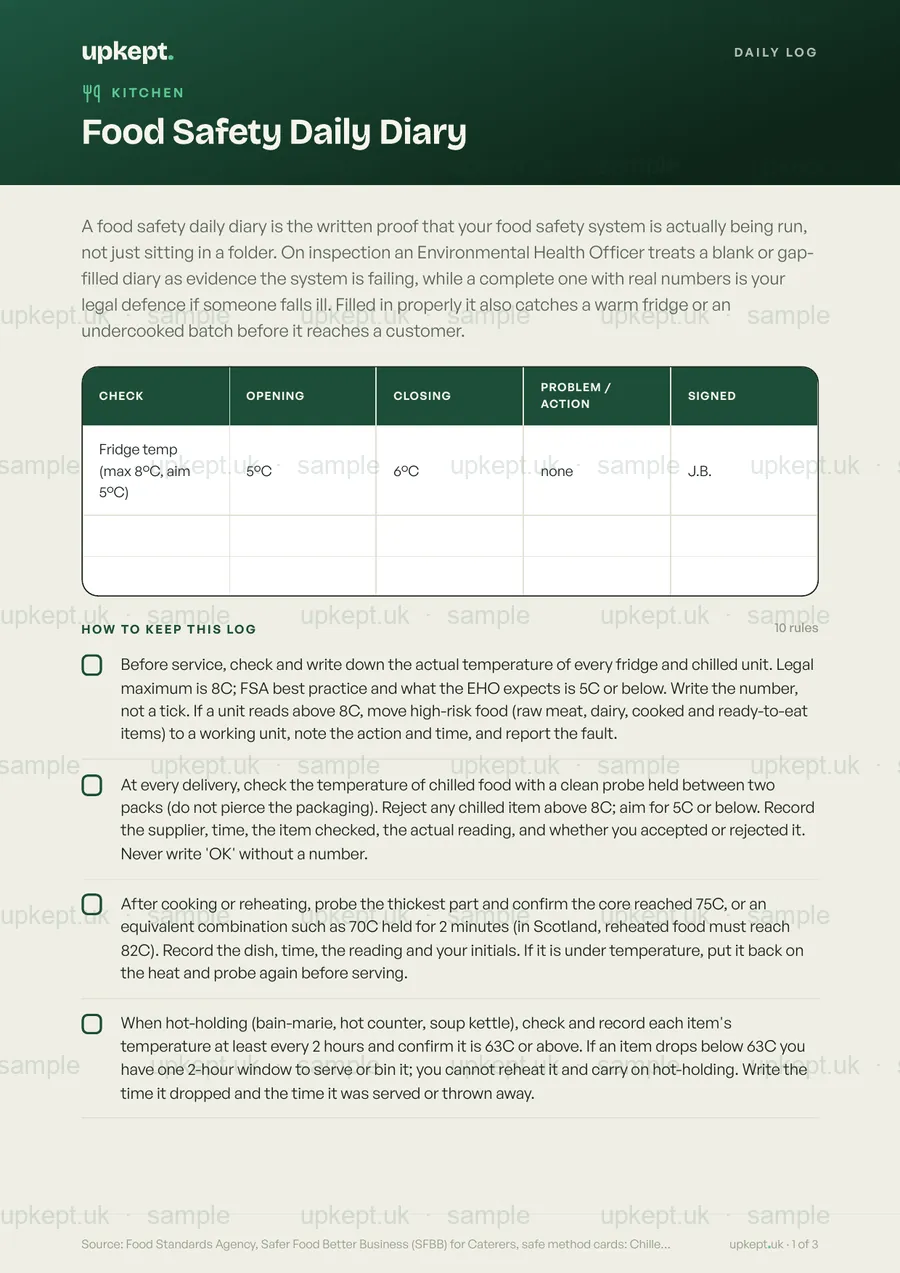
A food safety daily diary is the written proof that your food safety system is actually being run, not just sitting in a folder. On inspection an Environmental Health Officer treats a blank or gap-filled diary as evidence the system is failing, while a complete one with real numbers is your legal defence if someone falls ill. Filled in properly it also catches a warm fridge or an undercooked batch before it reaches a customer.
A food safety checklist in the Safer Food, Better Business style: opening checks, closing checks and the day's temperature records on one page, signed, dated, and easy to keep up in a real service.
10 checksPDF + phoneReviewed August 2026
Built on published UK guidance Show sources
Food Standards Agency, Safer Food Better Business (SFBB) for Caterers, safe method cards: Chilled Storage, Cooking, Hot Holding, Chilling Down, and Prove It (food.gov.uk); Food Safety (Temperature Control) Regulations 1995 (SI 1995/2200), reg 4 (chill holding at 8C) and reg 8 (hot holding at 63C); Regulation (EC) 852/2004 as retained in UK law, Article 5 (HACCP-based management and records); FSA 'Cooking safely in your business' (75C or equivalent such as 70C for 2 minutes); Food Hygiene (Scotland) Regulations 2006 (reheating to 82C); Food Information (Amendment) (England) Regulations 2019 (Natasha's Law, PPDS allergen labelling, in force 1 October 2021).
£14one-off, yours forever
Replaces a DIY doc, and you get every future update free when the guidance changes.
3 for 2 on documents and packs. Add 3 and your cheapest is free.
A clean one-page PDF, ready to print
Opens and ticks off on any phone
Clear, no jargon, easy to follow
Free updates whenever the guidance changes
Secure checkout30-day money-backInstant downloadNo subscriptionCard & Apple Pay
Best valueSave 42%
Or get all 56 templates
The Everything Bundle: every template today and every future one.£399 one-off, instead of £686 bought separately.
Made for places like this
What’s on it
10 things to check.
Everything that matters, nothing that does not. Here is the full list, exactly as it appears on the template.
1Before service, check and write down the actual temperature of every fridge and chilled unit. Legal maximum is 8C; FSA best practice and what the EHO expects is 5C or below. Write the number, not a tick. If a unit reads above 8C, move high-risk food (raw meat, dairy, cooked and ready-to-eat items) to a working unit, note the action and time, and report the fault.
2At every delivery, check the temperature of chilled food with a clean probe held between two packs (do not pierce the packaging). Reject any chilled item above 8C; aim for 5C or below. Record the supplier, time, the item checked, the actual reading, and whether you accepted or rejected it. Never write 'OK' without a number.
3After cooking or reheating, probe the thickest part and confirm the core reached 75C, or an equivalent combination such as 70C held for 2 minutes (in Scotland, reheated food must reach 82C). Record the dish, time, the reading and your initials. If it is under temperature, put it back on the heat and probe again before serving.
4When hot-holding (bain-marie, hot counter, soup kettle), check and record each item's temperature at least every 2 hours and confirm it is 63C or above. If an item drops below 63C you have one 2-hour window to serve or bin it; you cannot reheat it and carry on hot-holding. Write the time it dropped and the time it was served or thrown away.
5When cooling cooked food, write down the time it came off the heat. Speed it up using shallow containers (no deeper than 5cm), an ice bath or a blast chiller, then get it into the fridge within 90 minutes and record that time. Any batch still warm after 2 hours must be thrown away, with the decision recorded.
6At opening, walk the food storage areas and look for pest signs: droppings near walls or behind equipment, smear marks along skirting, gnaw marks on packaging, or live insects. If you find any, record what and where, remove affected stock, and call your pest contractor the same day. Log the contractor's name and visit date when they attend.
7Each time a dish's ingredients or a supplier changes, record it and re-check that dish against your allergen information (the 14 named allergens). Update the allergen matrix, menu note or PPDS label before that dish is served again. For pre-packed-for-direct-sale items (Natasha's Law) the label must show a full ingredient list with the 14 allergens emphasised.
8At closing, record that food-contact surfaces and equipment (boards, slicers, prep counters) have been cleaned and sanitised. Name the chemical used and its contact time or dilution (for example sanitiser left for the time stated on the label). 'Cleaned' on its own tells the EHO nothing; name the surface and the product.
9Check the probe accuracy each week in iced water: fill a cup with crushed ice and a little cold water, wait 3 minutes, then insert the probe. It must read between -1C and +1C. If it is outside that, take the probe out of use until replaced or calibrated. Record the date, the reading and pass or fail.
10At the end of each day the most senior person on site signs the diary to confirm the checks were done and that every problem logged has a corrective action written against it. A problem recorded with no action beside it is read by an EHO as proof the system is not being managed.
Good to know
The hot-holding 'two-hour rule' is a one-time allowance per batch, not a window you can reset by reheating. Once food has been below 63C for up to two hours you serve it, chill it down, or bin it; you cannot reheat it and start hot-holding again. Separately, the 8C chill limit is the legal maximum, but EHOs work to the FSA best-practice target of 5C, so storing at 7C is lawful yet invites scrutiny and shortens safe shelf life.
Source: Food Standards Agency, Safer Food Better Business (SFBB) for Caterers, safe method cards: Chilled Storage, Cooking, Hot Holding, Chilling Down, and Prove It (food.gov.uk); Food Safety (Temperature Control) Regulations 1995 (SI 1995/2200), reg 4 (chill holding at 8C) and reg 8 (hot holding at 63C); Regulation (EC) 852/2004 as retained in UK law, Article 5 (HACCP-based management and records); FSA 'Cooking safely in your business' (75C or equivalent such as 70C for 2 minutes); Food Hygiene (Scotland) Regulations 2006 (reheating to 82C); Food Information (Amendment) (England) Regulations 2019 (Natasha's Law, PPDS allergen labelling, in force 1 October 2021).
Good to know
Questions, answered
What is a food safety diary?
The daily written record that sits behind SFBB: your opening and closing checks, fridge and cooking temperatures, and anything that went wrong plus what you did about it, signed and dated. Kept daily, it is the evidence your food safety management system is actually being used.
Do I legally need to keep food safety records?
UK food businesses must run a food safety management system based on HACCP principles and be able to show it working. For small businesses the FSA's Safer Food, Better Business pack with a daily diary is the accepted route, and this diary follows that format.
What is the Food Safety Daily Diary?
A food safety daily diary is the written proof that your food safety system is actually being run, not just sitting in a folder. On inspection an Environmental Health Officer treats a blank or gap-filled diary as evidence the system is failing, while a complete one with real numbers is your legal defence if someone falls ill. Filled in properly it also catches a warm fridge or an undercooked batch before it reaches a customer.
Why does it matter?
The hot-holding 'two-hour rule' is a one-time allowance per batch, not a window you can reset by reheating. Once food has been below 63C for up to two hours you serve it, chill it down, or bin it; you cannot reheat it and start hot-holding again. Separately, the 8C chill limit is the legal maximum, but EHOs work to the FSA best-practice target of 5C, so storing at 7C is lawful yet invites scrutiny and shortens safe shelf life.
How do I get it, and is it up to date?
The PDF downloads the moment you check out, prints sharp in black and white, and opens on any phone. It is reviewed for August 2026 and you get any future update free when the official guidance changes.
Your temperature log is the main evidence that your cold storage is actually working. A missing entry, or an out-of-range reading nobody acted on, is what turns a single fridge fault into a food poisoning case and a failed hygiene inspection. This list makes every entry a real number, taken at the right time, with the action recorded when something goes wrong.
A wrong, out-of-date, or missing allergen line can put a customer into anaphylaxis and kill them. It also breaks the Food Information Regulations 2014, where giving false or misleading allergen information is a criminal offence carrying an unlimited fine, not just a hygiene black mark. A correct matrix is what lets any team member answer "what's in this?" the same way every time.
Cooking and reheating temperature records are the main evidence an Environmental Health Officer (EHO) uses to judge whether your food safety system actually works on the floor, not just on paper. Ticks, the word 'OK', or numbers all written up at the end of the shift are treated as no record at all, and that alone can drop your hygiene rating and trigger a return visit. Done properly, this log catches food that never reached a safe core temperature and flags failing equipment before it causes a food poisoning incident.