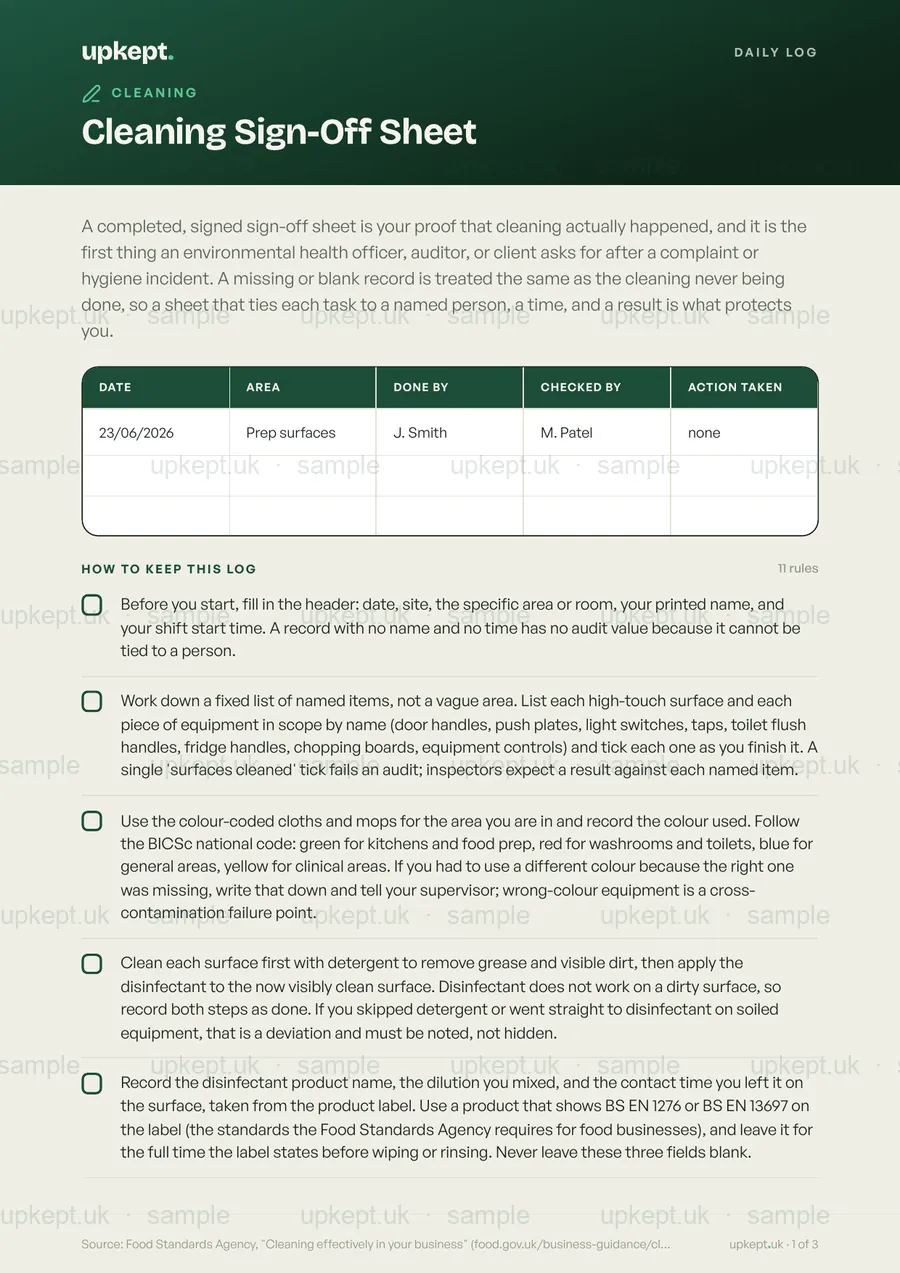
A completed, signed sign-off sheet is your proof that cleaning actually happened, and it is the first thing an environmental health officer, auditor, or client asks for after a complaint or hygiene incident. A missing or blank record is treated the same as the cleaning never being done, so a sheet that ties each task to a named person, a time, and a result is what protects you.
11 checksPDF + phoneReviewed August 2026
Built on published UK guidance Show sources
Food Standards Agency, "Cleaning effectively in your business" (food.gov.uk/business-guidance/cleaning-effectively-in-your-business) and SFBB Safe Method: Cleaning Effectively, which require disinfectants to meet BS EN 1276 or BS EN 13697 and to be left for the manufacturer's stated contact time; FSA SFBB pack guidance on keeping completed diary/record pages until the next local authority visit (no fixed retention period set by the FSA); Regulation (EC) No 852/2004 on the hygiene of foodstuffs, Article 5 (HACCP-based procedures and records); HSE COSHH guidance for cleaning (hse.gov.uk/coshh); BICSc national colour-coding standard (bics.org.uk/colour-coding). Food-contact chlorine concentration of 50 to 200 ppm available chlorine per established UK catering/chlorine-use guidance; 1,000 ppm relates to blood and body-fluid spill disinfection.
£14one-off, yours forever
Replaces a DIY doc, and you get every future update free when the guidance changes.
3 for 2 on documents and packs. Add 3 and your cheapest is free.
A clean one-page PDF, ready to print
Opens and ticks off on any phone
Clear, no jargon, easy to follow
Free updates whenever the guidance changes
Secure checkout30-day money-backInstant downloadNo subscriptionCard & Apple Pay
Best valueSave 42%
Or get all 56 templates
The Everything Bundle: every template today and every future one.£399 one-off, instead of £686 bought separately.
Made for places like this
What’s on it
11 things to check.
Everything that matters, nothing that does not. Here is the full list, exactly as it appears on the template.
1Before you start, fill in the header: date, site, the specific area or room, your printed name, and your shift start time. A record with no name and no time has no audit value because it cannot be tied to a person.
2Work down a fixed list of named items, not a vague area. List each high-touch surface and each piece of equipment in scope by name (door handles, push plates, light switches, taps, toilet flush handles, fridge handles, chopping boards, equipment controls) and tick each one as you finish it. A single 'surfaces cleaned' tick fails an audit; inspectors expect a result against each named item.
3Use the colour-coded cloths and mops for the area you are in and record the colour used. Follow the BICSc national code: green for kitchens and food prep, red for washrooms and toilets, blue for general areas, yellow for clinical areas. If you had to use a different colour because the right one was missing, write that down and tell your supervisor; wrong-colour equipment is a cross-contamination failure point.
4Clean each surface first with detergent to remove grease and visible dirt, then apply the disinfectant to the now visibly clean surface. Disinfectant does not work on a dirty surface, so record both steps as done. If you skipped detergent or went straight to disinfectant on soiled equipment, that is a deviation and must be noted, not hidden.
5Record the disinfectant product name, the dilution you mixed, and the contact time you left it on the surface, taken from the product label. Use a product that shows BS EN 1276 or BS EN 13697 on the label (the standards the Food Standards Agency requires for food businesses), and leave it for the full time the label states before wiping or rinsing. Never leave these three fields blank.
6If you had to swap to a substitute product because your normal one ran out, record what you used and at what dilution. An unrecorded substitution breaks the COSHH paper trail (the assessment is product-specific) and leaves you exposed if anything goes wrong.
7For any item or area you did not complete, write the specific reason in the exception column (for example: oven in use, store room locked, scaffold blocking access). Never leave a blank cell. A blank reads as a skipped task; a written reason is a legitimate, defensible record.
8At the end of the shift, check and sign off the washroom consumables: soap dispensers filled, hand towels or dryer working, toilet roll stocked. These are the first things a client or inspector notices and the most common trigger for a formal complaint.
9Enter your shift finish time and sign the sheet before you leave the building. Signing the next day, or signing a sheet you filled in from memory, is what gets a record challenged.
10Get a supervisor or manager to countersign the same sheet on the same day. A cleaner self-certifying with no second signature is not an accountable audit trail; the countersignature confirms someone actually checked the work, not just that paperwork exists.
11File the completed sheet on site (paper in a labelled folder or the digital equivalent) so it can be produced within five minutes. Keep all sheets at least until the next local authority visit, and ask the visiting officer how long they want you to keep them; the Food Standards Agency sets no fixed period, so 'we threw it away' is never an acceptable answer.
Good to know
For food-contact surfaces, a chlorine-based disinfectant should be diluted to roughly 50 to 200 ppm available chlorine, not the 1,000 ppm figure often quoted for blood and body-fluid spills; 1,000 ppm is too strong for food areas and can taint food, so always follow the product label rather than a number you half-remember. The bigger trap is the surface itself: organic matter such as grease and food residue neutralises chlorine-based and quaternary-ammonium disinfectants before they can kill bacteria, which is why the Food Standards Agency two-stage method (clean with detergent first, then disinfect the visibly clean surface and leave it for the full contact time) is the step that makes disinfection actually work. Most people who think they are disinfecting are only cleaning, because they skip the first stage or wipe the disinfectant off before its contact time is up.
Source: Food Standards Agency, "Cleaning effectively in your business" (food.gov.uk/business-guidance/cleaning-effectively-in-your-business) and SFBB Safe Method: Cleaning Effectively, which require disinfectants to meet BS EN 1276 or BS EN 13697 and to be left for the manufacturer's stated contact time; FSA SFBB pack guidance on keeping completed diary/record pages until the next local authority visit (no fixed retention period set by the FSA); Regulation (EC) No 852/2004 on the hygiene of foodstuffs, Article 5 (HACCP-based procedures and records); HSE COSHH guidance for cleaning (hse.gov.uk/coshh); BICSc national colour-coding standard (bics.org.uk/colour-coding). Food-contact chlorine concentration of 50 to 200 ppm available chlorine per established UK catering/chlorine-use guidance; 1,000 ppm relates to blood and body-fluid spill disinfection.
Good to know
Questions, answered
What is the Cleaning Sign-Off Sheet?
A completed, signed sign-off sheet is your proof that cleaning actually happened, and it is the first thing an environmental health officer, auditor, or client asks for after a complaint or hygiene incident. A missing or blank record is treated the same as the cleaning never being done, so a sheet that ties each task to a named person, a time, and a result is what protects you.
Why does it matter?
For food-contact surfaces, a chlorine-based disinfectant should be diluted to roughly 50 to 200 ppm available chlorine, not the 1,000 ppm figure often quoted for blood and body-fluid spills; 1,000 ppm is too strong for food areas and can taint food, so always follow the product label rather than a number you half-remember. The bigger trap is the surface itself: organic matter such as grease and food residue neutralises chlorine-based and quaternary-ammonium disinfectants before they can kill bacteria, which is why the Food Standards Agency two-stage method (clean with detergent first, then disinfect the visibly clean surface and leave it for the full contact time) is the step that makes disinfection actually work. Most people who think they are disinfecting are only cleaning, because they skip the first stage or wipe the disinfectant off before its contact time is up.
How do I get it, and is it up to date?
The PDF downloads the moment you check out, prints sharp in black and white, and opens on any phone. It is reviewed for August 2026 and you get any future update free when the official guidance changes.
A signed cleaning record is the main evidence an Environmental Health Officer uses to decide whether your kitchen is clean every day, not just on inspection day. Done properly, this routine stops the four things that sink hygiene ratings and trigger enforcement: cross-contamination between raw and ready-to-eat food, allergen cross-contact, grease fires in the extract system, and pest infestations.
A signed, time-stamped hourly check gives you a paper trail that protects you if someone slips, complains, or is injured, and it forces a physical walk-through that catches the small failures (empty soap, no toilet roll, a broken lock, a wet floor) before they turn into complaints, bad reviews, or a downmark from the Environmental Health Officer. The log is usually the first thing an EHO asks to see.
A neglected waste area is the most common cause of pest infestation, the most common spot for a deliberate fire to start and spread into the building, and the source of unlimited fines under the duty of care in EPA 1990 s.34. This check keeps the environmental health officer, your insurer, and the fire risk assessment satisfied, and proves the area was inspected if anyone asks.