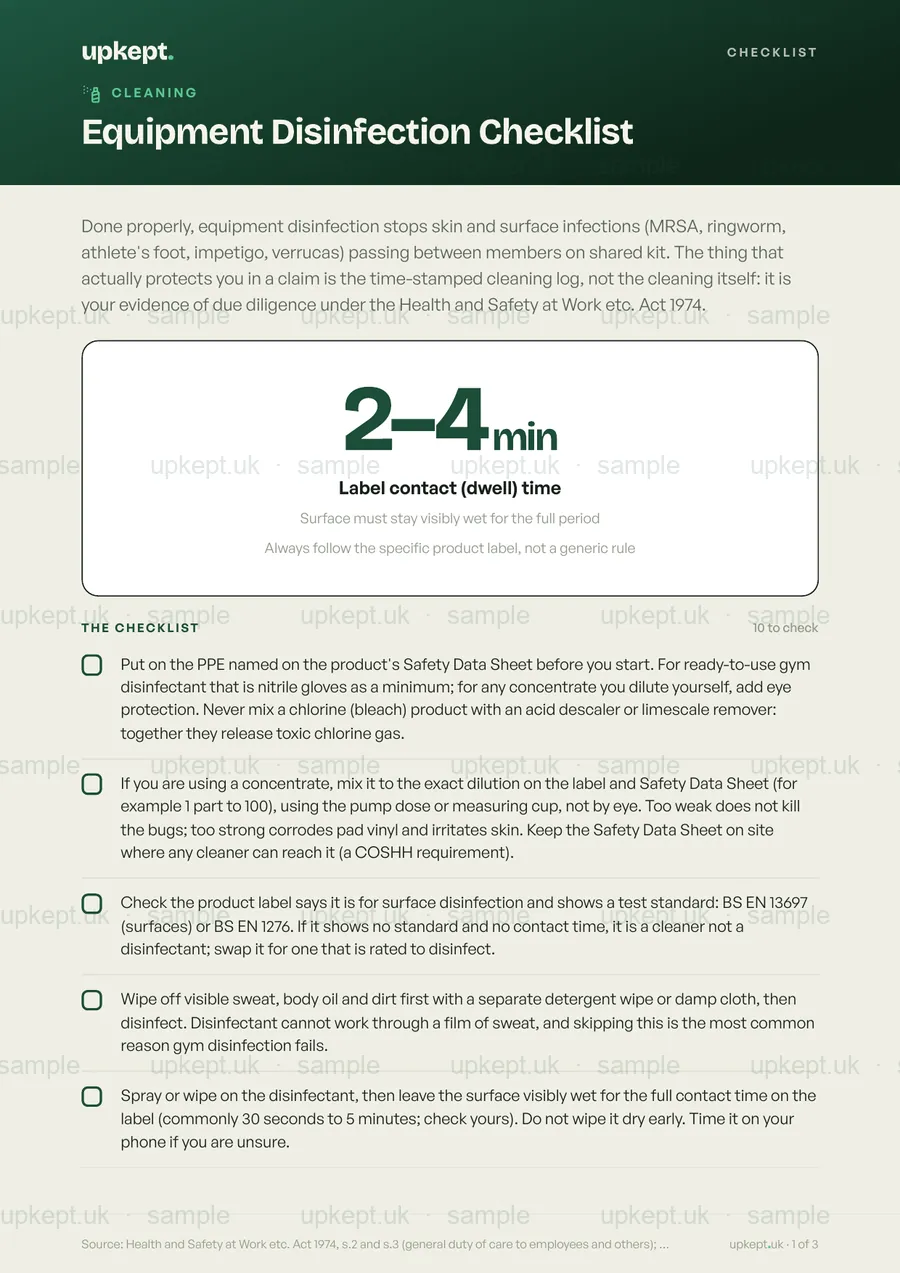
Done properly, equipment disinfection stops skin and surface infections (MRSA, ringworm, athlete's foot, impetigo, verrucas) passing between members on shared kit. The thing that actually protects you in a claim is the time-stamped cleaning log, not the cleaning itself: it is your evidence of due diligence under the Health and Safety at Work etc. Act 1974.
10 checksPDF + phoneReviewed August 2026
Built on published UK guidance Show sources
Health and Safety at Work etc. Act 1974, s.2 and s.3 (general duty of care to employees and others); Control of Substances Hazardous to Health Regulations 2002 (SI 2002/2677), reg.7 (control of exposure) and reg.12 (information, instruction and training, including access to the Safety Data Sheet); BS EN 13697:2015+A1:2019 (non-porous surface test, minimum 4 log10 bactericidal reduction) and BS EN 1276 (suspension test, minimum 5 log10); GB Biocidal Products Regulation (retained Regulation (EU) 528/2012), Product Type 2 surface disinfectants, administered by HSE Biocides, currently under the transitional review programme to at least 31 December 2027 (so most products are lawfully supplied without a GB product-authorisation number); ukactive operational hygiene guidance on equipment wipe-down before and after use and respecting product contact times.
£14one-off, yours forever
Replaces a DIY doc, and you get every future update free when the guidance changes.
3 for 2 on documents and packs. Add 3 and your cheapest is free.
A clean one-page PDF, ready to print
Opens and ticks off on any phone
Clear, no jargon, easy to follow
Free updates whenever the guidance changes
Secure checkout30-day money-backInstant downloadNo subscriptionCard & Apple Pay
Best valueSave 42%
Or get all 56 templates
The Everything Bundle: every template today and every future one.£399 one-off, instead of £686 bought separately.
Made for places like this
What’s on it
10 things to check.
Everything that matters, nothing that does not. Here is the full list, exactly as it appears on the template.
1Put on the PPE named on the product's Safety Data Sheet before you start. For ready-to-use gym disinfectant that is nitrile gloves as a minimum; for any concentrate you dilute yourself, add eye protection. Never mix a chlorine (bleach) product with an acid descaler or limescale remover: together they release toxic chlorine gas.
2If you are using a concentrate, mix it to the exact dilution on the label and Safety Data Sheet (for example 1 part to 100), using the pump dose or measuring cup, not by eye. Too weak does not kill the bugs; too strong corrodes pad vinyl and irritates skin. Keep the Safety Data Sheet on site where any cleaner can reach it (a COSHH requirement).
3Check the product label says it is for surface disinfection and shows a test standard: BS EN 13697 (surfaces) or BS EN 1276. If it shows no standard and no contact time, it is a cleaner not a disinfectant; swap it for one that is rated to disinfect.
4Wipe off visible sweat, body oil and dirt first with a separate detergent wipe or damp cloth, then disinfect. Disinfectant cannot work through a film of sweat, and skipping this is the most common reason gym disinfection fails.
5Spray or wipe on the disinfectant, then leave the surface visibly wet for the full contact time on the label (commonly 30 seconds to 5 minutes; check yours). Do not wipe it dry early. Time it on your phone if you are unsure.
6Clean every hand and body contact point, not just the seat: handles and grips, weight-stack selector pin, adjustment pop-pins, cable hooks, the screen and its surround, head and chest pads, and foot plates. These are the spots that get skipped.
7Use a fresh wipe or a clean cloth for each machine. Carrying one wipe from machine to machine just moves bacteria like MRSA along the row instead of removing it.
8Inspect every padded surface (bench pads, seat cushions, back rests) once per shift for splits, tears or peeling vinyl. Foam under a torn pad cannot be disinfected, so tag it out of use and book a repair or replacement rather than wiping it and putting it back.
9Fill in the cleaning log for every round: zone or machine, time, your name, and the product used. Sign it. "We clean regularly" counts for nothing in a complaint; the signed, timed log is the only proof that holds up.
10Once a day, outside peak hours, do a deep clean on top of the between-member wipe-downs: move machines, clean underneath, remove built-up product residue, and check pins and cables are sound. The quick wipes control contamination; the daily clean is what keeps the kit hygienic and safe.
Good to know
The most common gym mistake is spray-and-instantly-wipe. Surface disinfectants are tested under BS EN 13697 to kill 99.99% of bacteria (a 4-log reduction) only when left wet for the full label contact time, often 30 seconds to a few minutes. Wiping it off within a couple of seconds leaves the bacteria alive and gives you nothing but a wet-look shine.
Source: Health and Safety at Work etc. Act 1974, s.2 and s.3 (general duty of care to employees and others); Control of Substances Hazardous to Health Regulations 2002 (SI 2002/2677), reg.7 (control of exposure) and reg.12 (information, instruction and training, including access to the Safety Data Sheet); BS EN 13697:2015+A1:2019 (non-porous surface test, minimum 4 log10 bactericidal reduction) and BS EN 1276 (suspension test, minimum 5 log10); GB Biocidal Products Regulation (retained Regulation (EU) 528/2012), Product Type 2 surface disinfectants, administered by HSE Biocides, currently under the transitional review programme to at least 31 December 2027 (so most products are lawfully supplied without a GB product-authorisation number); ukactive operational hygiene guidance on equipment wipe-down before and after use and respecting product contact times.
Good to know
Questions, answered
What is the Equipment Disinfection Checklist?
Done properly, equipment disinfection stops skin and surface infections (MRSA, ringworm, athlete's foot, impetigo, verrucas) passing between members on shared kit. The thing that actually protects you in a claim is the time-stamped cleaning log, not the cleaning itself: it is your evidence of due diligence under the Health and Safety at Work etc. Act 1974.
Why does it matter?
The most common gym mistake is spray-and-instantly-wipe. Surface disinfectants are tested under BS EN 13697 to kill 99.99% of bacteria (a 4-log reduction) only when left wet for the full label contact time, often 30 seconds to a few minutes. Wiping it off within a couple of seconds leaves the bacteria alive and gives you nothing but a wet-look shine.
How do I get it, and is it up to date?
The PDF downloads the moment you check out, prints sharp in black and white, and opens on any phone. It is reviewed for August 2026 and you get any future update free when the official guidance changes.
A signed cleaning record is the main evidence an Environmental Health Officer uses to decide whether your kitchen is clean every day, not just on inspection day. Done properly, this routine stops the four things that sink hygiene ratings and trigger enforcement: cross-contamination between raw and ready-to-eat food, allergen cross-contact, grease fires in the extract system, and pest infestations.
A signed, time-stamped hourly check gives you a paper trail that protects you if someone slips, complains, or is injured, and it forces a physical walk-through that catches the small failures (empty soap, no toilet roll, a broken lock, a wet floor) before they turn into complaints, bad reviews, or a downmark from the Environmental Health Officer. The log is usually the first thing an EHO asks to see.
A neglected waste area is the most common cause of pest infestation, the most common spot for a deliberate fire to start and spread into the building, and the source of unlimited fines under the duty of care in EPA 1990 s.34. This check keeps the environmental health officer, your insurer, and the fire risk assessment satisfied, and proves the area was inspected if anyone asks.