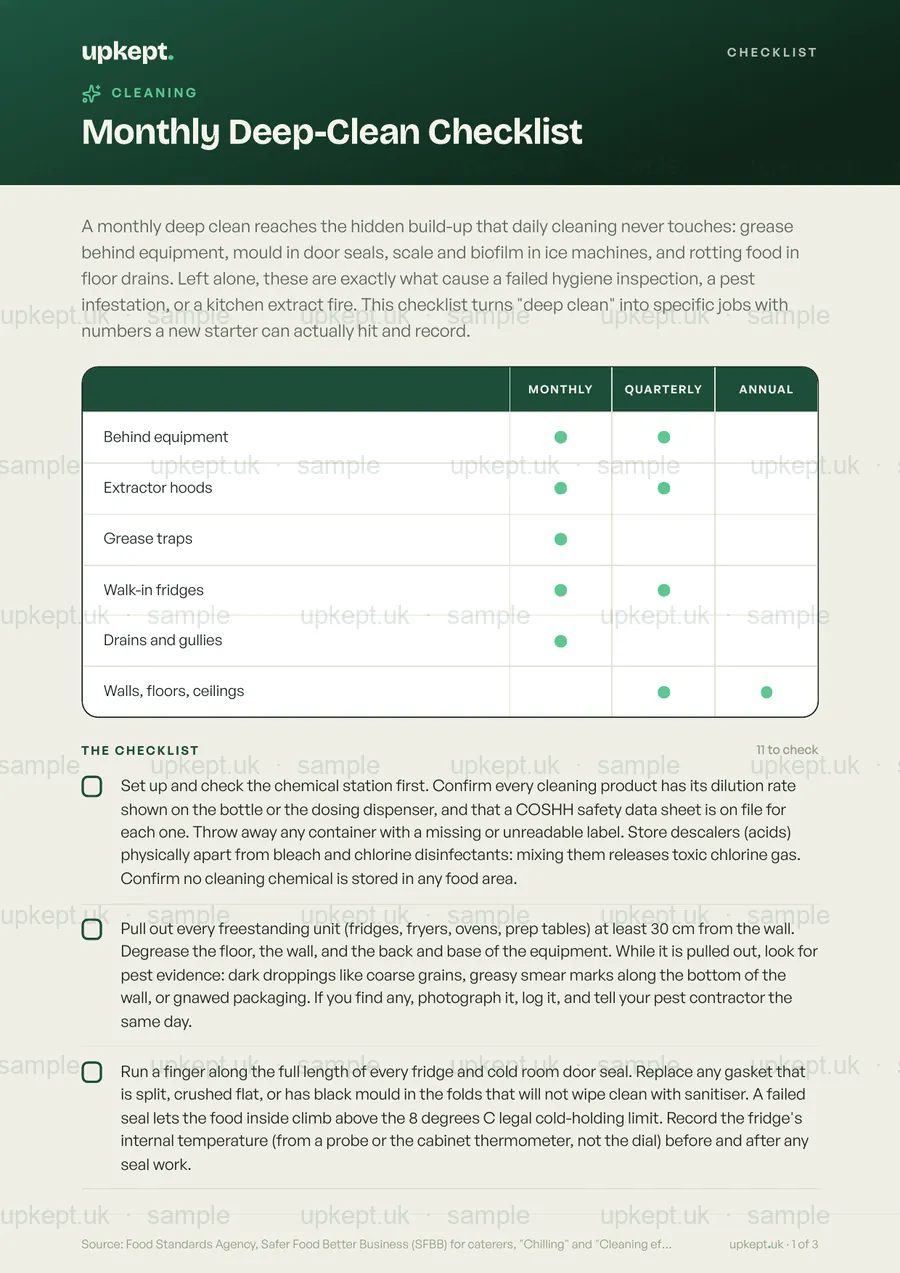
A monthly deep clean reaches the hidden build-up that daily cleaning never touches: grease behind equipment, mould in door seals, scale and biofilm in ice machines, and rotting food in floor drains. Left alone, these are exactly what cause a failed hygiene inspection, a pest infestation, or a kitchen extract fire. This checklist turns "deep clean" into specific jobs with numbers a new starter can actually hit and record.
11 checksPDF + phoneReviewed August 2026
Built on published UK guidance Show sources
Food Standards Agency, Safer Food Better Business (SFBB) for caterers, "Chilling" and "Cleaning effectively" safe methods (food.gov.uk/sfbb); Food Hygiene (England) Regulations 2013 (SI 2013/2996), Schedule 4 temperature control requirements (8 degrees C cold-holding limit; equivalent regulations apply in Wales, Scotland and Northern Ireland); retained Regulation (EC) 852/2004, Annex II (Chapter II premises, Chapter V equipment); BESA TR19 Grease, "Specification for Fire Risk Management of Grease Accumulation within Kitchen Extraction Systems" (post-clean grease limit below 50 microns; cleaning-frequency-by-usage table); COSHH Regulations 2002 (SI 2002/2677), enforced by the HSE.
£14one-off, yours forever
Replaces a DIY doc, and you get every future update free when the guidance changes.
3 for 2 on documents and packs. Add 3 and your cheapest is free.
A clean one-page PDF, ready to print
Opens and ticks off on any phone
Clear, no jargon, easy to follow
Free updates whenever the guidance changes
Secure checkout30-day money-backInstant downloadNo subscriptionCard & Apple Pay
Best valueSave 42%
Or get all 56 templates
The Everything Bundle: every template today and every future one.£399 one-off, instead of £686 bought separately.
Made for places like this
What’s on it
11 things to check.
Everything that matters, nothing that does not. Here is the full list, exactly as it appears on the template.
1Set up and check the chemical station first. Confirm every cleaning product has its dilution rate shown on the bottle or the dosing dispenser, and that a COSHH safety data sheet is on file for each one. Throw away any container with a missing or unreadable label. Store descalers (acids) physically apart from bleach and chlorine disinfectants: mixing them releases toxic chlorine gas. Confirm no cleaning chemical is stored in any food area.
2Pull out every freestanding unit (fridges, fryers, ovens, prep tables) at least 30 cm from the wall. Degrease the floor, the wall, and the back and base of the equipment. While it is pulled out, look for pest evidence: dark droppings like coarse grains, greasy smear marks along the bottom of the wall, or gnawed packaging. If you find any, photograph it, log it, and tell your pest contractor the same day.
3Run a finger along the full length of every fridge and cold room door seal. Replace any gasket that is split, crushed flat, or has black mould in the folds that will not wipe clean with sanitiser. A failed seal lets the food inside climb above the 8 degrees C legal cold-holding limit. Record the fridge's internal temperature (from a probe or the cabinet thermometer, not the dial) before and after any seal work.
4Take down all canopy grease filters. Soak and scrub them in hot water with a food-safe degreaser until they run clear when held up to the light, then refit and record the date. Separately, confirm the full duct and canopy have been professionally cleaned to BESA TR19 Grease standard at the right frequency: every 3 months for heavy use (12 to 16 hours a day, or deep frying or charcoal), every 6 months for moderate use (6 to 12 hours), every 12 months for light use (2 to 6 hours). File the certificate; it must show grease left below 50 microns. Your insurer and fire risk assessment both require it.
5Strip all shelving out of the cold store and dry store. Clean each shelf in two stages: a food-safe detergent first to lift grease and debris, then a food-safe disinfectant left on for the full contact time printed on the label (usually 30 to 60 seconds) before wiping. Check the shelf undersides and brackets for droppings or gnaw marks. Inspect door frames and skirting for any gap wider than 6 mm (a mouse fits through anything a pencil fits into); fill it or report it the same day.
6Scrub the wall tiles, grout, and ceiling panels above the cooking line. Grout is porous and traps grease and mould, so use a stiff grout brush with a food-safe degreaser, then disinfect. Pay special attention to the sealed joint where the wall meets the floor, where grease packs in and feeds pests. Record any cracked, loose, or missing tile and report it for repair: the surface must stay smooth, waterproof, and easy to clean.
7Descale every ice machine. Empty the bin, run the manufacturer's descale cycle using a food-grade descaler at the stated dilution, rinse twice with clean water, then sanitise every internal surface you can reach. Mould and biofilm grow inside ice machines even when they look clean. Log the date, the product used, its dilution, and who did the work.
8Deep-clean the dishwasher and glasswasher. Remove and soak the filter and spray arms, descale the inside with an approved machine descaler at the correct dilution, then run a hot empty cycle. Check the final rinse temperature on the machine display or with a probe: it must reach 82 degrees C or above to disinfect the crockery. If it cannot hold 82 degrees C, log it and book a service call before the next service.
9Clean the smaller vents and grilles that are not part of the main canopy: toilet extract fans, dry store vents, and cold room condenser grilles. Take off the cover, vacuum the dust from the face, then wipe with a damp cloth and mild detergent. Blocked vents cause damp, which grows mould and draws in pests. Log any grille that is corroded or broken and arrange a replacement.
10Service every floor drain. Lift the cover, remove and scrub the basket, then pour a food-safe enzyme or biological drain treatment down each drain to break down the grease and food waste that breed drain flies. Flush with hot water and refit the cover securely. If you see drain flies (small, fuzzy, moth-like, 2 to 4 mm, hovering near drains), treat that drain weekly until they are gone and tell your pest contractor.
11Finish at the bins and grease trap (the dirtiest area, done last). Wash the inside of every waste and recycling bin with hot water and food-safe disinfectant, check the lids close fully, and clean the floor and wall around them, looking for grease runs or pest signs. Check the grease trap service log: a busy kitchen needs it emptied every 4 to 6 weeks, or sooner once grease reaches a quarter of its depth. If the last service is overdue, book it now; an overflowing trap is an instant inspection flag and a blocked-drain liability.
Good to know
The legal cold-holding limit in England, Wales and Northern Ireland is 8 degrees C, and it applies to the temperature of the food, not the air around it. The FSA recommends setting fridges to 5 degrees C or below so the food still stays under 8 degrees C when the door is opened. The single most common reason a cold-hold failure goes unnoticed is that operators read the thermostat dial, which is a setting, not a measurement; you must probe the food or read a calibrated internal thermometer to know the real temperature.
Source: Food Standards Agency, Safer Food Better Business (SFBB) for caterers, "Chilling" and "Cleaning effectively" safe methods (food.gov.uk/sfbb); Food Hygiene (England) Regulations 2013 (SI 2013/2996), Schedule 4 temperature control requirements (8 degrees C cold-holding limit; equivalent regulations apply in Wales, Scotland and Northern Ireland); retained Regulation (EC) 852/2004, Annex II (Chapter II premises, Chapter V equipment); BESA TR19 Grease, "Specification for Fire Risk Management of Grease Accumulation within Kitchen Extraction Systems" (post-clean grease limit below 50 microns; cleaning-frequency-by-usage table); COSHH Regulations 2002 (SI 2002/2677), enforced by the HSE.
Good to know
Questions, answered
What is the Monthly Deep-Clean Checklist?
A monthly deep clean reaches the hidden build-up that daily cleaning never touches: grease behind equipment, mould in door seals, scale and biofilm in ice machines, and rotting food in floor drains. Left alone, these are exactly what cause a failed hygiene inspection, a pest infestation, or a kitchen extract fire. This checklist turns "deep clean" into specific jobs with numbers a new starter can actually hit and record.
Why does it matter?
The legal cold-holding limit in England, Wales and Northern Ireland is 8 degrees C, and it applies to the temperature of the food, not the air around it. The FSA recommends setting fridges to 5 degrees C or below so the food still stays under 8 degrees C when the door is opened. The single most common reason a cold-hold failure goes unnoticed is that operators read the thermostat dial, which is a setting, not a measurement; you must probe the food or read a calibrated internal thermometer to know the real temperature.
How do I get it, and is it up to date?
The PDF downloads the moment you check out, prints sharp in black and white, and opens on any phone. It is reviewed for August 2026 and you get any future update free when the official guidance changes.
A signed cleaning record is the main evidence an Environmental Health Officer uses to decide whether your kitchen is clean every day, not just on inspection day. Done properly, this routine stops the four things that sink hygiene ratings and trigger enforcement: cross-contamination between raw and ready-to-eat food, allergen cross-contact, grease fires in the extract system, and pest infestations.
A signed, time-stamped hourly check gives you a paper trail that protects you if someone slips, complains, or is injured, and it forces a physical walk-through that catches the small failures (empty soap, no toilet roll, a broken lock, a wet floor) before they turn into complaints, bad reviews, or a downmark from the Environmental Health Officer. The log is usually the first thing an EHO asks to see.
A neglected waste area is the most common cause of pest infestation, the most common spot for a deliberate fire to start and spread into the building, and the source of unlimited fines under the duty of care in EPA 1990 s.34. This check keeps the environmental health officer, your insurer, and the fire risk assessment satisfied, and proves the area was inspected if anyone asks.