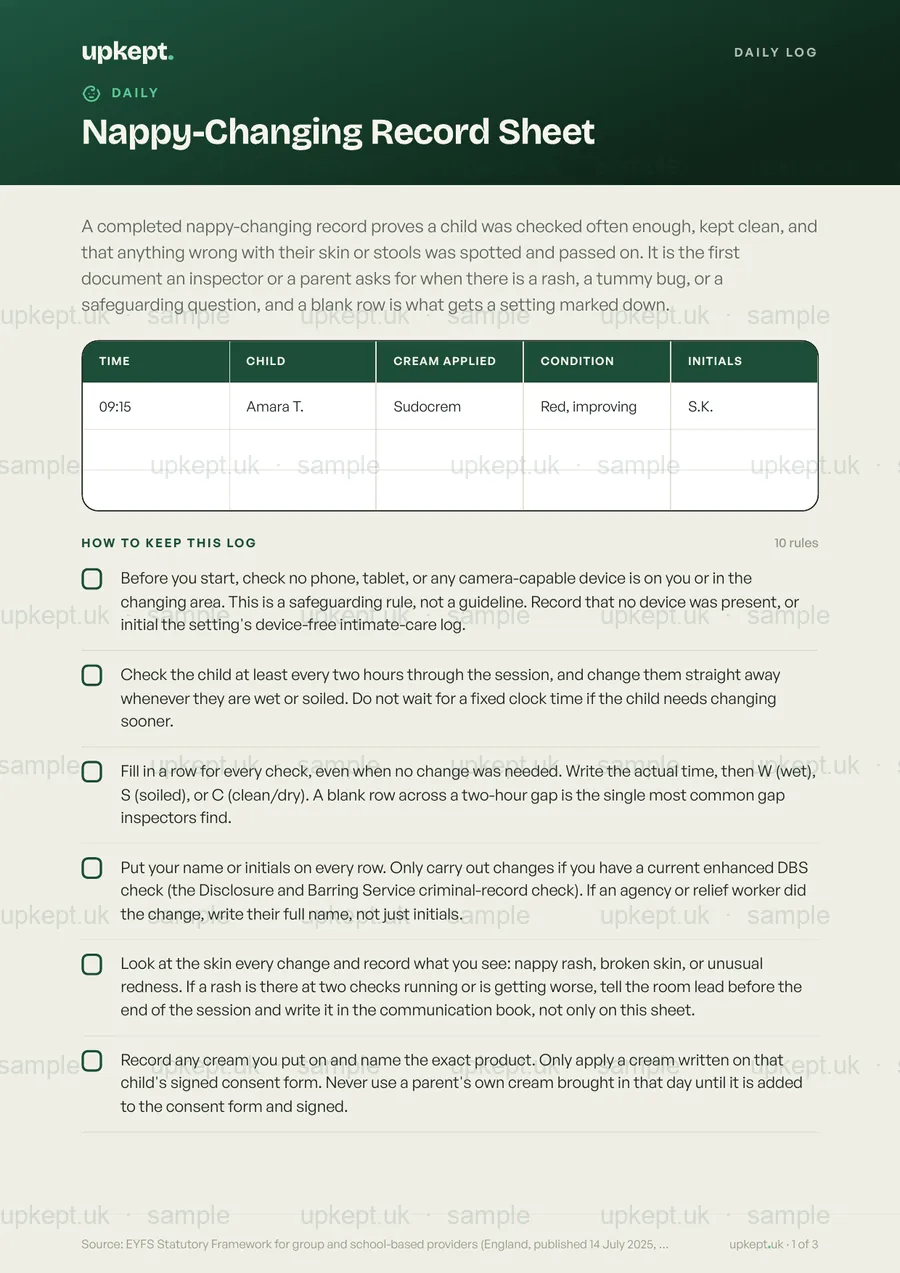
A completed nappy-changing record proves a child was checked often enough, kept clean, and that anything wrong with their skin or stools was spotted and passed on. It is the first document an inspector or a parent asks for when there is a rash, a tummy bug, or a safeguarding question, and a blank row is what gets a setting marked down.
10 checksPDF + phoneReviewed August 2026
Built on published UK guidance Show sources
EYFS Statutory Framework for group and school-based providers (England, published 14 July 2025, effective 1 September 2025), safeguarding and welfare requirements on nappy changing, toileting, and children's privacy; UK Health Security Agency, "Health protection in children and young people settings, including education" (exclusion table: 48 hours after the last episode of diarrhoea or vomiting); Early Years Alliance / NDNA record retention guidance (routine records held around three years after the child leaves, welfare- and safeguarding-relevant records held longer).
£14one-off, yours forever
Replaces a DIY doc, and you get every future update free when the guidance changes.
3 for 2 on documents and packs. Add 3 and your cheapest is free.
A clean one-page PDF, ready to print
Opens and ticks off on any phone
Clear, no jargon, easy to follow
Free updates whenever the guidance changes
Secure checkout30-day money-backInstant downloadNo subscriptionCard & Apple Pay
Best valueSave 42%
Or get all 56 templates
The Everything Bundle: every template today and every future one.£399 one-off, instead of £686 bought separately.
Made for places like this
What’s on it
10 things to check.
Everything that matters, nothing that does not. Here is the full list, exactly as it appears on the template.
1Before you start, check no phone, tablet, or any camera-capable device is on you or in the changing area. This is a safeguarding rule, not a guideline. Record that no device was present, or initial the setting's device-free intimate-care log.
2Check the child at least every two hours through the session, and change them straight away whenever they are wet or soiled. Do not wait for a fixed clock time if the child needs changing sooner.
3Fill in a row for every check, even when no change was needed. Write the actual time, then W (wet), S (soiled), or C (clean/dry). A blank row across a two-hour gap is the single most common gap inspectors find.
4Put your name or initials on every row. Only carry out changes if you have a current enhanced DBS check (the Disclosure and Barring Service criminal-record check). If an agency or relief worker did the change, write their full name, not just initials.
5Look at the skin every change and record what you see: nappy rash, broken skin, or unusual redness. If a rash is there at two checks running or is getting worse, tell the room lead before the end of the session and write it in the communication book, not only on this sheet.
6Record any cream you put on and name the exact product. Only apply a cream written on that child's signed consent form. Never use a parent's own cream brought in that day until it is added to the consent form and signed.
7Record the stool only when it is not normal for that child: very loose, watery, hard, or containing mucus or blood. Tell the room lead straight away if a stool is watery or there is blood. A child with diarrhoea or vomiting must stay off until 48 hours after the last episode (UK Health Security Agency rule); blood in a stool needs the room lead and a possible GP referral.
8After every change, record that you completed the clean-down: wipe the mat with a fresh antibacterial wipe or spray and paper towel, replace the liner or paper roll, put used gloves and apron in a nappy sack and into the nappy bin, then wash your hands at the changing-area sink with liquid soap and warm water for at least 20 seconds. Alcohol gel does not replace handwashing here.
9At collection, say any skin or stool observation out loud to the parent rather than expecting them to read the sheet. Then write 'shared with parent', the collection time, and sign it.
10At the end of the session, check the sheet has no blank rows during the child's hours and get the room lead to countersign it. File it in the child's own care folder, never a shared tray, and keep it for the period set by your setting's retention policy (longer if it records a welfare or safeguarding concern).
Good to know
The September 2025 EYFS framework does not require two staff for a nappy change. It requires settings to balance the child's privacy against safeguarding: changes happen where the area cannot be seen into but the staff member is still supervised, and for a lone childminder a privacy screen meets this. A two-staff rule is good practice some settings adopt, but training that calls it a statutory requirement is wrong.
Source: EYFS Statutory Framework for group and school-based providers (England, published 14 July 2025, effective 1 September 2025), safeguarding and welfare requirements on nappy changing, toileting, and children's privacy; UK Health Security Agency, "Health protection in children and young people settings, including education" (exclusion table: 48 hours after the last episode of diarrhoea or vomiting); Early Years Alliance / NDNA record retention guidance (routine records held around three years after the child leaves, welfare- and safeguarding-relevant records held longer).
Good to know
Questions, answered
What is the Nappy-Changing Record Sheet?
A completed nappy-changing record proves a child was checked often enough, kept clean, and that anything wrong with their skin or stools was spotted and passed on. It is the first document an inspector or a parent asks for when there is a rash, a tummy bug, or a safeguarding question, and a blank row is what gets a setting marked down.
Why does it matter?
The September 2025 EYFS framework does not require two staff for a nappy change. It requires settings to balance the child's privacy against safeguarding: changes happen where the area cannot be seen into but the staff member is still supervised, and for a lone childminder a privacy screen meets this. A two-staff rule is good practice some settings adopt, but training that calls it a statutory requirement is wrong.
How do I get it, and is it up to date?
The PDF downloads the moment you check out, prints sharp in black and white, and opens on any phone. It is reviewed for August 2026 and you get any future update free when the official guidance changes.
This checklist stops the two failures that close kitchens: food sitting in the danger zone (8 to 63 degrees C) long enough for bacteria to multiply, and staff working from memory instead of a record an Environmental Health Officer can read back. A weak opening compromises food before the first order; a rushed close lets fridges drift, pests settle, and yesterday's record go unsigned.
A proper opening check, done before the first customer or the first food is touched, is your strongest defence against a poor Food Hygiene Rating, a customer falling ill, or an enforcement notice. The Environmental Health Officer scores how well you manage safety every day, not just on inspection day, so a signed daily record that proves you check temperatures, allergens and sickness exclusion is what protects the rating and the business.
A closing checklist stops the overnight failures that trigger enforcement notices, voided insurance claims, and food poisoning: fridges drifting above 8C unnoticed, hot food cooled too slowly, gas left on, fire exits blocked, and cash left out. These are the specific things an EHO inspector or an insurer's loss adjuster looks for, and the closing record is the proof you did them.