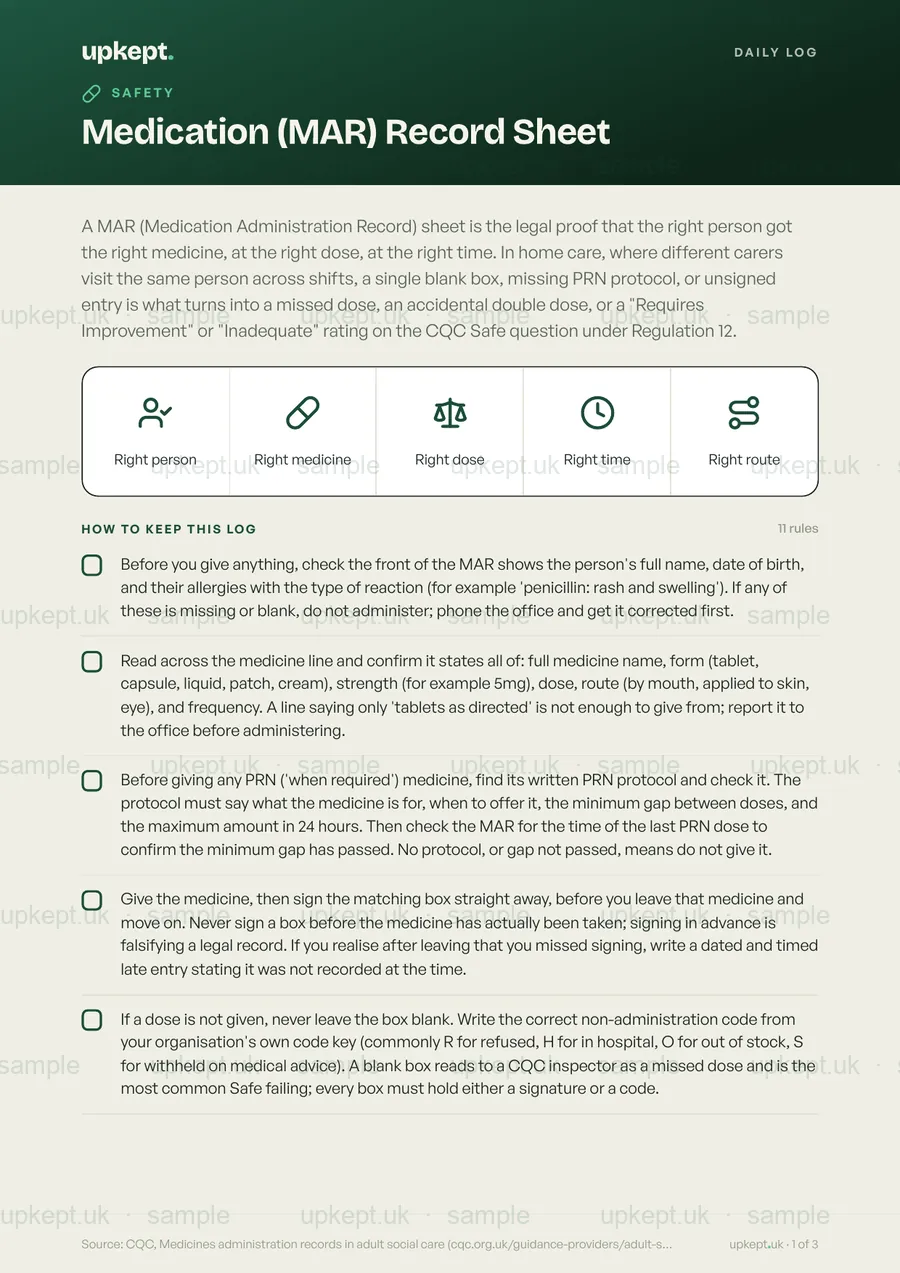
A MAR (Medication Administration Record) sheet is the legal proof that the right person got the right medicine, at the right dose, at the right time. In home care, where different carers visit the same person across shifts, a single blank box, missing PRN protocol, or unsigned entry is what turns into a missed dose, an accidental double dose, or a "Requires Improvement" or "Inadequate" rating on the CQC Safe question under Regulation 12.
11 checksPDF + phoneReviewed August 2026
Built on published UK guidance Show sources
CQC, Medicines administration records in adult social care (cqc.org.uk/guidance-providers/adult-social-care/medicines-administration-records-adult-social-care) for MAR contents, signing as soon as possible, and the second-staff check on handwritten entries; CQC, When required medicines in adult social care, for PRN protocols (purpose, timing, minimum gap, 24-hour maximum); NICE NG67 Managing medicines for adults receiving social care in the community and NICE SC1 Managing medicines in care homes, section 1.4 (recording administration and refusals, non-standardised codes); Records Management Code of Practice for Health and Social Care (NHS England) for the 8-year retention period; Health and Social Care Act 2008 (Regulated Activities) Regulations 2014, Regulation 12 (Safe care and treatment) and Regulation 17 (Good governance).
£14one-off, yours forever
Replaces a DIY doc, and you get every future update free when the guidance changes.
3 for 2 on documents and packs. Add 3 and your cheapest is free.
A clean one-page PDF, ready to print
Opens and ticks off on any phone
Clear, no jargon, easy to follow
Free updates whenever the guidance changes
Secure checkout30-day money-backInstant downloadNo subscriptionCard & Apple Pay
Best valueSave 42%
Or get all 56 templates
The Everything Bundle: every template today and every future one.£399 one-off, instead of £686 bought separately.
Made for places like this
What’s on it
11 things to check.
Everything that matters, nothing that does not. Here is the full list, exactly as it appears on the template.
1Before you give anything, check the front of the MAR shows the person's full name, date of birth, and their allergies with the type of reaction (for example 'penicillin: rash and swelling'). If any of these is missing or blank, do not administer; phone the office and get it corrected first.
2Read across the medicine line and confirm it states all of: full medicine name, form (tablet, capsule, liquid, patch, cream), strength (for example 5mg), dose, route (by mouth, applied to skin, eye), and frequency. A line saying only 'tablets as directed' is not enough to give from; report it to the office before administering.
3Before giving any PRN ('when required') medicine, find its written PRN protocol and check it. The protocol must say what the medicine is for, when to offer it, the minimum gap between doses, and the maximum amount in 24 hours. Then check the MAR for the time of the last PRN dose to confirm the minimum gap has passed. No protocol, or gap not passed, means do not give it.
4Give the medicine, then sign the matching box straight away, before you leave that medicine and move on. Never sign a box before the medicine has actually been taken; signing in advance is falsifying a legal record. If you realise after leaving that you missed signing, write a dated and timed late entry stating it was not recorded at the time.
5If a dose is not given, never leave the box blank. Write the correct non-administration code from your organisation's own code key (commonly R for refused, H for in hospital, O for out of stock, S for withheld on medical advice). A blank box reads to a CQC inspector as a missed dose and is the most common Safe failing; every box must hold either a signature or a code.
6For any refused dose, write the R code in the box and also write the reason in the daily notes (for example distressed, in pain, asleep, or simply declined). If the same person refuses the same medicine repeatedly, tell the office that day so the GP or medication plan can be reviewed.
7For creams, ointments, patches, eye or ear drops, use the separate topical MAR or body map that shows exactly where to apply, how much, and how often, and sign that chart. Putting a cream on the wrong area, or forgetting to apply or remove a patch, is a medication error even if it seems minor.
8If a district nurse, GP, or paramedic gives a medicine during your visit, record it on the MAR with their name, their role, and the time, even though you did not give it yourself. Leaving it off creates a gap that makes the stock count and the record disagree.
9Where you count medicine stock, count the remaining quantity of each medicine and check it against what the MAR shows has been given. If the count does not match, write down the discrepancy, report it to the office the same day, and do not give any more of that medicine until it is explained. Repeated stock discrepancies are a safeguarding concern, not just an admin error.
10If a MAR entry has to be handwritten mid-cycle (for example a new prescription from the pharmacy), a second trained and competent staff member must independently check the new entry against the prescription and sign it before any dose is given from it. One person writing and signing a new handwritten entry alone is not acceptable to CQC. Never alter or overwrite an existing entry; add a new dated, signed line and do not use correction fluid.
11When a monthly MAR is finished, store it securely and keep it for at least 8 years after the person's care with your service ends (locked storage or a password-protected eMAR system). This covers MAR charts, body maps, and PRN protocols. Do not shred, redact, or change any completed MAR before the 8 years are up.
Good to know
A blank box on a MAR is never acceptable, even when nothing happened. Under CQC and NICE guidance every dose slot for a scheduled medicine must hold either a signature (given) or an agreed non-administration code (refused, in hospital, out of stock, and so on). There is no "nothing to record" option: inspectors read a blank as a missed dose or a recording failure, and both breach Regulation 12. Note that the code letters themselves are not nationally standardised, so always use your own service's printed code key rather than assuming R, H or S mean the same everywhere.
Source: CQC, Medicines administration records in adult social care (cqc.org.uk/guidance-providers/adult-social-care/medicines-administration-records-adult-social-care) for MAR contents, signing as soon as possible, and the second-staff check on handwritten entries; CQC, When required medicines in adult social care, for PRN protocols (purpose, timing, minimum gap, 24-hour maximum); NICE NG67 Managing medicines for adults receiving social care in the community and NICE SC1 Managing medicines in care homes, section 1.4 (recording administration and refusals, non-standardised codes); Records Management Code of Practice for Health and Social Care (NHS England) for the 8-year retention period; Health and Social Care Act 2008 (Regulated Activities) Regulations 2014, Regulation 12 (Safe care and treatment) and Regulation 17 (Good governance).
Good to know
Questions, answered
What is the Medication (MAR) Record Sheet?
A MAR (Medication Administration Record) sheet is the legal proof that the right person got the right medicine, at the right dose, at the right time. In home care, where different carers visit the same person across shifts, a single blank box, missing PRN protocol, or unsigned entry is what turns into a missed dose, an accidental double dose, or a "Requires Improvement" or "Inadequate" rating on the CQC Safe question under Regulation 12.
Why does it matter?
A blank box on a MAR is never acceptable, even when nothing happened. Under CQC and NICE guidance every dose slot for a scheduled medicine must hold either a signature (given) or an agreed non-administration code (refused, in hospital, out of stock, and so on). There is no "nothing to record" option: inspectors read a blank as a missed dose or a recording failure, and both breach Regulation 12. Note that the code letters themselves are not nationally standardised, so always use your own service's printed code key rather than assuming R, H or S mean the same everywhere.
How do I get it, and is it up to date?
The PDF downloads the moment you check out, prints sharp in black and white, and opens on any phone. It is reviewed for August 2026 and you get any future update free when the official guidance changes.
A discharged or depressurised extinguisher found during a real fire is no better than having no extinguisher at all. The monthly visual check catches the common pre-failure states (lost pressure, broken tamper seal, blocked access, overdue service) before they matter, and it gives the responsible person the maintenance records the Regulatory Reform (Fire Safety) Order 2005 requires.
A fire door only works if it closes fully, latches, and seals the gaps; one door that fails to do that lets smoke and fire spread through a building in minutes and removes people's time to escape. These checks catch the specific, common failures (props, blown gaps, missing closers, painted-up seals) that turn a survivable fire into a fatal one.
An under-stocked or expired first aid kit means the person treating an injury reaches for a dressing and finds an empty slot, a perished wrapper, or latex gloves that trigger an allergic reaction. A regular documented check fixes that in advance and gives an HSE or Ofsted inspector evidence that your first aid provision is genuinely maintained, not just present.