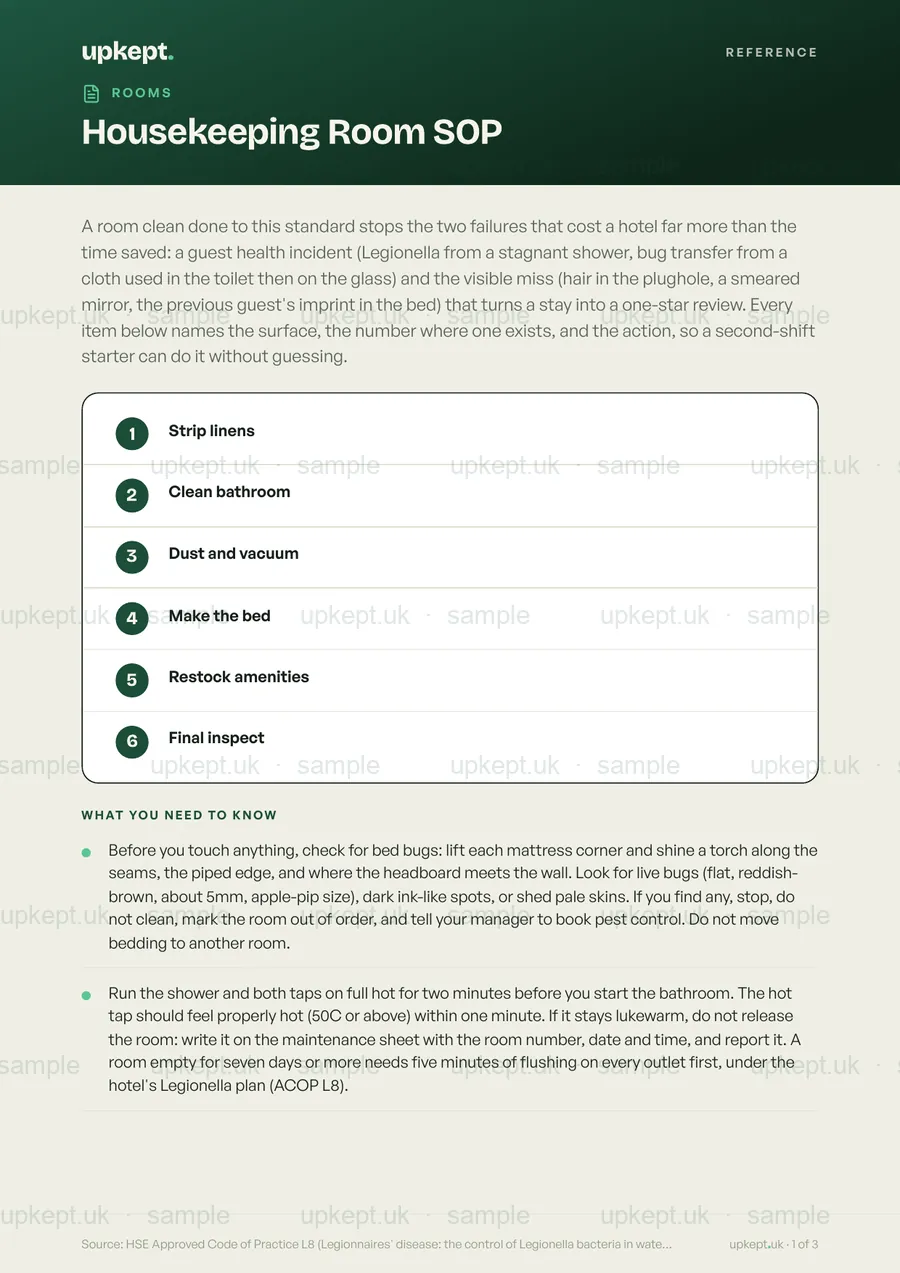
A room clean done to this standard stops the two failures that cost a hotel far more than the time saved: a guest health incident (Legionella from a stagnant shower, bug transfer from a cloth used in the toilet then on the glass) and the visible miss (hair in the plughole, a smeared mirror, the previous guest's imprint in the bed) that turns a stay into a one-star review. Every item below names the surface, the number where one exists, and the action, so a second-shift starter can do it without guessing.
10 checksPDF + phoneReviewed August 2026
Built on published UK guidance Show sources
HSE Approved Code of Practice L8 (Legionnaires' disease: the control of Legionella bacteria in water systems, 4th edition 2013) and HSG274 Part 2: 50C at the outlet within one minute, weekly flushing of outlets unused for seven days or more. NHS/BICSc national colour-coding scheme for cleaning equipment: red for washrooms, toilets and showers; blue for general/bedroom areas; green for kitchens; yellow for clinical/infection areas. Control of Substances Hazardous to Health Regulations 2002 (COSHH) for chemical dilution, dwell time and PPE. Thermal disinfection thresholds (65C for 10 minutes or 71C for 3 minutes) from HSG(95)18 and its successor HTM 01-04 (Decontamination of linen for health and social care, 2016), which are healthcare standards used here as the benchmark, not a hotel legal requirement. Bed bug identification per CIEH and pest-control (e.g. Rentokil) guidance for hospitality.
£14one-off, yours forever
Replaces a DIY doc, and you get every future update free when the guidance changes.
3 for 2 on documents and packs. Add 3 and your cheapest is free.
A clean one-page PDF, ready to print
Opens and ticks off on any phone
Clear, no jargon, easy to follow
Free updates whenever the guidance changes
Secure checkout30-day money-backInstant downloadNo subscriptionCard & Apple Pay
Best valueSave 42%
Or get all 56 templates
The Everything Bundle: every template today and every future one.£399 one-off, instead of £686 bought separately.
Made for places like this
What’s on it
10 things to check.
Everything that matters, nothing that does not. Here is the full list, exactly as it appears on the template.
1Before you touch anything, check for bed bugs: lift each mattress corner and shine a torch along the seams, the piped edge, and where the headboard meets the wall. Look for live bugs (flat, reddish-brown, about 5mm, apple-pip size), dark ink-like spots, or shed pale skins. If you find any, stop, do not clean, mark the room out of order, and tell your manager to book pest control. Do not move bedding to another room.
2Run the shower and both taps on full hot for two minutes before you start the bathroom. The hot tap should feel properly hot (50C or above) within one minute. If it stays lukewarm, do not release the room: write it on the maintenance sheet with the room number, date and time, and report it. A room empty for seven days or more needs five minutes of flushing on every outlet first, under the hotel's Legionella plan (ACOP L8).
3Use red cloths for the whole bathroom and blue cloths for the bedroom, and never swap them. Red does the toilet, basin, bath, shower and bathroom floor; blue does the bedroom and surfaces. A cloth that has touched the bathroom never touches a bedroom surface. Put used cloths straight into the bag on your trolley, never back in the bucket and never loose.
4Mix every chemical to the dilution on the bottle before you go in, and keep it in its labelled bottle (never decant into a blank one). After spraying disinfectant, leave it the dwell time on the label (usually 30 to 60 seconds) before you wipe; spraying and wiping straight away does not disinfect. Check the product sheet for the gloves or eye protection it needs (COSHH).
5Clean the toilet in order: squirt cleaner under the rim first and leave it while you do the rest of the bathroom. Come back to it last. Scrub under the rim and the bowl, then wipe the outside, the base, the seat top and underside, and the flush handle with a red cloth. Once you have touched the toilet, do not go back to any other surface; bin or bag that cloth.
6Check every bathroom item a guest touches: mirror with no smears at eye level, basin plug and chain clear of hair, taps dried and polished so there are no water spots. Descale the shower head if you can see white limescale (soak in descaler, then run it). If you see black mould on the sealant, grout or curtain hem, do not just wipe it: flag it for a deep clean, because a wipe does not remove mould.
7Strip the bed fully and check the mattress protector for stains or damage before you put clean linen on; swap it if it is marked. Fit the sheet tight with no ridges, sit the duvet square in the cover with no bunching at the corners, and leave the surface flat with no dent from the last guest. Change all bed linen on every checkout. Only change towels mid-stay if the guest has left them on the floor, following the hotel's reuse card.
8Vacuum last, once dusting is done, in this order: under the bed with the crevice tool along the skirting, then the open floor, then up to the door. Check under the desk chair and beside the bedside tables where crumbs collect. If you see a carpet stain, treat it with the carpet spotter before vacuuming; if it will not lift, log it on the maintenance sheet.
9Report every fault in writing with the room number, your name, the date, and what is wrong (for example: Room 14, hot tap dripping, 23 June). A verbal mention does not count. Anything that affects safety or the next guest's stay (a flickering light, a loose grab rail, a sticking lock) must be reported before the room is released, not saved for the end of your shift.
10Do a final check from the doorway: scan once at eye level, once at floor level. Bin empty and re-lined, remote and any leaflets straight, all amenities back to the set amount, curtains hanging even, and the air smelling clean with no chemical or previous-guest smell. Close the door and mark the room clean on your sheet.
Good to know
A standard hotel is not legally tied to a wash temperature, but the recognised UK thermal disinfection points (from the healthcare laundry standards HSG(95)18 and HTM 01-04) are 65C held for 10 minutes or 71C held for 3 minutes. A popular 40C "eco" cycle does not disinfect; it leaves bacteria alive. If your linen goes to a contractor, get them to state the actual wash temperature and hold time in writing on the service spec rather than assuming it is hot enough.
Source: HSE Approved Code of Practice L8 (Legionnaires' disease: the control of Legionella bacteria in water systems, 4th edition 2013) and HSG274 Part 2: 50C at the outlet within one minute, weekly flushing of outlets unused for seven days or more. NHS/BICSc national colour-coding scheme for cleaning equipment: red for washrooms, toilets and showers; blue for general/bedroom areas; green for kitchens; yellow for clinical/infection areas. Control of Substances Hazardous to Health Regulations 2002 (COSHH) for chemical dilution, dwell time and PPE. Thermal disinfection thresholds (65C for 10 minutes or 71C for 3 minutes) from HSG(95)18 and its successor HTM 01-04 (Decontamination of linen for health and social care, 2016), which are healthcare standards used here as the benchmark, not a hotel legal requirement. Bed bug identification per CIEH and pest-control (e.g. Rentokil) guidance for hospitality.
Good to know
Questions, answered
What is the Housekeeping Room SOP?
A room clean done to this standard stops the two failures that cost a hotel far more than the time saved: a guest health incident (Legionella from a stagnant shower, bug transfer from a cloth used in the toilet then on the glass) and the visible miss (hair in the plughole, a smeared mirror, the previous guest's imprint in the bed) that turns a stay into a one-star review. Every item below names the surface, the number where one exists, and the action, so a second-shift starter can do it without guessing.
Why does it matter?
A standard hotel is not legally tied to a wash temperature, but the recognised UK thermal disinfection points (from the healthcare laundry standards HSG(95)18 and HTM 01-04) are 65C held for 10 minutes or 71C held for 3 minutes. A popular 40C "eco" cycle does not disinfect; it leaves bacteria alive. If your linen goes to a contractor, get them to state the actual wash temperature and hold time in writing on the service spec rather than assuming it is hot enough.
How do I get it, and is it up to date?
The PDF downloads the moment you check out, prints sharp in black and white, and opens on any phone. It is reviewed for August 2026 and you get any future update free when the official guidance changes.
A proper room check before you release a room to the next guest catches the faults that drive complaints, refunds, bad reviews, and repeat cleans. It also keeps the operator on the right side of fire safety law and HSE Legionella rules, so a missed self-closer or a stagnant tap does not become an enforcement notice or an illness.
The bathroom is where guests judge how clean a hotel really is, and it carries the room's two biggest legal risks: Legionella from stagnant or lukewarm water, and scalding or slip injuries. This daily check catches the visible faults that get photographed into one-star reviews (mould, limescale, failed silicone) and the invisible ones that get a hotel prosecuted (water sitting at the wrong temperature). It is built so a new starter can run it with a pocket thermometer and a phone.
A daily housekeeping check has two jobs: keep the floor safe (fire and infection risk) and keep every room clean enough to hold its review score and pass an unannounced inspection. The risks are real and personal: under the Fire Safety Order the named responsible person, not just the company, can be prosecuted and fined, and one photo of a dirty or stained room on a review site can dent occupancy for months. Every item below names the exact thing to check, the number to hit, and what to do when it fails.