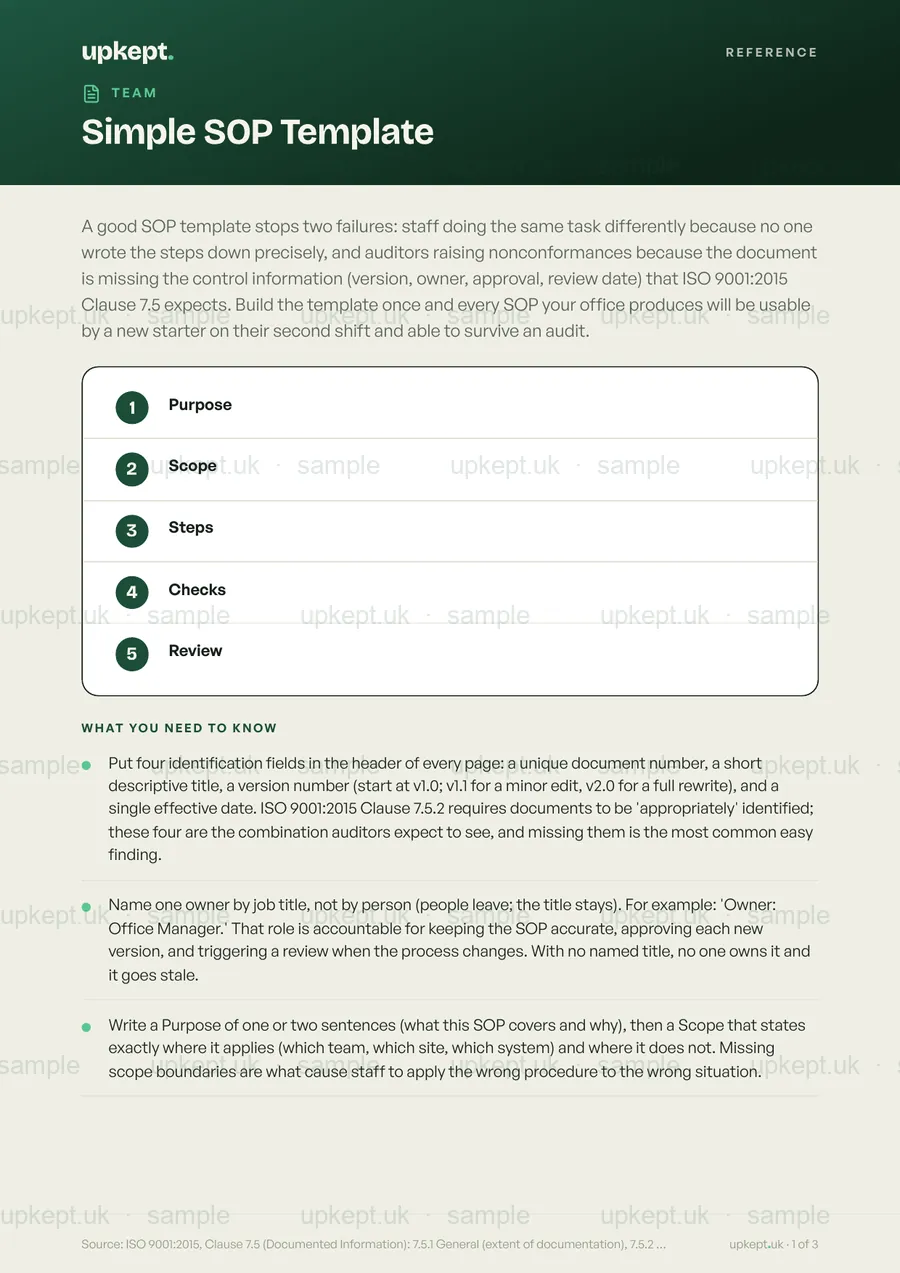
A good SOP template stops two failures: staff doing the same task differently because no one wrote the steps down precisely, and auditors raising nonconformances because the document is missing the control information (version, owner, approval, review date) that ISO 9001:2015 Clause 7.5 expects. Build the template once and every SOP your office produces will be usable by a new starter on their second shift and able to survive an audit.
11 checksPDF + phoneReviewed August 2026
Built on published UK guidance Show sources
ISO 9001:2015, Clause 7.5 (Documented Information): 7.5.1 General (extent of documentation), 7.5.2 Creating and updating (appropriate identification and description; review and approval for suitability before release), and 7.5.3 Control of documented information (distribution, access, storage, retention, and prevention of unintended use of obsolete documents). Note: ISO sets no mandatory document review frequency; the 12-month interval is a widely used industry convention, not a clause requirement. Practical UK sector reference: NHS-style SOP templates (e.g. Oxford University Hospitals), which apply these same header, approval, and revision-history fields.
£14one-off, yours forever
Replaces a DIY doc, and you get every future update free when the guidance changes.
3 for 2 on documents and packs. Add 3 and your cheapest is free.
A clean one-page PDF, ready to print
Opens and ticks off on any phone
Clear, no jargon, easy to follow
Free updates whenever the guidance changes
Secure checkout30-day money-backInstant downloadNo subscriptionCard & Apple Pay
Best valueSave 42%
Or get all 56 templates
The Everything Bundle: every template today and every future one.£399 one-off, instead of £686 bought separately.
Made for places like this
What’s on it
11 things to check.
Everything that matters, nothing that does not. Here is the full list, exactly as it appears on the template.
1Put four identification fields in the header of every page: a unique document number, a short descriptive title, a version number (start at v1.0; v1.1 for a minor edit, v2.0 for a full rewrite), and a single effective date. ISO 9001:2015 Clause 7.5.2 requires documents to be 'appropriately' identified; these four are the combination auditors expect to see, and missing them is the most common easy finding.
2Name one owner by job title, not by person (people leave; the title stays). For example: 'Owner: Office Manager.' That role is accountable for keeping the SOP accurate, approving each new version, and triggering a review when the process changes. With no named title, no one owns it and it goes stale.
3Write a Purpose of one or two sentences (what this SOP covers and why), then a Scope that states exactly where it applies (which team, which site, which system) and where it does not. Missing scope boundaries are what cause staff to apply the wrong procedure to the wrong situation.
4Write every step as one action that starts with a verb, for example: 'Open the client folder in SharePoint.' or 'Check the invoice total matches the purchase order to within 2 percent.' Never put two actions in one step. A new starter must be able to read step 3, do only step 3, then move to step 4.
5Where a step is done by someone other than the main operator, start that step with the role, for example: 'Manager: sign the approval box before the form is submitted.' Leaving responsibilities unnamed inside the steps is the single most common reason a procedure breaks down when the usual person is off.
6Add a References section listing every document, system, or regulation the SOP relies on, with version numbers where they exist. Instead of 'follow the data retention policy', write the exact title and version, for example: 'Data Retention Policy v3.2, effective 01 March 2024.' Vague references become dead links within months.
7Add an Approval block at the end with two different job titles: an author and an approver, each with a signature space and a date. The two must be different people. ISO 9001:2015 Clause 7.5.2 requires documents to be reviewed and approved for suitability before release, so a single-signatory SOP does not meet the standard.
8Add a Revision History table below the approval block with four columns: version, date, author, and a one-line note of what changed. Fill in the v1.0 row from the start. Without it you cannot show an auditor what changed between versions or prove the current version is the approved one.
9Set a review interval and write the next review date on the face of the SOP, for example: 'Next review due: June 2027.' ISO 9001 sets no fixed frequency, so 12 months is the common convention for office procedures; shorten it to 6 months for anything touching data protection, financial controls, or health and safety. An SOP with no next-review date is the leading reason staff follow a procedure that was superseded years ago.
10When a new version is issued, replace or remove every copy of the old one at every point of use the same day. Mark any printed copy 'SUPERSEDED' and take it out of the workplace. ISO 9001:2015 Clause 7.5.3 requires you to prevent unintended use of obsolete documents; an old version left in a shared drive is a finding waiting to happen.
11Before you publish, have one person who has never done the task follow the finished SOP start to finish with no help while you watch. Wherever they pause, ask a question, or make a mistake, the step has a gap; fix it before release. No SOP should go out without this one-person walkthrough.
Good to know
ISO 9001:2015 dropped the old requirement for a quality manual and for the six mandatory procedures that the 2008 version demanded. It replaced them with one principle (Clause 7.5.1): keep documented information 'to the extent necessary' to be confident your processes run as planned. So a two-page SOP on a shared drive is fully compliant as long as it carries the identification, review, approval, and control information the standard expects. Most small UK offices get this backwards: they over-write the step-by-step body and under-fill the control fields (version, owner, approval, review date), which is exactly where audit findings come from.
Source: ISO 9001:2015, Clause 7.5 (Documented Information): 7.5.1 General (extent of documentation), 7.5.2 Creating and updating (appropriate identification and description; review and approval for suitability before release), and 7.5.3 Control of documented information (distribution, access, storage, retention, and prevention of unintended use of obsolete documents). Note: ISO sets no mandatory document review frequency; the 12-month interval is a widely used industry convention, not a clause requirement. Practical UK sector reference: NHS-style SOP templates (e.g. Oxford University Hospitals), which apply these same header, approval, and revision-history fields.
Good to know
Questions, answered
What is the Simple SOP Template?
A good SOP template stops two failures: staff doing the same task differently because no one wrote the steps down precisely, and auditors raising nonconformances because the document is missing the control information (version, owner, approval, review date) that ISO 9001:2015 Clause 7.5 expects. Build the template once and every SOP your office produces will be usable by a new starter on their second shift and able to survive an audit.
Why does it matter?
ISO 9001:2015 dropped the old requirement for a quality manual and for the six mandatory procedures that the 2008 version demanded. It replaced them with one principle (Clause 7.5.1): keep documented information 'to the extent necessary' to be confident your processes run as planned. So a two-page SOP on a shared drive is fully compliant as long as it carries the identification, review, approval, and control information the standard expects. Most small UK offices get this backwards: they over-write the step-by-step body and under-fill the control fields (version, owner, approval, review date), which is exactly where audit findings come from.
How do I get it, and is it up to date?
The PDF downloads the moment you check out, prints sharp in black and white, and opens on any phone. It is reviewed for August 2026 and you get any future update free when the official guidance changes.
A weak handover is the most common root cause of medication errors, choking on the wrong diet texture, missed post-fall checks, and pressure damage that goes unwatched. A sheet that names the specific person, number, and action passes information the next shift can act on immediately, and it is the record CQC reads back when something goes wrong.
Onboarding done right keeps the business clear of an illegal-working civil penalty (up to £60,000 per worker), of tribunal claims for a missing written statement or unlawful pay deductions, and of the early attrition that hits when someone leaves inside 90 days because day one was a mess. This is the order an onboarder actually works through, from legal must-dos to the things that make a new starter productive.
A new starter induction that is actually done, not just signed off, prevents two kinds of expensive failure: legal exposure (a £45,000 to £60,000 illegal-working penalty, an unfair dismissal or discrimination claim, an ICO breach, an HMRC tax-records penalty) and operational failure (someone who cannot evacuate the building, cannot log in for three days, or hits month five of probation with no documented reviews). Each item below names the document, the number or deadline, and the action, so it can be ticked off and evidenced.