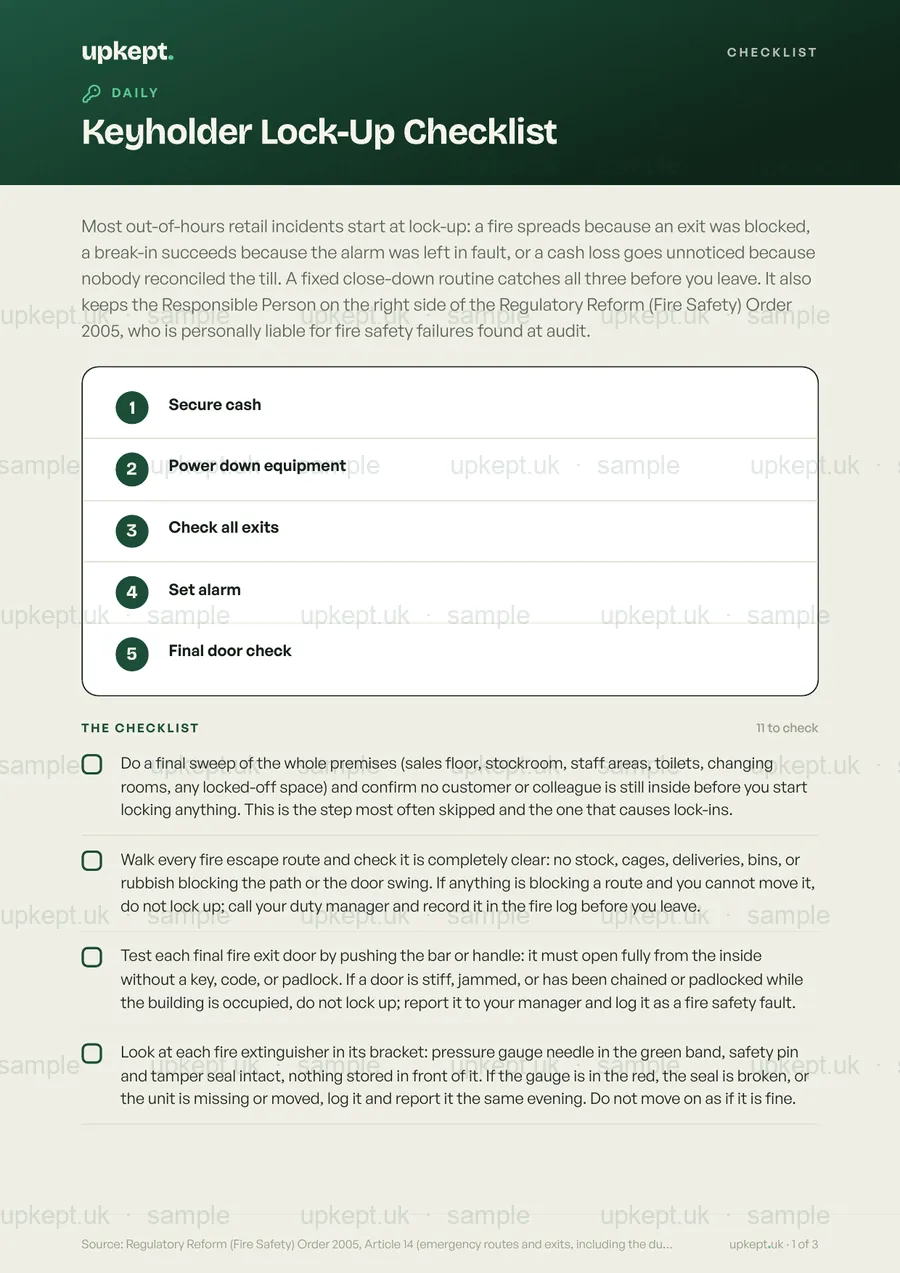
Most out-of-hours retail incidents start at lock-up: a fire spreads because an exit was blocked, a break-in succeeds because the alarm was left in fault, or a cash loss goes unnoticed because nobody reconciled the till. A fixed close-down routine catches all three before you leave. It also keeps the Responsible Person on the right side of the Regulatory Reform (Fire Safety) Order 2005, who is personally liable for fire safety failures found at audit.
11 checksPDF + phoneReviewed August 2026
Built on published UK guidance Show sources
Regulatory Reform (Fire Safety) Order 2005, Article 14 (emergency routes and exits, including the duty that exits open easily and are not locked while occupied) and Article 17 (duty to maintain fire safety equipment); HM Government, "Fire Safety Risk Assessment: Offices and Shops" (travel-distance benchmarks: 18m single direction of escape, 12m in higher-risk areas, treated as guidance not a fixed legal limit); GOV.UK, "Fire prevention and protection statistics, England, April 2024 to March 2025" (51,020 audits; 10,106 shop audits, the most of any premises type; shops 61% satisfactory / 39% unsatisfactory; 58% satisfactory across all premises, i.e. 42% unsatisfactory); BS 5306-3 (monthly visual inspection by the responsible person, annual basic service by a competent person); NPCC "Police Requirements for Security Systems" and NSI/SSAIB schemes (Type A police response requires a URN and keyholder attendance within 20 minutes); HSE "Lone working: protect those working alone" with the Management of Health and Safety at Work Regulations 1999 and Health and Safety at Work etc. Act 1974 (lone-worker risk assessment duty).
£14one-off, yours forever
Replaces a DIY doc, and you get every future update free when the guidance changes.
3 for 2 on documents and packs. Add 3 and your cheapest is free.
A clean one-page PDF, ready to print
Opens and ticks off on any phone
Clear, no jargon, easy to follow
Free updates whenever the guidance changes
Secure checkout30-day money-backInstant downloadNo subscriptionCard & Apple Pay
Best valueSave 42%
Or get all 56 templates
The Everything Bundle: every template today and every future one.£399 one-off, instead of £686 bought separately.
Made for places like this
What’s on it
11 things to check.
Everything that matters, nothing that does not. Here is the full list, exactly as it appears on the template.
1Do a final sweep of the whole premises (sales floor, stockroom, staff areas, toilets, changing rooms, any locked-off space) and confirm no customer or colleague is still inside before you start locking anything. This is the step most often skipped and the one that causes lock-ins.
2Walk every fire escape route and check it is completely clear: no stock, cages, deliveries, bins, or rubbish blocking the path or the door swing. If anything is blocking a route and you cannot move it, do not lock up; call your duty manager and record it in the fire log before you leave.
3Test each final fire exit door by pushing the bar or handle: it must open fully from the inside without a key, code, or padlock. If a door is stiff, jammed, or has been chained or padlocked while the building is occupied, do not lock up; report it to your manager and log it as a fire safety fault.
4Look at each fire extinguisher in its bracket: pressure gauge needle in the green band, safety pin and tamper seal intact, nothing stored in front of it. If the gauge is in the red, the seal is broken, or the unit is missing or moved, log it and report it the same evening. Do not move on as if it is fine.
5Switch off and unplug non-essential electricals at the socket: kettles, microwaves, heaters, phone chargers, display and window lighting. Standby is not off. Anything with a frayed lead, scorch marks, or a burning smell must be unplugged, labelled 'Do not use', and reported before you leave.
6Reconcile the till against the system total before you bag any cash. Count away from the shop window with a second person present if your cash policy requires dual control. Record the counted amount, the expected amount, and any difference in the cash log. Report any variance over your policy threshold (commonly plus or minus 5 pounds) to a manager that same evening, not the next day.
7Take the till down to the float stated in your cash policy and put the excess straight into the drop safe or time-delay safe. Never carry shop cash off-site in a personal bag. Leave the empty drawer open so anyone looking through the window can see there is nothing to steal.
8Set the intruder alarm and confirm the panel reads 'Armed' or 'Set', not 'Fault' or 'Tamper'. If it shows a fault and will not set, do not leave; call your alarm monitoring centre or duty manager. A police response depends on the alarm being properly set and on a keyholder being able to attend within 20 minutes if it activates.
9Lock the final door and physically test it by pulling the handle. If your site has a shutter, security gate, or entry vestibule, secure that too and check it is fully down or locked.
10Complete the lock-up log: the time you secured the premises, your name, and anything outside normal (a blocked exit, a faulty extinguisher, a till variance, an alarm fault). It must be a written or app record an inspector can see; a verbal handover does not count.
11Make your lone-worker safety check: call or message the colleague or manager named as your buddy to confirm you are out and clear. If they have not heard from you within 15 minutes of your expected lock-up time, they must call you. This is a documented step under your employer's lone-working risk assessment.
Good to know
You can legally chain or padlock a fire exit overnight only while the building is empty; the device must be removed before anyone enters. Locking an exit while the premises is occupied is a criminal offence under the Fire Safety Order 2005, so if you padlock up at night and the first person in next morning opens up before the lock comes off, that is a breach. Shops are the single most-audited premises type in England (10,106 fire safety audits in the year to March 2025), and even shops, which fare better than average, failed 39% of those audits; across all premises the unsatisfactory rate was 42%.
Source: Regulatory Reform (Fire Safety) Order 2005, Article 14 (emergency routes and exits, including the duty that exits open easily and are not locked while occupied) and Article 17 (duty to maintain fire safety equipment); HM Government, "Fire Safety Risk Assessment: Offices and Shops" (travel-distance benchmarks: 18m single direction of escape, 12m in higher-risk areas, treated as guidance not a fixed legal limit); GOV.UK, "Fire prevention and protection statistics, England, April 2024 to March 2025" (51,020 audits; 10,106 shop audits, the most of any premises type; shops 61% satisfactory / 39% unsatisfactory; 58% satisfactory across all premises, i.e. 42% unsatisfactory); BS 5306-3 (monthly visual inspection by the responsible person, annual basic service by a competent person); NPCC "Police Requirements for Security Systems" and NSI/SSAIB schemes (Type A police response requires a URN and keyholder attendance within 20 minutes); HSE "Lone working: protect those working alone" with the Management of Health and Safety at Work Regulations 1999 and Health and Safety at Work etc. Act 1974 (lone-worker risk assessment duty).
Good to know
Questions, answered
What is the Keyholder Lock-Up Checklist?
Most out-of-hours retail incidents start at lock-up: a fire spreads because an exit was blocked, a break-in succeeds because the alarm was left in fault, or a cash loss goes unnoticed because nobody reconciled the till. A fixed close-down routine catches all three before you leave. It also keeps the Responsible Person on the right side of the Regulatory Reform (Fire Safety) Order 2005, who is personally liable for fire safety failures found at audit.
Why does it matter?
You can legally chain or padlock a fire exit overnight only while the building is empty; the device must be removed before anyone enters. Locking an exit while the premises is occupied is a criminal offence under the Fire Safety Order 2005, so if you padlock up at night and the first person in next morning opens up before the lock comes off, that is a breach. Shops are the single most-audited premises type in England (10,106 fire safety audits in the year to March 2025), and even shops, which fare better than average, failed 39% of those audits; across all premises the unsatisfactory rate was 42%.
How do I get it, and is it up to date?
The PDF downloads the moment you check out, prints sharp in black and white, and opens on any phone. It is reviewed for August 2026 and you get any future update free when the official guidance changes.
This checklist stops the two failures that close kitchens: food sitting in the danger zone (8 to 63 degrees C) long enough for bacteria to multiply, and staff working from memory instead of a record an Environmental Health Officer can read back. A weak opening compromises food before the first order; a rushed close lets fridges drift, pests settle, and yesterday's record go unsigned.
A proper opening check, done before the first customer or the first food is touched, is your strongest defence against a poor Food Hygiene Rating, a customer falling ill, or an enforcement notice. The Environmental Health Officer scores how well you manage safety every day, not just on inspection day, so a signed daily record that proves you check temperatures, allergens and sickness exclusion is what protects the rating and the business.
A closing checklist stops the overnight failures that trigger enforcement notices, voided insurance claims, and food poisoning: fridges drifting above 8C unnoticed, hot food cooled too slowly, gas left on, fire exits blocked, and cash left out. These are the specific things an EHO inspector or an insurer's loss adjuster looks for, and the closing record is the proof you did them.