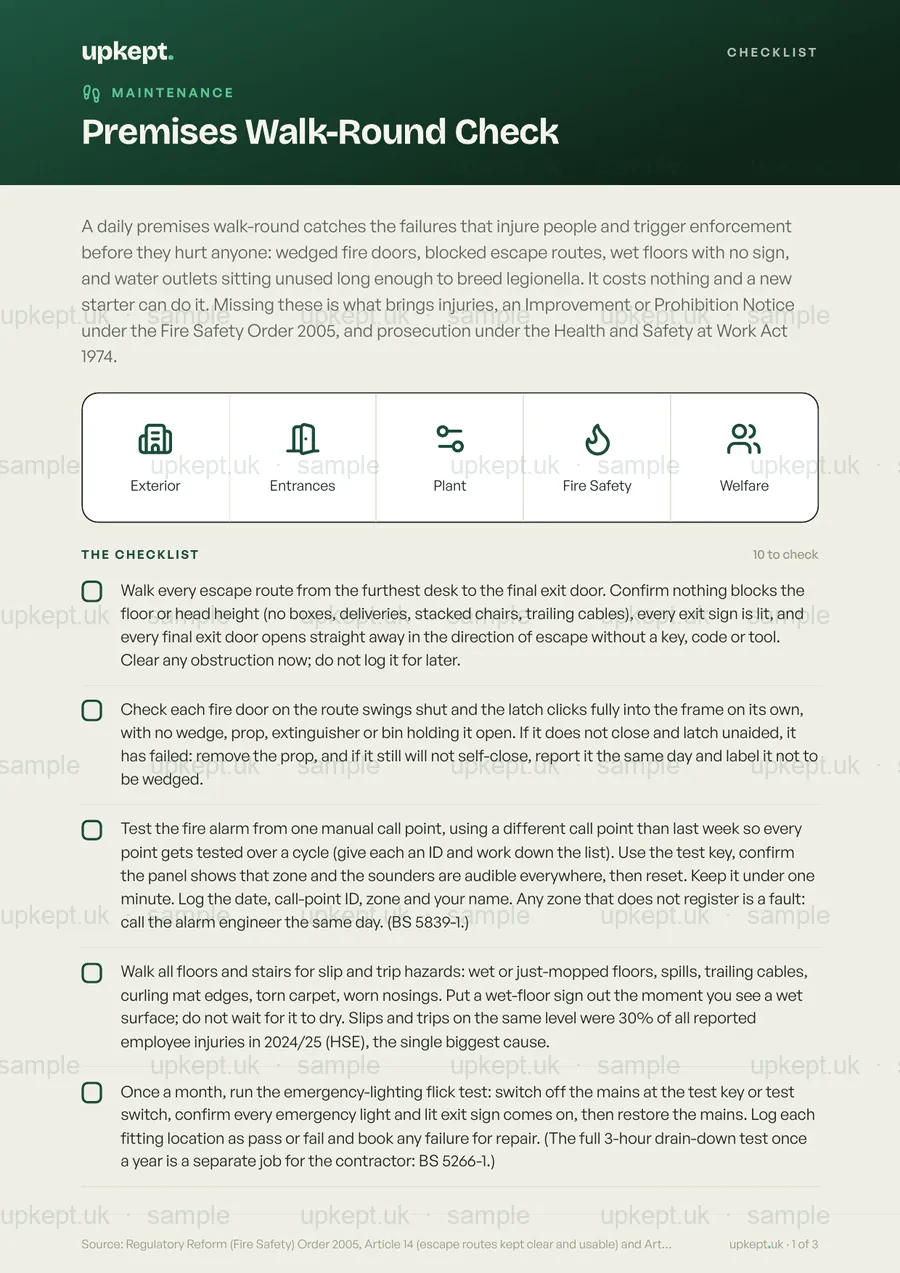
A daily premises walk-round catches the failures that injure people and trigger enforcement before they hurt anyone: wedged fire doors, blocked escape routes, wet floors with no sign, and water outlets sitting unused long enough to breed legionella. It costs nothing and a new starter can do it. Missing these is what brings injuries, an Improvement or Prohibition Notice under the Fire Safety Order 2005, and prosecution under the Health and Safety at Work Act 1974.
10 checksPDF + phoneReviewed August 2026
Built on published UK guidance Show sources
Regulatory Reform (Fire Safety) Order 2005, Article 14 (escape routes kept clear and usable) and Article 17 (fire safety equipment maintained); BS 5839-1:2017 (weekly fire alarm test from a different manual call point, under one minute, logged); BS 5266-1:2016 (emergency lighting: brief monthly function test, full-duration annual test); Workplace (Health, Safety and Welfare) Regulations 1992, Reg 7 (temperature), Reg 17 (traffic routes), Reg 21 (sanitary and washing facilities), with HSE ACOP L24 paras setting the 16C / 13C minimums; HSE ACOP L8 (4th edition, 2013) and HSG274 Part 2 (flush infrequently used outlets at least weekly; legionella grows 20C to 45C); Occupiers' Liability Act 1957 (duty to lawful visitors); HSE non-fatal injury statistics 2024/25 (slips and trips on the same level, 18,051 reported injuries, 30% of the total). Note: the Fire Safety (England) Regulations 2022 quarterly fire-door check applies specifically to communal areas of residential buildings over 11m, not to general commercial premises; the daily close-and-latch check above applies everywhere.
£14one-off, yours forever
Replaces a DIY doc, and you get every future update free when the guidance changes.
3 for 2 on documents and packs. Add 3 and your cheapest is free.
A clean one-page PDF, ready to print
Opens and ticks off on any phone
Clear, no jargon, easy to follow
Free updates whenever the guidance changes
Secure checkout30-day money-backInstant downloadNo subscriptionCard & Apple Pay
Best valueSave 42%
Or get all 56 templates
The Everything Bundle: every template today and every future one.£399 one-off, instead of £686 bought separately.
Made for places like this
What’s on it
10 things to check.
Everything that matters, nothing that does not. Here is the full list, exactly as it appears on the template.
1Walk every escape route from the furthest desk to the final exit door. Confirm nothing blocks the floor or head height (no boxes, deliveries, stacked chairs, trailing cables), every exit sign is lit, and every final exit door opens straight away in the direction of escape without a key, code or tool. Clear any obstruction now; do not log it for later.
2Check each fire door on the route swings shut and the latch clicks fully into the frame on its own, with no wedge, prop, extinguisher or bin holding it open. If it does not close and latch unaided, it has failed: remove the prop, and if it still will not self-close, report it the same day and label it not to be wedged.
3Test the fire alarm from one manual call point, using a different call point than last week so every point gets tested over a cycle (give each an ID and work down the list). Use the test key, confirm the panel shows that zone and the sounders are audible everywhere, then reset. Keep it under one minute. Log the date, call-point ID, zone and your name. Any zone that does not register is a fault: call the alarm engineer the same day. (BS 5839-1.)
4Walk all floors and stairs for slip and trip hazards: wet or just-mopped floors, spills, trailing cables, curling mat edges, torn carpet, worn nosings. Put a wet-floor sign out the moment you see a wet surface; do not wait for it to dry. Slips and trips on the same level were 30% of all reported employee injuries in 2024/25 (HSE), the single biggest cause.
5Once a month, run the emergency-lighting flick test: switch off the mains at the test key or test switch, confirm every emergency light and lit exit sign comes on, then restore the mains. Log each fitting location as pass or fail and book any failure for repair. (The full 3-hour drain-down test once a year is a separate job for the contractor: BS 5266-1.)
6Check the indoor temperature before people arrive, using a thermometer in the occupied area. The HSE Approved Code of Practice minimum is 16C for normal office or seated work, or 13C where the work is physically active. Record the reading and where you took it. If it is below the figure, tell building services and warn staff before the space fills. (There is no legal maximum, see below.)
7Flush any tap or shower that has not run in the last week. Run it for a few minutes until the water reaches its normal hot or cold temperature, keeping your hands clear of any spray. Log the outlet, date and who flushed it. Stagnant water in little-used outlets is where legionella breeds (it multiplies between 20C and 45C), so this weekly flush is the core of HSE ACOP L8 control. Flag any tap that only runs cold, as that outlet may be stagnant.
8Check toilets and washrooms are usable and clean: hot and cold water running, soap stocked, and a working way to dry hands (towels or a working dryer). Report anything missing or broken so it is fixed the same day. These must be kept clean and working under Regulation 21 of the Workplace Regulations 1992.
9Check the bin and waste store: bins not overflowing, no cardboard or pallets piling up, nothing combustible stored against the building, in a stairwell, or blocking a fire exit. Waste left in or near an escape route is one of the most common reasons a fire officer issues an Improvement Notice. Clear it or get it cleared today.
10Check the outside areas you control: paths, steps, ramps, the car park and the bin route. Look for ice or standing water, broken or lifted paving, and any failed outdoor light. Grit before 07:30 if frost was forecast and sign the gritting record. You can be liable for a visitor injured on the approach to the building under the Occupiers' Liability Act 1957.
Good to know
There is no legal maximum workplace temperature in the UK. The 16C minimum (13C for physical work) comes from the HSE Approved Code of Practice L24, not from a number in the regulations themselves, and even that is a guide to what counts as "reasonable" rather than a hard line. So a sign claiming "the legal maximum is 30C, you can go home" is inventing a rule that does not exist. When it gets too hot, the law expects a risk assessment and practical cooling (blinds, fans, relaxed dress code, water), not an automatic walk-out.
Source: Regulatory Reform (Fire Safety) Order 2005, Article 14 (escape routes kept clear and usable) and Article 17 (fire safety equipment maintained); BS 5839-1:2017 (weekly fire alarm test from a different manual call point, under one minute, logged); BS 5266-1:2016 (emergency lighting: brief monthly function test, full-duration annual test); Workplace (Health, Safety and Welfare) Regulations 1992, Reg 7 (temperature), Reg 17 (traffic routes), Reg 21 (sanitary and washing facilities), with HSE ACOP L24 paras setting the 16C / 13C minimums; HSE ACOP L8 (4th edition, 2013) and HSG274 Part 2 (flush infrequently used outlets at least weekly; legionella grows 20C to 45C); Occupiers' Liability Act 1957 (duty to lawful visitors); HSE non-fatal injury statistics 2024/25 (slips and trips on the same level, 18,051 reported injuries, 30% of the total). Note: the Fire Safety (England) Regulations 2022 quarterly fire-door check applies specifically to communal areas of residential buildings over 11m, not to general commercial premises; the daily close-and-latch check above applies everywhere.
Good to know
Questions, answered
What is the Premises Walk-Round Check?
A daily premises walk-round catches the failures that injure people and trigger enforcement before they hurt anyone: wedged fire doors, blocked escape routes, wet floors with no sign, and water outlets sitting unused long enough to breed legionella. It costs nothing and a new starter can do it. Missing these is what brings injuries, an Improvement or Prohibition Notice under the Fire Safety Order 2005, and prosecution under the Health and Safety at Work Act 1974.
Why does it matter?
There is no legal maximum workplace temperature in the UK. The 16C minimum (13C for physical work) comes from the HSE Approved Code of Practice L24, not from a number in the regulations themselves, and even that is a guide to what counts as "reasonable" rather than a hard line. So a sign claiming "the legal maximum is 30C, you can go home" is inventing a rule that does not exist. When it gets too hot, the law expects a risk assessment and practical cooling (blinds, fans, relaxed dress code, water), not an automatic walk-out.
How do I get it, and is it up to date?
The PDF downloads the moment you check out, prints sharp in black and white, and opens on any phone. It is reviewed for August 2026 and you get any future update free when the official guidance changes.
Your temperature and flushing records are the main legal evidence that you are controlling Legionella, the bacteria that causes Legionnaires' disease (a pneumonia that can kill). Done properly, these records protect occupants and give you a defence if the HSE inspects; done as ticks with no readings, they are treated as no records at all and have led to UK prosecutions and six-figure fines.
This logbook is the duty holder's running proof that Legionella bacteria are being actively controlled in the building's water system, as required under the Health and Safety at Work etc. Act 1974, COSHH Regulations 2002, and the L8 Approved Code of Practice. Without it, an HSE inspector has no evidence that legal duties have been met, and a confirmed case of Legionnaires' disease on premises with no records can lead to prosecution, unlimited fines, and imprisonment for up to two years.
This register is the written evidence that your portable electrical equipment is being maintained in a safe condition, as required by the Electricity at Work Regulations 1989 (Regulation 4) and PUWER 1998 (Regulations 5 and 6). Without it, a single electrical incident or HSE inspection can leave you unable to demonstrate compliance, exposing the duty holder to unlimited criminal liability under the Health and Safety at Work etc. Act 1974.