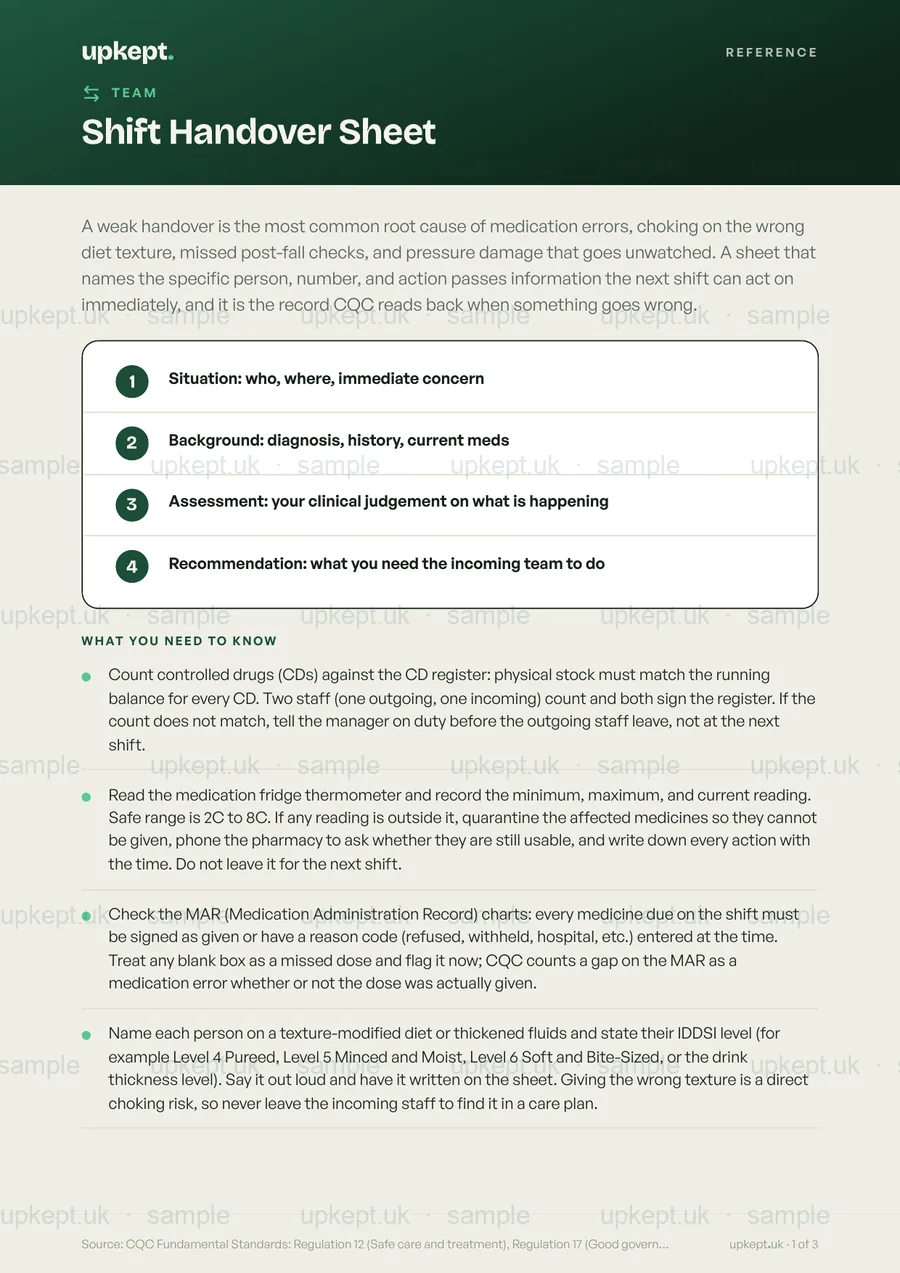
A weak handover is the most common root cause of medication errors, choking on the wrong diet texture, missed post-fall checks, and pressure damage that goes unwatched. A sheet that names the specific person, number, and action passes information the next shift can act on immediately, and it is the record CQC reads back when something goes wrong.
11 checksPDF + phoneReviewed August 2026
Built on published UK guidance Show sources
CQC Fundamental Standards: Regulation 12 (Safe care and treatment), Regulation 17 (Good governance, records must be accurate, complete and contemporaneous, 17(2)(c)), Regulation 18 (Staffing, no prescribed ratio). CQC guidance: Controlled drugs in care homes (running balance; two-staff witnessing of CD checks is good practice); Storing medicines in fridges in care homes (2C to 8C; record min/max/current; quarantine and seek pharmacist advice if out of range). NICE NG232 Head injury: assessment and early management (neurological observation schedule of half-hourly for 2 hours, then hourly for 4 hours, then 2-hourly; anticoagulant/antiplatelet treatment as a red flag for CT and referral). NICE NG249 Falls: assessment and prevention in people 50 and over at higher risk (April 2025). IDDSI Framework (International Dysphagia Diet Standardisation Initiative; texture levels 0 to 7, used across UK NHS and social care).
Freeno card needed
Replaces a DIY doc, and you get every future update free when the guidance changes.
3 for 2 on documents and packs. Add 3 and your cheapest is free.
A clean one-page PDF, ready to print
Opens and ticks off on any phone
Clear, no jargon, easy to follow
Free updates whenever the guidance changes
Secure checkout30-day money-backInstant downloadNo subscriptionCard & Apple Pay
Made for places like this
What’s on it
11 things to check.
Everything that matters, nothing that does not. Here is the full list, exactly as it appears on the template.
1Count controlled drugs (CDs) against the CD register: physical stock must match the running balance for every CD. Two staff (one outgoing, one incoming) count and both sign the register. If the count does not match, tell the manager on duty before the outgoing staff leave, not at the next shift.
2Read the medication fridge thermometer and record the minimum, maximum, and current reading. Safe range is 2C to 8C. If any reading is outside it, quarantine the affected medicines so they cannot be given, phone the pharmacy to ask whether they are still usable, and write down every action with the time. Do not leave it for the next shift.
3Check the MAR (Medication Administration Record) charts: every medicine due on the shift must be signed as given or have a reason code (refused, withheld, hospital, etc.) entered at the time. Treat any blank box as a missed dose and flag it now; CQC counts a gap on the MAR as a medication error whether or not the dose was actually given.
4Name each person on a texture-modified diet or thickened fluids and state their IDDSI level (for example Level 4 Pureed, Level 5 Minced and Moist, Level 6 Soft and Bite-Sized, or the drink thickness level). Say it out loud and have it written on the sheet. Giving the wrong texture is a direct choking risk, so never leave the incoming staff to find it in a care plan.
5Name each person who had a fall this shift, however minor. State the time, where it happened, whether they hit or may have hit their head, and what checks were done. Flag anyone on a blood thinner (anticoagulant or antiplatelet) who has had any bump to the head: they need urgent medical review. For a head injury, neurological observations run half-hourly for 2 hours, then hourly for 4 hours, then 2-hourly, so tell the incoming staff who is on checks and when the next one is due.
6Name each person showing a new or changed pressure area: give the body location, the skin grade if known, and how often they must be repositioned. Say if anyone was found lying or sitting in a way that puts a vulnerable area at risk. The incoming staff cannot act on damage they have not been told about.
7Name each person whose food or fluid intake was below their normal level or their care plan target, with the amount recorded and the reason if known. This is the early signal for dehydration, falls, and pressure damage. Do not write "eating and drinking fine" as a group line.
8Name each person whose behaviour, mood, or alertness changed noticeably: new confusion, agitation, withdrawal, distress, or signs of pain. In older people new confusion is often the first sign of a urine infection or other deterioration, so it needs watching, not just noting. "No changes" is only acceptable if it is genuinely true for everyone.
9List every professional visit due or expected on the incoming shift (GP, district nurse, physiotherapist, mental health worker, social worker): name, purpose, expected time, and anything to have ready such as a urine sample or a completed form.
10Hospitality only: list every out-of-order room with its work order number and expected return date, every VIP or special-requirements arrival due (name, room, stated preferences), and any room held by a billing dispute or a housekeeping-versus-system status mismatch, so the incoming team does not sell or allocate a room that is not ready.
11Before the outgoing staff leave the building, the incoming staff confirm out loud that they have received the handover and have no outstanding questions. A handover that ends with "any questions?" and the person walking out before the answer is not complete.
Good to know
There is no legal minimum staff-to-resident ratio for care homes in England. CQC Regulation 18 requires only \"sufficient numbers of suitably qualified, competent\" staff for the assessed needs of the people in the service, and there is no official tool that sets a safe ratio. So a home cannot defend a rushed handover or a missed task by pointing at a headcount: inspectors judge sufficiency by what actually happened to residents, which is exactly what the handover sheet records.
Source: CQC Fundamental Standards: Regulation 12 (Safe care and treatment), Regulation 17 (Good governance, records must be accurate, complete and contemporaneous, 17(2)(c)), Regulation 18 (Staffing, no prescribed ratio). CQC guidance: Controlled drugs in care homes (running balance; two-staff witnessing of CD checks is good practice); Storing medicines in fridges in care homes (2C to 8C; record min/max/current; quarantine and seek pharmacist advice if out of range). NICE NG232 Head injury: assessment and early management (neurological observation schedule of half-hourly for 2 hours, then hourly for 4 hours, then 2-hourly; anticoagulant/antiplatelet treatment as a red flag for CT and referral). NICE NG249 Falls: assessment and prevention in people 50 and over at higher risk (April 2025). IDDSI Framework (International Dysphagia Diet Standardisation Initiative; texture levels 0 to 7, used across UK NHS and social care).
Good to know
Questions, answered
What is the Shift Handover Sheet?
A weak handover is the most common root cause of medication errors, choking on the wrong diet texture, missed post-fall checks, and pressure damage that goes unwatched. A sheet that names the specific person, number, and action passes information the next shift can act on immediately, and it is the record CQC reads back when something goes wrong.
Why does it matter?
There is no legal minimum staff-to-resident ratio for care homes in England. CQC Regulation 18 requires only \"sufficient numbers of suitably qualified, competent\" staff for the assessed needs of the people in the service, and there is no official tool that sets a safe ratio. So a home cannot defend a rushed handover or a missed task by pointing at a headcount: inspectors judge sufficiency by what actually happened to residents, which is exactly what the handover sheet records.
How do I get it, and is it up to date?
The PDF downloads the moment you check out, prints sharp in black and white, and opens on any phone. It is reviewed for August 2026 and you get any future update free when the official guidance changes.
Onboarding done right keeps the business clear of an illegal-working civil penalty (up to £60,000 per worker), of tribunal claims for a missing written statement or unlawful pay deductions, and of the early attrition that hits when someone leaves inside 90 days because day one was a mess. This is the order an onboarder actually works through, from legal must-dos to the things that make a new starter productive.
A new starter induction that is actually done, not just signed off, prevents two kinds of expensive failure: legal exposure (a £45,000 to £60,000 illegal-working penalty, an unfair dismissal or discrimination claim, an ICO breach, an HMRC tax-records penalty) and operational failure (someone who cannot evacuate the building, cannot log in for three days, or hits month five of probation with no documented reviews). Each item below names the document, the number or deadline, and the action, so it can be ticked off and evidenced.
A good SOP template stops two failures: staff doing the same task differently because no one wrote the steps down precisely, and auditors raising nonconformances because the document is missing the control information (version, owner, approval, review date) that ISO 9001:2015 Clause 7.5 expects. Build the template once and every SOP your office produces will be usable by a new starter on their second shift and able to survive an audit.