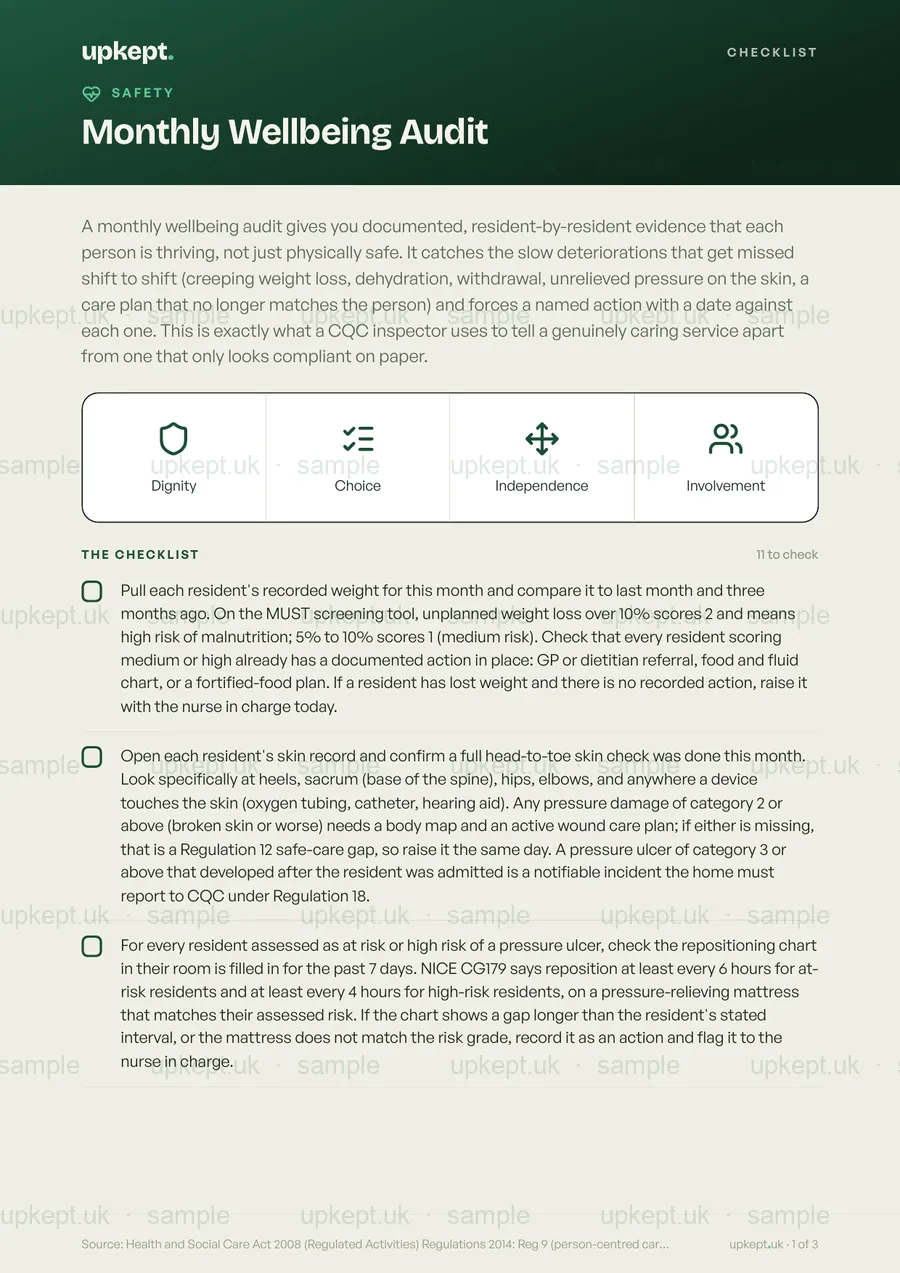
A monthly wellbeing audit gives you documented, resident-by-resident evidence that each person is thriving, not just physically safe. It catches the slow deteriorations that get missed shift to shift (creeping weight loss, dehydration, withdrawal, unrelieved pressure on the skin, a care plan that no longer matches the person) and forces a named action with a date against each one. This is exactly what a CQC inspector uses to tell a genuinely caring service apart from one that only looks compliant on paper.
11 checksPDF + phoneReviewed August 2026
Built on published UK guidance Show sources
Health and Social Care Act 2008 (Regulated Activities) Regulations 2014: Reg 9 (person-centred care), Reg 10 (dignity and respect), Reg 12 (safe care and treatment), Reg 16 (receiving and acting on complaints), Reg 18 (notification of other incidents, including category 3+ pressure ulcers acquired after admission). NICE CG179 (Pressure ulcers), recommendation 1.4.3: reposition at-risk adults at least every 6 hours and high-risk adults at least every 4 hours. NICE QS50 (Mental wellbeing of older people in care homes), Quality Statement 1: opportunities during the day for meaningful activity (no fixed day-count). BAPEN MUST tool: weight loss over 10% scores 2 (high risk), 5 to 10% scores 1 (medium risk). Local Authority Social Services and NHS Complaints (England) Regulations 2009, reg 13(3): acknowledge a complaint within 3 working days.
£14one-off, yours forever
Replaces a DIY doc, and you get every future update free when the guidance changes.
3 for 2 on documents and packs. Add 3 and your cheapest is free.
A clean one-page PDF, ready to print
Opens and ticks off on any phone
Clear, no jargon, easy to follow
Free updates whenever the guidance changes
Secure checkout30-day money-backInstant downloadNo subscriptionCard & Apple Pay
Best valueSave 42%
Or get all 56 templates
The Everything Bundle: every template today and every future one.£399 one-off, instead of £686 bought separately.
Made for places like this
What’s on it
11 things to check.
Everything that matters, nothing that does not. Here is the full list, exactly as it appears on the template.
1Pull each resident's recorded weight for this month and compare it to last month and three months ago. On the MUST screening tool, unplanned weight loss over 10% scores 2 and means high risk of malnutrition; 5% to 10% scores 1 (medium risk). Check that every resident scoring medium or high already has a documented action in place: GP or dietitian referral, food and fluid chart, or a fortified-food plan. If a resident has lost weight and there is no recorded action, raise it with the nurse in charge today.
2Open each resident's skin record and confirm a full head-to-toe skin check was done this month. Look specifically at heels, sacrum (base of the spine), hips, elbows, and anywhere a device touches the skin (oxygen tubing, catheter, hearing aid). Any pressure damage of category 2 or above (broken skin or worse) needs a body map and an active wound care plan; if either is missing, that is a Regulation 12 safe-care gap, so raise it the same day. A pressure ulcer of category 3 or above that developed after the resident was admitted is a notifiable incident the home must report to CQC under Regulation 18.
3For every resident assessed as at risk or high risk of a pressure ulcer, check the repositioning chart in their room is filled in for the past 7 days. NICE CG179 says reposition at least every 6 hours for at-risk residents and at least every 4 hours for high-risk residents, on a pressure-relieving mattress that matches their assessed risk. If the chart shows a gap longer than the resident's stated interval, or the mattress does not match the risk grade, record it as an action and flag it to the nurse in charge.
4Check each resident's fluid chart for the past 7 days. A care home resident needs at least 1,500 ml (1.5 litres) of fluid a day as a baseline; residents on thickened fluids, with a catheter, or with a higher target set in their care plan may need more. If recorded intake is under 1,500 ml on three or more days in the past week with no clinical reason written down, flag it to the nurse in charge and start a fluid monitoring plan.
5Read each resident's care plan against how they actually are today, not what was written at admission or the last formal review. Confirm these are current and being followed: preferred name, preferred wake and bed times, current food preferences and any texture-modified diet, and how they communicate (language, hearing aid, preferred format). Under CQC Regulation 9 the plan must be updated whenever needs or preferences change significantly, so if any of these is absent or out of date, update it before you leave the room.
6Speak directly to each resident (or their named family member or advocate if the resident lacks capacity) and ask two things: is there anything you have been wanting that you have not had, and is there anything in your day you would rather stop. Write the answer in their own words, not a summary. If they name a wish or a worry, record the specific action you will take and the date you will check back. CQC Regulations 9 and 10 both require the person's own voice to be evidenced in their record.
7Check the activity record for the past four weeks against what each resident's care plan says they actually enjoy. NICE QS50 says residents must be offered opportunities during their day to take part in meaningful activity, and that they help choose what is meaningful to them, so the test is genuine individual engagement, not a tick. If the same group activity is logged for everyone on the same days, treat that as a flag and ask one care staff member to name two things this specific resident finds meaningful; if they cannot, record an action to refresh that resident's activity plan.
8Confirm each resident has had a one-to-one with their named keyworker this month, separate from personal care tasks, and that the keyworker has recorded whether the resident seems their usual self or has shown any change in mood, behaviour, or appetite. If the keyworker cannot describe the resident's presentation over the past month, that is the gap: they are delivering care but not monitoring wellbeing. Where low mood or anxiety is suspected, note that it has been flagged for GP review; the PHQ-4 is a quick four-question validated screen you can use at the bedside if unsure.
9Confirm every healthcare review due this month has actually happened: GP review at the interval set in the care plan, dentist (at least once a year, with last and next dates in the plan), optician, and any specialist such as a community nurse, physiotherapist, or speech and language therapist. If a referral or appointment was due and has not been actioned, write today's date and the name of the person now responsible for chasing it. Missed health appointments are one of the most common CQC findings under the Responsive question.
10Confirm each resident has had meaningful contact with someone outside the home this month, in person, by video, or by phone. If a resident has had no outside contact and has no family or friends, check whether a befriending or advocacy service is recorded in their care plan, since social isolation in care homes is linked to depression and faster cognitive decline. If there is no outside contact and no plan, record an action to source a befriending or advocacy referral within 14 days.
11Review the complaints, concerns, and compliments log for each resident's care over the past month. Any concern raised by the resident, a relative, or a staff member must have been acknowledged within 3 working days (Local Authority Social Services and NHS Complaints Regulations 2009) and have a recorded outcome or a live resolution date. If any concern is over 28 days old with no documented update, that is a Regulation 16 complaints-handling failure, so escalate it. Also note any pattern of repeated complaints about the same resident's care with no change made, which points to a deeper gap.
Good to know
CQC sets no fixed monthly or quarterly deadline for care plan reviews. Regulation 9 requires a review whenever the person's needs or preferences change significantly, and the plan must reflect who they are today. So a recent quarterly review date in the file proves nothing on its own: inspectors test whether the plan actually matches the person now, and a plan can sit stale for weeks between scheduled reviews while still looking compliant on paper.
Source: Health and Social Care Act 2008 (Regulated Activities) Regulations 2014: Reg 9 (person-centred care), Reg 10 (dignity and respect), Reg 12 (safe care and treatment), Reg 16 (receiving and acting on complaints), Reg 18 (notification of other incidents, including category 3+ pressure ulcers acquired after admission). NICE CG179 (Pressure ulcers), recommendation 1.4.3: reposition at-risk adults at least every 6 hours and high-risk adults at least every 4 hours. NICE QS50 (Mental wellbeing of older people in care homes), Quality Statement 1: opportunities during the day for meaningful activity (no fixed day-count). BAPEN MUST tool: weight loss over 10% scores 2 (high risk), 5 to 10% scores 1 (medium risk). Local Authority Social Services and NHS Complaints (England) Regulations 2009, reg 13(3): acknowledge a complaint within 3 working days.
Good to know
Questions, answered
What is the Monthly Wellbeing Audit?
A monthly wellbeing audit gives you documented, resident-by-resident evidence that each person is thriving, not just physically safe. It catches the slow deteriorations that get missed shift to shift (creeping weight loss, dehydration, withdrawal, unrelieved pressure on the skin, a care plan that no longer matches the person) and forces a named action with a date against each one. This is exactly what a CQC inspector uses to tell a genuinely caring service apart from one that only looks compliant on paper.
Why does it matter?
CQC sets no fixed monthly or quarterly deadline for care plan reviews. Regulation 9 requires a review whenever the person's needs or preferences change significantly, and the plan must reflect who they are today. So a recent quarterly review date in the file proves nothing on its own: inspectors test whether the plan actually matches the person now, and a plan can sit stale for weeks between scheduled reviews while still looking compliant on paper.
How do I get it, and is it up to date?
The PDF downloads the moment you check out, prints sharp in black and white, and opens on any phone. It is reviewed for August 2026 and you get any future update free when the official guidance changes.
A discharged or depressurised extinguisher found during a real fire is no better than having no extinguisher at all. The monthly visual check catches the common pre-failure states (lost pressure, broken tamper seal, blocked access, overdue service) before they matter, and it gives the responsible person the maintenance records the Regulatory Reform (Fire Safety) Order 2005 requires.
A fire door only works if it closes fully, latches, and seals the gaps; one door that fails to do that lets smoke and fire spread through a building in minutes and removes people's time to escape. These checks catch the specific, common failures (props, blown gaps, missing closers, painted-up seals) that turn a survivable fire into a fatal one.
An under-stocked or expired first aid kit means the person treating an injury reaches for a dressing and finds an empty slot, a perished wrapper, or latex gloves that trigger an allergic reaction. A regular documented check fixes that in advance and gives an HSE or Ofsted inspector evidence that your first aid provision is genuinely maintained, not just present.