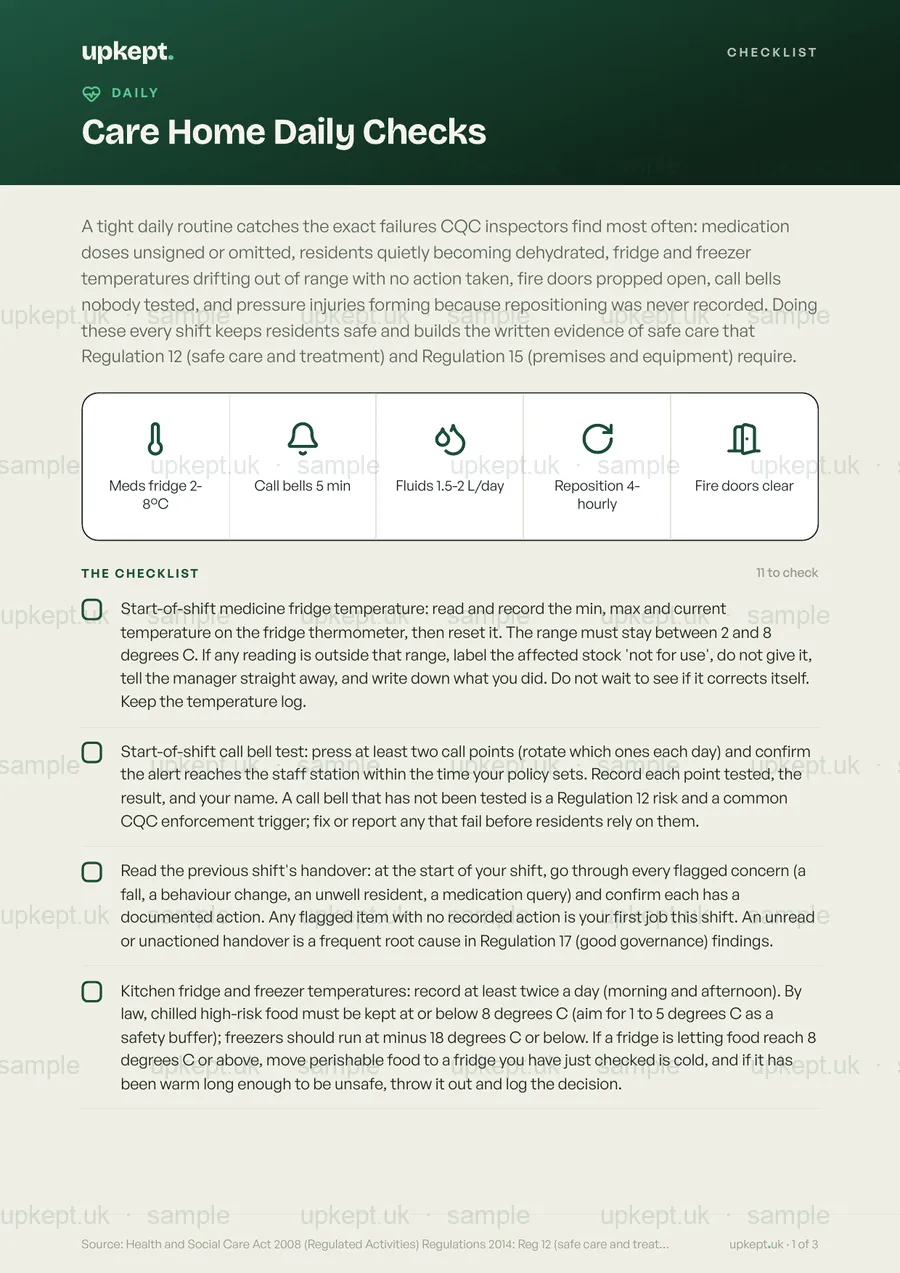
A tight daily routine catches the exact failures CQC inspectors find most often: medication doses unsigned or omitted, residents quietly becoming dehydrated, fridge and freezer temperatures drifting out of range with no action taken, fire doors propped open, call bells nobody tested, and pressure injuries forming because repositioning was never recorded. Doing these every shift keeps residents safe and builds the written evidence of safe care that Regulation 12 (safe care and treatment) and Regulation 15 (premises and equipment) require.
11 checksPDF + phoneReviewed August 2026
Built on published UK guidance Show sources
Health and Social Care Act 2008 (Regulated Activities) Regulations 2014: Reg 12 (safe care and treatment), Reg 15 (premises and equipment), Reg 17 (good governance), Reg 18 (staffing). CQC, "Storing medicines in fridges in care homes" (2 to 8 degrees C; record min/max/current on a min/max thermometer and reset after each reading). Food Standards Agency / Food Hygiene (England) Regulations 2013 and the equivalent 2006 regulations in Wales and Northern Ireland (high-risk chilled food at or below 8 degrees C by law; freezers at minus 18 degrees C; the limit applies to the food temperature, not the air). HSE ACOP L8 (2013) and HSG274 Part 2 (hot water stored at 60 degrees C, reaching 50 degrees C or more at the outlet within one minute; sentinel-outlet monitoring, weekly for higher-risk premises such as care homes). NICE Quality Standard QS89 (Pressure ulcers, 2015), Quality Statement 5 on repositioning. Regulatory Reform (Fire Safety) Order 2005 (fire alarm and fire door duties). Public Health England Cold Weather Plan guidance on minimum indoor temperatures (at least 18 degrees C, with 21 degrees C for living areas), reflected in CQC inspection practice under Reg 15.
£14one-off, yours forever
Replaces a DIY doc, and you get every future update free when the guidance changes.
3 for 2 on documents and packs. Add 3 and your cheapest is free.
A clean one-page PDF, ready to print
Opens and ticks off on any phone
Clear, no jargon, easy to follow
Free updates whenever the guidance changes
Secure checkout30-day money-backInstant downloadNo subscriptionCard & Apple Pay
Best valueSave 42%
Or get all 56 templates
The Everything Bundle: every template today and every future one.£399 one-off, instead of £686 bought separately.
Made for places like this
What’s on it
11 things to check.
Everything that matters, nothing that does not. Here is the full list, exactly as it appears on the template.
1Start-of-shift medicine fridge temperature: read and record the min, max and current temperature on the fridge thermometer, then reset it. The range must stay between 2 and 8 degrees C. If any reading is outside that range, label the affected stock 'not for use', do not give it, tell the manager straight away, and write down what you did. Do not wait to see if it corrects itself. Keep the temperature log.
2Start-of-shift call bell test: press at least two call points (rotate which ones each day) and confirm the alert reaches the staff station within the time your policy sets. Record each point tested, the result, and your name. A call bell that has not been tested is a Regulation 12 risk and a common CQC enforcement trigger; fix or report any that fail before residents rely on them.
3Read the previous shift's handover: at the start of your shift, go through every flagged concern (a fall, a behaviour change, an unwell resident, a medication query) and confirm each has a documented action. Any flagged item with no recorded action is your first job this shift. An unread or unactioned handover is a frequent root cause in Regulation 17 (good governance) findings.
4Kitchen fridge and freezer temperatures: record at least twice a day (morning and afternoon). By law, chilled high-risk food must be kept at or below 8 degrees C (aim for 1 to 5 degrees C as a safety buffer); freezers should run at minus 18 degrees C or below. If a fridge is letting food reach 8 degrees C or above, move perishable food to a fridge you have just checked is cold, and if it has been warm long enough to be unsafe, throw it out and log the decision.
5Fluid intake for at-risk residents: by 14:00 each day, total each at-risk resident's recorded fluid intake so far. Most adults need about 1.5 litres over 24 hours; if a resident is under 750 ml by mid-afternoon, offer a drink now, write down what they took, and tell the senior on shift. Dark urine, new confusion or drowsiness are clinical signs to report the same hour, not at handover.
6Repositioning records for at-risk residents: check that every resident with a repositioning plan has a turning chart filled in showing the position and the actual time. If any entry is more than 30 minutes overdue, check whether they were repositioned, do it if not, and correct the record now. NICE Quality Standard QS89 requires repositioning at the frequency agreed for each resident, recorded and reviewed.
7MAR (Medication Administration Record) check before handover: before you hand over, confirm every medication entry for your shift is either signed or has a code giving the reason it was not given. A blank box is a recording error, not evidence the dose was missed. Explain any gap in writing and escalate it to the nurse or senior on shift before the shift ends, not at handover.
8Fire door walk, once per shift: walk each corridor and check every self-closing fire door shuts fully against the frame, with nothing wedging or propping it open and no damage to the strip around the edge of the door. Release or report any held-open door immediately. A propped fire door breaches the Regulatory Reform (Fire Safety) Order 2005 and can trigger an enforcement notice.
9Bedroom and communal room temperature: each morning, use a thermometer to check and record the temperature in at least two resident bedrooms and the main lounge. Aim for at least 21 degrees C in living areas and at least 18 degrees C in bedrooms (Public Health England cold-weather guidance, in line with Regulation 15). If a room is below that, turn the heating up, record the action, and note when it reached temperature.
10Weekly fire alarm test (log it on the same day each week): operate one manual call point, confirm the alarm sounds across the zones that point covers, then record the point tested, the time, your name, and the result. Rotate which call point you use so all are covered over time. A gap in the weekly test log is a primary target for the fire authority and CQC.
11Weekly hot water temperature at a sentinel outlet: run the hot tap furthest from the hot water cylinder for one minute and record the temperature. It should reach at least 50 degrees C within that minute (HSE ACOP L8 and HSG274 Part 2; care settings often aim for 55 degrees C to reduce scald risk while controlling Legionella). If it does not, do not use that outlet for resident washing, tell the manager, and log it. Keep the record to show Legionella control.
Good to know
There is no fixed staffing ratio in UK law. Regulation 18 of the Health and Social Care Act 2008 (Regulated Activities) Regulations 2014 requires you to set your own safe staffing level from the actual dependency needs of the residents present, using a documented method. Inspectors ask to see how you worked out the rota, not just how many staff were on shift. Showing a flat figure like one carer to eight residents with no dependency assessment behind it is itself a compliance failure.
Source: Health and Social Care Act 2008 (Regulated Activities) Regulations 2014: Reg 12 (safe care and treatment), Reg 15 (premises and equipment), Reg 17 (good governance), Reg 18 (staffing). CQC, "Storing medicines in fridges in care homes" (2 to 8 degrees C; record min/max/current on a min/max thermometer and reset after each reading). Food Standards Agency / Food Hygiene (England) Regulations 2013 and the equivalent 2006 regulations in Wales and Northern Ireland (high-risk chilled food at or below 8 degrees C by law; freezers at minus 18 degrees C; the limit applies to the food temperature, not the air). HSE ACOP L8 (2013) and HSG274 Part 2 (hot water stored at 60 degrees C, reaching 50 degrees C or more at the outlet within one minute; sentinel-outlet monitoring, weekly for higher-risk premises such as care homes). NICE Quality Standard QS89 (Pressure ulcers, 2015), Quality Statement 5 on repositioning. Regulatory Reform (Fire Safety) Order 2005 (fire alarm and fire door duties). Public Health England Cold Weather Plan guidance on minimum indoor temperatures (at least 18 degrees C, with 21 degrees C for living areas), reflected in CQC inspection practice under Reg 15.
Good to know
Questions, answered
What is the Care Home Daily Checks?
A tight daily routine catches the exact failures CQC inspectors find most often: medication doses unsigned or omitted, residents quietly becoming dehydrated, fridge and freezer temperatures drifting out of range with no action taken, fire doors propped open, call bells nobody tested, and pressure injuries forming because repositioning was never recorded. Doing these every shift keeps residents safe and builds the written evidence of safe care that Regulation 12 (safe care and treatment) and Regulation 15 (premises and equipment) require.
Why does it matter?
There is no fixed staffing ratio in UK law. Regulation 18 of the Health and Social Care Act 2008 (Regulated Activities) Regulations 2014 requires you to set your own safe staffing level from the actual dependency needs of the residents present, using a documented method. Inspectors ask to see how you worked out the rota, not just how many staff were on shift. Showing a flat figure like one carer to eight residents with no dependency assessment behind it is itself a compliance failure.
How do I get it, and is it up to date?
The PDF downloads the moment you check out, prints sharp in black and white, and opens on any phone. It is reviewed for August 2026 and you get any future update free when the official guidance changes.
This checklist stops the two failures that close kitchens: food sitting in the danger zone (8 to 63 degrees C) long enough for bacteria to multiply, and staff working from memory instead of a record an Environmental Health Officer can read back. A weak opening compromises food before the first order; a rushed close lets fridges drift, pests settle, and yesterday's record go unsigned.
A proper opening check, done before the first customer or the first food is touched, is your strongest defence against a poor Food Hygiene Rating, a customer falling ill, or an enforcement notice. The Environmental Health Officer scores how well you manage safety every day, not just on inspection day, so a signed daily record that proves you check temperatures, allergens and sickness exclusion is what protects the rating and the business.
A closing checklist stops the overnight failures that trigger enforcement notices, voided insurance claims, and food poisoning: fridges drifting above 8C unnoticed, hot food cooled too slowly, gas left on, fire exits blocked, and cash left out. These are the specific things an EHO inspector or an insurer's loss adjuster looks for, and the closing record is the proof you did them.