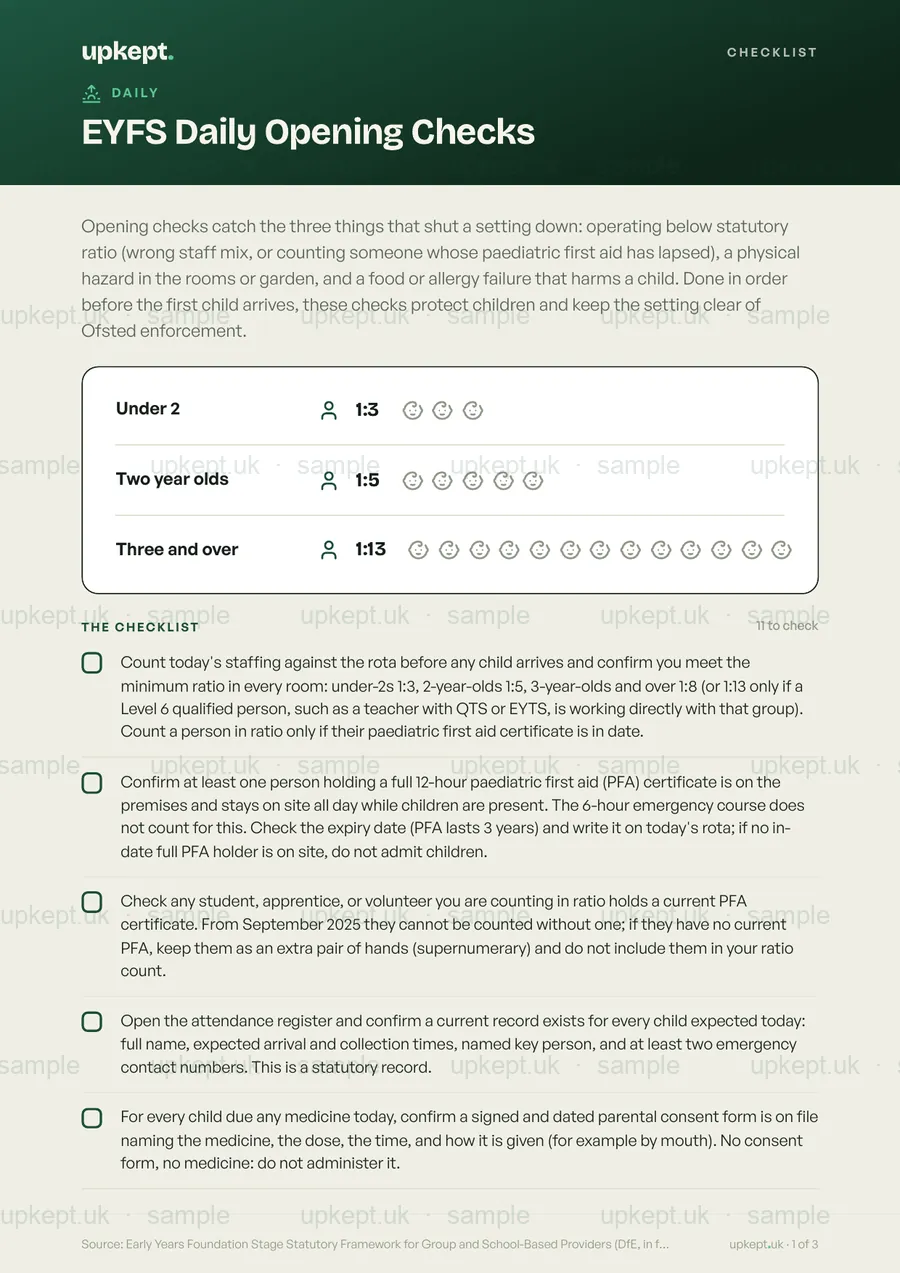
Opening checks catch the three things that shut a setting down: operating below statutory ratio (wrong staff mix, or counting someone whose paediatric first aid has lapsed), a physical hazard in the rooms or garden, and a food or allergy failure that harms a child. Done in order before the first child arrives, these checks protect children and keep the setting clear of Ofsted enforcement.
11 checksPDF + phoneReviewed August 2026
Built on published UK guidance Show sources
Early Years Foundation Stage Statutory Framework for Group and School-Based Providers (DfE, in force 1 September 2025): staffing ratios and qualifications (Section 3, paras 3.29 to 3.48), paediatric first aid (para 3.26 and Annex A), food and drink and safer eating (paras 3.48 to 3.50), attendance records, and administering medicines (parental consent). Food Standards Agency chilled storage guidance (fridge 5°C best practice, 8°C legal maximum under the Food Safety and Hygiene (England) Regulations 2013; freezer at or below -18°C).
£14one-off, yours forever
Replaces a DIY doc, and you get every future update free when the guidance changes.
3 for 2 on documents and packs. Add 3 and your cheapest is free.
A clean one-page PDF, ready to print
Opens and ticks off on any phone
Clear, no jargon, easy to follow
Free updates whenever the guidance changes
Secure checkout30-day money-backInstant downloadNo subscriptionCard & Apple Pay
Best valueSave 42%
Or get all 56 templates
The Everything Bundle: every template today and every future one.£399 one-off, instead of £686 bought separately.
Made for places like this
What’s on it
11 things to check.
Everything that matters, nothing that does not. Here is the full list, exactly as it appears on the template.
1Count today's staffing against the rota before any child arrives and confirm you meet the minimum ratio in every room: under-2s 1:3, 2-year-olds 1:5, 3-year-olds and over 1:8 (or 1:13 only if a Level 6 qualified person, such as a teacher with QTS or EYTS, is working directly with that group). Count a person in ratio only if their paediatric first aid certificate is in date.
2Confirm at least one person holding a full 12-hour paediatric first aid (PFA) certificate is on the premises and stays on site all day while children are present. The 6-hour emergency course does not count for this. Check the expiry date (PFA lasts 3 years) and write it on today's rota; if no in-date full PFA holder is on site, do not admit children.
3Check any student, apprentice, or volunteer you are counting in ratio holds a current PFA certificate. From September 2025 they cannot be counted without one; if they have no current PFA, keep them as an extra pair of hands (supernumerary) and do not include them in your ratio count.
4Open the attendance register and confirm a current record exists for every child expected today: full name, expected arrival and collection times, named key person, and at least two emergency contact numbers. This is a statutory record.
5For every child due any medicine today, confirm a signed and dated parental consent form is on file naming the medicine, the dose, the time, and how it is given (for example by mouth). No consent form, no medicine: do not administer it.
6Walk every room and corridor before children enter. Confirm each fire exit opens fully from the inside, nothing is stored in front of it or along the escape route, and the path to the assembly point is clear. Note that you have done this with the time.
7Walk the outdoor area before opening it and remove or make safe: animal faeces, broken glass, sharp debris, and standing water. Check fences, gates, and latches for overnight damage and confirm gates self-close and latch at adult height. Do not let children out until this is done.
8Read the allergy and dietary notes for every child booked in for any meal or snack today before food is prepared. On the daily plan, name the staff member responsible for checking each child's plate at each meal, and make sure a full-PFA holder is in the room whenever children are eating.
9Check and record the fridge and freezer temperatures. Aim for the fridge at 5°C or below (8°C is the legal maximum; 5°C gives a safety buffer) and the freezer at -18°C or below. If either is out of range, move the perishable food to a unit that is in range, do not serve food from the faulty unit, and write down the reading and what you did.
10Check the first aid kit in each room in use is stocked and within reach, and that staff on shift know where it is. Write down any missing items so stock is reordered before the next session.
11Do a visual check that fire alarm call points, fire doors, and extinguishers are unobstructed and undamaged. Report any fault to the named responsible person straight away and log it. (The weekly alarm test is separate; record it in the fire log on test day.)
Good to know
From September 2025, students, apprentices, and volunteers can only be counted in your staffing ratios if they hold a current paediatric first aid certificate, not just qualified staff. Many settings still count placement students in ratio without checking this, which means they may be running below statutory ratio without realising; one missing certificate can put the whole room out of compliance.
Source: Early Years Foundation Stage Statutory Framework for Group and School-Based Providers (DfE, in force 1 September 2025): staffing ratios and qualifications (Section 3, paras 3.29 to 3.48), paediatric first aid (para 3.26 and Annex A), food and drink and safer eating (paras 3.48 to 3.50), attendance records, and administering medicines (parental consent). Food Standards Agency chilled storage guidance (fridge 5°C best practice, 8°C legal maximum under the Food Safety and Hygiene (England) Regulations 2013; freezer at or below -18°C).
Good to know
Questions, answered
What is the EYFS Daily Opening Checks?
Opening checks catch the three things that shut a setting down: operating below statutory ratio (wrong staff mix, or counting someone whose paediatric first aid has lapsed), a physical hazard in the rooms or garden, and a food or allergy failure that harms a child. Done in order before the first child arrives, these checks protect children and keep the setting clear of Ofsted enforcement.
Why does it matter?
From September 2025, students, apprentices, and volunteers can only be counted in your staffing ratios if they hold a current paediatric first aid certificate, not just qualified staff. Many settings still count placement students in ratio without checking this, which means they may be running below statutory ratio without realising; one missing certificate can put the whole room out of compliance.
How do I get it, and is it up to date?
The PDF downloads the moment you check out, prints sharp in black and white, and opens on any phone. It is reviewed for August 2026 and you get any future update free when the official guidance changes.
This checklist stops the two failures that close kitchens: food sitting in the danger zone (8 to 63 degrees C) long enough for bacteria to multiply, and staff working from memory instead of a record an Environmental Health Officer can read back. A weak opening compromises food before the first order; a rushed close lets fridges drift, pests settle, and yesterday's record go unsigned.
A proper opening check, done before the first customer or the first food is touched, is your strongest defence against a poor Food Hygiene Rating, a customer falling ill, or an enforcement notice. The Environmental Health Officer scores how well you manage safety every day, not just on inspection day, so a signed daily record that proves you check temperatures, allergens and sickness exclusion is what protects the rating and the business.
A closing checklist stops the overnight failures that trigger enforcement notices, voided insurance claims, and food poisoning: fridges drifting above 8C unnoticed, hot food cooled too slowly, gas left on, fire exits blocked, and cash left out. These are the specific things an EHO inspector or an insurer's loss adjuster looks for, and the closing record is the proof you did them.