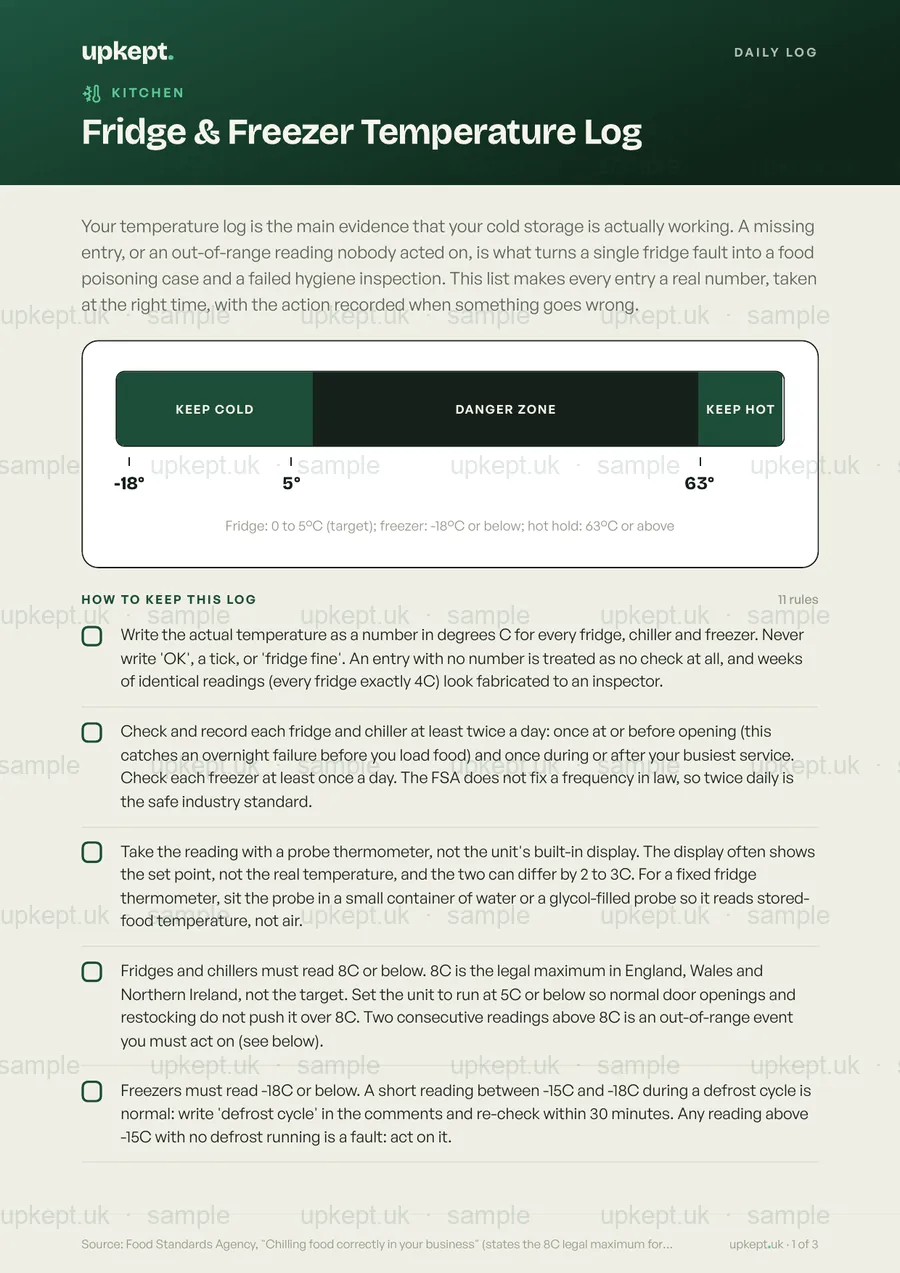
Your temperature log is the main evidence that your cold storage is actually working. A missing entry, or an out-of-range reading nobody acted on, is what turns a single fridge fault into a food poisoning case and a failed hygiene inspection. This list makes every entry a real number, taken at the right time, with the action recorded when something goes wrong.
A fridge temperature log is one of the records environmental health officers actually ask to see. This one covers fridges and freezers, twice-daily checks with a place to initial, on one printable page.
11 checksPDF + phoneReviewed August 2026
Built on published UK guidance Show sources
Food Standards Agency, "Chilling food correctly in your business" (states the 8C legal maximum for England, Wales and Northern Ireland and the 5C recommended operating temperature); FSA Safer Food, Better Business (SFBB) temperature record sheets and Safe Method "Chilled storage and display". The 8C requirement is set by the Food Safety and Hygiene (England) Regulations 2013 (which revoked and replaced the Food Hygiene (England) Regulations 2006), with equivalent regulations in Wales and Northern Ireland; Scotland operates under separate rules. The -18C frozen standard and the 1-year retention of frozen monitoring records come from the Quick-frozen Foodstuffs (England) Regulations 2007 (and equivalents), retained in UK law post-Brexit.
£14one-off, yours forever
Replaces a DIY doc, and you get every future update free when the guidance changes.
3 for 2 on documents and packs. Add 3 and your cheapest is free.
A clean one-page PDF, ready to print
Opens and ticks off on any phone
Clear, no jargon, easy to follow
Free updates whenever the guidance changes
Secure checkout30-day money-backInstant downloadNo subscriptionCard & Apple Pay
Best valueSave 42%
Or get all 56 templates
The Everything Bundle: every template today and every future one.£399 one-off, instead of £686 bought separately.
Made for places like this
What’s on it
11 things to check.
Everything that matters, nothing that does not. Here is the full list, exactly as it appears on the template.
1Write the actual temperature as a number in degrees C for every fridge, chiller and freezer. Never write 'OK', a tick, or 'fridge fine'. An entry with no number is treated as no check at all, and weeks of identical readings (every fridge exactly 4C) look fabricated to an inspector.
2Check and record each fridge and chiller at least twice a day: once at or before opening (this catches an overnight failure before you load food) and once during or after your busiest service. Check each freezer at least once a day. The FSA does not fix a frequency in law, so twice daily is the safe industry standard.
3Take the reading with a probe thermometer, not the unit's built-in display. The display often shows the set point, not the real temperature, and the two can differ by 2 to 3C. For a fixed fridge thermometer, sit the probe in a small container of water or a glycol-filled probe so it reads stored-food temperature, not air.
4Fridges and chillers must read 8C or below. 8C is the legal maximum in England, Wales and Northern Ireland, not the target. Set the unit to run at 5C or below so normal door openings and restocking do not push it over 8C. Two consecutive readings above 8C is an out-of-range event you must act on (see below).
5Freezers must read -18C or below. A short reading between -15C and -18C during a defrost cycle is normal: write 'defrost cycle' in the comments and re-check within 30 minutes. Any reading above -15C with no defrost running is a fault: act on it.
6If a fridge reads above 8C: check the door is shut and the seal is clean and sealing, probe the densest high-risk item directly, and if the food itself is above 8C move dairy, cooked meat and ready-to-eat items to a working unit straight away. Log the exact action and time, for example 'Moved cooked chicken to Fridge 2 at 09:45, engineer called'.
7Probe every chilled and frozen delivery before you accept it. Probe between packs or into the centre of a solid item. Reject and record any chilled load above 8C, and any frozen load above -15C or showing signs of thawing (soft packs, ice crystals, refrozen clumps).
8Write the name or initials of the person who took each reading, and have a supervisor or manager sign the sheet at the end of every day. A sheet with no names and no daily sign-off carries no weight at inspection.
9Note anything that explains an unusual reading in the comments column at the time: a large delivery just loaded, a long restock, a defrost. This accounts for a brief spike (for example 9C that drops back under 8C within 30 minutes) and shows the log is honest rather than guessed.
10Check your probe thermometer reads correctly at least once a week using the ice-slush method: pack a cup with crushed ice, add a little cold water, stir, and the probe should read 0C (anywhere from -1C to +1C is fine). Record the check. A probe reading 2C low will pass a dangerous fridge as safe.
11Keep completed sheets on-site and available for inspection. The FSA Safer Food, Better Business diary runs on a rolling 4-week format; quick-frozen monitoring records should be kept for at least 1 year. Keeping 12 months of all sheets is the safest option and is what many insurers and enforcement teams ask for.
Good to know
8C is a hard legal ceiling, not a target, and it applies to the temperature of the food, not the air. Food near the door or loaded in warm can sit 2 to 3C above the air reading, so an air temperature of 5C or below is what actually keeps the food legal. Most operators aim for 8C and run non-compliant without knowing it.
Source: Food Standards Agency, "Chilling food correctly in your business" (states the 8C legal maximum for England, Wales and Northern Ireland and the 5C recommended operating temperature); FSA Safer Food, Better Business (SFBB) temperature record sheets and Safe Method "Chilled storage and display". The 8C requirement is set by the Food Safety and Hygiene (England) Regulations 2013 (which revoked and replaced the Food Hygiene (England) Regulations 2006), with equivalent regulations in Wales and Northern Ireland; Scotland operates under separate rules. The -18C frozen standard and the 1-year retention of frozen monitoring records come from the Quick-frozen Foodstuffs (England) Regulations 2007 (and equivalents), retained in UK law post-Brexit.
Good to know
Questions, answered
What temperature should a commercial fridge be?
In England, food that needs chilling must be kept at 8°C or below by law; FSA guidance is to set the fridge at 5°C or below so food stays safe even with the door in use. Freezers should run at -18°C.
How often should fridge temperatures be recorded?
Standard practice under Safer Food, Better Business is to check at opening and closing, every day, and to write it down with initials, which is exactly what this log is laid out for.
What is the Fridge & Freezer Temperature Log?
Your temperature log is the main evidence that your cold storage is actually working. A missing entry, or an out-of-range reading nobody acted on, is what turns a single fridge fault into a food poisoning case and a failed hygiene inspection. This list makes every entry a real number, taken at the right time, with the action recorded when something goes wrong.
Why does it matter?
8C is a hard legal ceiling, not a target, and it applies to the temperature of the food, not the air. Food near the door or loaded in warm can sit 2 to 3C above the air reading, so an air temperature of 5C or below is what actually keeps the food legal. Most operators aim for 8C and run non-compliant without knowing it.
How do I get it, and is it up to date?
The PDF downloads the moment you check out, prints sharp in black and white, and opens on any phone. It is reviewed for August 2026 and you get any future update free when the official guidance changes.
A wrong, out-of-date, or missing allergen line can put a customer into anaphylaxis and kill them. It also breaks the Food Information Regulations 2014, where giving false or misleading allergen information is a criminal offence carrying an unlimited fine, not just a hygiene black mark. A correct matrix is what lets any team member answer "what's in this?" the same way every time.
A food safety daily diary is the written proof that your food safety system is actually being run, not just sitting in a folder. On inspection an Environmental Health Officer treats a blank or gap-filled diary as evidence the system is failing, while a complete one with real numbers is your legal defence if someone falls ill. Filled in properly it also catches a warm fridge or an undercooked batch before it reaches a customer.
Cooking and reheating temperature records are the main evidence an Environmental Health Officer (EHO) uses to judge whether your food safety system actually works on the floor, not just on paper. Ticks, the word 'OK', or numbers all written up at the end of the shift are treated as no record at all, and that alone can drop your hygiene rating and trigger a return visit. Done properly, this log catches food that never reached a safe core temperature and flags failing equipment before it causes a food poisoning incident.