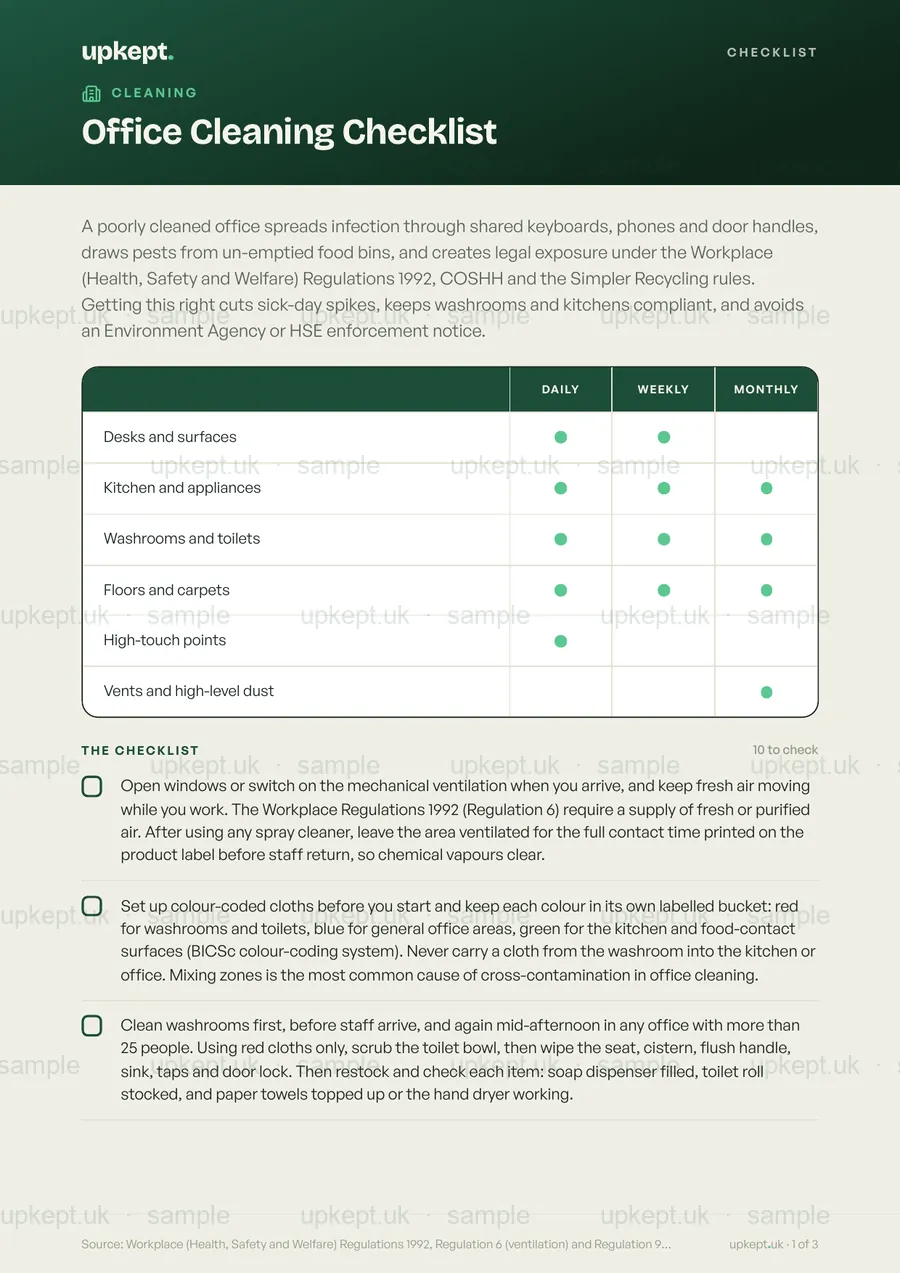
A poorly cleaned office spreads infection through shared keyboards, phones and door handles, draws pests from un-emptied food bins, and creates legal exposure under the Workplace (Health, Safety and Welfare) Regulations 1992, COSHH and the Simpler Recycling rules. Getting this right cuts sick-day spikes, keeps washrooms and kitchens compliant, and avoids an Environment Agency or HSE enforcement notice.
10 checksPDF + phoneReviewed August 2026
Built on published UK guidance Show sources
Workplace (Health, Safety and Welfare) Regulations 1992, Regulation 6 (ventilation) and Regulation 9 (cleanliness and waste materials); HSE ACOP L24 (floors and traffic routes cleaned at least weekly; waste and refuse removed at least daily where not in suitable closed containers); COSHH Regulations 2002 (chemical storage, decanted-bottle labelling and Safety Data Sheet requirements); Food Standards Agency chilled-food guidance (aim for 5 degrees C or below; 8 degrees C legal maximum in England, Wales and Northern Ireland); Simpler Recycling rules under the Environment Act 2021, in force 31 March 2025 for English workplaces with 10 or more employees (food waste, dry recycling, general waste; paper and card separable); BICSc colour-coding system (red washrooms, blue general areas, green kitchen).
£14one-off, yours forever
Replaces a DIY doc, and you get every future update free when the guidance changes.
3 for 2 on documents and packs. Add 3 and your cheapest is free.
A clean one-page PDF, ready to print
Opens and ticks off on any phone
Clear, no jargon, easy to follow
Free updates whenever the guidance changes
Secure checkout30-day money-backInstant downloadNo subscriptionCard & Apple Pay
Best valueSave 42%
Or get all 56 templates
The Everything Bundle: every template today and every future one.£399 one-off, instead of £686 bought separately.
Made for places like this
What’s on it
10 things to check.
Everything that matters, nothing that does not. Here is the full list, exactly as it appears on the template.
1Open windows or switch on the mechanical ventilation when you arrive, and keep fresh air moving while you work. The Workplace Regulations 1992 (Regulation 6) require a supply of fresh or purified air. After using any spray cleaner, leave the area ventilated for the full contact time printed on the product label before staff return, so chemical vapours clear.
2Set up colour-coded cloths before you start and keep each colour in its own labelled bucket: red for washrooms and toilets, blue for general office areas, green for the kitchen and food-contact surfaces (BICSc colour-coding system). Never carry a cloth from the washroom into the kitchen or office. Mixing zones is the most common cause of cross-contamination in office cleaning.
3Clean washrooms first, before staff arrive, and again mid-afternoon in any office with more than 25 people. Using red cloths only, scrub the toilet bowl, then wipe the seat, cistern, flush handle, sink, taps and door lock. Then restock and check each item: soap dispenser filled, toilet roll stocked, and paper towels topped up or the hand dryer working.
4Check the kitchen or breakout fridge temperature at the start of each day and aim for 5 degrees C or below (Food Standards Agency guidance). 8 degrees C is the legal maximum for chilled food in England, Wales and Northern Ireland, so if the reading is above 8 degrees C, move perishable food out, report the fault, and do not use the fridge until it is fixed. Wipe the shelves and door seals weekly with a food-safe antibacterial cleaner.
5Clean the kitchen sink, draining board and worktops every day with a green cloth and a food-safe antibacterial cleaner, and tip away any standing water from the draining board before you leave. Standing water and food residue let bacteria multiply on kitchen surfaces overnight.
6Wipe every shared high-touch surface with disinfectant mixed to the dilution on the label, and leave it wet for the full contact time stated on the label before wiping dry or letting it air-dry. Cover: desk phones, keyboards, mice, door handles, light switches, lift buttons, hot-desk tops, printer touchpads and the kettle handle. These surfaces are the main route for coughs and colds to spread between staff.
7Clean floors and indoor walkways at least once a week, the legal minimum under ACOP L24 to the Workplace Regulations 1992. Clean daily near the kitchen and entrance lobby where dirt builds up fastest. Mop up any spillage as soon as you see it rather than waiting for the next clean. Put out a wet floor sign straight away and only remove it once the floor is dry.
8Empty every waste bin at the end of the day. If a bin holds food waste (fruit peel, sandwich wrappers, tea bags), take the bag out and put a fresh one in; never leave food waste in the office overnight, as it is the single most common cause of pest activity. ACOP L24 requires waste and refuse to be removed at least daily where it is not held in suitable closed containers.
9Separate waste into the streams required by the Simpler Recycling rules (in force since 31 March 2025 for English workplaces with 10 or more employees): food waste; dry recycling (plastic, metal, glass, paper and card); and general non-recyclable waste. Keep paper and card separate from the other dry recycling unless your waste collector takes them mixed. Putting recycling or food waste in the general bin risks a compliance notice from the Environment Agency.
10Return all cleaning chemicals to the locked, ventilated cupboard at the end of the shift, kept away from food and staff areas as COSHH 2002 requires, and keep a current Safety Data Sheet for each product with them. Any chemical you decant into a spray bottle must be labelled with the product name, the dilution and the hazard symbols. Never store bleach and acid-based products in the same cupboard.
Good to know
Most people assume cleaning office floors daily is a legal requirement. It is not. The Approved Code of Practice (ACOP L24) to the Workplace (Health, Safety and Welfare) Regulations 1992 sets the minimum for floors and indoor traffic routes at once a week. The genuine daily legal duty is removing waste and clearing spillages, not the mopping itself. Daily floor cleaning is good practice in busy areas but exceeds the legal floor.
Source: Workplace (Health, Safety and Welfare) Regulations 1992, Regulation 6 (ventilation) and Regulation 9 (cleanliness and waste materials); HSE ACOP L24 (floors and traffic routes cleaned at least weekly; waste and refuse removed at least daily where not in suitable closed containers); COSHH Regulations 2002 (chemical storage, decanted-bottle labelling and Safety Data Sheet requirements); Food Standards Agency chilled-food guidance (aim for 5 degrees C or below; 8 degrees C legal maximum in England, Wales and Northern Ireland); Simpler Recycling rules under the Environment Act 2021, in force 31 March 2025 for English workplaces with 10 or more employees (food waste, dry recycling, general waste; paper and card separable); BICSc colour-coding system (red washrooms, blue general areas, green kitchen).
Good to know
Questions, answered
What is the Office Cleaning Checklist?
A poorly cleaned office spreads infection through shared keyboards, phones and door handles, draws pests from un-emptied food bins, and creates legal exposure under the Workplace (Health, Safety and Welfare) Regulations 1992, COSHH and the Simpler Recycling rules. Getting this right cuts sick-day spikes, keeps washrooms and kitchens compliant, and avoids an Environment Agency or HSE enforcement notice.
Why does it matter?
Most people assume cleaning office floors daily is a legal requirement. It is not. The Approved Code of Practice (ACOP L24) to the Workplace (Health, Safety and Welfare) Regulations 1992 sets the minimum for floors and indoor traffic routes at once a week. The genuine daily legal duty is removing waste and clearing spillages, not the mopping itself. Daily floor cleaning is good practice in busy areas but exceeds the legal floor.
How do I get it, and is it up to date?
The PDF downloads the moment you check out, prints sharp in black and white, and opens on any phone. It is reviewed for August 2026 and you get any future update free when the official guidance changes.
A signed cleaning record is the main evidence an Environmental Health Officer uses to decide whether your kitchen is clean every day, not just on inspection day. Done properly, this routine stops the four things that sink hygiene ratings and trigger enforcement: cross-contamination between raw and ready-to-eat food, allergen cross-contact, grease fires in the extract system, and pest infestations.
A signed, time-stamped hourly check gives you a paper trail that protects you if someone slips, complains, or is injured, and it forces a physical walk-through that catches the small failures (empty soap, no toilet roll, a broken lock, a wet floor) before they turn into complaints, bad reviews, or a downmark from the Environmental Health Officer. The log is usually the first thing an EHO asks to see.
A neglected waste area is the most common cause of pest infestation, the most common spot for a deliberate fire to start and spread into the building, and the source of unlimited fines under the duty of care in EPA 1990 s.34. This check keeps the environmental health officer, your insurer, and the fire risk assessment satisfied, and proves the area was inspected if anyone asks.