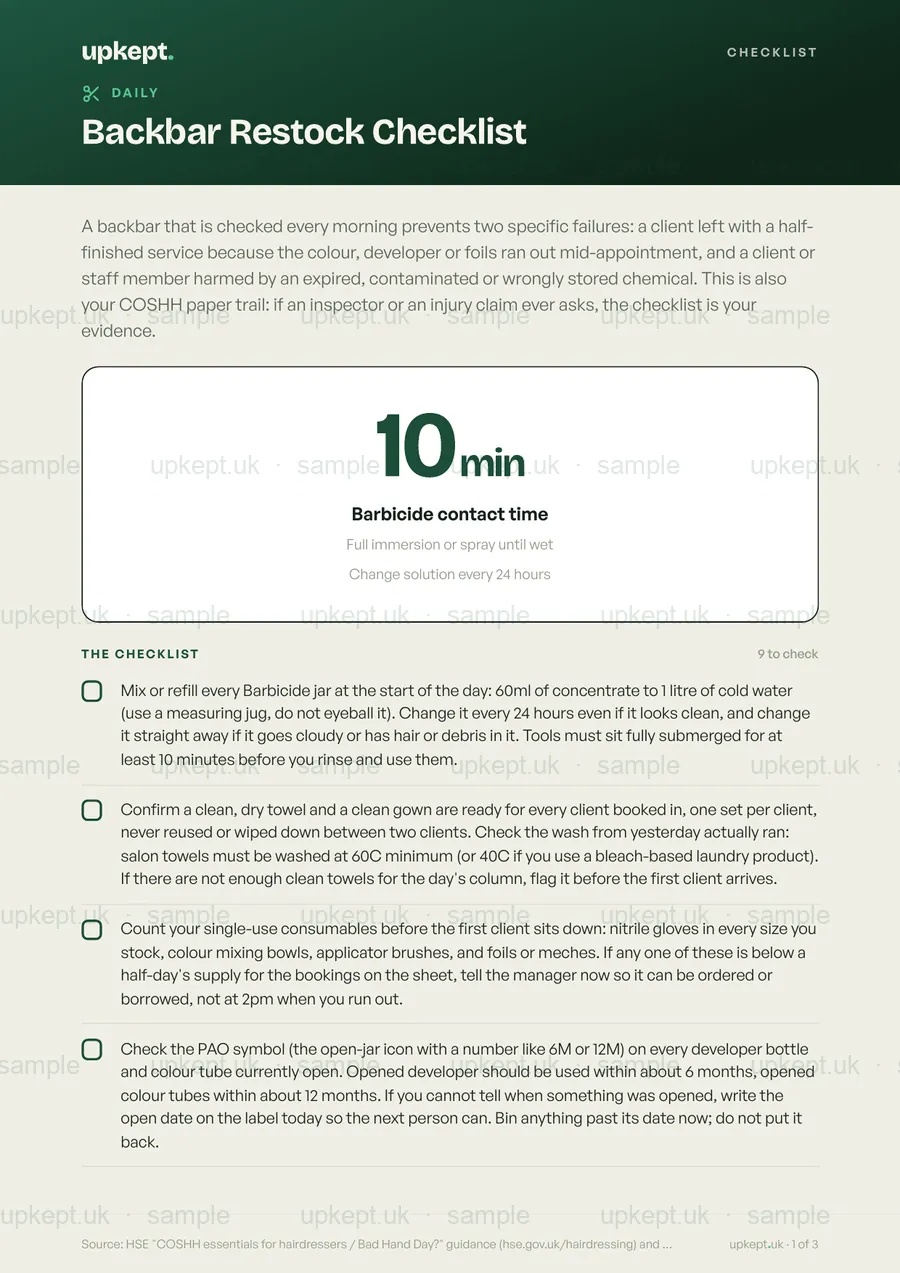
A backbar that is checked every morning prevents two specific failures: a client left with a half-finished service because the colour, developer or foils ran out mid-appointment, and a client or staff member harmed by an expired, contaminated or wrongly stored chemical. This is also your COSHH paper trail: if an inspector or an injury claim ever asks, the checklist is your evidence.
9 checksPDF + phoneReviewed August 2026
Built on published UK guidance Show sources
HSE "COSHH essentials for hairdressers / Bad Hand Day?" guidance (hse.gov.uk/hairdressing) and the Control of Substances Hazardous to Health Regulations 2002, Reg. 6 (written assessment) and Reg. 7 (SDS-informed control); NHBF Salons and Barbershops Code of Practice (nhbf.co.uk) on towel laundering at 60C and single-use linen per client; Barbicide / King Research manufacturer directions (barbicide.com) specifying 60ml per litre, 10 minutes contact time and a 24-hour change; UK Cosmetics Regulation (Regulation (EC) 1223/2009 as retained in UK law) requiring PAO labelling on products with a shelf life over 30 months and product identifiability at point of use.
£14one-off, yours forever
Replaces a DIY doc, and you get every future update free when the guidance changes.
3 for 2 on documents and packs. Add 3 and your cheapest is free.
A clean one-page PDF, ready to print
Opens and ticks off on any phone
Clear, no jargon, easy to follow
Free updates whenever the guidance changes
Secure checkout30-day money-backInstant downloadNo subscriptionCard & Apple Pay
Best valueSave 42%
Or get all 56 templates
The Everything Bundle: every template today and every future one.£399 one-off, instead of £686 bought separately.
Made for places like this
What’s on it
9 things to check.
Everything that matters, nothing that does not. Here is the full list, exactly as it appears on the template.
1Mix or refill every Barbicide jar at the start of the day: 60ml of concentrate to 1 litre of cold water (use a measuring jug, do not eyeball it). Change it every 24 hours even if it looks clean, and change it straight away if it goes cloudy or has hair or debris in it. Tools must sit fully submerged for at least 10 minutes before you rinse and use them.
2Confirm a clean, dry towel and a clean gown are ready for every client booked in, one set per client, never reused or wiped down between two clients. Check the wash from yesterday actually ran: salon towels must be washed at 60C minimum (or 40C if you use a bleach-based laundry product). If there are not enough clean towels for the day's column, flag it before the first client arrives.
3Count your single-use consumables before the first client sits down: nitrile gloves in every size you stock, colour mixing bowls, applicator brushes, and foils or meches. If any one of these is below a half-day's supply for the bookings on the sheet, tell the manager now so it can be ordered or borrowed, not at 2pm when you run out.
4Check the PAO symbol (the open-jar icon with a number like 6M or 12M) on every developer bottle and colour tube currently open. Opened developer should be used within about 6 months, opened colour tubes within about 12 months. If you cannot tell when something was opened, write the open date on the label today so the next person can. Bin anything past its date now; do not put it back.
5Check opened bleach (powder lightener) is sealed with its proper lid or a clip-seal bag, never left open to the air, which makes it absorb moisture and clump. If any bleach is hard, lumpy when you dry-scoop it, or has gone from white or cream to a yellow or grey tinge, throw it out and open a fresh tub.
6Check developer bottles are stored upright, sealed, in the designated cool dark cupboard, not lying on their side and not on the open colour-bar shelf next to a heat source or dryer. Warm, light or loosely capped developer loses strength, so the lift comes out weaker than the tube says.
7Read the label on every product on the backbar. If any container is unlabelled, or has a torn or unreadable label, or is a decant (for example bleach tipped into a plain tub), label it right now with the product name and any hazard wording copied from the original. UK law requires every product to be identifiable at the point you use it.
8Check every colour line you actually use against its minimum-stock level (ask your distributor rep to set these if they are not written down). Order any shade or developer strength the moment it drops to that level, not when the last one is gone. Allow two working days for most UK professional distributors, so ordering on empty means a client gets turned away.
9Confirm the COSHH folder is on the salon floor and you can open it, not locked in the office. It must hold a current Safety Data Sheet for every chemical on site: shampoo, colour, bleach, developer, relaxers and cleaning products. If a new product has arrived with no Safety Data Sheet, do not use it; email the supplier for the sheet before the next order goes in.
Good to know
Low-strength salon developer (3 percent / 10 vol up to 12 percent / 40 vol) does not need a "hazardous" classification, and many owners wrongly assume that means it is exempt from COSHH. It is not: HSE guidance for hairdressers is clear that any substance that can cause occupational dermatitis or other harm must have a written COSHH assessment, whatever its strength. Skin contact with peroxide and colour is the single biggest cause of dermatitis in salons, so the assessment and the gloves are the legal baseline, not optional extras.
Source: HSE "COSHH essentials for hairdressers / Bad Hand Day?" guidance (hse.gov.uk/hairdressing) and the Control of Substances Hazardous to Health Regulations 2002, Reg. 6 (written assessment) and Reg. 7 (SDS-informed control); NHBF Salons and Barbershops Code of Practice (nhbf.co.uk) on towel laundering at 60C and single-use linen per client; Barbicide / King Research manufacturer directions (barbicide.com) specifying 60ml per litre, 10 minutes contact time and a 24-hour change; UK Cosmetics Regulation (Regulation (EC) 1223/2009 as retained in UK law) requiring PAO labelling on products with a shelf life over 30 months and product identifiability at point of use.
Good to know
Questions, answered
What is the Backbar Restock Checklist?
A backbar that is checked every morning prevents two specific failures: a client left with a half-finished service because the colour, developer or foils ran out mid-appointment, and a client or staff member harmed by an expired, contaminated or wrongly stored chemical. This is also your COSHH paper trail: if an inspector or an injury claim ever asks, the checklist is your evidence.
Why does it matter?
Low-strength salon developer (3 percent / 10 vol up to 12 percent / 40 vol) does not need a "hazardous" classification, and many owners wrongly assume that means it is exempt from COSHH. It is not: HSE guidance for hairdressers is clear that any substance that can cause occupational dermatitis or other harm must have a written COSHH assessment, whatever its strength. Skin contact with peroxide and colour is the single biggest cause of dermatitis in salons, so the assessment and the gloves are the legal baseline, not optional extras.
How do I get it, and is it up to date?
The PDF downloads the moment you check out, prints sharp in black and white, and opens on any phone. It is reviewed for August 2026 and you get any future update free when the official guidance changes.
This checklist stops the two failures that close kitchens: food sitting in the danger zone (8 to 63 degrees C) long enough for bacteria to multiply, and staff working from memory instead of a record an Environmental Health Officer can read back. A weak opening compromises food before the first order; a rushed close lets fridges drift, pests settle, and yesterday's record go unsigned.
A proper opening check, done before the first customer or the first food is touched, is your strongest defence against a poor Food Hygiene Rating, a customer falling ill, or an enforcement notice. The Environmental Health Officer scores how well you manage safety every day, not just on inspection day, so a signed daily record that proves you check temperatures, allergens and sickness exclusion is what protects the rating and the business.
A closing checklist stops the overnight failures that trigger enforcement notices, voided insurance claims, and food poisoning: fridges drifting above 8C unnoticed, hot food cooled too slowly, gas left on, fire exits blocked, and cash left out. These are the specific things an EHO inspector or an insurer's loss adjuster looks for, and the closing record is the proof you did them.