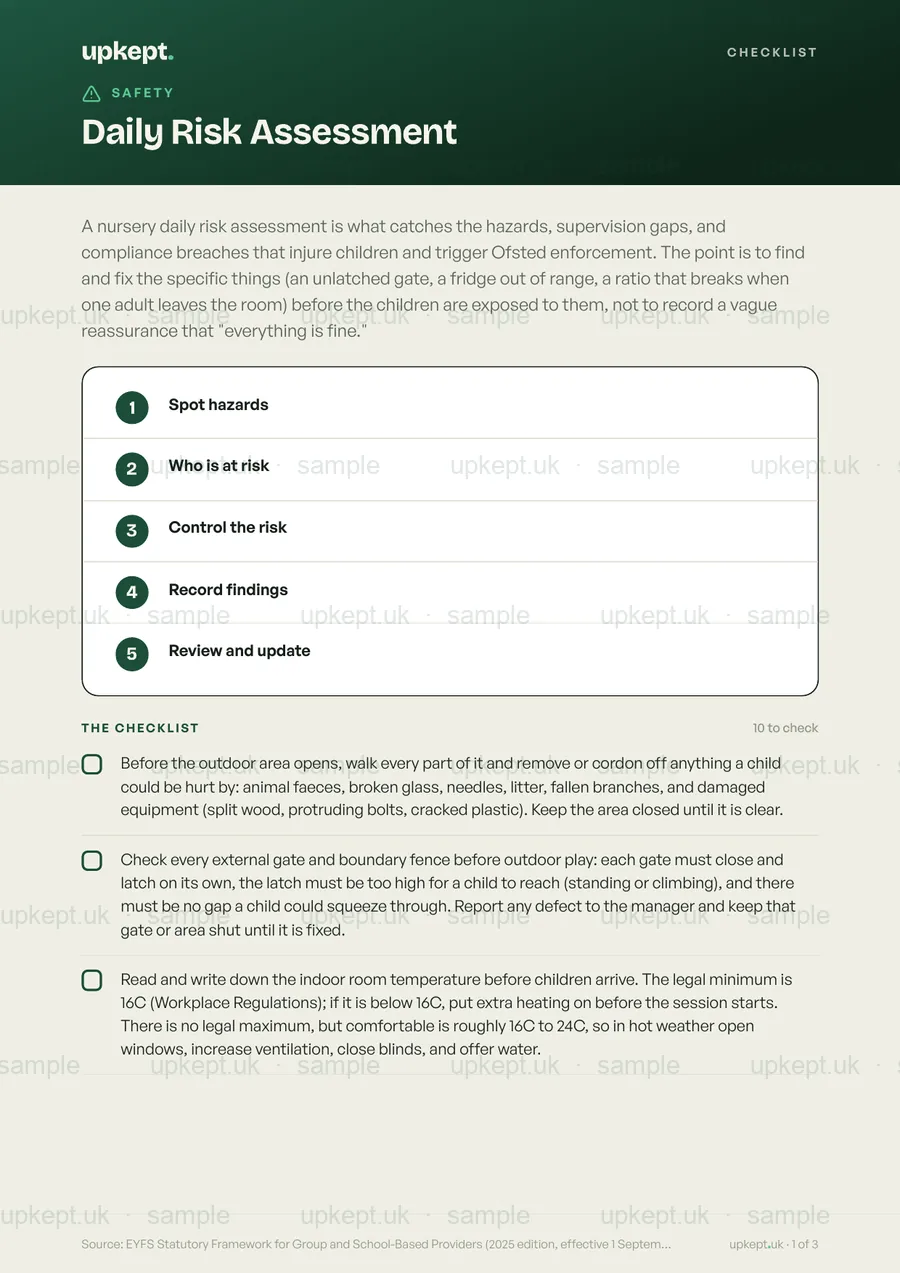
A nursery daily risk assessment is what catches the hazards, supervision gaps, and compliance breaches that injure children and trigger Ofsted enforcement. The point is to find and fix the specific things (an unlatched gate, a fridge out of range, a ratio that breaks when one adult leaves the room) before the children are exposed to them, not to record a vague reassurance that "everything is fine."
10 checksPDF + phoneReviewed August 2026
Built on published UK guidance Show sources
EYFS Statutory Framework for Group and School-Based Providers (2025 edition, effective 1 September 2025), Section 3 Safeguarding and Welfare Requirements: staff:child ratios, Paediatric First Aid (full 12-hour certificate, at least one holder present whenever children are present), mealtime supervision (children within sight AND hearing while eating, from 1 September 2025), and active follow-up of unexplained absence. Strengthened safer sleep requirements (under-2s placed on their back, 12 months and under in a cot, under-6-months in the same room as an adult, frequent checks) confirmed by DfE for the EYFS and assessed at Ofsted inspection from September 2026. Minimum indoor temperature of 16C: Workplace (Health, Safety and Welfare) Regulations 1992, Regulation 7 (no statutory maximum). Refrigerated medicines 2C to 8C: standard pharmaceutical cold-chain range (General Pharmaceutical Council storage guidance).
£14one-off, yours forever
Replaces a DIY doc, and you get every future update free when the guidance changes.
3 for 2 on documents and packs. Add 3 and your cheapest is free.
A clean one-page PDF, ready to print
Opens and ticks off on any phone
Clear, no jargon, easy to follow
Free updates whenever the guidance changes
Secure checkout30-day money-backInstant downloadNo subscriptionCard & Apple Pay
Best valueSave 42%
Or get all 56 templates
The Everything Bundle: every template today and every future one.£399 one-off, instead of £686 bought separately.
Made for places like this
What’s on it
10 things to check.
Everything that matters, nothing that does not. Here is the full list, exactly as it appears on the template.
1Before the outdoor area opens, walk every part of it and remove or cordon off anything a child could be hurt by: animal faeces, broken glass, needles, litter, fallen branches, and damaged equipment (split wood, protruding bolts, cracked plastic). Keep the area closed until it is clear.
2Check every external gate and boundary fence before outdoor play: each gate must close and latch on its own, the latch must be too high for a child to reach (standing or climbing), and there must be no gap a child could squeeze through. Report any defect to the manager and keep that gate or area shut until it is fixed.
3Read and write down the indoor room temperature before children arrive. The legal minimum is 16C (Workplace Regulations); if it is below 16C, put extra heating on before the session starts. There is no legal maximum, but comfortable is roughly 16C to 24C, so in hot weather open windows, increase ventilation, close blinds, and offer water.
4Confirm staffing ratios are actually met in each room as children arrive, not just on the day's rota: 1 adult to 3 children under 2; 1 adult to 5 two-year-olds; 1 adult to 8 children aged 3 to 5 (1 to 13 only while a Level 6 qualified person is working directly with that group). Name on the daily sheet the person on site who holds a current full 12-hour Paediatric First Aid (PFA) certificate; at least one PFA holder must be present the whole time children are there.
5Take a headcount as children arrive and check it against today's register: two staff count separately, then compare. Repeat and record the count at every move (going outside, coming in, changing room, leaving the building). Never rely on one person or on memory.
6For every child on today's register, confirm there are at least two emergency contacts with phone numbers checked within the last term. If a child expected in has not arrived by their start time, phone the parent and then the emergency contacts within 15 minutes (the September 2025 EYFS change requires absences to be actively followed up, not just noted).
7If you store children's prescription medicines in a fridge, read and record the temperature: it must be between 2C and 8C. If it is outside that range, follow your medicines escalation procedure and tell affected parents the same day. Check each medicine is in a labelled, in-date container with a signed consent form attached.
8While any child is eating (meals or snacks), a staff member holding a current PFA certificate must be in the room, and children must be within both sight and hearing of staff (the September 2025 EYFS change made it sight AND hearing during eating, not either/or). Post today's allergy and dietary list and check every plate served matches it.
9When you put a child under 2 down to sleep, lay them on their back on a firm flat mattress in their own cot (not a bouncy chair, car seat, or soft surface), with nothing loose in it: no pillows, duvets, soft toys, or cot bumpers. A child 12 months or under must be in a cot specifically; a child under 6 months must have an adult in the same room the whole time they sleep. Record the time down and position, then check them frequently at your setting's set interval (commonly every 10 minutes) and log each check.
10Before the last child leaves, do a closing sweep: lock or secure every external door and gate, close every window above ground level, check no child is left in a toilet, sleep room, or store room, and confirm the closing headcount matches the number of children collected. Sign and date the form.
Good to know
Ratios must hold in each room at all times, not across the building as an average. The moment a key person steps out for a toilet break or a phone call, the children left behind can be over ratio, and inspectors judge it room by room in practice. Build cover into breaks so a room is never one adult short, even for two minutes.
Source: EYFS Statutory Framework for Group and School-Based Providers (2025 edition, effective 1 September 2025), Section 3 Safeguarding and Welfare Requirements: staff:child ratios, Paediatric First Aid (full 12-hour certificate, at least one holder present whenever children are present), mealtime supervision (children within sight AND hearing while eating, from 1 September 2025), and active follow-up of unexplained absence. Strengthened safer sleep requirements (under-2s placed on their back, 12 months and under in a cot, under-6-months in the same room as an adult, frequent checks) confirmed by DfE for the EYFS and assessed at Ofsted inspection from September 2026. Minimum indoor temperature of 16C: Workplace (Health, Safety and Welfare) Regulations 1992, Regulation 7 (no statutory maximum). Refrigerated medicines 2C to 8C: standard pharmaceutical cold-chain range (General Pharmaceutical Council storage guidance).
Good to know
Questions, answered
What is the Daily Risk Assessment?
A nursery daily risk assessment is what catches the hazards, supervision gaps, and compliance breaches that injure children and trigger Ofsted enforcement. The point is to find and fix the specific things (an unlatched gate, a fridge out of range, a ratio that breaks when one adult leaves the room) before the children are exposed to them, not to record a vague reassurance that "everything is fine."
Why does it matter?
Ratios must hold in each room at all times, not across the building as an average. The moment a key person steps out for a toilet break or a phone call, the children left behind can be over ratio, and inspectors judge it room by room in practice. Build cover into breaks so a room is never one adult short, even for two minutes.
How do I get it, and is it up to date?
The PDF downloads the moment you check out, prints sharp in black and white, and opens on any phone. It is reviewed for August 2026 and you get any future update free when the official guidance changes.
A discharged or depressurised extinguisher found during a real fire is no better than having no extinguisher at all. The monthly visual check catches the common pre-failure states (lost pressure, broken tamper seal, blocked access, overdue service) before they matter, and it gives the responsible person the maintenance records the Regulatory Reform (Fire Safety) Order 2005 requires.
A fire door only works if it closes fully, latches, and seals the gaps; one door that fails to do that lets smoke and fire spread through a building in minutes and removes people's time to escape. These checks catch the specific, common failures (props, blown gaps, missing closers, painted-up seals) that turn a survivable fire into a fatal one.
An under-stocked or expired first aid kit means the person treating an injury reaches for a dressing and finds an empty slot, a perished wrapper, or latex gloves that trigger an allergic reaction. A regular documented check fixes that in advance and gives an HSE or Ofsted inspector evidence that your first aid provision is genuinely maintained, not just present.