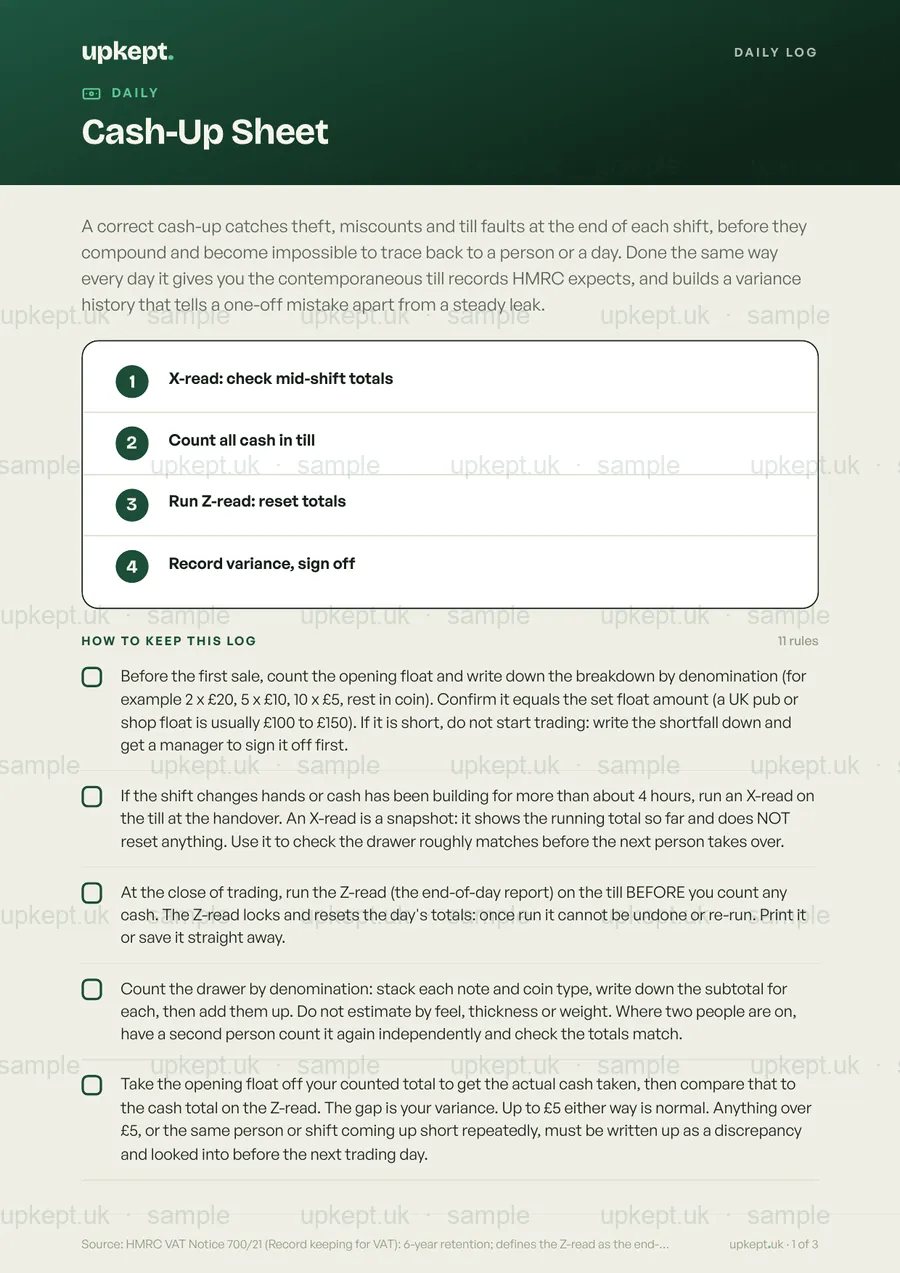
A correct cash-up catches theft, miscounts and till faults at the end of each shift, before they compound and become impossible to trace back to a person or a day. Done the same way every day it gives you the contemporaneous till records HMRC expects, and builds a variance history that tells a one-off mistake apart from a steady leak.
11 checksPDF + phoneReviewed August 2026
Built on published UK guidance Show sources
HMRC VAT Notice 700/21 (Record keeping for VAT): 6-year retention; defines the Z-read as the end-of-day breakdown of daily gross takings by VAT rate. HMRC Compliance Handbook CH15200 (6-year VAT period) and CH15300. GOV.UK Self Assessment / business records guidance: 5-year retention for non-VAT sole traders, running from the 31 January submission deadline. Employment (Allocation of Tips) Act 2023 (legislation.gov.uk) plus Acas guidance: 3-year tipping record and the 4-week deadline to respond to a worker's request. Card terminal settlement and acquirer batch reconciliation per UK acquirer guidance (e.g. Worldpay, Takepayments). Overnight cash limits set by the safe's insurance cash rating (EN 1143-1), per UK money-insurance policy conditions.
£14one-off, yours forever
Replaces a DIY doc, and you get every future update free when the guidance changes.
3 for 2 on documents and packs. Add 3 and your cheapest is free.
A clean one-page PDF, ready to print
Opens and ticks off on any phone
Clear, no jargon, easy to follow
Free updates whenever the guidance changes
Secure checkout30-day money-backInstant downloadNo subscriptionCard & Apple Pay
Best valueSave 42%
Or get all 56 templates
The Everything Bundle: every template today and every future one.£399 one-off, instead of £686 bought separately.
Made for places like this
What’s on it
11 things to check.
Everything that matters, nothing that does not. Here is the full list, exactly as it appears on the template.
1Before the first sale, count the opening float and write down the breakdown by denomination (for example 2 x £20, 5 x £10, 10 x £5, rest in coin). Confirm it equals the set float amount (a UK pub or shop float is usually £100 to £150). If it is short, do not start trading: write the shortfall down and get a manager to sign it off first.
2If the shift changes hands or cash has been building for more than about 4 hours, run an X-read on the till at the handover. An X-read is a snapshot: it shows the running total so far and does NOT reset anything. Use it to check the drawer roughly matches before the next person takes over.
3At the close of trading, run the Z-read (the end-of-day report) on the till BEFORE you count any cash. The Z-read locks and resets the day's totals: once run it cannot be undone or re-run. Print it or save it straight away.
4Count the drawer by denomination: stack each note and coin type, write down the subtotal for each, then add them up. Do not estimate by feel, thickness or weight. Where two people are on, have a second person count it again independently and check the totals match.
5Take the opening float off your counted total to get the actual cash taken, then compare that to the cash total on the Z-read. The gap is your variance. Up to £5 either way is normal. Anything over £5, or the same person or shift coming up short repeatedly, must be written up as a discrepancy and looked into before the next trading day.
6Run the card machine's end-of-day banking (settlement) report and check its total against the card total on the Z-read. They should match to the penny; a healthy report says totals confirmed or agreed. If they do not match, call your card provider before you bank anything. Do not assume it will sort itself out.
7Write every void, refund and no-sale drawer opening from the shift onto the cash-up sheet, with the amount and (where you can) who did it. The till logs these, but copy them onto the sheet by hand as well: a run of unexplained voids or no-sale opens is the most common sign of cash being skimmed.
8Keep the Z-read, the cash-up sheet and the card settlement slip together as one set for each trading day. If you are VAT-registered, keep these till records for 6 years (VAT Notice 700/21). If you are not VAT-registered, keep them for 5 years after the 31 January Self Assessment deadline for that tax year.
9If tips or service charges go into a shared pot, write the total taken each day on the cash-up sheet, separate from the takings. Under the Employment (Allocation of Tips) Act 2023 you must keep a tipping record of what came in and what each worker was allocated for 3 years, and a worker can ask to see their record (you have 4 weeks to respond).
10Bank cash regularly so it does not pile up in the safe: as a working rule, bank daily once you are holding more than about £500. Never leave more in the safe overnight than your insurance allows. That limit is set by your safe's cash rating on your policy certificate (often only £1,000 to £2,000 for a low-rated safe), so check the certificate, not a guess. Write the amount banked and who banked it on the sheet.
11Put one named person on each till for the shift so any shortage points to one person. The moment two people share a drawer without counting and signing at the swap, you cannot tell whose till was short. If a handover mid-shift is unavoidable, both people count the drawer and both sign it at the point it changes hands.
Good to know
The Z-read permanently resets the till and cannot be undone. The classic mistake is running it by accident mid-shift: every sale after that lands in the next day's figures, leaving a gap that is genuinely hard to unpick. Run the Z-read only once trading is fully closed for the session, and always before you count the cash, so the report and the drawer cover exactly the same takings.
Source: HMRC VAT Notice 700/21 (Record keeping for VAT): 6-year retention; defines the Z-read as the end-of-day breakdown of daily gross takings by VAT rate. HMRC Compliance Handbook CH15200 (6-year VAT period) and CH15300. GOV.UK Self Assessment / business records guidance: 5-year retention for non-VAT sole traders, running from the 31 January submission deadline. Employment (Allocation of Tips) Act 2023 (legislation.gov.uk) plus Acas guidance: 3-year tipping record and the 4-week deadline to respond to a worker's request. Card terminal settlement and acquirer batch reconciliation per UK acquirer guidance (e.g. Worldpay, Takepayments). Overnight cash limits set by the safe's insurance cash rating (EN 1143-1), per UK money-insurance policy conditions.
Good to know
Questions, answered
What is the Cash-Up Sheet?
A correct cash-up catches theft, miscounts and till faults at the end of each shift, before they compound and become impossible to trace back to a person or a day. Done the same way every day it gives you the contemporaneous till records HMRC expects, and builds a variance history that tells a one-off mistake apart from a steady leak.
Why does it matter?
The Z-read permanently resets the till and cannot be undone. The classic mistake is running it by accident mid-shift: every sale after that lands in the next day's figures, leaving a gap that is genuinely hard to unpick. Run the Z-read only once trading is fully closed for the session, and always before you count the cash, so the report and the drawer cover exactly the same takings.
How do I get it, and is it up to date?
The PDF downloads the moment you check out, prints sharp in black and white, and opens on any phone. It is reviewed for August 2026 and you get any future update free when the official guidance changes.
This checklist stops the two failures that close kitchens: food sitting in the danger zone (8 to 63 degrees C) long enough for bacteria to multiply, and staff working from memory instead of a record an Environmental Health Officer can read back. A weak opening compromises food before the first order; a rushed close lets fridges drift, pests settle, and yesterday's record go unsigned.
A proper opening check, done before the first customer or the first food is touched, is your strongest defence against a poor Food Hygiene Rating, a customer falling ill, or an enforcement notice. The Environmental Health Officer scores how well you manage safety every day, not just on inspection day, so a signed daily record that proves you check temperatures, allergens and sickness exclusion is what protects the rating and the business.
A closing checklist stops the overnight failures that trigger enforcement notices, voided insurance claims, and food poisoning: fridges drifting above 8C unnoticed, hot food cooled too slowly, gas left on, fire exits blocked, and cash left out. These are the specific things an EHO inspector or an insurer's loss adjuster looks for, and the closing record is the proof you did them.